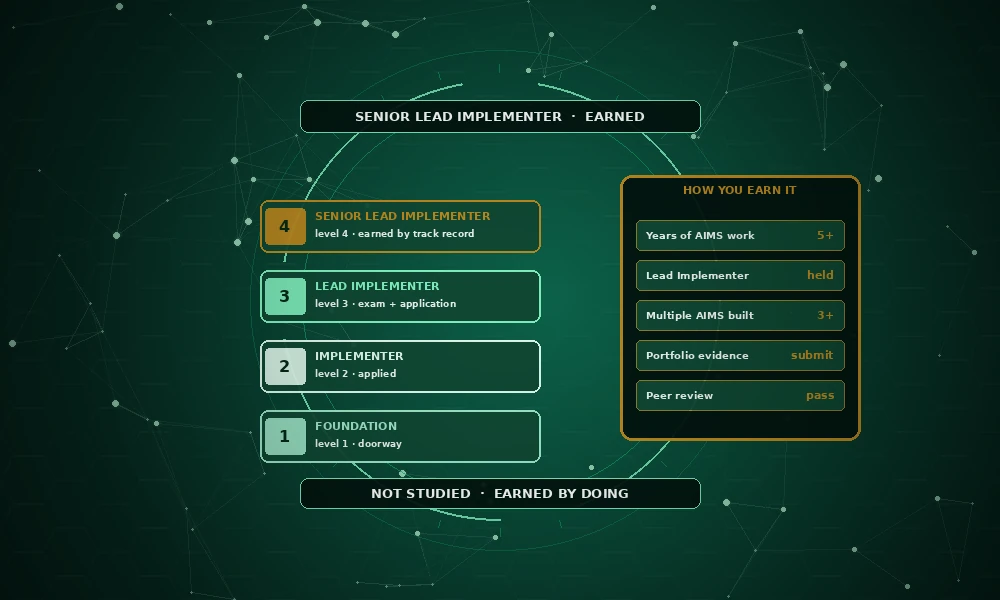
You cannot revise your way to this one. The Senior Lead Implementer is the rare credential you earn by doing, not by studying harder for a bigger exam.
It sits at the top of the implementer ladder for ISO/IEC 42001:2023, the AI management system standard, and its defining requirement is not knowledge but a track record: extensive, real experience implementing AI management systems.
That single fact makes it a different kind of credential from the ones below it. Where a Lead Implementer proves you can lead an implementation, the senior grade proves you have led many, and can be trusted with the hardest ones.
This guide from the AI Governance Certification Institute (AIGCI) explains what the senior grade actually adds, why experience defines it, the honest paradox of a senior credential in a field this new, and how to earn it.
|
"Experience is the name everyone gives to their mistakes." Oscar Wilde, Lady Windermere's Fan |
Wilde's line explains why the senior grade cannot be rushed. The judgement it certifies is built from real projects, including the ones that went wrong, and that kind of learning simply takes time to accumulate.
What Senior actually adds
The word senior can mislead, so it helps to be precise about what changes and what does not.
The subject matter is the same standard. A Senior Lead Implementer is not certified against a different, harder version of ISO 42001; they are recognised for a deeper, longer body of practice with the same standard a Lead Implementer knows.
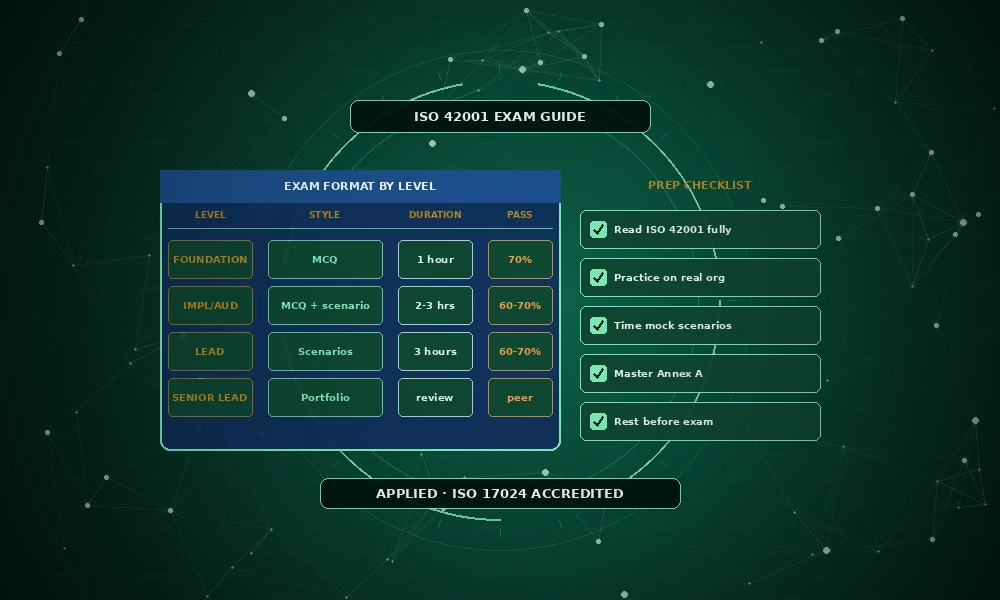
What the senior grade adds is proof of a track record. Some schemes mark this with a more demanding, case-based assessment rather than a multiple-choice exam, but the defining difference is the experience behind the person, not the difficulty of a single test.
In short, the senior grade certifies who you have become through practice, not merely what you can recall on a given day.
Why experience, not another exam, defines it
This is the heart of the credential, and it follows directly from the standard's own logic. An AI management system is judged by whether it works in the real world, so the person certified as its senior expert must have made real ones work, repeatedly.
The requirements reflect that. In a typical scheme, the senior grade asks for roughly ten years of professional experience, about seven of them in AI management, and on the order of a thousand hours of project work, against roughly five years and a few hundred project hours for the Lead Implementer level. The exact figures vary, and the experience each tier needs is set out in full separately.
The point of those numbers is not their precision but their message: the gap between Lead and Senior Lead is measured in years of practice, not in extra study. You close it by doing the work, over and over, until the judgement becomes yours.
Lead Implementer and Senior Lead Implementer, side by side
Set against each other, the two grades separate along a single axis: proven experience. Read the defining-basis row as the key to the rest:
|
Attribute |
Lead Implementer |
Senior Lead Implementer |
|---|---|---|
|
What it certifies |
You can lead an AIMS implementation |
You have led many, with proven depth |
|
Defining basis |
An exam plus baseline experience |
Extensive, documented project experience |
|
Experience bar |
Several years, one or more projects |
Roughly double the years and far more project hours |
|
Assessment style |
A knowledge exam |
Often a case-based, applied assessment |
|
What it signals |
Capability |
A track record |
|
Career stage |
An established practitioner |
A seasoned expert |
Everything else on the table flows from that defining basis. For the full scope of the level beneath it, the Lead Implementer level is described in its own guide, so this page can stay on what makes the senior grade distinct.
The paradox of a senior credential in a new field
Here is the honest tension no one likes to name, and understanding it tells you a great deal about the current market.
ISO 42001 was published in 2023, as ISO itself explains in its overview of the standard. Yet the senior grade can ask for something like seven years of AI management experience. In other words, the credential asks for more standard-specific experience than the standard has existed to provide.
The resolution is that the experience is counted from adjacent work, not from ISO 42001 alone. Today's senior implementers bring years of related AI, data governance, and management-system practice to meet the bar, because purely AIMS-specific senior experience barely exists yet. Almost no one on earth has a decade of it.
That scarcity is the opportunity hidden in the paradox. The people who start accumulating genuine AIMS experience now are the ones who will hold uncontested senior standing in a few years, when the field finally has a history long enough to measure.
What extensive AIMS project experience looks like
Because the requirement is experience, it is worth being concrete about what actually counts. It is not time served, but implementations delivered.
-
Multiple full implementations, not one project repeated, but AI management systems built for different organizations and contexts.
-
The whole lifecycle, from gap analysis and scope through risk and impact assessment, controls, certification, and continual improvement.
-
Leadership of others, directing teams and making the judgement calls the standard leaves open, not just executing tasks.
-
Hard cases survived, the failed audit, the resistant leadership, the model that drifted, each of which teaches what a smooth project cannot.
An implementer with one polished project is not yet senior. One who has carried several through, including the difficult ones, is exactly what the grade is meant to recognise.
The judgement that only experience builds
Beneath the years and the hours sits the thing they actually produce: judgement.
A senior implementer has seen enough AI systems to sense where risk really hides, to tell a control that works from one that merely looks right, and to weigh trade-offs the standard deliberately leaves open. That instinct draws on deep familiarity with AI-specific risk, the kind mapped by frameworks such as the NIST AI Risk Management Framework, but it is sharpened by applying that knowledge to real, messy systems rather than tidy examples.
This is why experience cannot be simulated. The judgement is the residue of many real decisions, and it is exactly what an organization is buying when it hires at the senior grade.
It also clears up a common misconception. Senior here means senior in practice, not senior in age or job title. A driven implementer can reach it faster than expected by seeking varied, demanding projects, while a passive one may never reach it despite long tenure, because unchallenged years teach very little.
Why the market rewards proven experience now
The timing could hardly be better for those who have the experience, because the market is actively asking for it. Analyses of AI governance job postings suggest most now ask for around five or more years of experience, and the bar rises with seniority, which means proven implementers are in unusually short supply relative to demand.
Regulation sharpens that demand. As the EU AI Act pushes organizations to demonstrate real, working AI governance rather than intentions, employers increasingly want people who have visibly done it before, not only those who have studied how. A senior grade is a compact way to signal exactly that.
In a field where almost everyone is new, verifiable, extensive experience is the scarcest asset of all, and the senior credential exists to make it legible to employers and clients.
How to become a Senior Lead Implementer
Because you cannot shortcut experience, the path is less a study plan than a career strategy. It runs in a clear order.
Earn the Lead Implementer credential first, then deliberately accumulate real implementations across varied organizations, keeping careful records of your projects and hours. When your experience meets the senior threshold, you apply for the grade, sometimes completing a case-based assessment that tests applied judgement rather than recall. The precise thresholds live in the experience each tier needs, which is worth checking early so you can plan toward it.
The most useful mindset is to treat every implementation as a deposit toward the senior grade. Seniority is not a course you book; it is a balance you build, one real project at a time.
Is it worth pursuing?
For anyone committed to implementation as a career, the senior grade is worth aiming at, though not worth rushing.
It is the highest recognition on the implementer path, it is scarce by definition, and in a market hungry for proven delivery it sets you distinctly apart. The catch is simply that it must be earned in real time, which is why the smartest move is to start building the experience now rather than waiting until you feel ready to pursue the title.
The bottom line
The ISO 42001 Senior Lead Implementer is the credential you grow into, not the one you cram for. Its currency is extensive, proven experience implementing AI management systems, which no exam can substitute for.
In a discipline barely old enough to have veterans, choosing to accumulate that experience deliberately is how you become one. Earn the Lead Implementer credential, do the work that matters, and let the senior grade arrive as the recognition of who you have become.
Frequently asked questions
What is an ISO 42001 Senior Lead Implementer?
It is the top grade of the implementer credential, awarded to professionals with extensive, documented experience implementing AI management systems. It certifies a proven track record rather than a harder body of knowledge, which is why it is earned through practice over years rather than through study alone.
How is it different from a Lead Implementer?
A Lead Implementer proves you can lead an AIMS implementation; a Senior Lead Implementer proves you have led many. The defining difference is extensive experience, often several more years and far more project hours, and some schemes add a case-based applied assessment at the senior level.
Can I take the Senior Lead Implementer exam without the experience?
No. Experience is the point of the grade, so you cannot substitute study for it. You typically earn the Lead Implementer credential first, then accumulate the required years and project hours before the senior grade is awarded, whatever assessment a scheme uses.
How can senior grades require years of experience when ISO 42001 is from 2023?
The required experience is counted from adjacent work, not from ISO 42001 alone. Because the standard is new, senior candidates draw on related AI, data governance, and management-system experience to meet the bar, since purely AIMS-specific senior experience barely exists yet.
Is the Senior Lead Implementer worth pursuing?
For committed implementation professionals, yes. It is the highest recognition on the path, it is scarce because the field is new, and employers increasingly want proven delivery. It cannot be rushed, so the best strategy is to start accumulating real experience now.
Start building the experience that earns it
The senior grade begins with the Lead Implementer credential and the real projects that follow it. AIGCI's Lead Implementer certification is built around leading actual implementations, which is exactly the experience the senior grade later recognises. Explore every option among the ISO 42001 courses, and to learn how the institute designs its programmes, read more about the institute.