The ISO/IEC 42001 standard organizes an AI management system across seven core clauses and a reference set of 38 controls. Those requirements do not put themselves into practice, and the ISO 42001 Lead Implementer is the professional trained to turn them into a working system. This certification builds exactly that capability: the ability to establish, run, and improve an AI management system inside a real organization.
This guide explains what the Lead Implementer certification covers, who it is for, what to expect from the exam and the investment, and where it leads. It is one of the most in-demand certifications the AI Governance Certification Institute offers, and the natural next step for anyone who will build AI governance rather than only understand it.
What the Lead Implementer certification is
The ISO 42001 Lead Implementer certification proves you can establish, implement, maintain, and improve an AI management system built to the international standard. Where a foundation-level qualification shows you understand AI governance, the Lead Implementer shows you can deliver it: set the policy, assign the roles, assess and treat the risks, operate the controls, and get the system ready for audit. It is a practical, implementation-focused credential, typically covering around four days of equivalent learning.
What a Lead Implementer builds
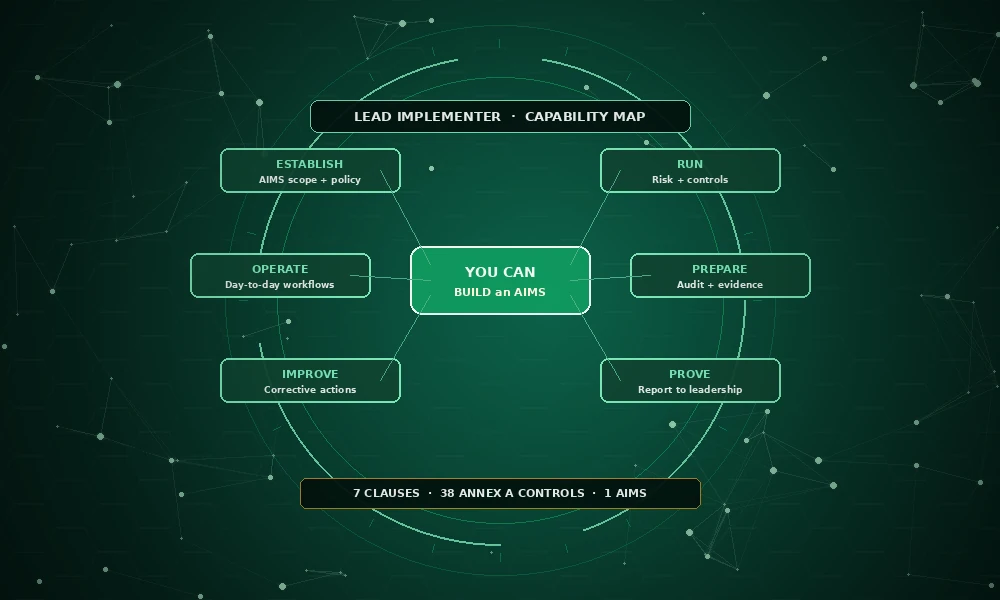
The heart of the role is captured in a single relationship: a Lead Implementer builds the AI management system. That system, the AIMS you will build, is the organized set of policies, roles, processes, and controls that governs how an organization develops, buys, deploys, and monitors AI. The certification prepares you to take an organization from having no structured governance to running a complete, auditable management system, and then to keep improving it as AI and the rules evolve.
This is what separates the Lead Implementer from more general AI governance awareness. You are not only learning what good governance looks like; you are learning how to construct it, piece by piece, in a way that stands up to an audit and to regulatory scrutiny.
What you learn on the certification
The certification is organized around the practical work of implementation. You come away able to carry the responsibilities below, each tied to part of the standard.
|
Capability you build |
What it means in practice |
|---|---|
|
Plan the management system |
Define scope, objectives, and the plan to establish an AIMS (Clauses 4 to 6) |
|
Set governance and policy |
Establish the AI policy, roles, and accountability that direct the system (Clause 5) |
|
Assess and treat AI risk |
Identify, evaluate, and treat AI risks across the lifecycle (Clauses 6 and 8) |
|
Run AI impact assessments |
Evaluate effects on individuals, groups, and society (Clause 8, control A.5) |
|
Select and operate controls |
Choose and justify the Annex A controls, then put them into operation |
|
Prepare for audit and improvement |
Set up internal audit, management review, and continual improvement (Clauses 9 and 10) |
Who should become a Lead Implementer
The certification is built for the people who will own or drive AI governance implementation. It suits governance, risk, compliance, and technology-governance professionals, AI program and project leads, and security or ISO 27001 practitioners moving into AI. You do not need to be an AI engineer or to write code, because the work is governance and delivery rather than model development. What helps most is experience running structured programs, managing risk, or working with a management system, all of which transfer directly.
The exam, the cost, and the career value
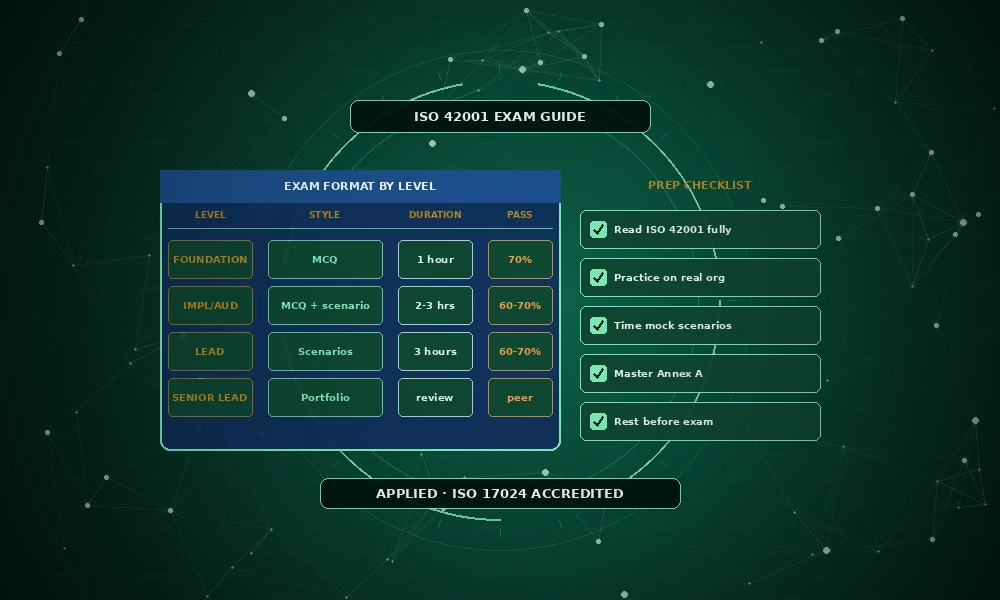
Three practical questions come up for almost everyone considering the certification, and each has its own detailed guide. Preparation for the exam is about applying the standard to real situations rather than recalling definitions, so it rewards understanding implementation over memorising clauses. A dedicated page on the cost covers the full investment and what is included, and the salary it commands looks at how the credential affects earning potential and career options. Because these figures vary by region and change over time, each is kept current on its own page rather than summarised here.
What is consistent is the direction of demand. As regulation such as the EU AI Act phases in and organizations are asked to show documented AI oversight, the people who can actually build that oversight are in short supply. That is the underlying reason the Lead Implementer is one of the most sought-after AI governance credentials.
The Lead Implementer Capability Map
The clearest way to see the certification's value is to look at what a Lead Implementer produces. The map below connects each capability to the part of ISO/IEC 42001 it addresses and the concrete deliverable it creates, so you can see the tangible output of the role. It is available as a one-page download.
|
What you can do |
ISO 42001 area |
The deliverable you produce |
|---|---|---|
|
Set direction and accountability |
Clause 5 leadership |
AI policy, roles, and responsibilities |
|
Plan the system |
Clauses 4 and 6 |
Scope, objectives, and risk plan |
|
Assess and treat AI risk |
Clauses 6 and 8 |
AI risk assessment and treatment plan |
|
Assess AI impact |
Clause 8, control A.5 |
AI impact assessments |
|
Operate controls |
Annex A |
Statement of applicability and working controls |
|
Prepare for audit |
Clauses 9 and 10 |
Internal audit, management review, improvements |
How to earn the certification
Most people reach the Lead Implementer by building a foundation first, then moving into implementation. If AI governance is new to you, the ISO 42001 Foundation certification gives you the shared language, after which the ISO 42001 Lead Implementer certification builds the capability to design and run the system. You can also see how it sits alongside the other levels across the full range of ISO/IEC 42001 certification courses. Wherever you begin, the destination is the same: the ability to build an AI management system an organization can rely on.
Frequently asked questions
What does an ISO 42001 Lead Implementer do?
A Lead Implementer establishes, runs, and improves an organization's AI management system. That means setting the AI policy and roles, assessing and treating AI risks, running impact assessments, operating the Annex A controls, and preparing the system for internal audit and certification.
Is the Lead Implementer certification worth it?
For anyone who will build or lead AI governance, it is one of the most directly useful credentials available, because it proves you can deliver a working management system rather than just describe one. Demand is rising as regulation requires organizations to show documented AI oversight.
Do I need to do Foundation first?
It is not always required, but it is the common and recommended route, especially if AI governance is new to you. Foundation builds the shared language that the Lead Implementer then applies to implementation. Your background determines whether you can start directly at Lead Implementer.
Do I need AI or coding experience?
No. The Lead Implementer role is about governance and delivery, not building AI models. Experience in governance, risk, compliance, project delivery, or a management system such as ISO 27001 transfers directly and is far more relevant than coding.
How long does the certification take?
The Lead Implementer certification covers around four days of equivalent learning. How quickly you complete it depends on your schedule and format, and the exam is designed to test applied understanding rather than memorisation.
What can I do after becoming a Lead Implementer?
You can lead the implementation of an AI management system, take ownership of an organization's AI governance program, or move toward senior implementer and audit roles. It is a strong basis for a career in AI governance, risk, and compliance.
Your next step
If you are ready to move from understanding AI governance to building it, the ISO 42001 Lead Implementer certification is the direct route. It gives you a capability that organizations increasingly need and cannot easily find, and it puts you at the centre of how responsible AI actually gets done.