In a well-run management system, the people who build it are not the same people who independently judge whether it works, a separation the international auditing guidelines, ISO 19011, are built around. That principle is the whole difference between the ISO 42001 Lead Implementer and the Lead Auditor. One builds the AI management system; the other audits it. Choosing between them is really choosing which side of that line you want to work on.
The core difference: build it or audit it
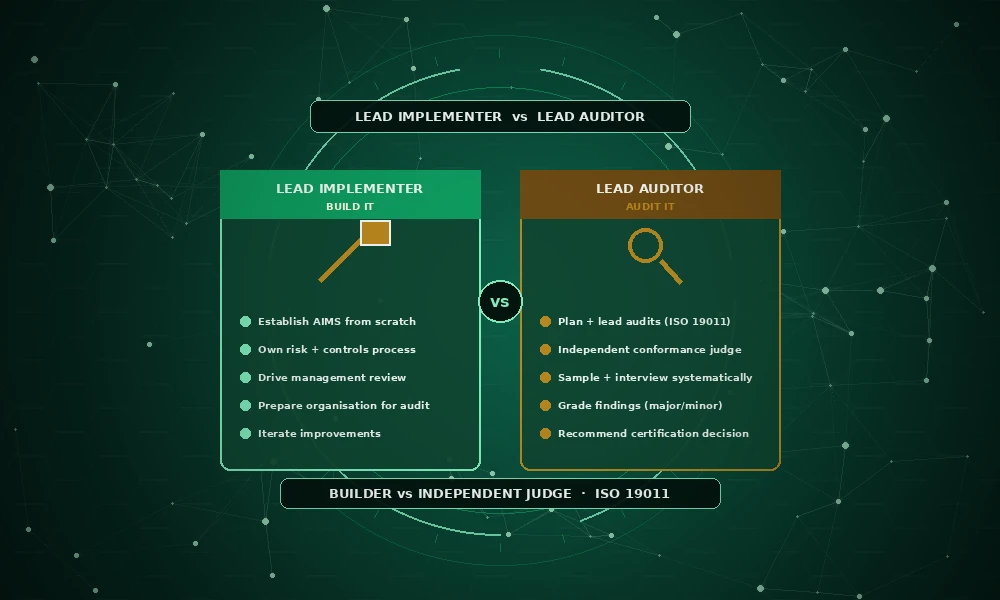
Both certifications sit at the professional level and both are about ISO/IEC 42001, but they point in opposite directions. The Lead Implementer establishes, runs, and improves an AI management system: setting policy, assigning roles, treating risk, and operating controls. The Lead Auditor evaluates that system against the standard: planning audits, gathering evidence, judging conformity, and reporting findings. Implementers make the system exist; auditors provide independent assurance that it does what it claims. The two are complementary, but for an individual they are a genuine fork rather than a sequence.
Lead Implementer vs Lead Auditor, side by side
Set against each other, the roles diverge on almost every dimension except their shared grounding in the standard.
|
Dimension |
Lead Implementer |
Lead Auditor |
|---|---|---|
|
Core purpose |
Builds and runs the AI management system |
Audits and evaluates the management system |
|
What it certifies |
Ability to establish, run, and improve an AIMS |
Ability to audit an AIMS against ISO/IEC 42001 |
|
Day-to-day work |
Policy, roles, risk treatment, controls, delivery |
Audit planning, evidence, conformity, reporting |
|
Relationship to the system |
Owns and operates it |
Stays independent of it |
|
Mindset it rewards |
Constructive and delivery-focused |
Evaluative, impartial, and evidence-driven |
|
Best for |
Those who want to build governance |
Those who want to verify and assure it |
|
Career direction |
Implementation lead, program owner |
Auditor, assurance, certification body work |
The mindset each role rewards
Beyond tasks, the two attract different temperaments, and knowing your own is the fastest way to choose well. Implementers tend to enjoy building: turning a blank page into a working system, solving practical problems, and driving something to completion. Auditors tend to enjoy evaluating: examining evidence, asking probing questions, and forming an independent judgement without being attached to the outcome. Neither is superior. The implementer's satisfaction comes from what they create; the auditor's comes from the rigour and independence of their assessment.
How the two roles fit together
Although they are a fork for a person, the two roles are partners for an organization. A management system needs both people who build it and people who can assure it, and the independence principle in ISO 19011 is exactly why they are usually different individuals: you cannot objectively audit a system you built yourself. The need for both is growing for a concrete reason: reported AI incidents rose 56.4% to a record 233 in 2024, according to the Stanford AI Index 2025, and containing that risk takes both people who build oversight and people who can independently verify it. Obligations such as the EU AI Act add to the pressure. Some professionals eventually learn both sides, which deepens their understanding, but they still keep the roles separate on any given system.
Implementer or auditor: which track fits you
The decision comes down to what you want to spend your time doing and where your strengths lie. The guide below turns the comparison into a straightforward choice, and is available as a one-page download.
|
Choose the Lead Implementer if |
Choose the Lead Auditor if |
|---|---|
|
You want to build and run the system |
You want to independently evaluate the system |
|
You enjoy delivery and practical problem-solving |
You enjoy evidence, judgement, and reporting |
|
Your goal is to own an AI governance program |
Your goal is assurance, audit, or certification work |
|
You are energised by creating something |
You are energised by verifying that it works |
Choosing your path
If you want to build AI governance, take the Lead Implementer path; if you want to assure it, take the Lead Auditor path. Both begin from the same foundation and both lead to roles in real demand, so the right choice is simply the one that matches how you like to work. When you have decided, the ISO 42001 Lead Implementer certification and the ISO 42001 Lead Auditor certification are the respective next steps.
Frequently asked questions
What is the difference between a Lead Implementer and a Lead Auditor?
A Lead Implementer builds and runs an AI management system, setting policy, roles, risk treatment, and controls. A Lead Auditor independently evaluates that system against ISO/IEC 42001, planning audits, examining evidence, and reporting findings. One creates the system; the other assures it.
Can the same person be both implementer and auditor?
A person can hold both certifications and understand both sides, but they should not audit a system they implemented themselves. The auditing guidelines in ISO 19011 are built on auditor independence, so the roles stay separate on any given management system even when one person is qualified for both.
Which is better, Lead Implementer or Lead Auditor?
Neither is better; they suit different goals and temperaments. Choose Lead Implementer if you want to build and own AI governance, and Lead Auditor if you want to independently evaluate and assure it. Both are in growing demand.
Do both require Foundation first?
Both professional levels build on the shared understanding that Foundation provides, so most people take Foundation first regardless of which track they choose. From that common base, the implementer and auditor paths then diverge.
Which pays more or has more demand?
Both are in strong and growing demand as organizations must implement AI oversight and demonstrate it. Rather than choosing by pay, choose by fit: the role you enjoy is the one you will excel in, and both offer solid career paths in AI governance.
The bottom line
Lead Implementer and Lead Auditor are not a ladder but a fork. The implementer builds the AI management system; the auditor independently judges it, and the two stay separate for exactly that reason. Decide by what you want to do: create governance, and the implementer path is yours; assure it, and the auditor path is. Both start from the same foundation, and both lead somewhere the field genuinely needs people.