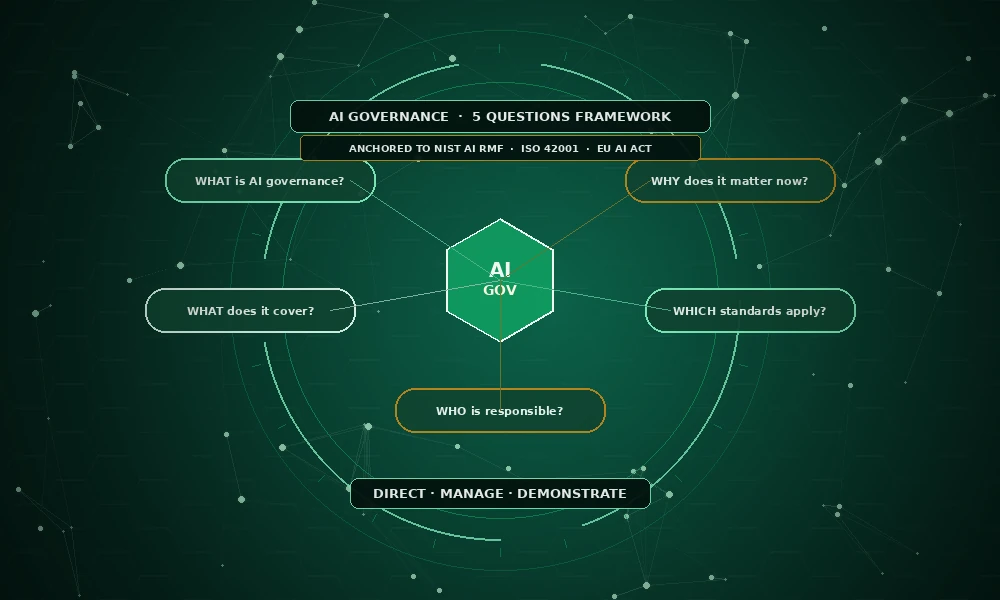
When the US National Institute of Standards and Technology released its AI Risk Management Framework in January 2023, it named a shift that was already underway: AI had become something organizations must actively govern, not simply build. AI governance is the discipline that meets that need. It is how an organization directs, manages, and demonstrates the responsible use of AI, so the technology serves people and the business without creating unacceptable risk.
This page explains what AI governance is, what it covers, and how the standards, roles, and regulations fit together. It is the foundation the rest of our library builds on, and the field the AI Governance Certification Institute exists to teach.
What AI governance is
AI governance is the system of oversight, rules, and processes an organization uses to make sure its AI is developed and used responsibly and accountably. It sets who decides what, what the acceptable limits are, how risks are found and treated, and how the organization can show, with evidence, that its AI is under control.
It helps to separate two ideas. Governing AI is different from building it. Data scientists and engineers create AI systems; AI governance decides how those systems may be used, who is answerable for them, and how their effects on people are managed. In that sense AI governance sits alongside established disciplines like information security governance and corporate risk management, and borrows much of their thinking, applied to the specific risks AI introduces such as bias, opacity, and automated decisions that affect people.
Why AI governance matters now
Three forces have moved AI governance from a nice-to-have to an expectation. The first is regulation. The EU AI Act began applying obligations in phases from 2025, and other jurisdictions are following, so organizations increasingly must show documented oversight of their AI. The second is risk: AI can discriminate, leak data, behave unpredictably, or fail quietly, and those harms carry legal, financial, and reputational cost. The third is trust. Customers, procurement teams, and boards now ask suppliers to explain how their AI is governed before they buy or deploy.
Put together, these forces mean an organization that cannot describe how it governs AI is increasingly at a disadvantage, while one that can move faster and with more confidence.
What AI governance covers
AI governance is not a single task or team. It runs across five connected areas, and a complete program needs all of them. The most practical way to make governance real is to operate it as a management system: a repeatable set of policies, roles, and controls. That is exactly what an AIMS is, an AI management system that turns governance from good intentions into something you can run and evidence.
|
Area of AI governance |
What it governs |
|---|---|
|
Oversight and accountability |
Who is answerable for AI, the policy that sets the rules, and how decisions are escalated |
|
Risk management |
Finding, assessing, and treating AI risks such as bias, security, safety, and third-party models |
|
Compliance |
Meeting standards and regulation, and mapping evidence to each obligation |
|
Audit and assurance |
Testing whether controls work, and documenting the evidence that they do |
|
Continual improvement |
Monitoring, reviewing, and improving the program as AI and the rules change |
Standards give AI governance its structure
AI governance works best when it is built on shared references rather than one organization's opinion. The central one is the ISO 42001 standard, the international AI management system standard, which provides a structure and a set of controls for governing AI. Around it sit complementary references: the NIST AI Risk Management Framework for managing AI risk, the EU AI Act for legal obligations, and the OECD AI Principles, the first intergovernmental standard on AI, for the values beneath responsible use. Working to these shared references is what lets a practitioner speak the same language as a regulator, an auditor, and a board.
Who is responsible for AI governance
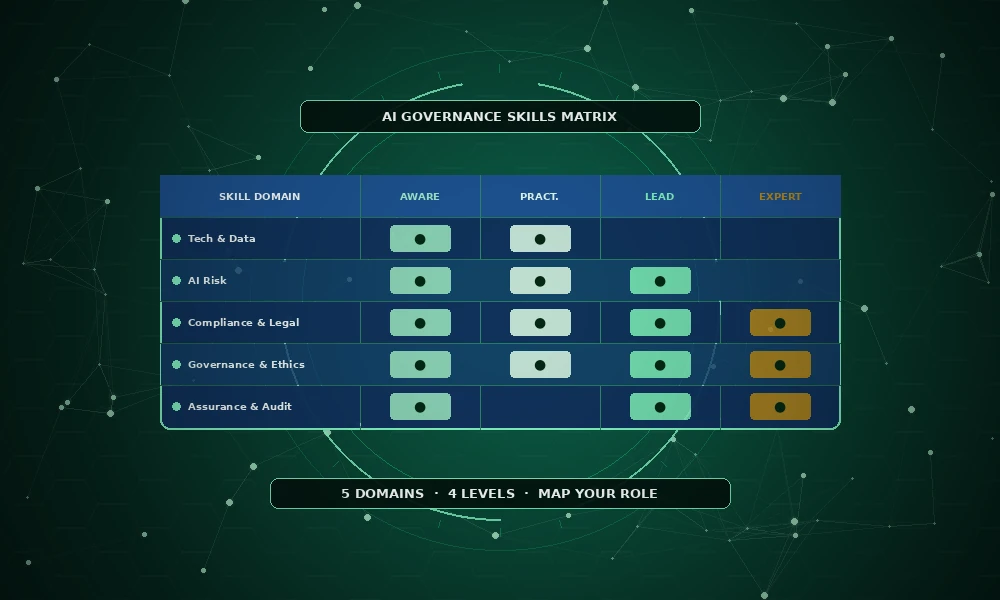
Because AI cuts across an organization, its governance is a shared responsibility rather than one person's job. Top management and the board set direction and own accountability. A governance lead maintains the policy and the program. Risk, compliance, and legal teams assess and treat risks and check obligations. Internal audit tests that it works. System owners, data scientists, and engineers build and operate the AI within the rules. The strength of a program comes from these roles sharing one language and one set of expectations, which is often the first thing an organization is missing.
The AI Governance Questions Framework
A useful way to understand AI governance is as a set of questions every organization must be able to answer. If you can answer all five with evidence, you have a functioning program. Each question is owned by one of the areas above and is supported by a standard.
|
The question you must answer |
Owned by |
Where the standard helps |
|---|---|---|
|
Who is accountable for our AI, and by what rules? |
Oversight and accountability |
ISO 42001 leadership and AI policy |
|
What could go wrong, and how serious would it be? |
Risk management |
NIST AI RMF, ISO 23894 |
|
Are we within the law and the standards? |
Compliance |
EU AI Act, ISO 42001 |
|
Can we prove our controls actually work? |
Audit and assurance |
ISO 42001 performance evaluation |
|
How do we keep this current as AI changes? |
Continual improvement |
ISO 42001 Plan-Do-Check-Act |
The value of the framing is that it turns an abstract topic into a checklist a leader can act on. A gap in any answer points straight to the area, and the standard, that closes it. This framework is available as a one-page download.
How to build AI governance capability
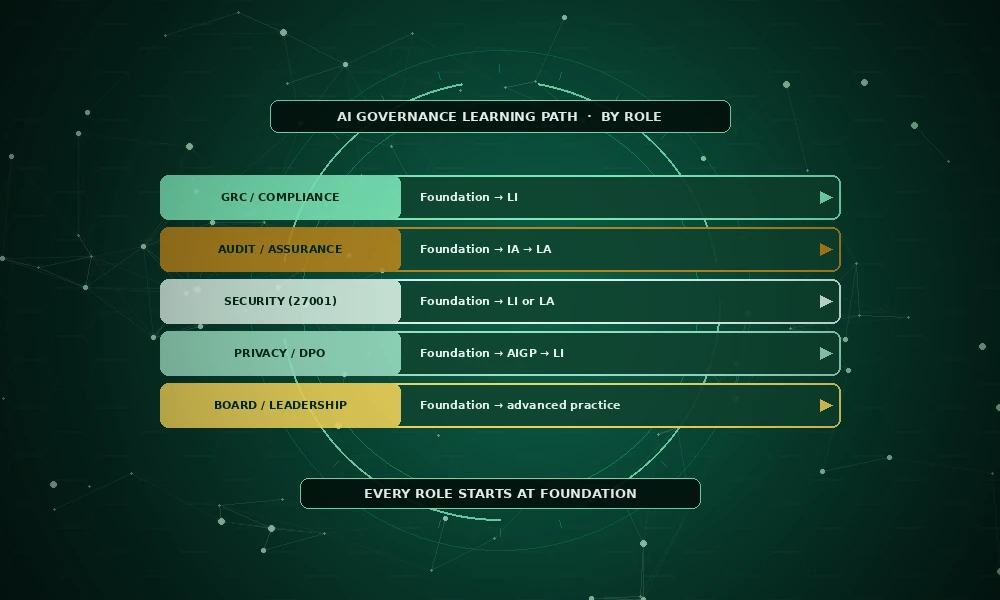
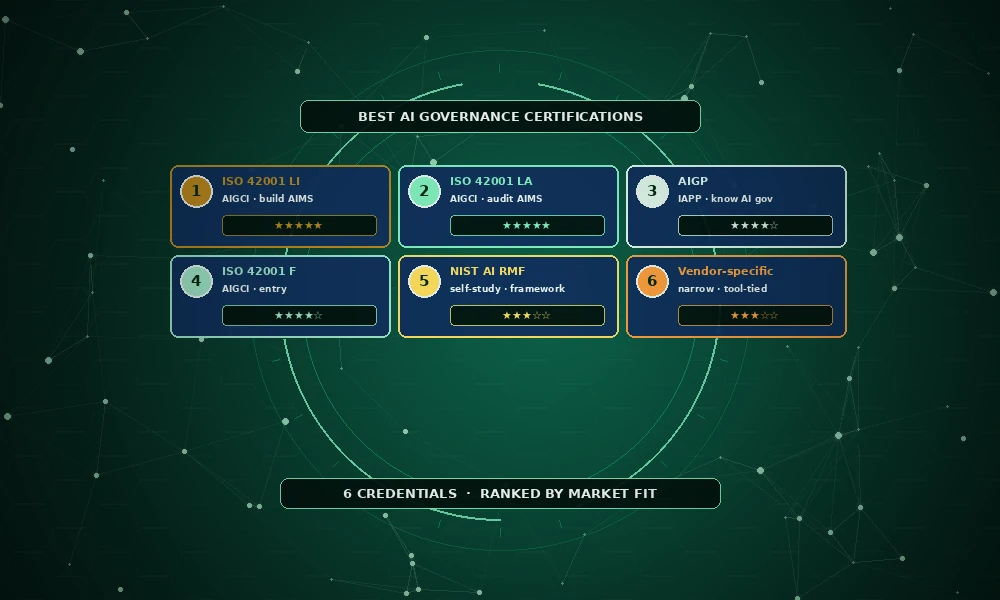
Programs are built by people who understand the discipline, so building capability is usually the first practical step. Most organizations start by giving a cross-functional group a shared grounding, then developing the depth to design and run a management system. If you want to get certified and lead this work, a structured path through recognised certification is the most direct route, beginning with the ISO 42001 Foundation certification and progressing from there.
Frequently asked questions
What is AI governance in simple terms?
AI governance is how an organization makes sure its AI is used responsibly and accountably. It defines who is answerable for AI, what the rules are, how risks are managed, and how the organization can prove, with evidence, that its AI is under control.
What is the difference between AI governance and an AIMS?
AI governance is the overall discipline; an AI management system (AIMS) is how you operate it. The AIMS is the repeatable set of policies, roles, and controls that turns governance into something an organization can run day to day, most commonly built to ISO/IEC 42001.
Why is AI governance important?
Regulation such as the EU AI Act increasingly requires documented oversight of AI, AI carries real risks like bias and security failures, and customers and boards now expect suppliers to explain how their AI is governed. Organizations that can govern AI well move faster and with more confidence.
Which standards and frameworks apply to AI governance?
ISO/IEC 42001 is the international AI management system standard at the centre. It is complemented by the NIST AI Risk Management Framework, the EU AI Act for legal obligations, ISO/IEC 23894 for risk, and the OECD AI Principles for underlying values.
Who is responsible for AI governance in an organization?
It is a shared responsibility. Top management owns accountability, a governance lead runs the program, risk and compliance teams manage risks and obligations, internal audit tests that it works, and technical teams build and operate AI within the rules.
How do I start with AI governance?
Begin by building shared understanding across the people involved, then develop the capability to design and run a management system. Structured certification, starting at Foundation level, is the most direct way to build that capability.
Bringing it together
AI governance is, at heart, the answer to a simple question: can your organization use AI and still show it is in control? A complete program covers oversight, risk, compliance, audit, and improvement; it is operated as a management system; it is built on shared standards; and it is carried by people across the organization who speak one language. Wherever you are starting from, the path forward is to build that shared understanding first, then the capability to run the system, and the field becomes far more manageable than it first appears.