Many of the EU AI Act obligations begin applying from August 2026, and organizations are already being asked to show they have people who can govern AI. That is what a learning path is for: a clear route from knowing little to holding a credential you can prove. At the AI Governance Certification Institute (AIGCI), the AI Governance Learning Path sequences our certifications so every step leads to the next, and every certification leads to a real responsibility you can carry.
This page lays out the route: where to start, how it branches by role, and where each certification takes you. The aim is simple, that you always know your next step, whatever your background.
How the AI governance learning path works
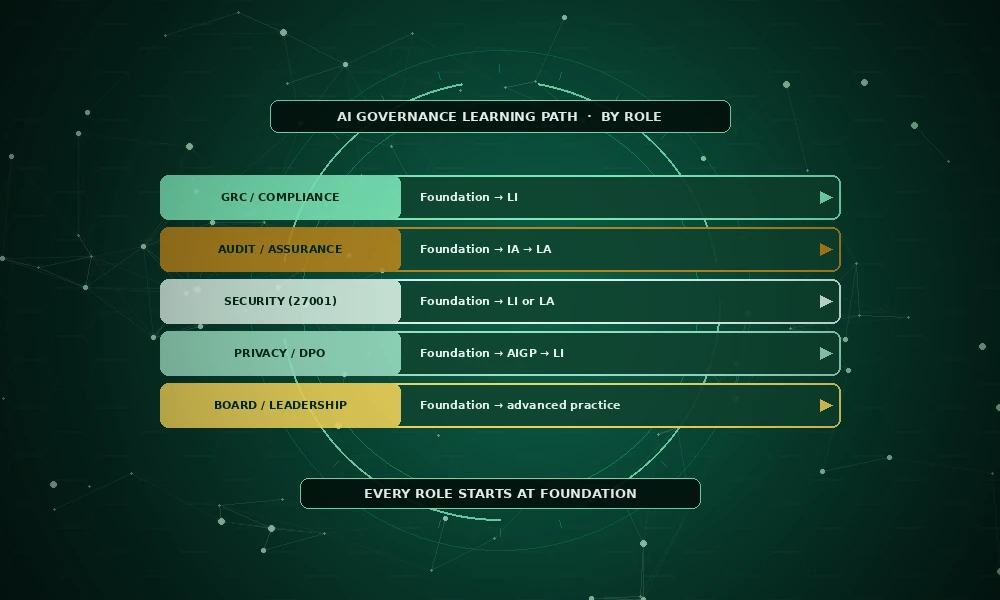
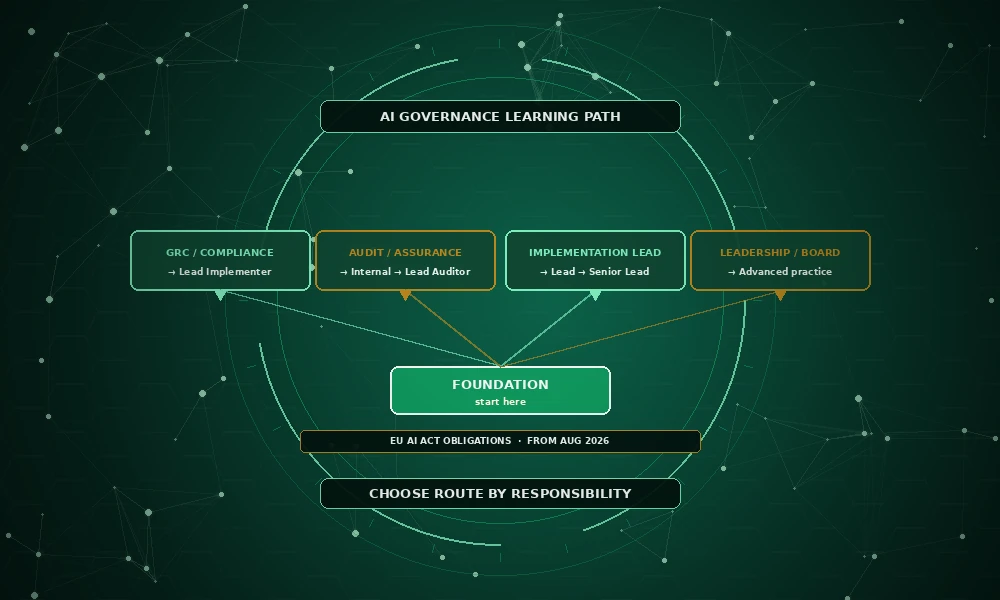
The path has one entry point and several routes out of it. Everyone begins by building a shared understanding of AI governance, then goes deeper along the route that matches the responsibility they carry. That design matters: it means a governance lead, an implementer, and an auditor share the same base before they specialize, so they can work from one language even as their roles diverge.
Each stage leads to a certification, and each certification maps to something you can then do, whether that is running a management system or evaluating one. You do not climb the whole ladder for its own sake. You take the steps your role needs, in an order that builds properly.
Choose your route by responsibility
The fastest way to place yourself is by the responsibility you hold or want to hold. Find your row, and the recommended certification is the strongest starting point for that route.
|
If your responsibility is |
The route |
Duration |
|---|---|---|
|
New to AI governance |
Foundation |
2 days equivalent |
|
Implementing and running an AIMS |
Lead Implementer |
4 days equivalent |
|
Auditing AI management systems |
Lead Auditor |
4 days equivalent |
|
Evaluating internal controls |
Internal Auditor |
4 days equivalent |
|
Leading at a senior level |
Senior Lead Implementer or Senior Lead Auditor |
Advanced |
Every route begins with Foundation
Whatever your destination, the first step is the same. We recommend you start with Foundation, which builds the shared language of AI governance, the essentials of an AI management system, and the responsibilities the ISO/IEC 42001 standard defines. It has no prerequisites, so a beginner and a seasoned risk manager can both begin here and leave with the same base.
From there the path branches by what you will actually do. You can progress to Lead Implementer to design, build, and run a management system, or Lead Auditor to evaluate one against ISO/IEC 42001. The Internal Auditor route covers internal review and management reporting for teams focused inside their own organization.
Experienced practitioners can then move to the senior levels, which deepen implementation or audit capability for those leading programs. The point is not to collect certificates, but to follow the route your responsibility calls for, one properly built step at a time.
Where each certification leads
Because the path is built around responsibility, each certification opens onto a clear set of things you can do next. The table shows what each step prepares you to carry.
|
Certification |
What it develops |
What you can then do |
|---|---|---|
|
Foundation |
Shared language, AIMS essentials, ISO/IEC 42001 responsibilities |
Contribute to AI governance and choose your next route with confidence |
|
Lead Implementer |
Management system design, controls, and lifecycle risk treatment |
Establish, run, and improve an AI management system |
|
Lead Auditor |
Audit planning, evidence evaluation, and conformity findings |
Audit AI management systems against ISO/IEC 42001 |
|
Internal Auditor |
Internal review, objective evidence, and management reporting |
Run internal audits and support management review |
The learning path at a glance
The whole path fits on one page: a shared Foundation, then a role-based professional level, then senior specialization, all built on ISO/IEC 42001 and aligned to the frameworks that shape the field, including the NIST AI Risk Management Framework and the OECD AI Principles. The summary below is available as a download, so you or your team can map out a route in one view.
|
Stage |
Certification |
For whom |
Builds on |
|---|---|---|---|
|
1. Start |
Foundation |
Everyone, no prerequisites |
The AI governance essentials |
|
2. Specialize |
Lead Implementer, Lead Auditor, or Internal Auditor |
By responsibility: build, audit, or review |
The Foundation base |
|
3. Lead |
Senior Lead Implementer or Senior Lead Auditor |
Experienced practitioners leading programs |
The professional level |
Frequently asked questions
Where should I start on the AI governance learning path?
Almost everyone starts with the Foundation certification. It has no prerequisites and builds the shared language and AI management system essentials that every later route depends on. From there you choose your professional level based on the responsibility you carry.
Do I have to take every certification in order?
No. The path is built around responsibility, not collecting credentials. Everyone benefits from Foundation first, but after that you take only the route your role needs, whether that is Lead Implementer to build a system or Lead Auditor to evaluate one.
What is the difference between the Lead Implementer and Lead Auditor routes?
Lead Implementer prepares you to design, run, and improve an AI management system. Lead Auditor prepares you to evaluate one against ISO/IEC 42001 and report findings. Implementers build the system; auditors test whether it works. Many professionals eventually understand both.
Which route is right for internal audit teams?
The Internal Auditor route is designed for evaluating internal governance activities, objective evidence, and management reporting. It suits internal audit, compliance, and risk professionals who support internal review rather than external certification audits.
How long does the learning path take?
Each step is measured in equivalent learning days rather than a fixed calendar: Foundation is two days equivalent, and the professional levels are around four days each. How quickly you progress depends on your role and how far along the path your responsibilities take you.
Take the first step
Wherever you are heading, the route is clear and the first step is within reach. When you are ready to enrol, explore the Foundation course or the full range of ISO/IEC 42001 certification courses, and pick the step that fits where you are today.