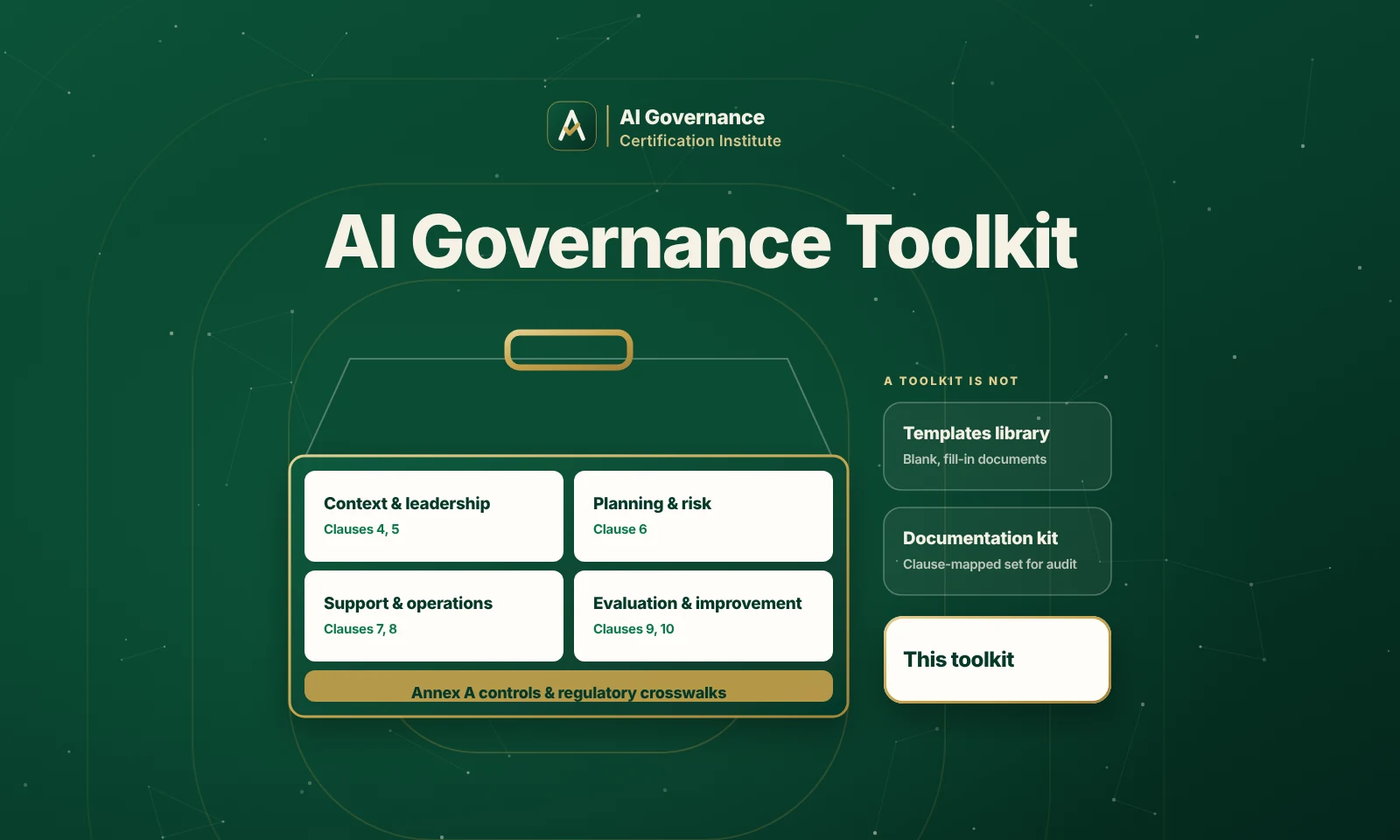
A template is a blank document that already knows what questions to ask. For ISO 42001, the value is not the formatting; it is that someone has already worked out which documents the standard expects and what each one has to contain, so you begin by answering rather than by guessing. A templates library is simply that worked-out set, gathered in one place and grouped by the kind of document each one is.
This guide from the AI Governance Certification Institute (AIGCI) lays out the AI governance templates an ISO 42001 program needs, grouped into policies, registers, and procedures, with each major template linked to its own guide. It also covers how many you actually need and how to turn a blank template into a document that reflects your organization rather than a generic one.
Templates are a starting point, not a shortcut around understanding. Used well they save the typing; the thinking is still yours to do.
What the Templates Library Is
The templates library is the set of blank, fill-in documents an AI management system is built from. Each template corresponds to a requirement of the standard and provides the structure that requirement expects, so the work becomes adapting a known shape rather than inventing one. It is narrower than a full toolkit, which also bundles checklists, registers, and worked procedures, and narrower than a documentation kit, which is the complete clause-mapped set assembled specifically to prove conformity.
The templates fall into three natural groups, and keeping them grouped helps you see what you have and what is missing. Policies set intent, registers track state, and procedures define how work is done. A program needs all three kinds; a library heavy on policies but light on registers and procedures describes what the organization believes without showing how it operates.
The Templates You Need, by Type
The templates below are grouped by type. Items with their own detailed guide are linked; build only the ones your scope actually requires.
Core Policies
-
A top-level statement of commitment and objectives for responsible AI, captured in the AI policy template.
-
An AI governance charter and a roles and responsibilities template defining accountability.
-
An acceptable use policy governing how staff use AI tools, plus a procurement and vendor policy.
Registers and Inventories
-
An AI system inventory cataloging every AI system, its owner, risk tier, and oversight model.
-
An AI risk register logging risks with likelihood, impact, residual risk, and treatment.
-
A fundamental-rights and data-protection register, plus the impact assessment template.
-
An incident and nonconformity register tracking unintended behavior, near-misses, and breaches.
Operational Procedures
-
An AI lifecycle management procedure with gates from design to decommissioning.
-
A human oversight and intervention procedure for reviewing or halting automated decisions.
-
A vendor and third-party assessment procedure, plus model validation and testing protocols.
-
A transparency and communication procedure and a competency and training log.
How Many Templates Is Enough
The honest answer is fewer than most libraries contain. Commercial sets advertise dozens of templates, and a complex organization may use most of them, but a focused scope needs only the documents that map to a requirement actually in play. Downloading sixty templates and feeling obliged to complete all sixty is how programs drown in paperwork that evidences nothing.
Start from your scope and your risks, not from the library's table of contents. Each template should trace to a requirement you must meet or a risk you must manage; if it traces to neither, it is padding. A lean set of genuinely used templates beats a comprehensive set half-completed, because the standard rewards a system that operates, not a folder that is full. Judge your library by how many of its templates are genuinely in use and evidenced, not by how many it contains. A library of ten documents that each reflect real decisions is worth more to an auditor than a library of sixty that were filled in to look complete.
Adapting a Template: From Blank to Yours
A blank template is boilerplate until you adapt it, and adaptation is where the governance actually happens. The procedures in particular are standard operating procedures that must describe how your organization really works, not how a template author imagined a generic one might. A procedure that does not match practice is worse than none, because it sets an expectation an auditor will test and you will fail.
Adapt each template in three passes: delete what does not apply to your scope, fill in your real context, owners, and thresholds, and then check the document against what your organization actually does. The third pass is the one people skip, and it is the one that separates a template that reflects your system from one that merely looks complete. A template is finished when someone who does the work could read it and recognize their job in it.
Library, Toolkit, and Documentation Kit
The three collection terms are easy to confuse. The templates library is the set of blank fill-in documents, grouped by type, which is this page. The toolkit is broader, adding checklists, worked registers, and procedures organized around the standard. And the documentation kit is the complete, clause-mapped document set assembled to prove conformity in an audit.
They are the same material seen at different resolutions. Reach for the templates library when you need a specific blank document to adapt, the toolkit when you want the whole practitioner collection, and the documentation kit when you need the audit-ready set mapped clause by clause. Most programs use all three at different moments rather than choosing one.
Why Grouping Templates by Type Matters
The three groups are not just tidy filing; they map to three different jobs a management system has to do, and a gap in any group is a gap in the system. Policies declare intent and set the boundaries everyone works within. Registers hold the living state of the program, the systems you run, the risks you carry, the incidents you have seen, so that governance is grounded in current fact rather than last year’s assumptions. Procedures turn intent into repeatable action, defining how a model is validated, how a human overrides a decision, how a vendor is assessed.
Seen this way, the groups reveal imbalance at a glance. A library with strong policies but thin registers describes an organization that has decided what it believes but is not tracking what it actually does. One with procedures but no policies has activity without direction. The fastest way to spot what your program is missing is to lay the templates out in these three columns and look for the short one.
Where Templates Come From
Templates reach an organization by three routes, and each has a trade-off. You can write them in-house, which fits your context exactly but demands the most time and expertise. You can download free baseline templates, which are quick to obtain but generic enough that adaptation does most of the work. Or you can buy a commercial set, which is comprehensive and clause-mapped but still arrives full of another organization’s assumptions.
None of these routes changes the real task. However a template arrives, it is boilerplate until your context, risks, and decisions are written into it, and the quality of the finished document depends far more on how well you adapt it than on where it came from. Choose the route that gets you to a usable starting structure fastest for your situation, then spend the saved time on the adaptation that actually produces governance.
Common Templates Mistakes
Template use fails in familiar ways. The first is completing templates mechanically, filling blanks without making the decisions the blanks represent, which produces documents that read well and mean nothing. The second is hoarding templates, treating a large count as progress rather than matching templates to actual scope. The third is leaving a template author's assumptions embedded, so your policy references a committee you do not have or a process you do not run. The fourth is writing procedures that describe an ideal rather than your reality, creating expectations an audit will expose. And the fifth is never updating the templates as your AI systems and the regulations change, so the library slowly describes a program that no longer exists.
Frequently Asked Questions
What Templates Does ISO 42001 Require?
A structured set covering policies, registers, and procedures mapped to the standard’s clauses and Annex A controls: an AI policy, a governance charter and roles, an acceptable use policy, an AI inventory, a risk register, impact assessments, an incident register, and lifecycle, oversight, validation, and transparency procedures, among others. The exact set depends on your scope.
How Is a Templates Library Different From a Toolkit?
The templates library is the set of blank, fill-in documents. The toolkit is broader, also including checklists, worked registers, and procedures organized and cross-referenced around the standard. The library is one part of the wider toolkit, reached for when you need a single document to adapt rather than the whole collection.
How Many Templates Do I Actually Need?
Only the ones that trace to a requirement in your scope or a risk you must manage. Commercial libraries offer dozens, but a focused program needs far fewer. Starting from your scope rather than the library’s contents keeps the set lean and every document meaningful, which an audit rewards more than a large but half-completed collection.
Can I Use a Template Without Adapting It?
No, not safely. An unadapted template carries another organization’s assumptions and describes a generic company rather than yours. Procedures especially must match how you actually work, because a procedure an auditor can disprove by watching practice is worse than having none. Every template needs deletion of what does not apply, your real context filled in, and a check against reality.
Are Free Templates Good Enough?
A free template is a fine starting structure; its quality matters less than how well you adapt it. Whether a template is free or paid, the governance comes from the decisions you make filling it in. A well-adapted free template beats an expensive one completed mechanically every time.
Fill the Templates, With the Judgment They Need
A template gives you the questions; answering them well takes understanding of what the standard requires and how your organization actually runs. The documentation kit shows how these templates come together into the complete, audit-ready set.
Building the judgment to adapt templates into a real system is what training provides. You can see every route through the ISO 42001 courses, with the full path in the Lead Implementer certification, so your templates become evidence of governance rather than decoration.