Ask ten people how to learn AI governance and you will get ten routes, all of them partly right. The reason is that the best path is not universal; it is tailored to the role you are starting from.
A learning path is most useful when it accounts for what you already bring. A CISO does not need to learn governance from scratch, and a data scientist does not need to be taught how models work. Each starts with a different foundation and therefore needs to add different things to reach the same destination: competent AI governance grounded in ISO/IEC 42001:2023, the AI management system standard.
This guide from the AI Governance Certification Institute (AIGCI) maps the route by role, so you can find the one that fits your starting point rather than following a generic path built for no one in particular.
|
"Start where you are. Use what you have. Do what you can." Arthur Ashe |
Ashe's advice is, in one line, the whole philosophy of this page. Your current role is not a limitation to overcome before you begin; it is the very thing you build from, and it usually gives you a head start you may be underrating.
Why the path depends on where you start
Every role arrives at AI governance carrying something valuable and missing something specific. The learning path is simply the shortest sensible route from what you have to what the work requires.
Picture the destination as a single summit reached by several trails. A security leader climbs from the governance side, a data scientist from the technical side, a lawyer from the regulatory side. They are heading to the same place, but starting them all on the same trail would waste the ground each has already covered.
So the first move is not to pick a course. It is to recognise honestly what your role already gives you, and what it does not.
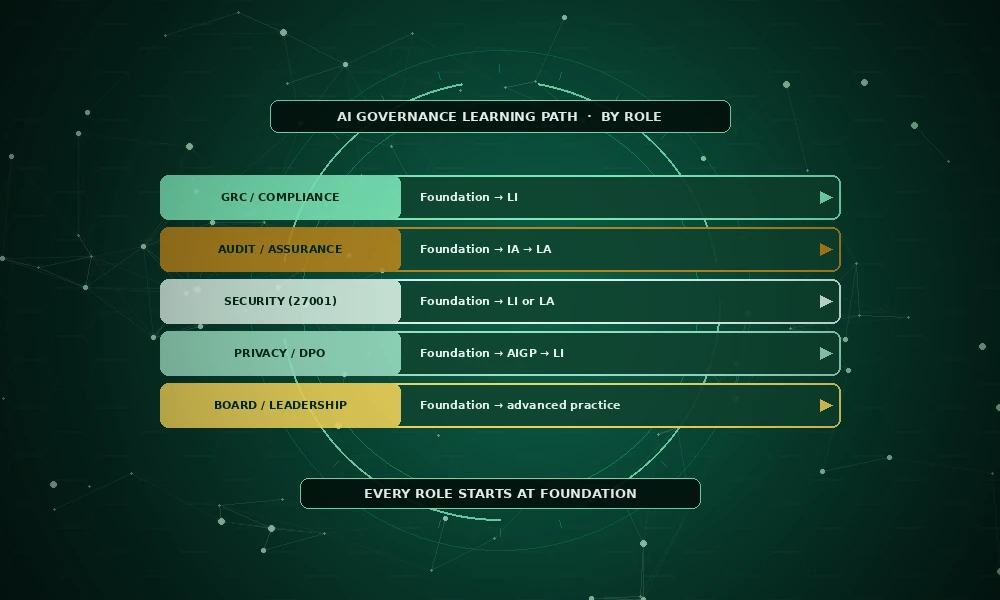
The learning paths by role
The table below maps the most common starting roles: what each already brings, what it needs to add, and a sensible first step. Find the row that matches you, and the shape of your path appears at once.
|
Starting role |
What you bring |
What to add |
A sensible first step |
|---|---|---|---|
|
CISO or security leader |
Security governance and risk leadership |
AI-specific risk, ethics, and the AI management system |
An ISO 42001 route that builds on your governance instinct |
|
GRC, risk, and compliance |
Risk, controls, and regulatory reasoning |
AI-specific governance and the AIMS structure |
ISO 42001, to cover the AI part of your remit |
|
Data scientist or ML engineer |
Deep technical grasp of models |
Governance, documentation, and risk discipline |
A foundation, then an implementer route |
|
Legal or privacy |
Regulatory and rights-based reasoning |
The operational how of governing AI systems |
Foundation for breadth, or ISO 42001 to help build |
|
Product or business leader |
Business context and decision authority |
AI risk literacy and governance fundamentals |
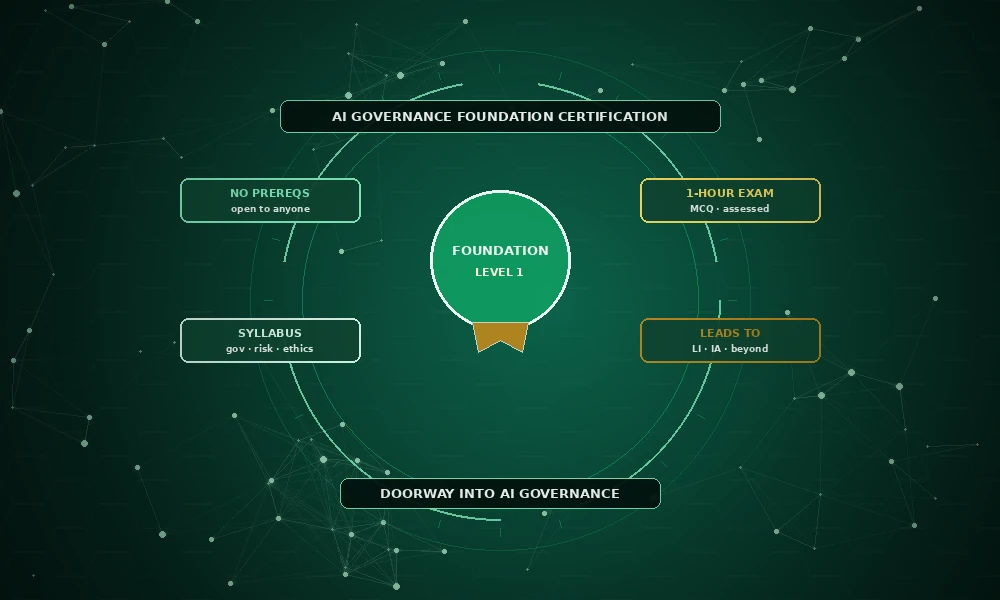
A foundation credential for shared language |
|
Internal auditor |
Audit discipline and objectivity |
AI-specific audit knowledge |
An ISO 42001 auditor route |
Notice that no two paths are the same, yet none starts from zero. The column that matters most is the second one, because what you already bring decides how short your path can be.
A closer look at the busiest routes
The security leader's path
Security leaders have the biggest head start and often the smallest sense of it. Governance, risk, and program discipline all transfer, so the work is mostly adding the AI-specific layer on top. The tailored detail sits in the CISO path, but the short version is: keep your governance instincts and point them at AI.
The GRC professional's path
GRC professionals arrive with risk and compliance fluency and usually need the AI-specific governance their remit has quietly absorbed. The route is set out in the GRC path, and it centres on covering the AI rows a security background leaves open.
The technical practitioner's path
Data scientists and engineers have the opposite profile: strong on how AI works, lighter on governance and documentation. Their path leans on building the discipline of a management system, which is exactly what an implementer route teaches, so the technical depth they bring becomes an advantage rather than a substitute.
The legal or privacy professional's path
Legal and privacy professionals bring regulatory and rights-based reasoning that transfers directly, since so much of AI governance is about obligations and impact. What they usually add is the operational side, how a governed system is actually built and evidenced. The route for this group is set out in the path for privacy professionals, and many pair a broad governance credential with enough implementation knowledge to work alongside the people who build.
The product or business leader's path
Product and business leaders rarely need to become practitioners, but they do need enough literacy to make and approve AI decisions responsibly. Their path is the shortest, usually a foundation credential that gives them the shared language to govern by, so they can ask the right questions of specialists rather than defer to them blindly.
The common core every path converges on
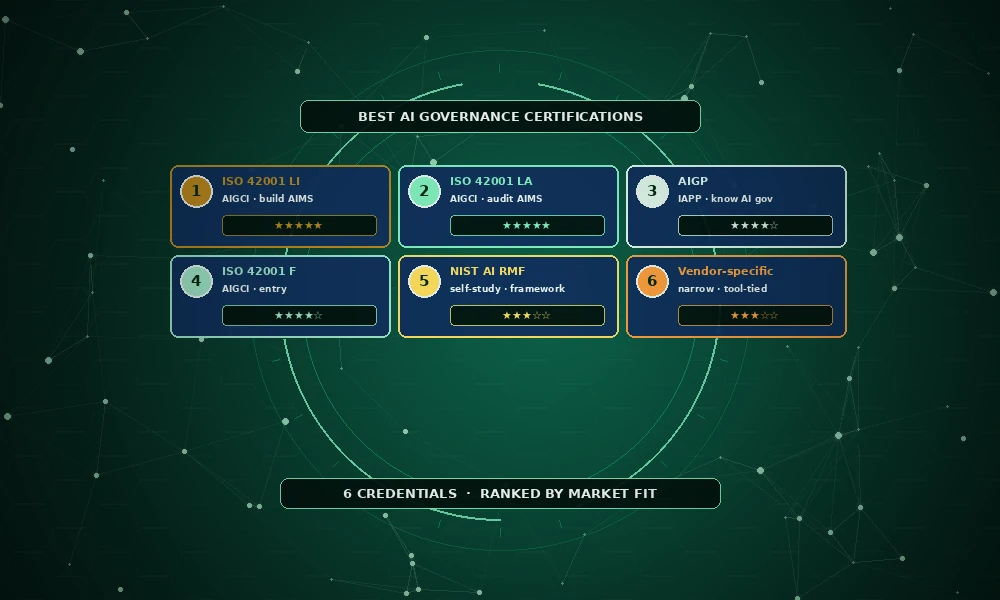
However different the starting points, the trails meet at a shared core. Everyone governing AI eventually needs the same essentials: how to assess AI risk, what responsible AI requires, and how an AI management system is built and run. Frameworks such as the NIST AI Risk Management Framework describe much of that shared ground.
This is why the paths, tailored as they are, point toward common credentials. Most converge on the certifications that prove you can actually govern AI, whichever role brought you there. The tailoring is in the on-ramp; the core is shared.
Why role-based learning matters now
The scale of retraining ahead makes a tailored path more than a convenience. In its Future of Jobs Report 2025, the World Economic Forum projected that 59 percent of the global workforce will need reskilling or upskilling by 2030, and that 85 percent of employers plan to prioritise upskilling their people.
When that much learning has to happen, efficiency matters. A path that respects what each person already knows, and adds only what they lack, is how organizations reskill at that scale without wasting the experience already on the payroll. Role-based learning is not a nicety; it is the only affordable way to close a gap this large.
For the individual, the same logic is personal. The fastest way to become valuable in AI governance is to add precisely what your role lacks, not to relearn what it already gave you. A tailored path is that logic applied on purpose, which is why it tends to reach competence faster and cost less than a generic programme that treats every learner as a blank slate.
How to build your own path in three steps
If your role is not in the table, or blends several, you can build your own path with the same logic:
-
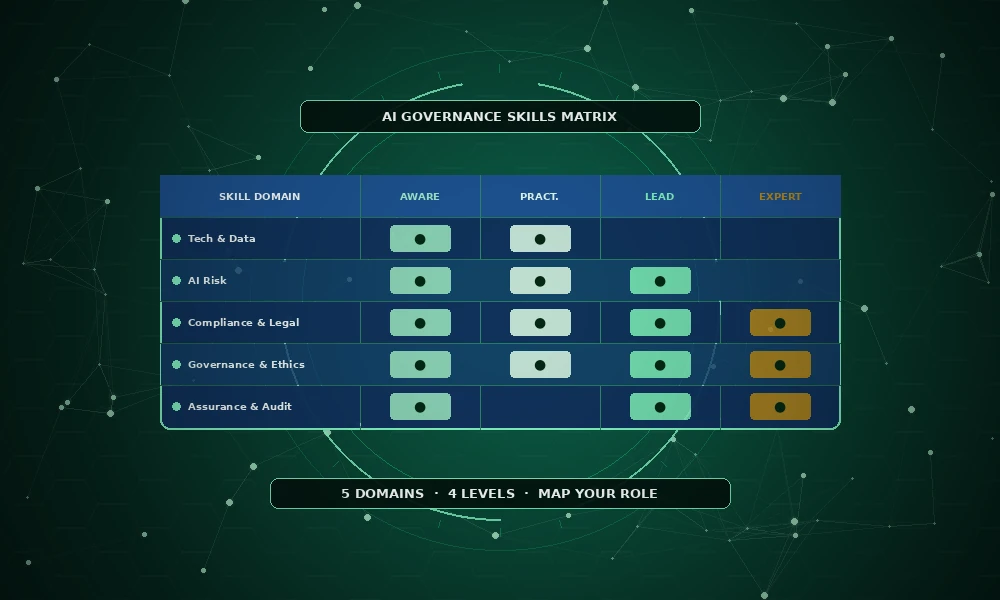
Assess honestly. Map what you already bring against what the work needs, using a tool like the skills matrix to find your real gaps.
-
Target the destination. Decide which AI governance role you are heading toward, because that sets the competencies you must reach.
-
Sequence the additions. Close the gaps in order of impact, starting with the shared core, then the role-specific skills your target demands.
Done this way, a learning path stops being a generic course list and becomes a route drawn specifically for you.
How long the journey takes
Timelines depend on your starting role, not on a fixed syllabus.
Someone with a strong adjacent background, a security leader or a seasoned GRC professional, can often reach working competence in months, because they are adding a layer rather than building from the ground. Someone entering from a role with little overlap should plan for longer, since they are learning both the governance craft and the AI subject at the same time.
The honest guide is your gaps, not the calendar. A shorter path is not a lesser one; it simply reflects how much relevant ground you had already covered before you began.
What tailoring does not mean
One caution keeps a role-based path honest. Tailoring means starting from your strengths, not skipping the parts you find unfamiliar.
A data scientist still has to learn governance properly, and a lawyer still has to understand how models fail. The path is shorter because of what you bring, not because any role is excused from the core. Mistaking a head start for a shortcut is how people arrive credentialed but not actually competent.
Common mistakes on a learning path
A few predictable errors send people down longer routes than they need:
-
Ignoring your head start, and paying to learn what your role already taught you.
-
Skipping the core because a part feels unfamiliar, which leaves a gap the credential only hides.
-
Collecting courses without a target role, so the path has no destination to give it shape.
-
Front-loading the specialised before the shared core, which makes the specialised far harder to absorb.
Your role is your on-ramp
The most useful thing to remember is that you are not starting from nothing, whatever your background. Your role is an on-ramp to AI governance, and the right learning path is the one that merges your existing strengths onto the main road as quickly as possible.
Find your starting role, respect what it already gives you, add what it lacks in order of impact, and the path that looked crowded and confusing resolves into a single clear route that is unmistakably yours, and short enough to actually finish.
Common questions about learning paths
Is there one best way to learn AI governance?
No. The best path depends on your starting role, because different roles bring different strengths and gaps. A security leader, a data scientist, and a lawyer should take different routes to the same destination, each building on what they already have rather than starting from scratch.
I am a CISO. Where should I start?
You already hold most of the governance foundation, so your path is mostly adding the AI-specific layer. An ISO 42001 route builds directly on your instincts. The tailored detail is set out in the dedicated CISO path, which accounts for your existing strengths.
I am technical, not a governance person. Can I still do this?
Yes, and your technical depth is an advantage. Your path leans toward learning governance and documentation discipline, which an implementer route teaches. The one rule is not to skip the governance core because it feels unfamiliar; your head start is in the technical understanding, not in the governance itself.
What do all the paths have in common?
They converge on a shared core: assessing AI risk, applying responsible AI, and building or running an AI management system. Whatever role you start from, you eventually need these essentials, which is why most paths lead toward the same core certifications.
How do I build a path if my role is not listed?
Use the same three steps: assess what you bring against what the work needs, choose your target role, and sequence the gaps by impact starting with the shared core. A skills matrix helps you find the gaps precisely so your path addresses the real ones.
Take the first step on your route
Wherever your path starts, most roads through AI governance pass through the ability to build and prove a management system. AIGCI's Lead Implementer certification develops that core capability, and you can see every option among the ISO 42001 courses. To learn how the institute designs its programmes, read more about the institute.