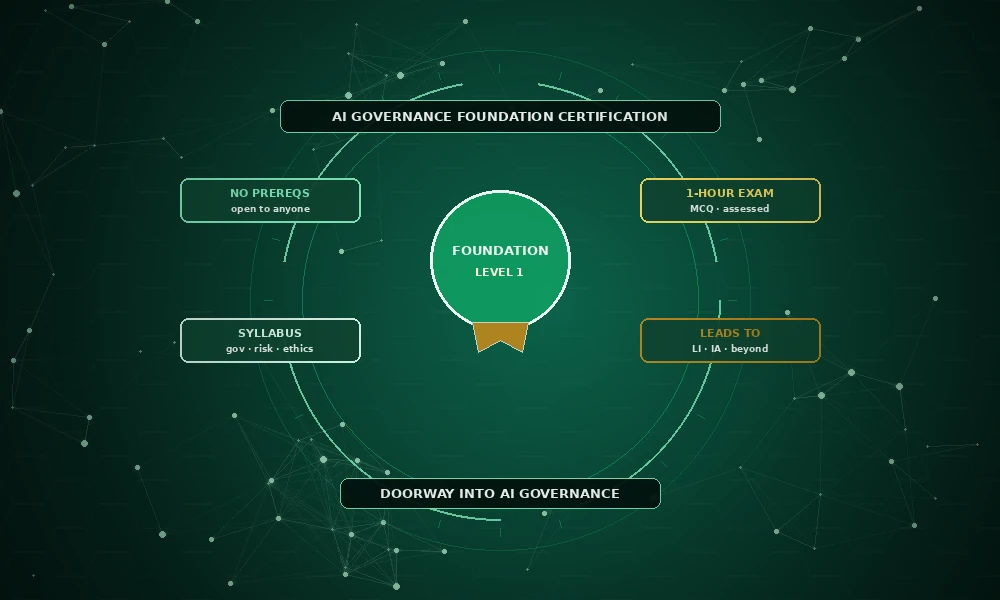
Every profession has an entry point, a first credential that turns curiosity into a foundation you can build on. In AI governance, that entry point is the foundation certification.
A foundation certification introduces AI governance: what it is, why it matters, and the standards and rules that shape it, including ISO/IEC 42001:2023, the AI management system standard. It is designed for people entering the field, not yet running or auditing anything.
But there is a catch worth knowing before you spend a rupee or a dollar. The phrase foundation certification is used by many providers of very different quality, so the real question is not only what it covers, but what it is anchored to.
This guide from the AI Governance Certification Institute (AIGCI) explains what a genuine AI governance foundation certification is, what a good one covers, who should take one, and how to tell a credible foundation from a hollow one.
|
"The beginning is the most important part of the work." Plato, The Republic |
Plato was writing about education, but the line fits a foundation credential exactly. What you learn first shapes everything you build afterward, which is why a weak or unanchored foundation is worse than no foundation at all: it teaches you to stand on sand.
What an AI governance foundation certification is, and is not
A foundation certification is a literacy credential. Its job is to give you a clear, shared understanding of AI governance so you can take part in the conversation and know where you fit.
What it is not is a licence to build or to audit. It does not qualify you to implement an AI management system or to certify one, and a credible provider will say so plainly rather than imply otherwise.
In the language of the field, a foundation introduces AI governance; it does not yet make you a practitioner of it. That distinction is the whole point of the level, and mistaking one for the other leads people to buy the wrong thing.
Why AI governance needs an entry credential at all
It is worth asking why a foundation level exists in the first place, because the answer explains its value.
AI governance became a profession in a remarkably short time, and professions need a shared starting point so newcomers speak the same language and hold the same base of knowledge. Without one, every organization would improvise its own understanding, and conversations across teams and companies would constantly break down.
A foundation supplies that common baseline. It is the reason a compliance officer, a data scientist, and a board member can discuss the same AI risk and mean the same things by the same words, which is the quiet precondition for governing anything well.
What a good one actually covers
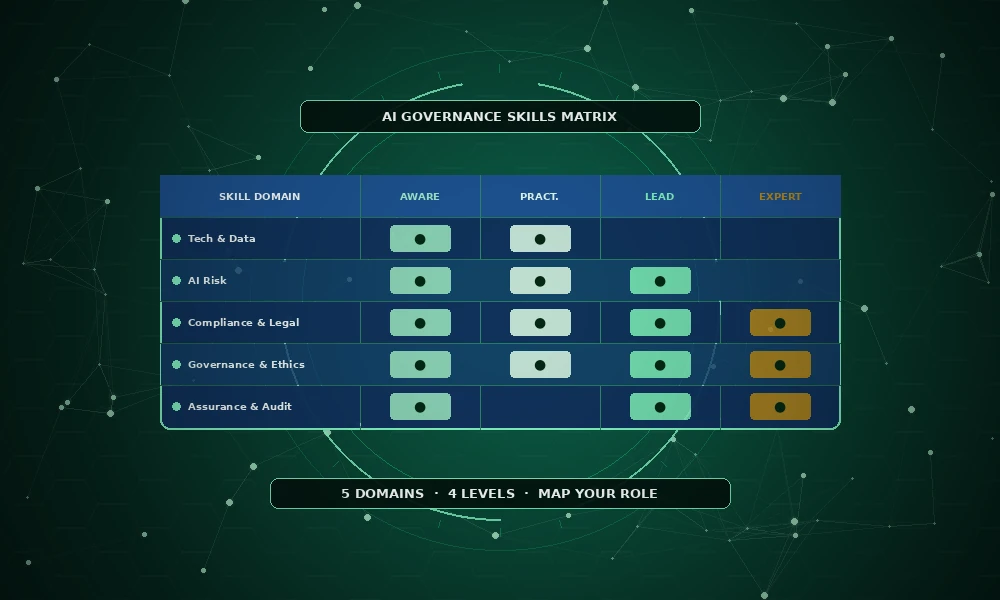
A foundation should map the territory before you try to travel it. The strongest ones cover five connected areas, and you can judge a course quickly by whether it addresses all of them:
|
Knowledge area |
What a foundation introduces |
|---|---|
|
What AI governance is |
The purpose of governing AI, and the core ideas of responsible AI |
|
Ethics and principles |
Fairness, transparency, and accountability, and how bias arises and spreads |
|
AI risk and the lifecycle |
How AI systems create risk, and how those risks shift across a model's life |
|
The regulatory landscape |
The rules now shaping AI, led by the EU AI Act |
|
Frameworks and standards |
The main reference points: ISO/IEC 42001, the NIST AI RMF, and the OECD AI Principles |
That fourth and fifth rows are larger than they look. The EU AI Act is only one instrument in a crowded field: the OECD AI Policy Observatory tracks more than 900 national AI policy initiatives across over 80 jurisdictions, which is precisely why newcomers need a foundation to make sense of the noise.
A good foundation does not teach every rule; it teaches you the shape of the landscape and the anchors within it, chiefly ISO 42001 for management, the NIST AI Risk Management Framework for risk, and the OECD AI Principles for shared values. Learn those, and the rest becomes navigable.
Who it is for
The great strength of a foundation is that it assumes nothing. It is built for people arriving from every direction, with no technical or legal background required:
-
Newcomers to AI governance who need solid ground before choosing a specialism.
-
Business, legal, compliance, and risk professionals whose work now touches AI and who need a shared language for it.
-
Leaders and teams who must make or approve AI decisions and want to do so knowledgeably.
-
Students and career changers using the foundation as a credible first step into the field.
If you can already implement or audit an AI management system, a foundation is likely beneath you. For almost everyone else entering the field, it is the sensible place to start.
How a foundation certification works
The mechanics are refreshingly simple, which is part of the appeal for busy newcomers.
A foundation is typically a short course followed by a knowledge exam, often taken online, with no prerequisites to enrol. The exam checks understanding of concepts rather than the ability to apply them under pressure, so preparation is about grasping ideas, not rehearsing procedures.
Because it introduces ISO/IEC 42001:2023 and the surrounding landscape rather than drilling into implementation, most people can prepare in days rather than weeks, scaled to how new the material is to them.
The question that decides quality: what is it anchored to?
Here is the insight that separates a valuable foundation from a decorative one. Because anyone can publish a course and call it a foundation certification, the label alone tells you almost nothing. The anchor tells you everything.
A foundation anchored to a recognised standard teaches you concepts that are stable, examinable, and respected, because they trace back to an agreed international reference rather than one provider's opinion. A foundation anchored to nothing teaches you a vocabulary that may not travel beyond the course that sold it.
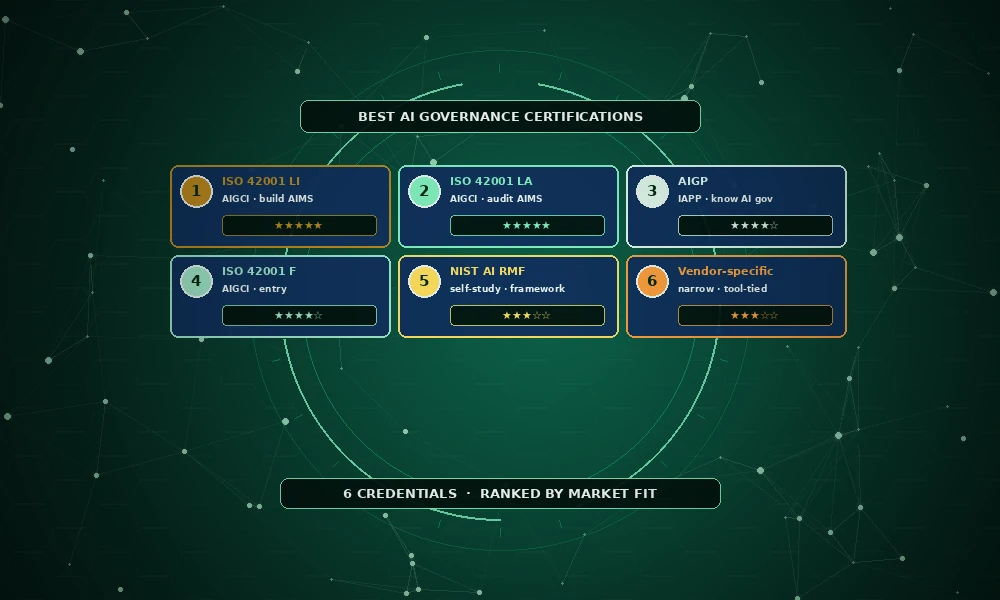
This is why a standards-based route is the safer choice for most people. The ISO 42001 Foundation is the clearest example: it grounds your first knowledge in the international AI management system standard, so what you learn is portable and credible from day one. When you compare foundation options, ask what each is anchored to before you ask what it costs.
Where the foundation leads
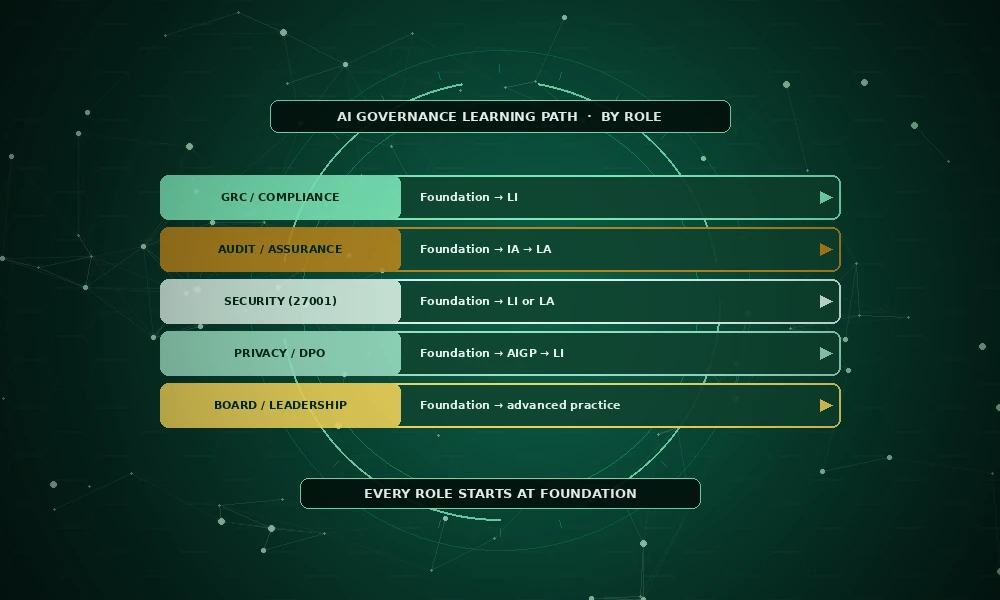
A foundation is a first rung, not a destination, and its value grows when you know where it points. From here, most people move toward building an AI management system or toward auditing one, choosing their next credential by their goal. How those routes connect is laid out in the full certification path, which places the foundation in the wider map.
Seen that way, a foundation is an investment in optionality. It opens several doors at once and lets you choose which to walk through later, once you understand the field well enough to decide.
Should you take a foundation, or skip ahead?
This is the honest question most guides dodge, so here is a straight answer. It depends on how much ground you already stand on.
If AI governance is genuinely new to you, a foundation repays its modest cost many times over, because it prevents the expensive confusion of learning advanced material without the basics. Starting higher to save time usually wastes it.
If you already work in governance, risk, security, or a related field and understand management systems, you can often skip straight to a professional level. In that case a foundation would confirm what you know rather than teach it, and your time is better spent elsewhere.
Common misconceptions to clear up
A few myths attach themselves to entry-level credentials, and clearing them sets the right expectations:
-
That a foundation is a formality. It is easy relative to professional levels, but a good one still requires you to understand real concepts.
-
That all foundations are equal. They are not, and the standard behind the certificate is what separates a credible one from a hollow one.
-
That it is only for absolute beginners. Leaders and specialists in adjacent fields often take one deliberately, to speak the language of AI governance credibly.
What a foundation will not do
Setting honest limits protects you from disappointment and from overselling yourself. A foundation certification will not:
-
Make you an implementer or auditor. It builds understanding, not the ability to build or independently assess a system.
-
Certify your organization. Only an accredited audit can do that, and it is a separate process entirely.
-
Replace experience. It is the start of a journey, and real capability still comes from doing the work.
None of this diminishes its worth. A foundation is meant to be a beginning, and it does that job well precisely because it does not pretend to be more.
Signs you are ready for the next level
You will know the foundation has done its job when a few things become true:
-
You can explain, without notes, what AI governance is and why it matters.
-
You can name the main standards and frameworks and say what each one is for.
-
You have a clear sense of whether you want to build AI management systems or audit them.
When those hold, the introductory material has nothing left to teach you, and the path forward is a professional credential rather than more foundations.
The bottom line
An AI governance foundation certification is the doorway into a fast-growing field, and for newcomers it is the right first step. Its value, though, is decided less by the word foundation on the certificate than by the standard behind it.
Choose a foundation anchored to a recognised standard, treat it as a beginning rather than a destination, and it becomes exactly what Plato promised: a strong start that makes everything after it easier.
Frequently asked questions
What is an AI governance foundation certification?
It is an entry-level credential that introduces the fundamentals of AI governance: responsible AI, ethics, risk, the regulatory landscape, and the main frameworks and standards. It builds literacy for people entering the field and does not qualify you to implement or audit an AI management system.
Do I need any background to take one?
No. A good foundation assumes no technical or legal expertise and is designed for people from business, compliance, risk, legal, product, HR, technology, and leadership roles. That accessibility is the point of the level.
How do I tell a good foundation certification from a weak one?
Look at what it is anchored to. A foundation grounded in a recognised standard, such as ISO 42001, teaches portable, credible concepts, while an unanchored course may teach a vocabulary that does not travel. Ask about the anchor before you ask about the price.
Is a foundation certification worth it, or should I start higher?
If AI governance is new to you, a foundation is worth it and prevents costly confusion later. If you already work in governance, risk, or security and understand management systems, you can usually skip to a professional level, where a foundation would only confirm what you know.
What can I do after a foundation certification?
Use it as a first rung. Most people progress toward implementing an AI management system or auditing one, choosing the next credential by their goal. The foundation gives you the understanding to make that choice well rather than blindly.
Start on solid ground
If you are entering AI governance, begin with a foundation anchored to the international standard. AIGCI's Foundation certification grounds your first knowledge in ISO 42001, so it is portable and credible from the start. To see the specific credential in detail, read about the ISO 42001 Foundation, browse all the ISO 42001 courses, and learn how the institute designs them by reading more about the institute.