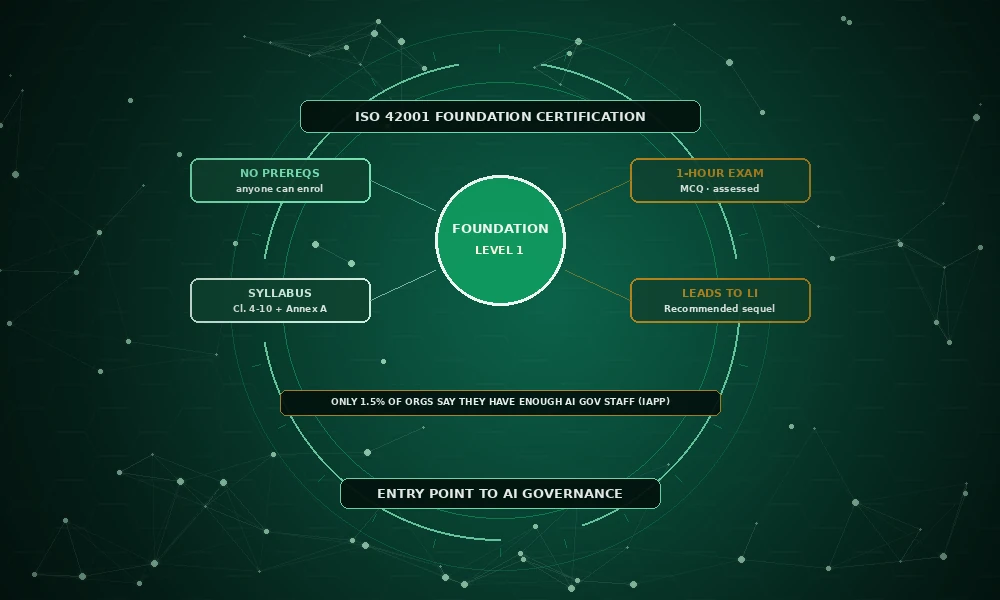
There has rarely been a better moment to learn AI governance from the ground up. The IAPP AI Governance Profession Report 2025 found that only about 1.5 percent of organizations believe they have adequate AI governance headcount, and that nearly a quarter cite a shortage of qualified professionals as a top barrier to managing AI.
The ISO 42001 Foundation certification is designed to help close that gap from the entry level. It gives you a structured, credible grounding in ISO/IEC 42001:2023, the international standard for AI management systems, with no prior experience required.
This page, from the AI Governance Certification Institute (AIGCI), sets out exactly what the Foundation covers, how the exam works, who it suits, and where it leads.
Is the ISO 42001 Foundation right for you? A quick check
The Foundation is the entry point to ISO 42001, so it is deliberately accessible and assumes nothing about your background. It is a strong fit if any of these describe you:
- You are new to AI governance and want a credible, structured starting point.
- You need to understand ISO 42001 without becoming the person who implements it.
- You are a student or career changer who wants a recognised credential with no prerequisites.
- You work near AI, in risk, compliance, security, product, or policy, and want to speak the language of governance.
- You intend to progress to Lead Implementer later and want the foundation firmly in place first.
If you already lead AI governance work day to day, you may be ready to skip ahead to a more advanced level; the rest of this page will still help you decide, and it is worth confirming you are not missing foundations you never formally covered.
What you will actually learn: the full syllabus
Most descriptions of a Foundation course stay vague. Here is the real content, organised into the two areas the certification assesses. The first builds the concepts; the second maps the standard itself.
Part 1: AI and AI management system fundamentals
|
Topic |
What it covers |
|---|---|
|
AI systems and the AI lifecycle |
What counts as an AI system, and how it moves from data to deployment to retirement |
|
Responsible-AI principles |
Fairness, transparency, accountability, human oversight, and explicability |
|
What an AIMS is |
The idea of an AI management system and why organizations need one |
|
Why it matters now |
The business and regulatory drivers, including the EU AI Act |
Part 2: The ISO/IEC 42001:2023 requirements
|
Topic |
What it covers |
|---|---|
|
The Harmonized Structure |
How Clauses 4 to 10 organise context, leadership, planning, support, operation, evaluation, and improvement |
|
Annex A controls |
The 38 AI-specific controls grouped under 9 objectives |
|
Statement of Applicability |
How an organization records which controls apply and why |
|
AI risk and impact assessment |
How the standard treats AI risk and the impact of AI on people |
|
The PDCA cycle |
How Plan, Do, Check, Act drives continual improvement |
|
The certification process |
How organizations get certified, at a high level |
By the end, you will not just recognise these terms; you will understand how they fit together into a working system. That is the difference between having heard of ISO 42001 and being able to talk about it with authority in a meeting, an interview or an audit conversation.
The Foundation is deliberately broad, so you leave with a mental map of the whole standard rather than isolated facts about parts of it.
The nine Annex A control objectives you will learn to recognise
Annex A of ISO/IEC 42001:2023 is where a lot of the AI-specific substance lives and the Foundation makes sure you can find your way around it.
Its 38 controls sit under nine objectives, and knowing what each one governs is a large part of speaking the standard fluently.
|
Control objective |
What it governs |
|---|---|
|
A.2 AI policy |
Setting a documented, approved direction for AI |
|
A.3 Internal organization |
Roles, responsibilities, and reporting lines |
|
A.4 Resources |
The data, tooling, compute, and people AI needs |
|
A.5 Impact assessment |
Assessing the effects of AI systems on people |
|
A.6 AI system life cycle |
Responsible development, deployment, and retirement |
|
A.7 Data for AI |
Data quality, provenance, and governance |
|
A.8 Information for interested parties |
What you tell users and stakeholders |
|
A.9 Use of AI systems |
Intended use and human oversight |
|
A.10 Third-party relationships |
Governing vendors and suppliers |
You are not expected to implement these at Foundation level. You are expected to understand what each covers, which is exactly what lets you follow a governance conversation and know where a given concern belongs.
The learning outcomes: what you can do afterwards
A credential is only useful if it changes what you can do. On completing the Foundation, you should be able to:
- Explain what an AI management system is and why an organization needs one.
- Describe the core responsible-AI principles and why each matters.
- Navigate the structure of ISO/IEC 42001:2023 and locate its key requirements.
- Recognise the Annex A controls and the purpose of the Statement of Applicability.
- Follow how AI risk and impact assessment work within the standard.
- Contribute to AI governance conversations, and decide whether to progress to implementation.
What the Foundation does not cover, and why that is fine
Being honest about scope is part of choosing well. The Foundation is an understanding-level credential, so it deliberately stops short of a few things:
- It does not teach you to implement an AIMS end to end; that is the Lead Implementer level.
- It does not qualify you to audit an AI management system; that is the auditor track.
- It does not go deep into designing individual controls or writing full documentation sets.
None of this is a weakness. A foundation is meant to be broad and solid, not deep and narrow. Trying to skip it and start at an advanced level is usually a false economy, because the advanced material assumes the understanding the Foundation builds.
How the Foundation exam works
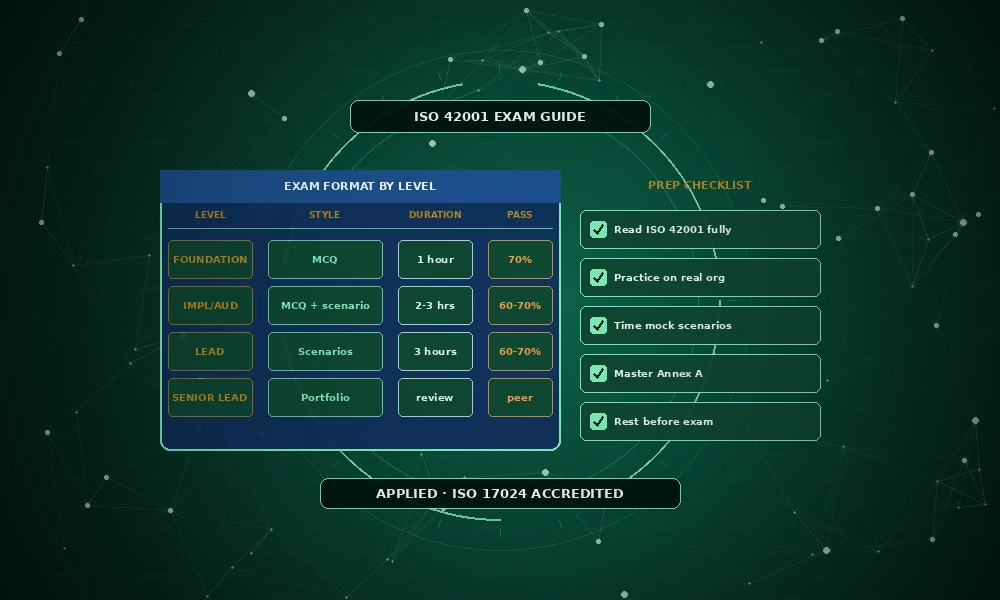
The Foundation is assessed by an exam that tests understanding rather than memorisation. Formats vary slightly between providers, so confirm the exact details when you enrol, but the typical shape is consistent:
|
Element |
Typical Foundation exam |
|---|---|
|
Question type |
Multiple choice |
|
Number of questions |
Around 40 |
|
Duration |
About 60 minutes |
|
Materials |
Usually closed book |
|
Pass mark |
Commonly around 70 percent |
|
Prerequisites |
None |
Because there are no prerequisites and the focus is on comprehension, most motivated learners can prepare for the Foundation in a matter of days rather than months. The exam confirms that you understand the standard well enough to work with it.
How to approach your preparation
Preparation for the Foundation is more about understanding than cramming. A sensible approach is to:
- Read the standard's structure first, so the terminology has somewhere to land.
- Study the two parts of the syllabus above, concepts then requirements, in that order.
- Practise placing a real AI concern, such as bias, against the right clause or control.
- Use practice questions to confirm understanding rather than to memorise answers.
Because the material is conceptual, most learners are ready within days. Treat the exam as a checkpoint on understanding, not a hurdle to be gamed, and it tends to look after itself.
Who takes the Foundation and why
The Foundation draws a wider range of people than most technical certifications, because AI governance is a cross-functional discipline that touches legal, risk, product, security, and the business as much as it touches engineering. Common starting points include:
- Beginners and career changers, who want a recognised entry into AI governance without a technical background.
- Risk, compliance, and security professionals, who already think in controls and want the AI-specific layer.
- Product managers and business analysts, who shape how AI is built and used and need the governance vocabulary.
- Students, who can earn a credential with no prerequisites while they study.
- Leaders and sponsors, who need enough fluency to govern AI responsibly without running the system themselves.
What the Foundation leads to: Lead Implementer and beyond
The Foundation is a destination for some and a launchpad for others. It is the recognised starting point of a progression that leads, for most people who want to run AI governance, to the Lead Implementer certification. Where the Foundation builds understanding, the Lead Implementer builds the ability to design and operate an AI management system end to end.
The simplest way to think about it: the Foundation proves you understand ISO 42001 and the Lead Implementer proves you can put it to work.
Why a foundational credential is worth it now
The case for certifying early rests on three trends, and they reinforce each other:
- A widening skills gap. With so few organizations confident in their AI governance headcount, even foundational knowledge is in short supply and high demand.
A hardening regulatory backdrop. The EU AI Act and similar frameworks are turning responsible AI from an aspiration into an obligation, and organizations need people who understand what that requires.
A maturing discipline. Responsible-AI concepts that the Foundation teaches, echoed in frameworks such as the NIST AI Risk Management Framework, are becoming standard professional knowledge rather than specialist expertise.
Put together, a Foundation certification is a small investment that signals you are ahead of a curve most organizations are only beginning to climb. In a field this young, being early is itself a credential.
The people who understand AI governance now, before it becomes a baseline expectation, are the ones who will be trusted to shape it as it matures, rather than scrambling to catch up once it is mandatory.
Frequently asked questions
Do I need experience or a technical background for the Foundation?
No. The Foundation has no prerequisites and assumes no technical or AI background. It is designed as an entry point, so beginners, students, and professionals from non-technical fields can all take it.
How long does it take to prepare?
For most people, a few days of focused study. The Foundation tests understanding of concepts and the structure of the standard rather than deep implementation skill, so it is achievable alongside work or study.
Is the Foundation enough to get a job in AI governance?
It is a strong start, especially for entry-level and adjacent roles, and it is often paired with relevant experience or a further certification. Many people use it to move into governance from a related field, then progress to Lead Implementer.
What is the difference between Foundation and Lead Implementer?
Foundation builds understanding of ISO 42001; Lead Implementer builds the ability to implement and run an AI management system. Foundation is usually the recommended first step before the more advanced level.
Does the Foundation expire?
Professional certifications are typically valid for a period and maintained through continuing professional development, with details varying by issuing body. Confirm the maintenance requirements when you certify.
How is the Foundation different from a general AI course?
A general AI course usually teaches you to use or build AI. The ISO 42001 Foundation teaches you to govern it: how to manage AI responsibly against an international standard. The two are complementary, but only the Foundation gives you a recognised governance credential grounded in ISO/IEC 42001:2023.
Can I take the Foundation online?
In most cases, yes. Foundation training and exams are widely available online, including self-paced options, which makes the credential accessible around work or study. Confirm the delivery format and any proctoring requirements with your provider when you enrol.
Start your AI governance credential
If you want a recognised, structured grounding in AI governance without a technical barrier, the Foundation is where to begin. You can enrol in AIGCI's ISO 42001 certification programmes and build from the entry level toward implementation at your own pace.
Whether you stop at Foundation or go on to lead AI governance, starting here means starting on solid ground. To see how the institute structures its certifications and supports career starters, read more about the institute.