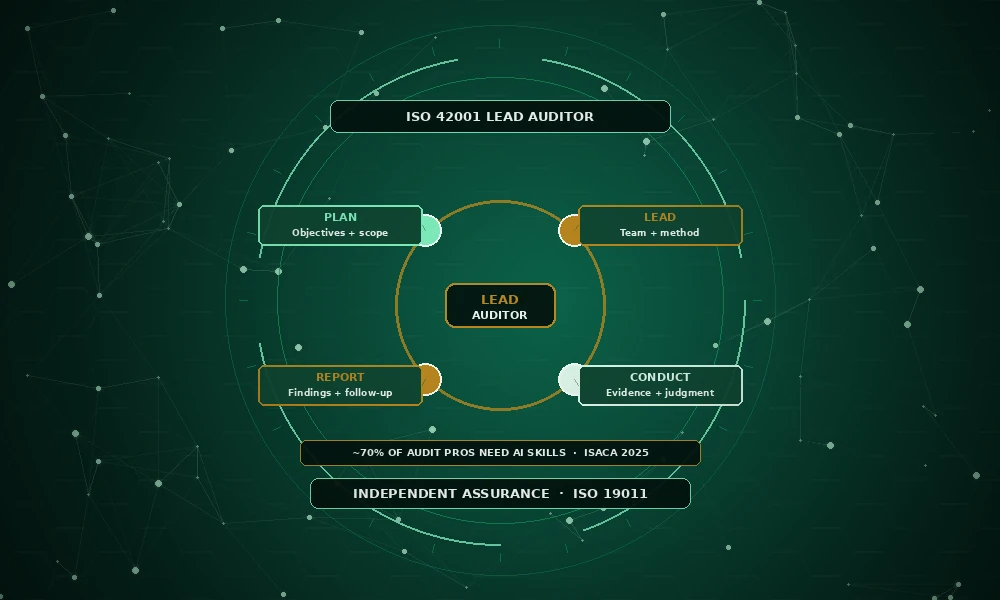
The audit profession is pivoting toward AI faster than almost any other. In ISACA's 2025 AI Pulse research, around 70 percent of audit and assurance professionals said they will need to increase their AI skills within a year just to advance or hold their positions. The ISO 42001 Lead Auditor certification is the credential built for exactly that shift.
It qualifies you to lead independent audits of an organization's AI management system, the assurance work that turns a claim of responsible AI into something a third party has actually checked. This page, from the AI Governance Certification Institute (AIGCI), explains what an ISO 42001 Lead Auditor does, what the certification develops, who it suits, and where it leads.
An ISO 42001 Lead Auditor is qualified to plan, lead, conduct, and report independent audits of an AI management system against ISO/IEC 42001:2023, providing the third-party assurance that a certificate depends on.
What an ISO 42001 Lead Auditor actually does
A Lead Auditor is not a checklist administrator, and the certification is not a formality. They own an audit from end to end and lead the team that delivers it. The role runs across a full cycle:
- Plan the audit. Define the objectives, scope, criteria, and method, and build the audit plan.
- Lead the team. Assign roles, manage the engagement, and keep the audit fair, evidenced, and on track.
- Conduct the assessment. Gather and evaluate evidence about how the AI management system actually operates.
- Judge conformity. Decide, on the evidence, where the system meets ISO 42001 and where it falls short.
- Report and follow up. Document findings, agree corrective actions, and confirm they are closed.
Because AI is the subject, a Lead Auditor works at the intersection of governance, engineering, legal, and compliance, and their judgement shapes whether an organization's AI is trusted by customers and regulators.
It is a role that demands breadth as much as depth: you must understand enough about how AI systems work to ask the right questions, and enough about governance and evidence to judge the answers.
The four standards a Lead Auditor works across
Auditing an AI management system is a discipline built on more than one standard. A capable Lead Auditor moves fluently between four of them, each playing a distinct role:
|
Standard |
Its role |
What the auditor uses it for |
|---|---|---|
|
ISO/IEC 42001:2023 |
The subject |
The requirements the AIMS is audited against |
|
ISO 19011 |
The method |
How to plan, conduct, and report a management-system audit |
|
ISO/IEC 17021-1 |
The rules |
The requirements governing third-party certification audits |
|
ISO/IEC 42006:2025 |
The bar |
The AI-specific competence a certification body and its auditors must meet |
That last one is new and important. Because ISO/IEC 42006:2025 now sets AI-specific competence requirements for the bodies that certify AI management systems, a Lead Auditor is expected to bring genuine AI understanding, not just management-system audit experience. The certification is where that combination is built.
What the Lead Auditor certification develops
The certification turns a competent management-system auditor, or a capable governance professional, into someone who can lead an AI audit with authority. It develops the seven audit principles of ISO 19011, risk-based auditing, evidence evaluation, and the professional ethics that keep an audit impartial, all applied to the specific risks of AI: bias, transparency, human oversight and data governance.
For the full breakdown of the audit skills you gain, see our dedicated guide; the essence is that you learn to audit not just whether documents exist, but whether an AI system is genuinely governed.
The seven audit principles you will apply
Every credible audit rests on the seven principles set out in ISO 19011, and a Lead Auditor internalises them until they are second nature. They are what keep an audit trustworthy rather than merely thorough:
- Integrity. Audit honestly, responsibly, and without favour.
- Fair presentation. Report findings truthfully and accurately, including what you could not conclude.
- Due professional care. Apply diligence and judgement proportionate to the stakes.
- Confidentiality. Protect the information you access during the audit.
- Independence. Stay impartial and free of conflicts, so conclusions are objective.
- Evidence-based approach. Base every conclusion on verifiable evidence, not impression.
- Risk-based approach. Focus effort where the AI risks, and the consequences of getting them wrong, are greatest.
These principles are the reason an accredited audit means something. Anyone can form an opinion about an AI system; a Lead Auditor forms one that others can rely on, because it was reached this way.
Lead Auditor, Internal Auditor and Lead Implementer are not the same role
It is easy to blur these three, so it is worth being precise, because employers and clients use the titles interchangeably even though they are genuinely different jobs. They sit at different points of the same system:
|
Role |
What they do |
Party |
|---|---|---|
|
Lead Implementer |
Builds and runs the AIMS |
Not an auditor |
|
Internal Auditor |
Audits their own organization's AIMS |
First-party |
|
Lead Auditor |
Leads independent audits of other organizations |
Third-party |
In short, the Lead Implementer builds the system, the Internal Auditor checks it from inside, and the Lead Auditor is the independent, external voice whose judgement leads to certification.
The Lead Auditor is the role that carries the most independence, and the most weight, which is exactly why the certification is rigorous and the credential respected.
Who becomes an ISO 42001 Lead Auditor
The certification suits people who already think like auditors, or who want to learn to. It is a natural move for several backgrounds:
- Existing management-system auditors, especially ISO 27001 auditors, who already know how to run an audit and need the AI layer.
- Governance, risk, and compliance professionals, who assess controls for a living and want to formalise it as assurance.
- Consultants and assessors, who want to offer independent AI audit and assurance to clients.
- Experienced AI governance practitioners, who want to move from building systems to independently judging them.
Where the Lead Auditor certification leads: AI assurance
The Lead Auditor credential is the entry to one of the fastest-emerging functions in the field: AI assurance, the independent evaluation of whether AI systems are governed and behave as claimed. Demand is being created on two sides at once. On the supply side, the audit profession is racing to reskill, with ISACA reporting that the vast majority of assurance professionals expect to need more AI expertise within a year or two.
On the demand side, regulation is making independent assessment mandatory: the EU AI Act introduces conformity assessments, and accredited third-party certification, recognised internationally, is becoming a procurement expectation. A Lead Auditor sits exactly where those two pressures meet.
The exam and the path to becoming a Lead Auditor
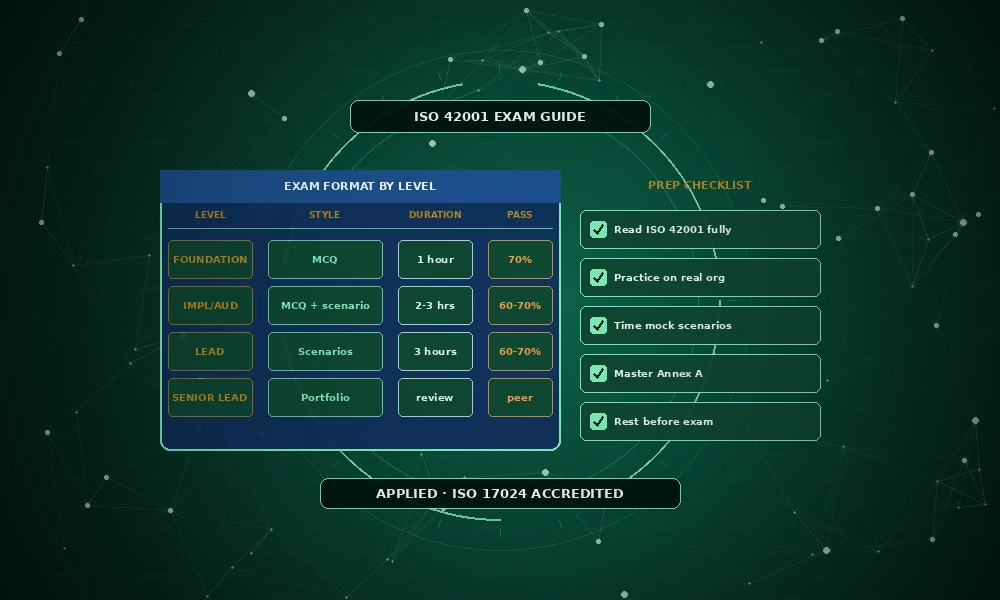
The Lead Auditor is an advanced certification, so it assesses applied audit competence rather than recall. Formats vary by provider, but expect a rigorous exam that tests your ability to plan and reason about a real audit, often based on a scenario rather than a set of definitions.
Many candidates come to it with a Foundation-level understanding of ISO 42001 and, ideally, some audit experience, and both make the material considerably easier to absorb.
It is more demanding than Foundation by design, because a Lead Auditor's judgement is what a certificate ultimately rests on. Confirm the exact exam format and any prerequisites with your provider before you enrol.
Why the timing favours new Lead Auditors
Three forces make this an unusually good moment to certify as a Lead Auditor, and they are compounding rather than competing:
- A reskilling audit profession. Most assurance professionals expect to need AI skills soon, so early AI-audit competence is scarce and valuable.
- Regulation creating mandatory demand. Conformity assessments and bias audits are moving from optional to required, which needs qualified auditors.
- A young accreditation ecosystem. With ISO/IEC 42006 only just setting the bar for AI audit competence, the pool of genuinely qualified AI auditors is still small.
Put together, the Lead Auditor certification is a bet on a role that barely existed two years ago and is about to be in serious demand. Unlike many technology skills that risk being automated, independent judgement about whether AI is trustworthy is precisely the kind of work that becomes more valuable as AI spreads, not less, because someone has to be accountable for the answer.
What a Lead Auditor engagement actually looks like
In practice, an audit is a structured piece of investigative work. It usually opens with planning: the Lead Auditor reviews the organization's scope, its Statement of Applicability, and its documentation, and decides where to look hardest. Then comes the fieldwork, interviewing the people who own the AI systems, sampling evidence, and testing whether the controls described on paper are the controls running in reality.
The moments that matter most are the judgement calls. A control exists, but is it effective? A risk was assessed, but was the assessment honest about bias or human oversight? The Lead Auditor weighs the evidence, records nonconformities where the system falls short, and leads the closing meeting where those findings are explained.
It is demanding work, part detective, part diplomat, and it is precisely this independent judgement that a certificate is bought to represent. That is why the role rewards people who are rigorous, curious, and comfortable delivering an uncomfortable finding when the evidence requires it.
Frequently asked questions
What does an ISO 42001 Lead Auditor do?
A Lead Auditor plans, leads, conducts, and reports independent audits of an organization's AI management system against ISO/IEC 42001:2023. They lead the audit team and their judgement determines whether the system conforms, which underpins certification.
Do I need to be an auditor already?
It helps, but it is not always required. Existing management-system auditors have the smoothest path, while governance and compliance professionals can also certify. Some audit experience makes the material easier, since the certification is applied rather than introductory.
What is the difference between a Lead Auditor and an Internal Auditor?
An Internal Auditor audits their own organization's AI management system, a first-party audit. A Lead Auditor leads independent, third-party audits of other organizations, the kind that lead to certification. The Lead Auditor role carries more independence.
Should I do Foundation first?
Often, yes. A Foundation-level grasp of ISO 42001 makes the Lead Auditor material far easier to absorb, because the certification assumes you already understand the standard you are auditing against.
Is there real demand for ISO 42001 auditors?
Yes, and it is rising fast. The audit profession is reskilling toward AI, and regulation is making independent AI assessment mandatory. Qualified AI auditors are currently scarce relative to that demand.
How long does it take to become a Lead Auditor?
The training itself is usually a focused course followed by an exam, so the credential can be earned in weeks rather than months. Building the judgement to audit well, however, develops with practice on real engagements, which is why some prior audit or governance experience helps so much.
What can I do after Lead Auditor?
The Lead Auditor is a strong base for a wider assurance career: leading larger or more complex audits, moving into senior audit roles, or specialising in independent AI assurance. As the field matures, experienced AI auditors are likely to be among its most sought-after professionals.
Become the independent voice on AI
If you want to move from understanding AI governance to independently judging it, the Lead Auditor is the credential that gets you there. You can train toward the ISO 42001 Lead Auditor certification with AIGCI and build the audit competence that regulation and the market are now demanding, ahead of the wave rather than behind it.
To see how the institute structures its certifications and supports auditors, read more about the institute.