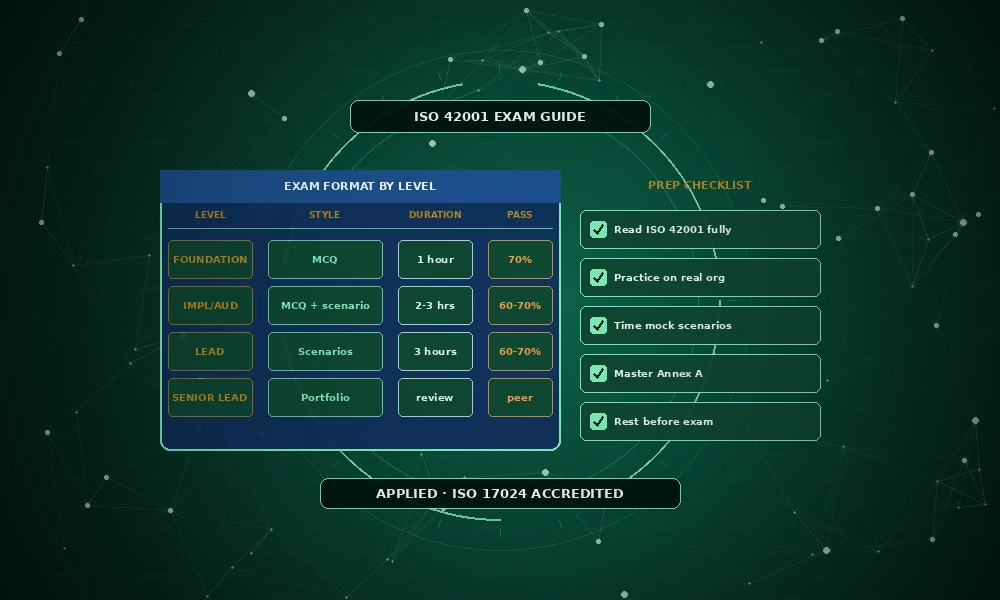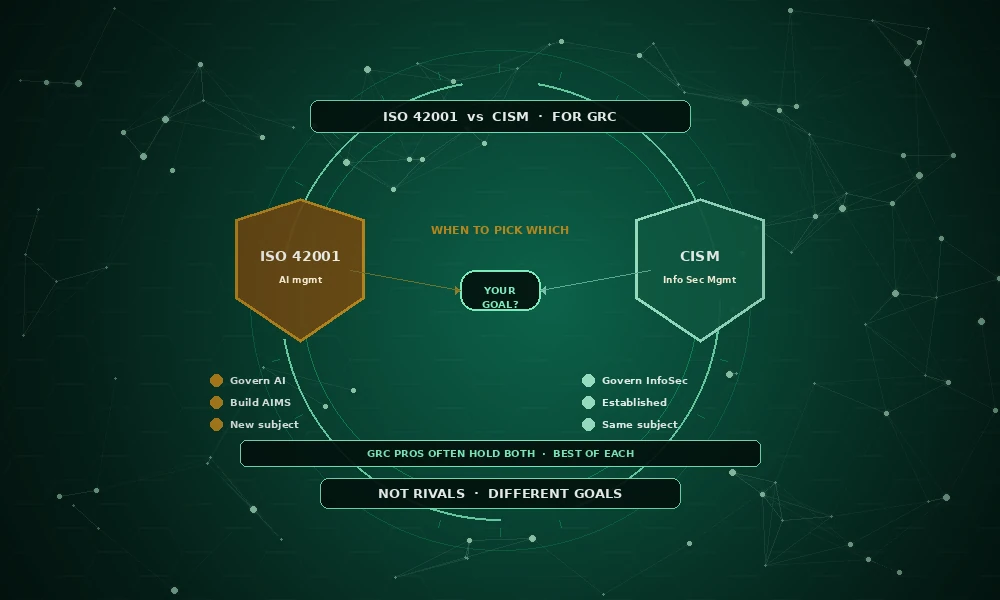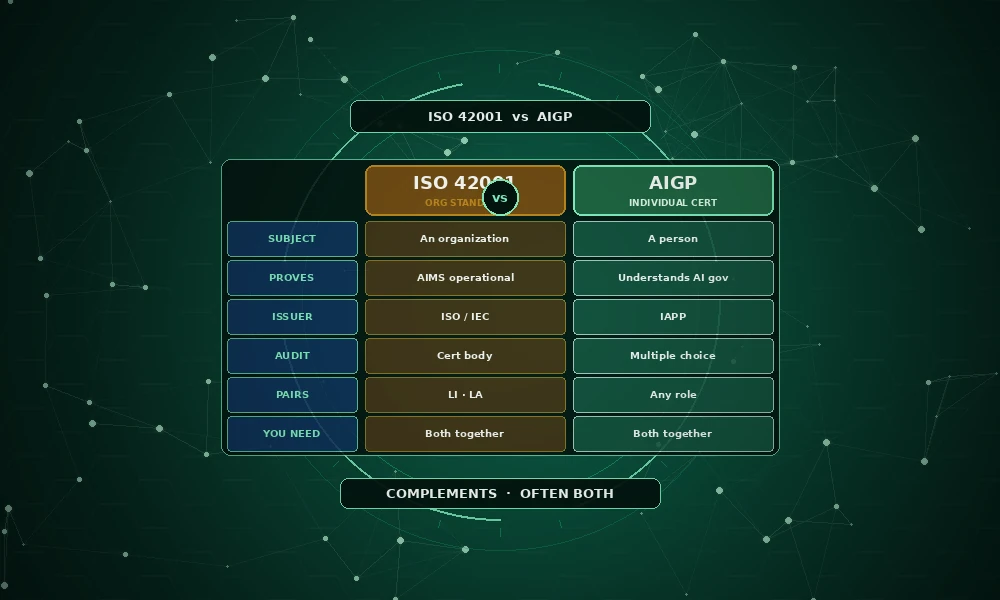
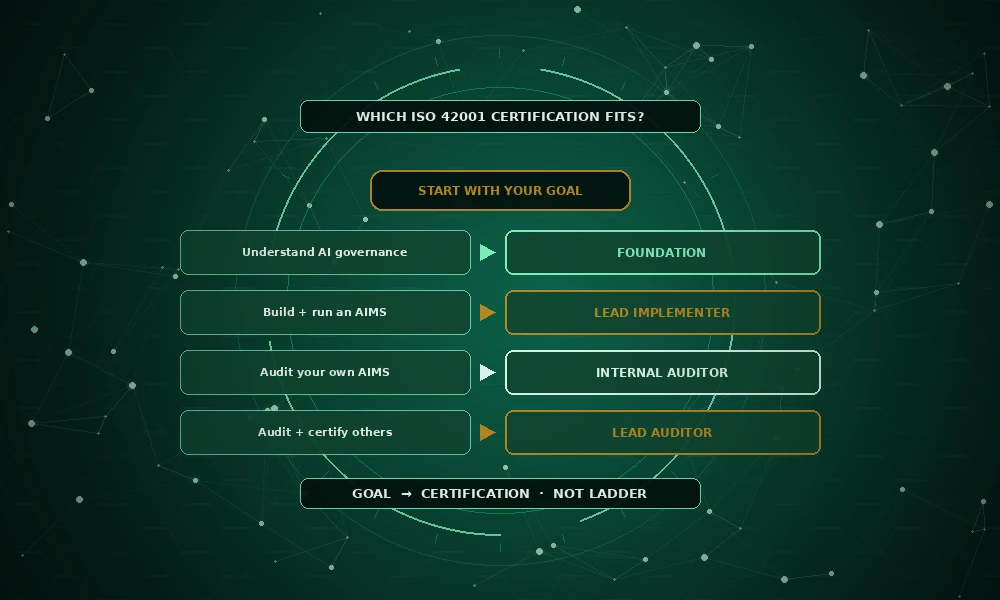
Most guides answer this question backwards. They list the ISO 42001 certifications and leave you to work out which one fits, when the better starting point is not the certification at all: it is you. AI governance has become what the IAPP describes as a distributed discipline, drawn from compliance, privacy, security, risk, legal, data science, product, and analysis, with no single route in.
That is good news, because it means there is a right ISO 42001 certification for almost every background, provided you choose it against your own goal rather than someone else's ladder. This guide, from the AI Governance Certification Institute (AIGCI), helps you make that choice deliberately, using ISO/IEC 42001:2023 as the common thread.
The quick answer
In one line: pick the certification that matches what you want to do. If you are in a hurry, this is the whole decision:
- Want to understand AI governance? Start with Foundation, no experience needed.
- Want to build and run an AI management system? Lead Implementer, with Foundation first if the standard is new to you.
- Want to audit your own organization's AIMS? Internal Auditor.
- Want to independently audit and certify others? Lead Auditor.
The rest of this guide explains the reasoning, so you can choose with confidence rather than by guesswork.
Start with your goal, not the certification
Here is the shift in thinking that makes the decision easy. The certifications are not a hierarchy you climb for its own sake; they are tools matched to different jobs. Someone who needs to understand AI governance well enough to contribute to a policy conversation needs something entirely different from someone who will build an AI management system, or from someone who will independently audit one.
Each is valuable, and none is simply a lesser version of the others. Ask what you want to be able to do, and the certification follows almost automatically, which is why the decision that feels complicated when you start from the certifications becomes simple when you start from yourself. The figure below turns that idea into a single path.
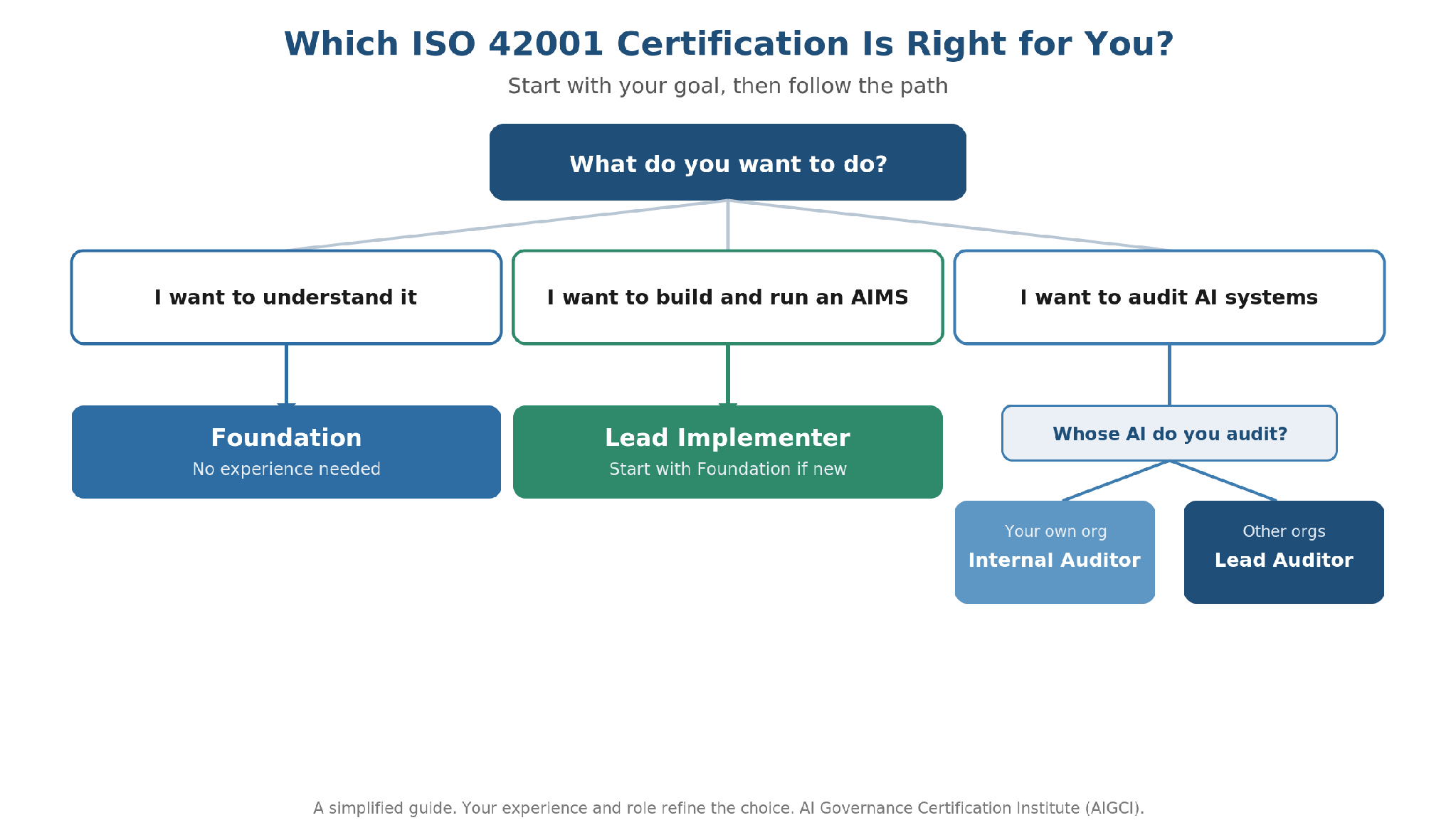
Figure 1. The fastest way to the right certification is to start from what you want to do.
Three questions decide it: your goal, your role and your experience
The selection genuinely depends on three things, in this order of importance. Your goal comes first, because it determines the kind of work the certification prepares you for. Your role comes second, because it shapes which goal is realistic and useful in your context; an auditor and an implementer sit on opposite sides of the same system.
Your experience comes third, because it decides where in a path you can sensibly start, not whether you can start at all.
Notice what is not on that list: seniority for its own sake, or the assumption that more advanced is always better.
A highly experienced compliance leader whose goal is simply to understand AI governance is better served by a Foundation than by a certification built for people who will run audits. Matching the tool to the job beats collecting the biggest tool.
In short, weigh them in this order:
- Goal (decides most). The work you want to be able to do: understand, build, or audit.
- Role (shapes the goal). What is realistic and useful in your job right now.
- Experience (sets the start). Where in the path you begin, not whether you can begin.
Work through those three in order, and the shortlist usually narrows to one. Mapped to the certifications, the goal-to-choice logic looks like this:
|
If your goal is to |
The right certification |
Typical background |
|---|---|---|
|
Understand AI governance and contribute |
Foundation |
Any, including beginners and students |
|
Build and run an AI management system |
Lead Implementer |
Governance, project, GRC, or implementation |
|
Audit your own organization's AIMS |
Internal Auditor |
Internal audit, risk, or compliance |
|
Independently audit and certify others |
Lead Auditor |
Auditing, GRC, or assurance |
Why matching the certification to your goal matters more now
Choosing well is not just tidy; it is increasingly consequential, because AI governance is shifting from a specialism to an expectation. The EU AI Act now requires organizations to ensure their staff have a sufficient level of AI literacy and frameworks such as the NIST AI Risk Management Framework treat governance as a cross-functional responsibility spanning legal, risk, product and engineering rather than one team's job.
In that environment, the wrong certification is not merely a wasted fee; it is a missed chance to match a rising demand with the exact capability an employer needs. The right one, chosen against your goal, is the opposite: a signal that you can do the specific work the market is now asking for.
If your goal is to understand AI governance
Start with the Foundation level. It is the entry point to ISO 42001, with no prerequisites and no technical barrier, and it is the right answer for a surprisingly large group: beginners, students, career changers, and experienced professionals who need fluency rather than implementation skill.
If your job is to sit in AI governance conversations and understand what is being decided, to review a policy, brief a team, or simply know the language, Foundation gives you exactly that grounding. It is also the sensible base for either of the paths below, which is why so many people begin here even when they intend to go further.
If your goal is to build and run an AI management system
Choose Lead Implementer. Where Foundation builds understanding, this level builds the ability to design, implement, and operate an AIMS end to end, the practical work of turning ISO 42001 into a running system. It suits governance leads, project and GRC professionals, and anyone whose organization is actually pursuing certification and needs someone to make it happen.
If you are new to the standard, it is usually wise to reach a Foundation-level understanding first, so the heavier implementation material lands on solid ground rather than guesswork. The two are complementary, not competing.
If your goal is to audit and assure AI systems
Here the choice splits by one question: whose AI will you audit? If you will assess your own organization's AI management system, an Internal Auditor certification fits, developing the first-party audit discipline that prepares an organization for certification.
Our overview of the internal auditor route covers it. If instead you will lead independent, external audits, the kind that result in certification for other organizations, then Lead Auditor is the credential. It is the more advanced and more independent of the two, and it is where the growing field of AI assurance begins.
The distinction matters: an internal auditor checks from inside, while a lead auditor is the external voice whose judgement carries certification weight.
A worked example: one professional, three futures
The goal-first rule is easiest to see through a single person. Picture a compliance manager at a company that has just started adopting AI. Give her three different goals and she needs three different certifications, even though nothing about her background changes.
If her goal is to understand the new rules well enough to advise the business, the Foundation level is the fit. If the company asks her to actually stand up an AI management system, Lead Implementer becomes the answer.
And if she later moves into internal audit to assess that system, an internal auditor certification serves her, with Lead Auditor waiting if she ever crosses into external assurance. Same person, same standard, three genuinely different choices, decided entirely by what she is being asked to do.
That is the whole method in one story: hold the person constant, change the goal, and watch the right certification change with it.
How your experience refines the starting point
Experience rarely changes which certification suits your goal, but it often changes where you begin the journey toward it. Use this as a rough guide rather than a rule, since motivation and study time matter as much as background.
|
Your experience |
Where to start |
Why |
|---|---|---|
|
New to AI and governance |
Foundation |
No prerequisites; builds the base |
|
Strong in governance, risk, or compliance |
Foundation, then Lead Implementer |
The management-system thinking transfers fast |
|
Experienced management-system auditor |
Foundation, then Lead Auditor |
You know auditing; add the AI layer |
|
Already leading AI governance |
Advanced level for your goal |
You may not need the entry step |
What every path shares, and why that lowers the stakes
One reassuring fact sits underneath all of this: every ISO 42001 certification rests on the same standard. Foundation, Lead Implementer, Internal Auditor, and Lead Auditor are different applications of a shared understanding of ISO/IEC 42001:2023, not separate bodies of knowledge. That shared root is why the decision is lower-stakes than it feels.
Whatever you choose first builds understanding the others reuse, so a choice made for today's goal keeps tomorrow's open rather than closing it. You are not picking a lane for life; you are picking the most useful next step, on a foundation that carries forward wherever you go next.
The common wrong turns and how to avoid them
Most poor choices come from ignoring the goal-first rule. Four wrong turns account for nearly all of them:
- Chasing prestige. Picking the most advanced certification because it sounds impressive, when a Lead Auditor credential is close to useless if your job is to implement, not audit.
- Skipping the basics. Bypassing Foundation to save time when the standard is new to you, which costs more time later, since the advanced material assumes it.
- Choosing by title. Picking by job title rather than the actual work; two people with the same title can need very different certifications.
- Treating it as permanent. Assuming the first choice locks you in, when the certifications build on one another.
There is also a quieter mistake, which is treating the decision as permanent. It is not. AI governance careers move, and a certification chosen for today's goal does not lock you out of tomorrow's.
Many people begin with Foundation, add Lead Implementer as their role grows, and later cross into auditing. Choose well for now, and let the path compound.
Frequently asked questions
Which ISO 42001 certification should a beginner take?
Foundation. It has no prerequisites, assumes no technical background, and builds the understanding every other level relies on. Beginners, students, and professionals new to AI governance all start well here, and nobody is too junior for it. It is also a sensible refresher for experienced people who have picked up AI governance informally and want to confirm the fundamentals are solid.
Do I have to take Foundation before Lead Implementer or Lead Auditor?
It is not always mandatory, but it is usually wise if the standard is new to you. The advanced certifications assume you already understand ISO 42001, so a Foundation-level grounding makes them considerably easier.
What is the difference between Lead Implementer and Lead Auditor?
A Lead Implementer builds and runs an AI management system; a Lead Auditor independently audits one. Choose Implementer to create governance and Auditor to assess it. They are different jobs, not different rungs of the same ladder.
Which certification pays best or is most in demand?
Demand is rising across all of them, and the best choice is the one that matches your goal, because a credential you will actually use is worth more than a more advanced one you will not. Fit beats prestige.
Can I change direction later?
Yes. The certifications build on a shared understanding of ISO 42001, so starting with one keeps the others open. Many careers move from understanding to implementing to auditing over time.
Is the Foundation enough on its own?
For many people, yes. If your goal is to understand AI governance and contribute to it rather than build or audit systems, Foundation may be all you need. It becomes a starting point only when your goal grows to include implementing or auditing, at which point the next level builds directly on it.
What if my role does not fit neatly into build, check, or understand?
Many do not, because AI governance is a distributed field. When in doubt, start from the single thing you most need to be able to do next. If that is still unclear, Foundation is the low-risk choice, since it keeps every other path open while you decide.
Choose the certification that fits your goal
Once you know what you want to do, the decision is straightforward, and the path is open in every direction. You can explore AIGCI's ISO 42001 certifications and start at the level that matches your goal today, knowing the others remain within reach as your work evolves.
There is no wrong first step here, only steps that are better or worse matched to what you want to do next. To see how the institute structures its certifications and supports each path, read more about the institute.