Here is the single most useful thing to understand about the ISO 42001 Lead Implementer exam before you sit it: it does not test whether you can remember the standard. It tests whether you can use it.
The exam assesses your ability to plan, build, and run an AI management system based on ISO/IEC 42001:2023, across six competency domains that mirror the real work of implementation. That reframing changes how you should think about it, how you should prepare and why a pass actually means something.
This guide, from the AI Governance Certification Institute (AIGCI), sets out what the exam covers, what to expect on the day and why it is built the way it is and how it maps directly to the job you are being certified to do.
The exam at a glance
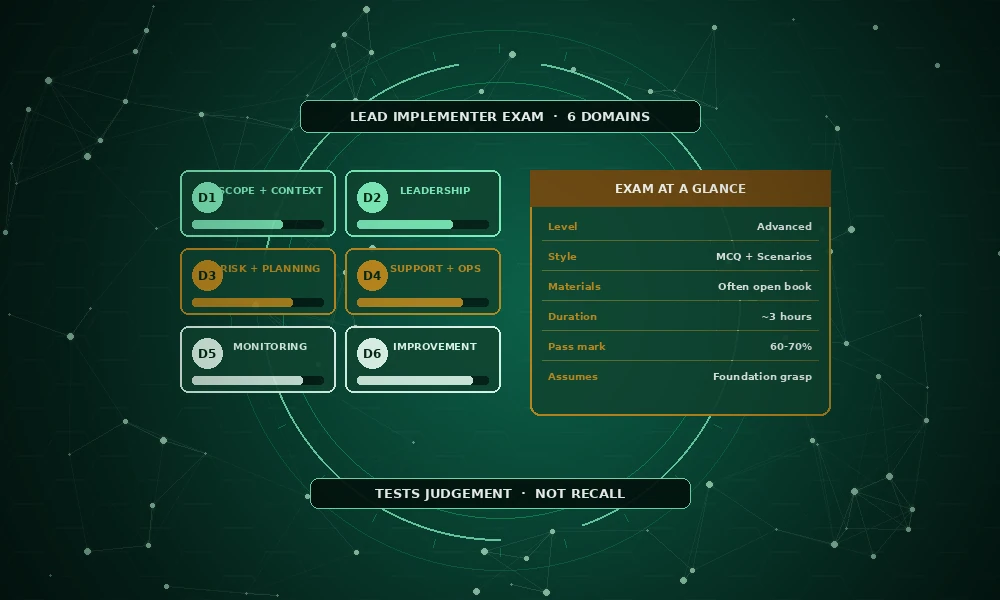
Exact formats vary between providers, so confirm the specifics when you enrol, but the Lead Implementer exam has a consistent shape:
|
Element |
Typical Lead Implementer exam |
|---|---|
|
Level |
Advanced, well beyond Foundation |
|
Question style |
Multiple choice and scenario-based, sometimes with essay-style exercises |
|
Materials |
Often open book, so you can consult the standard |
|
Duration |
Longer than Foundation, up to around three hours |
|
Pass mark |
Commonly in the range of 60 to 70 percent |
|
Assumed knowledge |
A Foundation-level grasp of ISO 42001 |
What the exam actually tests: six competency domains
The exam is built around six competency domains, and they are not random. Read them in order and you will notice they trace the entire lifecycle of implementing an AIMS, from understanding the idea to preparing for a certification audit.
|
Competency domain |
What it assesses |
|---|---|
|
1. AIMS principles and concepts |
Your grasp of responsible AI and what an AI management system is |
|
2. AIMS requirements |
The requirements of ISO/IEC 42001:2023 itself |
|
3. Planning an implementation |
Scoping the AIMS, assessing risk, and planning the work |
|
4. Implementing the AIMS |
Putting policies, roles, controls, and processes in place |
|
5. Monitoring and measurement |
Checking the system works and gathering the evidence |
|
6. Improvement and audit readiness |
Improving the system and preparing it for certification |
The weighting tells its own story. Domains 1 and 2 confirm you understand the standard, but the centre of gravity is Domains 3 to 6: planning, implementing, monitoring, and improving. In other words, most of the exam is about doing, not knowing.
That is the defining feature of this assessment, and the thing most candidates underestimate. Treat the six domains as a checklist of abilities to build, not topics to revise, and your preparation will point in the right direction from the start.
Why the Lead Implementer exam is not just a harder Foundation exam
A common misconception is that this exam is Foundation with more facts to memorise. It is a genuinely different kind of assessment. Foundation asks a simple question: do you understand ISO 42001? Lead Implementer asks a harder one: can you implement it? The first rewards recall; the second rewards judgement.
You will be given situations and asked what a competent implementer would do, which is why the standard being open in front of you does not make the exam easy. Knowing where a requirement lives is not the same as knowing how to apply it.
If you want an honest sense of how hard it is, our dedicated guide covers the difficulty in depth; the short version is that it is demanding precisely because it tests applied competence rather than memory.
How the three ISO 42001 exams differ in kind, not just difficulty
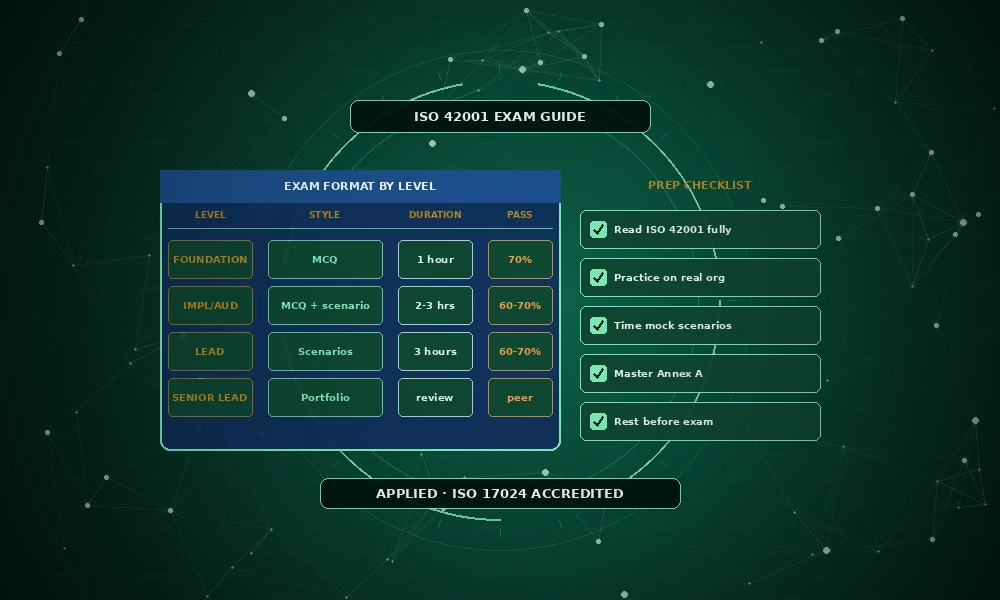
It helps to see where the Lead Implementer exam sits among the three ISO 42001 professional exams. They are not three difficulty settings of the same test; they assess different abilities.
|
Exam |
What it assesses |
Style |
|---|---|---|
|
Foundation |
Understanding of the standard |
Recall, multiple choice |
|
Lead Implementer |
Ability to build and run an AIMS |
Applied, scenario-based |
|
Lead Auditor |
Ability to audit an AIMS independently |
Applied, audit scenarios |
The Lead Implementer exam is the one that asks you to construct, not just to recognise or to inspect. That is why applied practice, rather than re-reading, is what separates a pass from a near miss, and why people who have implemented other management systems often adapt to it quickly.
What to expect on exam day
Walking in knowing the shape of the exam removes most of the anxiety. Expect the following:
- Scenarios, not definitions. Many questions describe a situation and ask what you would do.
- Open book, but time-pressured. You can often consult the standard, yet there is rarely time to look everything up.
- Coverage across all six domains, weighted toward the practical work of planning and implementing.
- Application over recall. Questions reward reasoning about requirements, not reciting them.
The practical implication: prepare by working through implementation problems, not by memorising clause numbers. The exam is trying to find out whether you could actually build an AIMS, so practise thinking like someone who is doing exactly that.
Candidates who arrive having designed a mock AIMS, scoped it, assessed its risks, and planned its controls tend to find the questions familiar rather than daunting.
How the exam mirrors the job you are certified to do
The reason the exam is structured this way is that it is designed to predict competence on the job. A Lead Implementer builds and runs an AI management system, and the six domains are simply that work, broken into stages.
Plan, implement, monitor, improve, and prepare for audit: that is the exam, and it is also the job. Seen this way, the exam is not an obstacle between you and the certification; it is a rehearsal for what the certification says you can do.
Passing it should mean you are genuinely ready, not merely that you crammed effectively, and that alignment is what gives a Lead Implementer credential its weight with employers. It is a rare exam where preparing well and doing the job well are almost the same activity.
That weight is protected, in turn, by international standards for fair, secure assessment such as ISO/IEC 17024, which govern how credible certification exams are run. And the competence matters far beyond the certificate: frameworks such as the EU AI Act and the NIST AI Risk Management Framework expect organizations to have people who can genuinely operationalise AI governance.
That expectation is why demand is real: the IAPP AI Governance Profession Report 2025 finds most organizations do not yet feel they have adequate governance headcount and this exam exists to verify the people who can close that gap.
Common reasons candidates fall short, and how to avoid them
Most near misses on this exam trace back to preparing for the wrong kind of test. The recurring patterns are worth naming:
- Memorising instead of applying. Learning clause numbers rather than practising how to use them under a scenario.
- Relying on open book. Assuming you can look everything up, then running out of time doing exactly that.
- Skipping the implementation domains. Studying concepts hardest when the exam weights planning and doing most.
- Underestimating it. Treating it like a longer Foundation, rather than the advanced, applied exam it is.
The fix for all four is the same: prepare by solving implementation problems, so the exam feels like more of what you have already practised.
How to prepare, in brief
Because the exam rewards application, the most effective preparation is practical. Understand the standard first, then practise applying it to scenarios: how you would scope an AIMS, assess AI risk, choose controls and prepare for an audit.
Reading alone rarely gets people over the line, whereas working through realistic implementation problems does, because it rehearses the exact reasoning the exam is looking for.
For a full study plan, see our preparation guide, and make sure you meet the requirements before you book. A structured course is worth it here, because a good one teaches you to think like an implementer rather than a test-taker.
If you do not pass the first time
Not passing an advanced exam is not the end of the road, and it is more common than people admit for a genuinely applied assessment. Most certification schemes allow a retake, usually with a waiting period and sometimes a reduced fee. The important thing is to treat a fail as feedback about which domains need more applied practice, not as a verdict on your ability.
Our overview of the retake path explains how it typically works, so a first attempt that falls short becomes a second attempt that succeeds. Many strong Lead Implementers passed on a retake and it made them better at the job, because the second round of study was more applied than the first.
For the specific rules, see the exam retake policy and confirm the details with your provider.
What passing the exam gives you
Passing the Lead Implementer exam earns you the credential that says you can build and run an AI management system, the practical heart of AI governance. It is the qualification organizations look for when they need someone to lead a certification project and it opens a clear path toward senior implementation and consulting roles.
For the complete picture of the certification, its value, and where it leads, read the full guide. The exam is the gate; the credential is what waits on the other side. Because the assessment is applied, employers can read a pass as a signal that you can actually do the work, not just that you sat a course, which is precisely why the credential carries weight in hiring and in winning certification projects.
Frequently asked questions
Is the ISO 42001 Lead Implementer exam open book?
Often, yes. Many providers run it as an open-book, scenario-based exam, so you can consult the standard. That does not make it easy, because the questions test how you apply requirements under time pressure, not whether you can find them.
How many questions is the Lead Implementer exam?
It varies by provider, commonly ranging from around 40 to 80 or more questions, often mixing multiple choice with scenario-based items and sometimes essay-style exercises. Confirm the exact format with your certification body, since the number and mix of questions is one of the details that changes most between providers.
What is the pass mark?
Usually somewhere between 60 and 70 percent, depending on the provider. Because the exam is applied, reaching the pass mark depends more on understanding how to implement than on memorising facts.
Do I need Foundation before the Lead Implementer exam?
It is strongly recommended even where it is not strictly required, because the Lead Implementer exam assumes you already understand ISO 42001. Starting from a Foundation-level grasp makes the applied material far more manageable, whereas skipping it usually means learning the fundamentals and their application at the same time.
How should I prepare for the applied questions?
Practise applying the standard to realistic scenarios rather than re-reading it. Work through how you would scope, plan, implement, and audit an AIMS. That is what the exam tests, so that is what your preparation should rehearse.
How long should I study for the Lead Implementer exam?
It depends on your background, but plan for weeks rather than days if the standard is new to you, and focus that time on applied practice rather than reading. Professionals with governance or management-system experience often need less, because the way of working is already familiar.
Is the exam the same everywhere?
The competency domains are consistent, because they follow ISO/IEC 42001:2023, but the exact format, length, and pass mark vary by certification body. Always confirm the specifics with your provider before you book.
Prepare to pass and to perform
The best way to pass an applied exam is to learn the way it assesses: by doing. AIGCI's Lead Implementer training is built around implementing an AI management system, not memorising it, so you prepare for the exam and the job at the same time. To see how the institute structures its certifications and supports candidates, read more about the institute.