Ask what the ISO 42001 Lead Implementer certification costs and you will get a price range. Useful, but incomplete, because the fee on the checkout page is only part of what you actually spend.
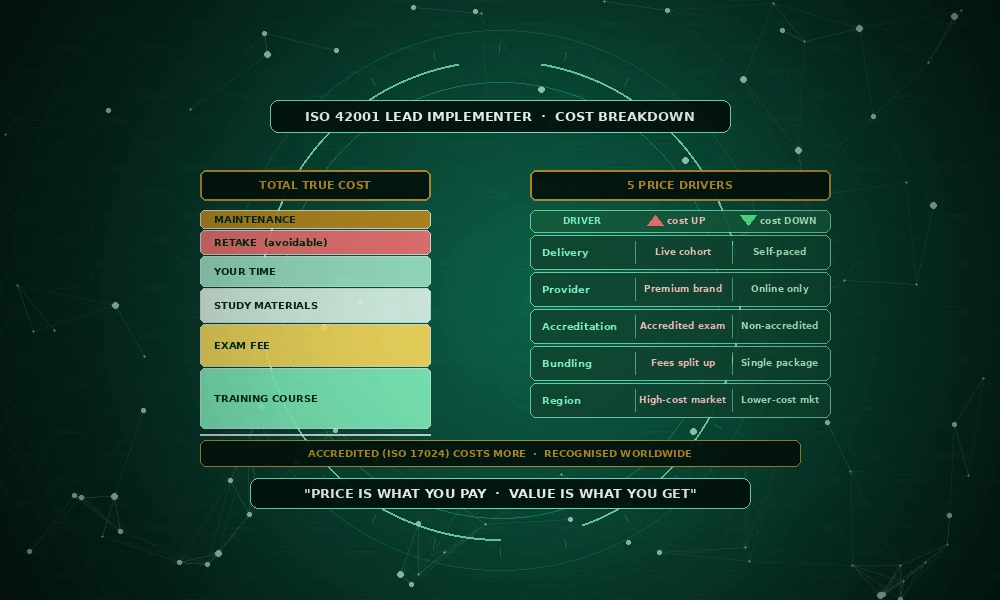
The real cost is the sum of the course, the exam, your time, the risk of a retake and a small ongoing amount to stay current and understanding that full picture is what stops a certification from costing more than you expected.
This guide, from the AI Governance Certification Institute (AIGCI), breaks the cost down honestly: what you pay for, what moves the price, where the hidden costs hide and how to spend less without buying a credential that is not worth holding. It is based on the certification for ISO/IEC 42001:2023, the AI management system standard the Lead Implementer credential is built on.
The cost of the ISO 42001 Lead Implementer certification is the total of the training course, the exam fee, your study time, any retake and ongoing maintenance and it varies mainly with delivery mode, provider, accreditation and region.
|
"Price is what you pay; value is what you get." Warren Buffett, 2008 Berkshire Hathaway letter, quoting Benjamin Graham |
Buffett's line, borrowed from his mentor, is the right frame for this page. What follows is entirely about price: what the certification costs and how to pay less. Whether that price is worth it, the value side of the ledger, is a separate question and we point you to it at the end.
Keeping the two apart is how you avoid both overpaying and, just as costly, underspending on a credential that will not be recognised.
What you are actually paying for
The Lead Implementer cost is not one number; it is a small stack of them. Seeing the whole stack is the first step to controlling it.
|
Cost component |
What it is |
Notes |
|---|---|---|
|
Training course |
The instruction that prepares you |
Usually the largest single item |
|
Exam fee |
The assessment that earns the credential |
Often bundled with the course |
|
Study materials |
Books, practice questions, or labs |
Frequently included in a package |
|
Your time |
Days of study plus the exam |
The cost people forget most |
|
Retake fee |
A second attempt if you do not pass |
Avoidable with good preparation |
|
Maintenance |
Renewal or continuing development |
Small, but ongoing over the years |
As a rough orientation rather than a quote, the visible fees, course plus exam, commonly land somewhere from the low hundreds to a couple of thousand in major currencies, depending heavily on the choices in the next section.
Always confirm the current figure with your provider, because prices change and vary by market. What matters more than the headline number is understanding which of these components you are being charged for and which are bundled, so you can compare like with like rather than being misled by a low headline that leaves the exam or materials out.
What drives the price up or down
Two people can pay very different amounts for the same credential, because a handful of factors move the price in each direction.
Here is what pushes it which way:
|
Factor |
Pushes cost up |
Pushes cost down |
|---|---|---|
|
Delivery mode |
Live, instructor-led training |
Self-paced online study |
|
Provider |
Premium brand or in-person cohort |
Established online provider |
|
Accreditation |
Accredited, exam-based certification |
Non-accredited, lower recognition |
|
Bundling |
Course, exam, materials bought separately |
A single bundled package |
|
Region and currency |
High-cost markets |
Lower-cost markets or online delivery |
One of these deserves a note, because it is where cost and value meet. A certification accredited to ISO/IEC 17024, the international standard for certifying people, usually costs more than an unaccredited alternative, because it involves a properly designed, independently overseen exam.
That extra cost is not waste; it is what makes the credential recognised. Bodies such as ANAB accredit personnel-certification schemes precisely so that a certificate means the same thing everywhere and that recognition is accepted internationally.
Paying less for a certificate that no employer trusts is the most expensive saving there is.
How the Lead Implementer cost sits among the levels
If you are weighing which certification to fund, it helps to see roughly where Lead Implementer sits on the price scale relative to the other professional levels.
The pattern is consistent, even though exact figures vary:
|
Certification |
Relative cost |
Why |
|---|---|---|
|
Foundation |
Lowest |
Short, introductory, a shorter exam |
|
Lead Implementer |
Higher |
A longer course and an advanced, applied exam |
|
Lead Auditor |
Similar to or above Lead Implementer |
Advanced audit competence and assessment |
The Lead Implementer is not the cheapest option, and it should not be, because it develops the ability to build and run a management system rather than simply to understand one.
If budget is the only constraint, Foundation is the lower-cost entry point; if capability is the goal, Lead Implementer is priced for what it delivers, and the gap between them buys a genuinely different level of capability.
The hidden costs people forget to count
The fees are easy to see. The costs that catch people out are the ones that do not appear on an invoice:
-
Your time. Days of study have a real value, especially if they come out of working hours or evenings.
-
The retake risk. An advanced exam has a genuine fail rate, and a second attempt means a second fee and more time.
-
Maintenance. Keeping a professional certification current can carry a periodic renewal or continuing-development cost.
-
Opportunity cost. The slower or cheaper route can cost more overall if it delays a role or a project that the credential would unlock.
None of these is a reason not to certify. They are reasons to budget for the whole thing, so the total does not surprise you halfway through.
A credential you planned and paid for calmly is worth more to you than the same credential bought in a scramble of unexpected fees.
Budget the whole thing: a simple worked example
The easiest way to avoid a nasty surprise is to build the budget once, from all the parts.
A realistic method looks like this:
Start with the course-and-exam bundle as your base figure. Add a modest allowance for study materials if they are not already included. Then take the step most people skip and put a value on your time: if you expect to spend, say, five to ten days preparing, that time has a real cost even when no money changes hands.
Finally, set aside a small retake buffer, not because you plan to fail, but because budgeting for it removes the pressure that can cause one.
Add those four together and you have the true cost of the certification, which is almost always higher than the sticker price and far easier to plan for once it is written down. Do this before you enrol and the number you commit to is the number you actually pay.
Cost is not the same as value and this page is only about cost
It is tempting to jump straight from a price to a judgement about whether it is worth it, but those are different questions with different answers. The cost is what you can see on this page. The value, the salary uplift, the roles it opens, the projects it lets you lead, depends on your situation and is genuinely a separate calculation. We keep them apart deliberately, so neither distorts the other.
If you want the value side, our analysis of whether it is worth it weighs the return and our guide to what you can earn looks at the salary picture. Read this page to understand the price; read those to decide if the price is right for you.
How to reduce the cost without cutting corners
There is a real difference between spending less and buying a worse credential. These moves lower the cost while keeping what you are paying for:
- Choose self-paced online over live instructor-led training if you have the discipline to study alone.
- Buy a bundle that includes the exam and materials, rather than paying for each separately.
- Prepare properly, because passing first time avoids the single most wasteful cost, a retake.
- Build a Foundation-level base first, so the advanced material lands on solid ground and the exam goes smoothly.
- Ask your employer, since many will sponsor a governance certification that benefits the organization directly.
What you should not do to save money is drop accreditation. A cheaper, unaccredited certificate can look identical on a wall and mean nothing in a hiring conversation, which turns the saving into a loss, because the point of certifying is to be believed by someone else.
Individual cost versus organizational cost
One more distinction prevents a common confusion. The cost on this page is the cost to an individual of earning the Lead Implementer credential. It is entirely separate from what it costs an organization to get its AI management system certified, which involves auditor fees, certification-body charges and internal effort on a different scale.
If you are pricing the organizational route rather than the personal one, our guide to overall certification cost covers it. The two often get muddled in the same search, so it is worth being clear which one you are budgeting for.
What the cost actually buys
For all the breakdown, it helps to remember what sits at the end of the spend: a recognised credential that says you can build and run an AI management system, the practical core of AI governance. That is what the course, the exam and the time are for. For the complete picture of the certification itself, what it develops and where it leads, read the complete guide.
Understanding the cost is simply making sure you pay for that outcome deliberately, rather than discovering the full price after you have started, when it is too late to plan for it.
Frequently asked questions
How much does the ISO 42001 Lead Implementer certification cost?
There is no single price, because it depends on the provider, the delivery mode, whether the exam is bundled, and your region. The visible fees for course and exam commonly range from the low hundreds to a couple of thousand, but always confirm the current figure with your chosen provider.
Is the exam included in the course price?
Often, but not always. Many providers bundle the exam with the training, while some charge separately. Check what is included before you compare prices, since a lower course fee can hide a separate exam fee.
Are there ongoing costs after I certify?
There can be. Professional certifications are frequently maintained through renewal or continuing professional development, which may carry a periodic cost. Confirm the maintenance requirements with your issuing body when you certify.
Is a cheaper, unaccredited certification a good way to save?
Usually not. An unaccredited certificate may cost less but carries far less recognition, which can make it a poor investment. The accreditation you pay a little more for is what gives the credential weight with employers.
Will my employer pay for it?
Often, yes, especially where AI governance is becoming a business need. Many organizations sponsor the Lead Implementer certification because the skills benefit the company directly. It is worth asking before you pay personally, and framing it around the value to the organization rather than to you tends to help.
Does the cost differ by country?
Yes. Prices vary with local markets and currencies, and online delivery can flatten some of that difference. Someone in a high-cost market may pay noticeably more for the same credential than someone who studies online with a provider based elsewhere, so it is worth comparing delivery options as well as providers.
Pay for the outcome, not just the exam
The smartest spend on any certification is the one that gets you a credential you will actually use and that others will actually recognise. AIGCI's Lead Implementer certification is designed to give you that outcome, so what you pay goes toward genuine, recognised capability rather than a certificate that stops at your own wall.
To see how the institute structures its certifications, read more about the institute