Let us start with an honest answer that most salary pages avoid: there is no single ISO 42001 Lead Implementer salary, because Lead Implementer is a certification, not a job title. What it pays is really what the roles it qualifies you for pay.
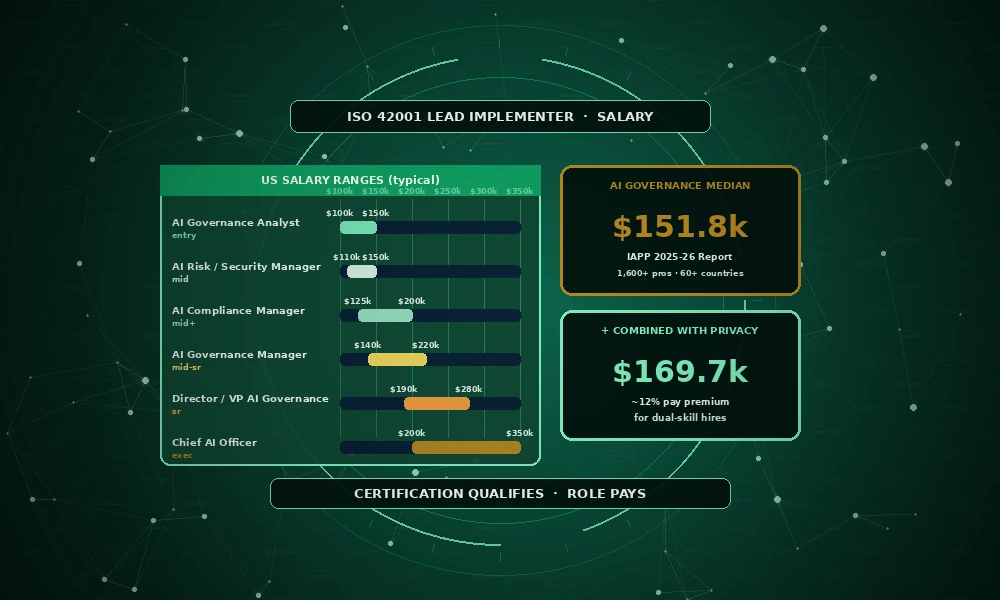
The good news is that those roles pay well. The IAPP Salary and Jobs Report 2025-26, based on more than 1,600 professionals across over 60 countries, puts the median AI governance salary at around 151,800 US dollars, rising to about 169,700 for those who combine AI governance with privacy work.
This guide, from the AI Governance Certification Institute (AIGCI), maps the credential to the roles it opens, shows what those roles actually pay and explains the factors that move the number, so you can read a salary figure with the context it needs.
The ISO 42001 Lead Implementer certification qualifies you for AI governance roles whose median pay sits around 150,000 US dollars and climbs well beyond 200,000 at senior levels, with the exact figure driven by seniority, sector, region and specialisation.
Why there is no single Lead Implementer salary
A certification does not carry a salary; a role does. The Lead Implementer credential says you can build and run an AI management system to ISO/IEC 42001:2023 and that capability is valued across a spread of jobs that pay very differently.
An AI governance analyst early in their career and a director of AI governance both draw on the same underlying skill, but their pay is worlds apart. So the useful question is not what does a Lead Implementer earn, but which roles does it qualify me for and what do those roles pay.
Answer that, and a salary figure stops being a mystery and becomes a map, one you can actually use to plan a career rather than just to satisfy curiosity.
Mapped to the market, the credential opens a ladder of roles, each with its own pay band.
What the roles a Lead Implementer targets actually pay
The figures below are typical United States ranges drawn from current market data on salary aggregators such as ZipRecruiter and Glassdoor. Treat them as estimates rather than guarantees; pay varies widely by employer, location and the rest of your experience and the same job title can sit at very different points in two different companies.
|
Role the credential supports |
Typical US range |
Level |
|---|---|---|
|
AI governance analyst |
About 100k to 150k |
Entry to mid |
|
AI risk or security manager |
About 110k to 150k |
Mid |
|
AI compliance manager |
About 125k to 200k |
Mid to senior |
|
AI governance manager |
About 140k to 170k and up |
Mid to senior |
|
Director or VP of AI governance |
About 190k to 280k |
Senior |
|
Chief AI Officer |
About 200k to 350k and up |
Executive |
Two things stand out. First, the range is enormous, which is why a single headline number is misleading. Second, the credential does not place you on this ladder by itself; it qualifies you to compete for a rung, and your experience decides which one.
That is why two Lead Implementers can earn very different salaries: the certificate is the same, but the role, the sector, and the years behind it are not.
How to read a salary range in a job posting
A range in a job advert is not a lottery; it is a map of the role's seniority, and reading it well changes what you can ask for. A few rules help:
- The bottom is the minimum-meets. It is usually what an employer pays someone who just clears the bar for the role.
- The top is reserved for the exceeds. Reaching it means demonstrating more than the posting asks, which is where a credential and evidence help.
- Check base versus total. In senior AI governance roles, bonus and equity can add materially, so a base-only figure understates the real number.
- Weigh the whole package. Remote flexibility, training budgets, and progression can be worth more than a few thousand on base.
Read this way, a Lead Implementer credential is an argument for the upper half of a band, because it evidences exactly the capability the posting is paying for.
What moves the number and by how much
Five factors explain most of the variation in AI governance pay. Some of them are large enough to change your salary by tens of thousands.
-
Seniority. The single biggest lever, taking you from analyst pay to director or executive pay over a career.
Specialisation. Blending AI governance with privacy is unusually well paid: the IAPP report finds a median of about 169,700 for that combination against 151,800 for AI governance alone.
- Sector. Technology pays the most, with IAPP reporting the highest medians for governance roles in tech, well above other industries.
- Region and currency. A US or Western European salary looks very different from the same role elsewhere, and remote roles can blur the line.
Certification. Credentials correlate with higher pay. The IAPP found that holding one professional certification aligns with around 13 percent higher pay and holding several with roughly 27 percent, evidence that a recognised credential such as the Lead Implementer tends to pay for itself.
Does the certification itself raise your salary?
This deserves a straight answer, because it is the question behind the question. A certificate does not automatically add a fixed sum to your salary. What it does is qualify you for higher-paying roles and signal capability to employers and the market data shows certified professionals earning materially more than uncertified peers.
So the honest framing is causal but indirect: the Lead Implementer credential does not set your pay, it improves your access to the roles that pay well and your standing when you compete for them.
Treat any promise of a specific salary bump from a certificate with caution; treat the credential as a door-opener, which is what the evidence supports.
How to turn the credential into a stronger salary conversation
Because the credential opens doors rather than setting a number, most of its salary value is realised in how you use it. A few moves make the difference:
- Lead with capability, not the certificate. Employers pay for what you can do; use the credential as proof of it, not as the argument itself.
- Bring the market data. Anchoring a conversation with credible ranges, as on this page, is more persuasive than a gut figure.
- Negotiate on total compensation. Especially at senior levels, where bonus and equity are where the real movement is.
- Point to the scarcity. Qualified AI governance people are in short supply, and a recognised credential signals you are one of the few who can do the work now.
Handled this way, the certification is not a line on a CV; it is leverage in a conversation and that is where its salary impact actually shows up.
How pay grows across an AI governance career
Because seniority is the biggest driver, it helps to see the trajectory rather than a single point. A typical path moves through four stages, and pay roughly doubles from the bottom to the top of it.
|
Stage |
Typical roles |
Where pay sits |
|---|---|---|
|
Early career |
AI governance analyst |
Lower six figures |
|
Mid career |
AI governance or compliance manager |
Solid six figures |
|
Senior |
Director or VP of AI governance |
High six figures |
|
Executive |
Chief AI Officer |
Well into the mid six figures and beyond |
The Lead Implementer credential is most valuable at the first two stages, where it helps you enter the field and establish credibility quickly; from there, seniority, delivery and reputation carry you the rest of the way, and the certificate matters less than the track record you build.
For a fuller view of that journey and of the specific jobs available to a Lead Implementer, our dedicated pages go deeper and the roles it opens hub maps the wider field.
Why AI governance pay sits where it does
It is worth understanding why these numbers are what they are, because it tells you whether they will hold. AI governance pay is high for a simple reason: demand has outrun supply.
Organizations are adopting AI far faster than they can find people who can govern it responsibly, and a role that did not exist a few years ago now sits on the critical path for shipping AI safely.
The IAPP Salary and Jobs Report 2025-26 was the largest of its kind, reflecting how quickly this profession is forming and scarcity of qualified people is exactly what keeps compensation elevated.
For a Lead Implementer, that scarcity is the opportunity: the credential marks you as one of the relatively few people who can do the work an expanding market urgently needs.
Reading salary against cost and return
A salary figure only means something next to what it took to reach it. The certification is a modest, one-time cost against a role that pays six figures, which is why the return question usually answers itself, but it is worth doing deliberately rather than assuming.
We keep those calculations on their own pages so this one can stay focused on pay: see what the credential costs on our guide to what it costs and the fuller return analysis in whether it is worth it
For salary benchmarks across the whole field rather than the Lead Implementer specifically, the wider salary picture sets the context.
Read together, they turn a salary number into a decision rather than a daydream, which is the point of looking at pay in the first place.
Frequently asked questions
How much does an ISO 42001 Lead Implementer earn?
There is no single figure, because pay depends on the role you hold. The AI governance roles the credential qualifies you for have a median around 150,000 US dollars, ranging from roughly 100,000 for early-career analysts to well over 200,000 for senior and executive roles.
Does the certification guarantee a higher salary?
No. It qualifies you for higher-paying roles and signals capability, and certified professionals do tend to earn more, but no credential adds a fixed amount to your pay by itself. Treat it as a door-opener rather than an automatic raise.
Which specialisation pays the most?
Blending AI governance with data privacy is notably well paid, with a median around 169,700 US dollars against about 151,800 for AI governance alone, according to IAPP. The technology sector also pays governance roles more than most other industries.
Do salaries differ a lot by country?
Yes, substantially. The figures here are US market estimates; pay in other regions can be markedly higher or lower for the same role. Remote and international roles are increasingly common, which can shift the picture.
Is the Lead Implementer or the Lead Auditor better paid?
They lead to different roles rather than a simple pay difference, so it depends on the jobs each opens in your market. Choose the one that matches the work you want to do, and let the salary follow the role rather than the title. Chasing the higher-paid label into work you dislike is a false economy.
Will AI governance salaries stay this high?
As long as demand for qualified people outpaces supply, pay is likely to stay strong. Salaries may normalise as the profession matures and more people qualify, which is another reason to enter while the scarcity premium is still in your favour.
Earn the credential that opens the roles
If the pay bands above are where you want to be, the credential is the entry ticket to compete for them. AIGCI's Lead Implementer certification builds the recognised, applied capability that AI governance employers are paying for, so the money you invest points toward the roles that pay it back many times over.
For the complete picture of the certification and where it leads, read the full guide, or learn more about the institute