If you search job boards for the exact phrase Lead Implementer, you will find surprisingly little and conclude the market is thin. It is not. The demand for people who can implement ISO/IEC 42001:2023, the AI management system standard commonly called ISO 42001, is booming; the jobs simply wear other names.
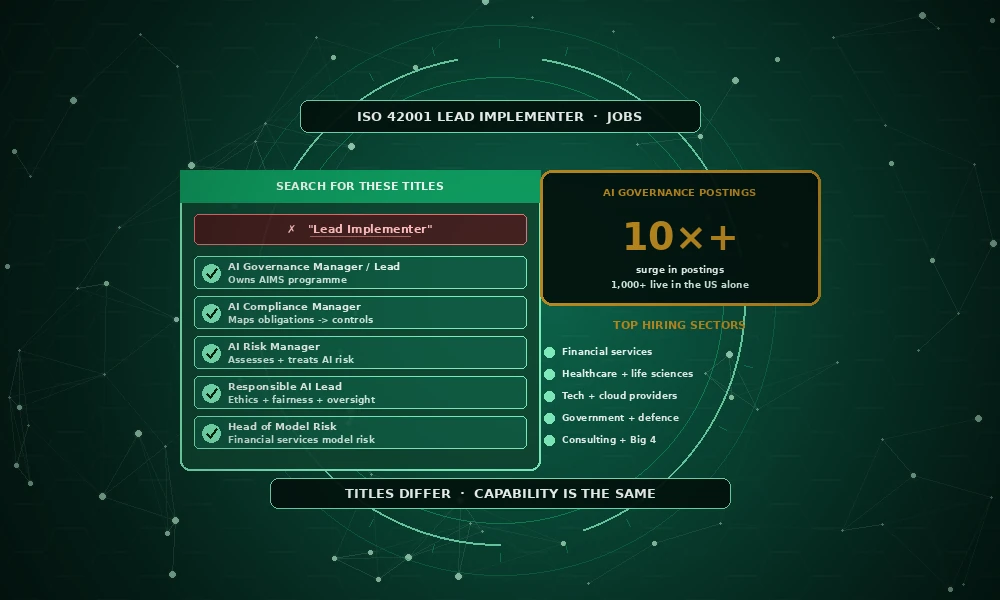
Market analyses report that AI governance postings have surged more than tenfold as organizations race to meet regulatory deadlines, with well over a thousand open AI governance roles visible on LinkedIn in the United States alone.
The catch and the opportunity, is that almost none of them are titled Lead Implementer. This guide, from the AI Governance Certification Institute (AIGCI), shows you the roles the credential actually opens, what employers ask for, where the jobs are and how to find and win them.
An ISO/IEC 42001:2023 Lead Implementer qualifies for a spread of AI governance jobs, rarely titled Lead Implementer, across roles such as AI governance manager, AI compliance manager and responsible AI lead, concentrated in a handful of hiring sectors.
|
"In the fields of observation, chance favours only the prepared mind." Louis Pasteur, lecture at the University of Lille, 1854 |
Pasteur was talking about scientific discovery, but the line fits a fast-moving job market perfectly. The opportunities in AI governance are appearing quickly and often quietly, under titles that do not announce themselves. The credential and the skills behind it are the preparation that lets you recognise a role you are qualified for and win it, when someone less prepared would scroll past it as a mismatch.
Why the jobs rarely say Lead Implementer
A Lead Implementer certificate proves a capability and employers hire for the capability under whatever title fits their org chart. A company that needs someone to build and run its AI management system will advertise for an AI governance manager, an AI compliance lead or a responsible AI specialist, not for a Lead Implementer.
The certification is the qualification; the job title is the packaging. Two employers with the identical need will advertise it with two different titles, which is exactly why title-based searching fails. This is why searching for the credential name is the wrong strategy and why so many qualified people believe the market is smaller than it is.
Learn to recognise the roles that need what you can do and a market that looked quiet turns out to be one of the busiest corners of the hiring landscape.
The job titles a Lead Implementer should search for
These are the titles that most often want exactly what the credential develops. Search for these, not for Lead Implementer.
|
Title to search |
What the role does |
Where it sits |
|---|---|---|
|
AI governance manager or lead |
Owns and runs the AI governance programme |
A governance, risk or dedicated AI function |
|
AI compliance manager |
Maps AI obligations to controls and evidence |
Compliance or legal |
|
AI risk manager |
Identifies, assesses and treats AI risk |
Risk or GRC |
|
Responsible AI lead |
Drives responsible-AI practice into delivery |
Product, data or ethics |
|
AI governance analyst |
Runs day-to-day AI management activities |
Governance or GRC, often entry level |
|
AI management consultant |
Builds AI management systems for clients |
Consulting or advisory |
The point here is recognition: any of these postings may be a Lead Implementer job in disguise.
What employers actually ask for
Read enough of these postings and a consistent shopping list emerges. Most ask for a blend of governance knowledge and practical exposure:
- Framework fluency. Familiarity with ISO/IEC 42001, the NIST AI Risk Management Framework, and the EU AI Act, often alongside data-protection law.
- Risk and compliance experience. A track record of turning obligations into controls and evidence.
- Some technical exposure. Comfort around data, AI systems, and sometimes tooling, without needing to build models.
- Stakeholder skills. The ability to work across legal, product, and engineering, and to explain risk to leadership.
One finding is worth dwelling on. In an analysis of AI governance job postings, only about 12 percent explicitly required a specific certification. That does not make the Lead Implementer credential pointless, quite the opposite: it means the credential rarely gets you screened out and it signals capability in a field where employers are still working out what to ask for.
It qualifies you and it reassures a hiring manager, but the skills it represents are what actually win the role, which is why the strongest candidates lead with capability and treat the certificate as evidence of it.
How to spot a Lead Implementer job hiding in a posting
Because the title will not tell you, the description has to. A few phrases are reliable tells that a posting is really asking for someone who can implement an AI management system, whatever it is called at the top of the page.
|
If a posting says something like this |
It is very likely a Lead Implementer role |
|---|---|
|
Implement and maintain our AI governance framework |
Building and running an AIMS is the core job |
|
Ensure AI compliance with ISO 42001 or the EU AI Act |
Mapping obligations to controls and evidence |
|
Develop AI policies, risk assessments, and controls |
The practical implementation work you are trained for |
|
Prepare the organization for AI certification or audit |
Getting an AIMS ready, which is exactly the credential |
When you see language like this, do not be put off by an unfamiliar job title. Read the responsibilities against what a Lead Implementer does, and if they match, you are qualified regardless of what the role is named.
Where the jobs are: the sectors hiring most
AI governance hiring is not spread evenly. It clusters where AI risk is highest and regulation bites hardest, which is being sharpened further by the EU AI Act. A handful of sectors generate most of the roles:
|
Sector |
Why it hires AI governance people |
|---|---|
|
Financial services |
Heavy regulation and high-stakes automated decisions |
|
Technology |
Building AI into products and answering customer governance demands |
|
Government and public sector |
Deploying AI under public scrutiny and new law |
|
Consulting and advisory |
Building AI assurance practices to sell to everyone else |
|
Healthcare and life sciences |
Safety-critical AI and strict oversight |
If you are open about sector, these are where the volume is. If you have domain experience in one of them, that combination, sector knowledge plus AI governance capability, is unusually valuable, because employers rarely find both in one person, and they pay attention when they do.
A former banker who can govern AI or a clinician who understands AIMS, is often more compelling than a pure specialist in either.
Where and how to find the roles
Once you know the titles, finding the jobs is mostly about looking in the right places with the right search terms:
- Search LinkedIn by role, not by credential. Use the titles above on LinkedIn jobs, and set alerts, since new postings appear constantly.
- Use specialist boards. GRC and AI governance job boards surface roles that generic sites bury.
- Look inside first. The fastest route is often an internal move; the AI project your employer is nervous about may be your opening, and volunteering for it turns a job search into a promotion.
- Follow the consultancies. Firms building AI assurance practices hire in waves and value certified people.
Do not wait for the perfect Lead Implementer posting; it may never come. Apply for the roles that describe the work and let your credential and skills make the case; the candidate who waits for a posting that names the certification is usually beaten to it by someone who recognised the role without one.
Remote, hybrid and where in the world the roles are
Two more practical facts widen the field. First, a large share of these roles are remote or hybrid, because AI governance is knowledge work that does not require a lab or a factory floor, which means a role advertised in one city may be open to you from another.
Second, demand is genuinely global: while the United States and the European Union lead the volume, the pressure to govern AI is spreading everywhere the technology is being adopted and organizations in many markets are hiring their first AI governance people right now.
If you are willing to work remotely or you hold relevant local-language and regulatory knowledge, the pool of roles you can realistically reach is larger than a single-city search suggests.
How to position yourself for these roles
Getting shortlisted is less about the certificate on your CV and more about how you present the capability behind it.
Three moves help most. First, translate the credential into outcomes: instead of listing Lead Implementer, describe that you can scope, build and run an AI management system, in the language the posting uses.
Second, pair it with proof: a project, a mock implementation or a governance improvement you drove, even a small one, so the claim is evidenced rather than asserted.
Third, close the gaps employers name, particularly the frameworks and the risk-and-compliance mindset, so your application reads like a match rather than an aspiration. Done well, the credential stops being a line item and becomes the headline of a coherent story about what you can do.
Jobs, pay and progression are three different questions
This page is about the jobs themselves: what they are called, who hires and how to find them. Two related questions live elsewhere, deliberately. What these roles pay is covered in our look at the salary range and how they connect into a longer trajectory is mapped in the governance roles hub and in our guide to the career path.
Keeping them separate means each answer stays clear, rather than blurring into a single overwhelming page and it lets you read only the part you need right now.
Frequently asked questions
Are there real jobs for an ISO 42001 Lead Implementer?
Yes, and the market is growing fast, but they are rarely titled Lead Implementer. They appear as AI governance manager, AI compliance manager, responsible AI lead, and similar roles, so you have to search by the work rather than the credential name.
Do employers require the Lead Implementer certification?
Usually not explicitly. Analyses suggest only around one in eight AI governance postings names a specific certification. The credential helps you qualify and signals capability, but the skills behind it are what employers hire for.
Which industries hire the most?
Financial services, technology, government, consulting, and healthcare generate most AI governance roles, because that is where AI risk and regulation concentrate. Domain experience in one of these plus governance capability is a strong combination.
Do I need a technical background to get these jobs?
Not usually. Employers value governance, risk, and compliance capability plus enough technical fluency to work with AI teams. Building models is rarely required for these roles, though being comfortable talking to the people who do build them is a real advantage.
What is the fastest way into an AI governance job?
Often an internal move. If your current employer is adopting AI, volunteering for the governance work is frequently quicker than applying externally, and it builds the evidence that makes external applications succeed later.
Can I get one of these jobs as a career changer?
Yes, and many people do. Governance, risk, compliance, legal, and analytical backgrounds transfer well, because the work is about managing AI responsibly rather than building it. The credential plus a transferable background and some applied evidence is a realistic route in from an adjacent field.
Qualify for the roles the market is filling now
The jobs are there, under many names, and the people who can do the work are scarce.
AIGCI's Lead Implementer certification builds the recognised, applied capability those roles are advertised for, so you can apply as a match rather than a hopeful and recognise the right roles before your competition does.
For the complete picture of the certification and where it leads, read the full guide or learn more about the institute.