Ask where a Lead Implementer certification leads and most answers draw a straight line upward, as if a career were a ladder with one direction. The reality is more interesting and more forgiving.
The credential in ISO/IEC 42001:2023, the AI management system standard commonly called ISO 42001, is a strong starting point for a career that can climb, widen and change direction over time.
AI governance is a young field being built by people arriving from many places, which means the path has more room to move than an established profession does.
This guide, from the AI Governance Certification Institute (AIGCI), maps that path honestly: the stages you pass through, the directions you can grow, where the credential fits and how to reach the top.
An ISO/IEC 42001:2023 Lead Implementer career progresses through stages from early practitioner to leadership and branches into specialist, management and consulting directions, rather than following a single fixed ladder.
|
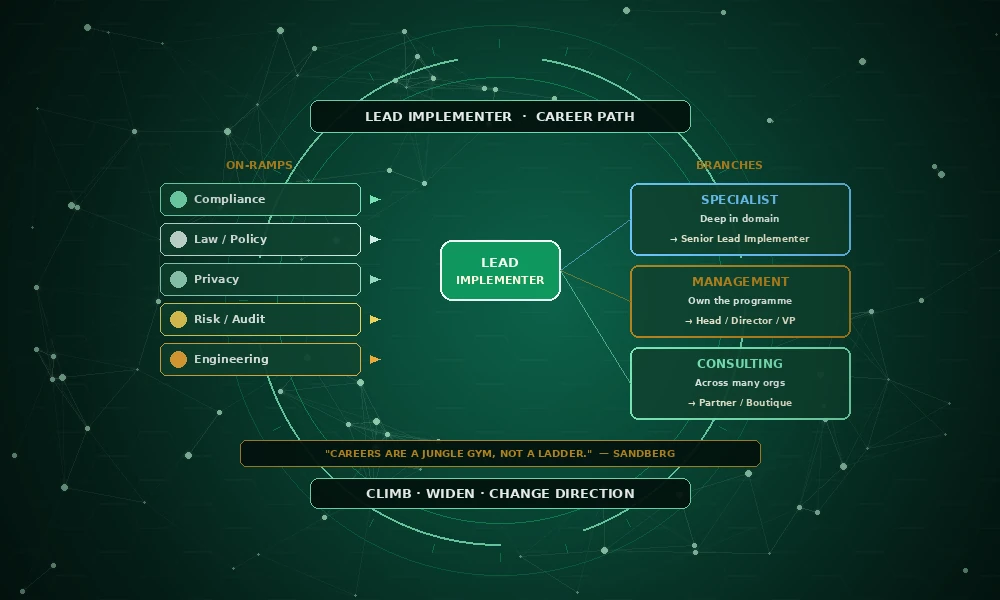
"Careers are a jungle gym, not a ladder." Sheryl Sandberg, Lean In (2013), crediting Fortune editor Pattie Sellers |
Sandberg's image, borrowed from Pattie Sellers, is the right one for AI governance. On a ladder there is only up and someone above you blocks the way. On a jungle gym you can climb, but you can also move sideways to a better hold or diagonally toward an opening others cannot see.
In a field this new, that mobility is the whole advantage and the Lead Implementer credential is a good place to grab on.
Why the path is a jungle gym, not a ladder
A traditional profession has a fixed ladder because the roles above you already exist and are well defined. AI governance does not; many of its senior roles are being invented right now and people are moving into them from compliance, law, privacy, audit and engineering. That means two things for you.
First, there is no single correct route, so a lateral move that builds a new skill can be worth more than a rung climbed.
Second, the people who advance fastest are those who keep their vision peripheral, as Sellers put it, watching for openings and swinging toward them.
The stages below are real, but treat them as holds on a frame you can move around, not steps you must take in a fixed order. Two people can reach the same senior role having climbed the frame in completely different sequences.
The many on-ramps onto the path
One reason the field is so open is that there is no single door into it. People arrive from a range of adjacent disciplines and each brings something that transfers directly. Recognising your own on-ramp is the first step to using it.
|
You come from |
What transfers |
A natural first step |
|---|---|---|
|
Compliance |
Turning rules into controls and evidence |
AI compliance or governance analyst |
|
Law or policy |
Interpreting regulation into requirements |
AI governance or policy roles |
|
Privacy |
Impact assessment and data governance |
AI and privacy governance |
|
Audit or risk |
Assurance discipline and risk thinking |
Internal auditor or governance analyst |
|
IT or engineering |
Understanding how AI systems work |
Technical AI governance |
Whatever your starting point, the Lead Implementer credential does the same job: it converts existing strength into a recognised qualification for AI governance, so your on-ramp becomes a genuine entry rather than a hopeful pivot.
The stages of an AI governance career
Careers in the field tend to organise into broad tiers, defined less by a title than by what you are trusted to own. The years are typical rather than fixed and move faster for those who arrive with adjacent experience.
|
Stage |
Typical years |
What you own |
What changes as you rise |
|---|---|---|---|
|
Early career |
0 to 2 |
Supporting governance tasks and learning the standard |
You move from doing tasks to owning them |
|
Practitioner |
3 to 5 |
Implementing and running an AI management system |
Scope widens from a system to a programme |
|
Senior |
6 to 8 |
Leading programmes, mentoring, shaping policy |
Influence widens from delivery to strategy |
|
Leadership |
9 to 12 |
AI governance for the whole organization |
Accountability shifts from projects to outcomes |
|
Executive |
13 and up |
Head of AI governance or Chief AI Officer |
You set direction rather than run it |
The Lead Implementer credential is most powerful in the first two stages, where it helps you enter and establish yourself quickly. After that, delivery, judgement and reputation carry the weight, and the certificate becomes one line in a much longer story.
The three directions you can grow
Progression is not only vertical. From the practitioner stage onward, most careers move in one of three directions and the best often combine them.
|
Direction |
What it means |
Where it leads |
|---|---|---|
|
Deepen |
Become the specialist others rely on |
Senior or principal Lead Implementer |
|
Broaden |
Add risk, audit, compliance, or privacy |
AI governance, risk, or compliance leadership |
|
Step out |
Advise many organizations rather than one |
Consulting and AI assurance |
These are not exclusive. A practitioner who deepens into a senior specialist and also broadens into risk becomes genuinely rare. If the specialist route appeals, the senior route is worth understanding early, because the choices you make as a practitioner shape how far it goes.
A worked example: the first five years
The stages are easier to believe as a story. Take someone entering from compliance. In year one they earn the Lead Implementer credential and join an AI governance function as an analyst, supporting the team and learning the standard in practice.
By year two they own a piece of the AI management system, running risk and impact assessments themselves rather than assisting. Across years three to five they lead an implementation end to end and begin to specialise, perhaps deepening into AI risk or broadening into privacy.
From there the frame opens up. The same person could become a senior specialist, step into a management role owning the whole programme or move into consulting to do this for many organizations.
Nothing about that trajectory is a straight climb; each move is a hold they reached for as it appeared and the credential was simply what let them start reaching sooner and hold on with more confidence.
Where the Lead Implementer credential fits on the path
It helps to be precise about what the credential does and does not do for a career. It does not carry you to leadership by itself; no certificate does. What it does is get you onto the frame and up the first holds fast. It qualifies you for entry and practitioner roles, signals capability while employers are still working out what to ask for and gives you a shared language with the governance, risk and engineering colleagues you will need to work across.
Think of it as the thing that lets you start climbing sooner and with more confidence, rather than the thing that decides how high you go. How high you go is decided by what you build once you are on and by how well you keep spotting the next hold.
Reaching the top: head of AI governance and Chief AI Officer
At the summit of the path sit roles that barely existed a few years ago. A head of AI governance owns the discipline for an organization; a Chief AI Officer, an emerging C-suite position, owns AI strategy, accountability and ethics posture and often reports to the chief executive or the board.
These are long-horizon destinations, commonly reached after a decade or more of combined technology, governance and regulatory experience and they demand business leadership as much as technical depth.
Regulation is accelerating their creation: as the EU AI Act and frameworks such as the NIST AI Risk Management Framework push AI governance up the corporate agenda, organizations increasingly want a senior owner accountable for it.
The Lead Implementer path does not reach these roles quickly, but it points in their direction from the very first stage.
How to advance at each stage
Moving up the frame is less about waiting your turn and more about earning trust with larger responsibility. A few moves matter at every stage:
- Deliver something real. An implementation you can point to, with outcomes, beats any amount of theory.
- Become T-shaped. Add depth in an adjacent area, such as risk or privacy, so you are rare rather than replaceable.
- Build visibility. Write, speak and mentor, so opportunities come looking for you.
- Move toward accountability. Volunteer to own a programme, not just tasks, because ownership is what promotion rewards.
Do these consistently and you create the peripheral vision the jungle-gym metaphor prizes: you start to see the next hold before it is obvious to anyone else.
What stalls a career and how to avoid it
Careers stall less from bad luck than from a few avoidable habits. Watch for these, because they are the difference between plateauing and progressing:
- Staying too narrow. Doing only implementation and never adding adjacent depth makes you replaceable rather than rare.
- Chasing titles over ownership. A bigger title without bigger accountability rarely leads anywhere; ownership is what promotion actually rewards.
- Nothing to point to. Without a real deliverable behind you, seniority is hard to argue for.
- Ignoring the business. Governance that cannot connect to value stalls; the people who rise translate risk into outcomes leaders care about.
Avoid these and the path keeps opening. The jungle gym rewards people who keep moving and keep looking, not those who stand on one rung and wait.
Pay, jobs and the wider map are separate views
This page is the trajectory, the shape of the journey over time. Three neighbouring questions have their own pages so this one can stay focused.
What each stage pays is set out in the salary at each level; the specific openings to apply for now are in our guide to the jobs available now; and how this path connects to the wider field is mapped in the roles this leads to hub.
Read this page for the direction of travel and those for the detail at each point along the way.
Frequently asked questions
Where does the Lead Implementer certification lead?
To a career in AI governance that can climb from practitioner to leadership and branch into specialist, management or consulting directions. The credential opens the early stages; experience and results carry you through the later ones.
How long does it take to reach senior or leadership roles?
It varies, but broadly the field organises into tiers: a few years to become an established practitioner, several more to reach senior and leadership roles and a decade or more for the executive track. Adjacent experience can shorten the early stages considerably.
Can I move into AI governance leadership from another field?
Yes. Most people in the field arrived from compliance, law, privacy, audit or engineering. Because the discipline is young, a lateral move that brings valuable experience is often an advantage rather than a detour.
Is the career path the same as the Lead Auditor path?
They overlap early and diverge later. The Lead Implementer path leans toward building and running governance, while the auditor path leans toward independent assessment. Some people move between them, which is exactly the jungle-gym mobility the field allows.
What is the highest role this can lead to?
The emerging Chief AI Officer role, or an equivalent head of AI governance, sits at the top. These are long-horizon executive positions that combine governance, technology and business leadership and they are becoming more common as AI moves up the corporate agenda.
Do I need more certifications to advance?
Sometimes, but rarely as many as people assume. Additional credentials help most when you are specialising, for example into audit or a specific domain. Beyond the early stages, delivered work and ownership matter more than adding certificates for their own sake.
Get onto the frame and start climbing
Every path needs a first hold and for AI governance the Lead Implementer credential is one of the surest. AIGCI's Lead Implementer certification gives you the recognised, applied capability to enter the field and establish yourself quickly, so the climbing can begin.
For the complete picture of the certification itself, read the full guide or learn more about the institute.