An auditor's whole job is captured in three words: prove it. The ISO 42001 Lead Auditor exam is built to test exactly that instinct, applied to ISO/IEC 42001:2023, the AI management system standard commonly called ISO 42001.
It is not a test of whether you can recite the standard; it is a test of whether, faced with an organization's evidence, you can reach a defensible conclusion about whether its AI management system truly conforms.
That is a different skill from implementing one, and the exam is structured around it, across seven competency domains that follow the arc of a real audit. This guide, from the AI Governance Certification Institute (AIGCI), explains what the exam covers, what to expect on the day, and why it is designed the way it is.
The ISO/IEC 42001:2023 Lead Auditor exam assesses audit competence across seven domains, from AIMS fundamentals to managing an audit programme, testing whether you can plan, conduct and conclude an audit on the evidence rather than recall the standard.
|
"Trust, but verify." A Russian proverb popularised in English by Ronald Reagan |
The proverb Reagan made famous is the auditor's creed in miniature. An organization may sincerely believe its AI is well governed; the auditor's task is not to doubt that belief, but to verify it against evidence.
The Lead Auditor exam is, at heart, an assessment of how well you can do that verifying: whether you gather the right evidence, weigh it fairly and draw a conclusion you could defend. Everything below is downstream of that idea.
What the exam actually tests: seven competency domains
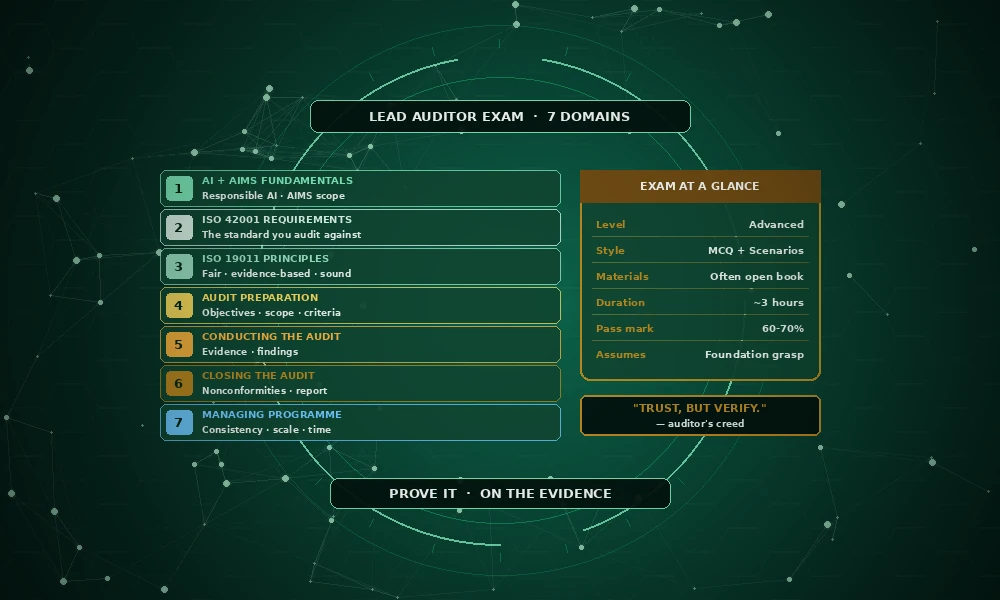
The exam is organised into seven domains, and their order is not arbitrary. Read down the list and you are walking through an audit from first principles to a mature audit programme.
|
Competency domain |
What it assesses |
|---|---|
|
1. AI and AIMS fundamentals |
Your grasp of responsible AI and what an AI management system is |
|
2. ISO/IEC 42001 requirements |
The standard you audit an organization against |
|
3. ISO 19011 audit principles |
The principles that keep an audit fair, evidence-based, and sound |
|
4. Audit preparation |
Defining objectives, scope, and criteria, and planning the work |
|
5. Conducting the audit |
Gathering and evaluating evidence, and forming findings |
|
6. Closing the audit |
Nonconformities, reporting, and the audit conclusion |
|
7. Managing an audit programme |
Running audits consistently, at scale, over time |
Notice where the weight sits. Domains 1 and 2 confirm you understand the subject, but the heart of the exam is Domains 3 to 7: the discipline of auditing itself, applied to AI.
This is what makes it a Lead Auditor exam rather than a longer knowledge test, and it is why prior audit experience helps so much: the reasoning is already familiar, only the subject is new.
Why the auditor exam differs from the implementer exam
It is worth being clear about how this exam differs from its sibling, the Lead Implementer exam, because the two are often confused. The implementer exam asks whether you can build and run an AI management system. The auditor exam asks whether you can independently judge one that someone else built.
Same standard, opposite vantage point. An implementer designs controls; an auditor tests whether those controls actually work. That difference runs through every question: where an implementer is asked what should be done, an auditor is asked whether, on this evidence, it was done well enough to pass.
If you are weighing the two, choose by the work you want to do, not by which sounds harder, because they lead to genuinely different careers.
The exam at a glance
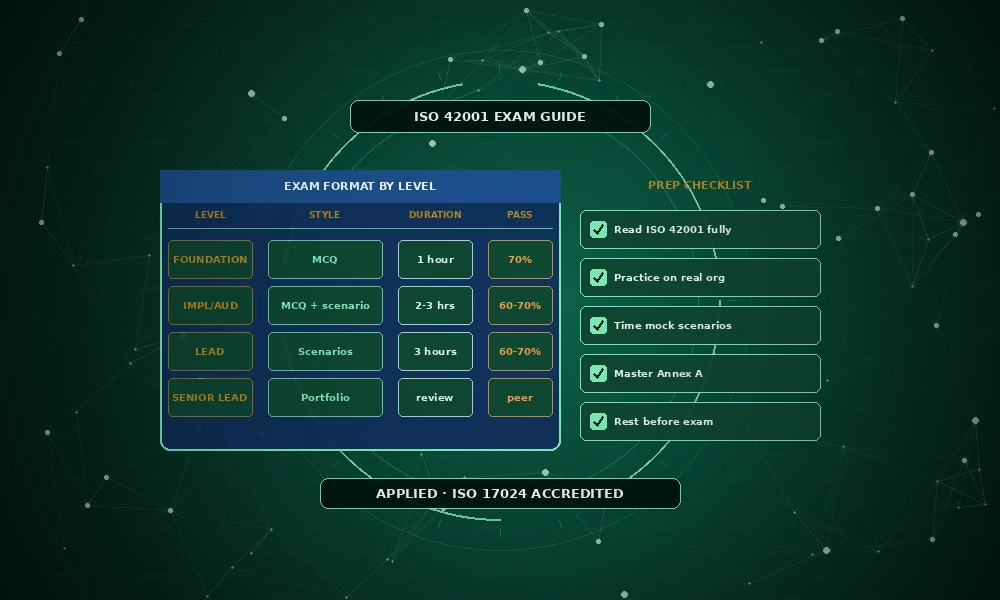
Formats vary by provider, so confirm the specifics when you enrol, but the Lead Auditor exam has a recognisable shape:
|
Element |
Typical Lead Auditor exam |
|---|---|
|
Level |
Advanced |
|
Question style |
Scenario-based, as essays or multiple choice |
|
Materials |
Often open book |
|
Duration |
Up to around three hours |
|
Pass mark |
Commonly around 70 percent |
|
Assumed knowledge |
ISO 42001 understanding, ideally with audit awareness |
Who sits the Lead Auditor exam
The exam suits people who already think, or want to think, like auditors. The most common backgrounds are:
- Existing management-system auditors, especially ISO 27001 auditors, who bring audit discipline and need the AI layer.
- Governance, risk, and compliance professionals, who assess controls already and want to formalise it as independent assurance.
- Consultants and assessors, who want to offer AI audit and assurance to clients.
- Experienced AI governance practitioners, moving from building management systems to independently judging them.
The common thread is comfort with evidence and objectivity. If you enjoy asking how do we know that rather than taking a claim on trust, the exam plays to your strengths.
What to expect on exam day
The experience rewards audit thinking rather than memorisation. Expect the following:
- Audit scenarios. You are given a situation and asked what a competent auditor would conclude or do next.
- Evidence over opinion. Answers that reason from evidence beat answers that assert a view.
- Open book, limited time. You may consult the standard, but the clock rewards knowing where to look and how to apply it.
- The full audit arc. Questions span preparation, conduct, and closing, not just the standard's clauses.
The practical lesson: prepare by practising audit judgement on scenarios, not by re-reading the standard. The exam wants to see how you think when the evidence is ambiguous, which is precisely when a real audit matters most and when a weak auditor either waves it through or freezes.
A worked scenario: what the exam is really asking
It is easier to see the exam's logic through a scenario like the ones it uses. Imagine you are shown an organization's AI policy, signed and dated, alongside a risk register with entries for each of its main models. The question: does this conform to ISO 42001?
A weaker answer says yes, because the documents exist. A strong answer asks the next questions: is the policy actually followed in practice, are those risks genuinely assessed and owned by someone, and where is the evidence that the controls operate rather than merely appear on paper? The exam rewards the second instinct every time.
It is far less interested in whether you can notice a missing document than in whether you can tell a working control from a decorative one. That single distinction, real versus paper, is the difference between a passing auditor and a failing one, because it is the difference on which a certificate ultimately rests.
How the exam mirrors leading a real audit
The seven domains are not an academic taxonomy; they are the lifecycle of an audit turned into an assessment. You prepare, you conduct, you close and at the senior level, you manage a programme of audits, all under the guidance of ISO 19011 and, for certification work, ISO/IEC 17021-1.
Because of that alignment, passing the exam should mean you are ready to lead an audit, not merely to talk about one.
That is also why the exam is protected by standards for fair, secure assessment such as ISO/IEC 17024: a credential that certifies independent judgement has to be earned through a genuinely rigorous test or it means nothing to the accredited bodies that rely on it.
Why the exam matters more than it used to
The stakes behind this exam are rising. As the EU AI Act pushes organizations toward independent assessment of their AI, and accredited certification, recognised across borders through the international mutual-recognition system, becomes a procurement expectation, the demand for auditors whose conclusions can be trusted is climbing fast. That trust is only as strong as the exam that gates it.
A Lead Auditor credential is valuable precisely because the assessment behind it is hard to fake, which is why the exam leans so heavily on applied judgement rather than recall. In a market that increasingly requires third-party proof, the people who can provide it credibly are the ones this exam is designed to identify.
How to prepare for the exam
Preparation for an audit exam is active, not passive. The most effective approach is to rehearse the audit itself: take a scenario, plan the audit, decide what evidence you would seek and practise judging whether a control is effective rather than merely present. That builds the muscle the exam tests. The deeper the audit skills you develop in a proper course, the more the exam feels like familiar work.
Reading the standard is necessary but not sufficient; you have to practise using it to reach conclusions, because that is what the exam asks you to do under time pressure, and it is what your first real engagement will demand of you too.
Common reasons candidates fall short
Most failures on this exam come from preparing as if it were a knowledge test. The recurring patterns are worth naming:
- Assuming instead of verifying. Taking evidence at face value, when the exam is testing whether you probe it.
- Asserting, not reasoning. Stating a conclusion without the evidence trail an auditor is expected to show.
- Studying the standard, not auditing. Knowing the clauses but never practising how to judge a control against them.
- Losing the clock. Treating open book as time to look everything up, and running out of time on the scenarios.
Each of these is fixable with the same remedy: practise reaching audit conclusions on evidence, under time, before you sit the exam.
What passing the exam gives you
Passing earns the credential that says you can independently audit an AI management system, the qualification that certification bodies and assurance functions look for. It is the entry to a role whose judgement carries real weight, because a certificate ultimately rests on it.
For the complete picture of the role, its value, and where it leads, read the full Lead Auditor guide. The exam is the proving ground; the credential is the recognition that you passed it, and the signal to employers that your judgement can be relied on.
Frequently asked questions
Is the ISO 42001 Lead Auditor exam open book?
Often, yes. Many providers run it as an open-book, scenario-based exam. That does not make it easy, because it tests how you apply the standard to reach an audit conclusion, not whether you can locate a clause.
How many domains does the exam cover?
Seven: AIMS fundamentals, ISO/IEC 42001 requirements, ISO 19011 audit principles, audit preparation, conducting the audit, closing the audit, and managing an audit programme. Most of the weight falls on the auditing domains rather than the knowledge ones.
How is it different from the Lead Implementer exam?
The implementer exam tests whether you can build an AI management system; the auditor exam tests whether you can independently judge one. Same standard, opposite role. Choose based on whether you want to build governance or assess it.
Do I need audit experience to pass?
It helps considerably, because the exam is applied. Existing management-system auditors adapt fastest. Those without audit experience can still pass, but should invest more in practising audit scenarios rather than only studying the standard.
What is the pass mark?
Commonly around 70 percent, though it varies by provider. Because the exam is scenario-based, reaching that mark depends on sound audit reasoning more than on recall.
How long should I prepare for the Lead Auditor exam?
Plan for weeks of active preparation rather than days, and weight it toward practising audit scenarios. Candidates with prior audit experience often need less, because the reasoning the exam tests is already familiar to them, and they mainly need to learn the AI-specific content.
Prepare to prove it
An audit exam rewards the person who has already practised auditing, not just studied it. AIGCI's Lead Auditor certification is built around real audit scenarios, so you prepare for the exam and the job in the same motion.
To see how the institute structures its certifications, read more about the institute.