Search for ISO 42001 Lead Auditor jobs and you will notice something odd: the exact phrase rarely appears in a job title, yet the work is everywhere and growing. That gap is the first thing worth understanding, and it points to what makes these jobs distinctive.
An auditor of ISO/IEC 42001:2023, the AI management system standard usually shortened to ISO 42001, is hired for one reason above all others: independence.
The whole value of the role is that the auditor did not build the AI they are judging. That single principle decides where the jobs sit, who is allowed to employ you, and why demand is rising.
This guide from the AI Governance Certification Institute (AIGCI) maps the real job landscape, from the organizations that hire to the titles you should actually search for.
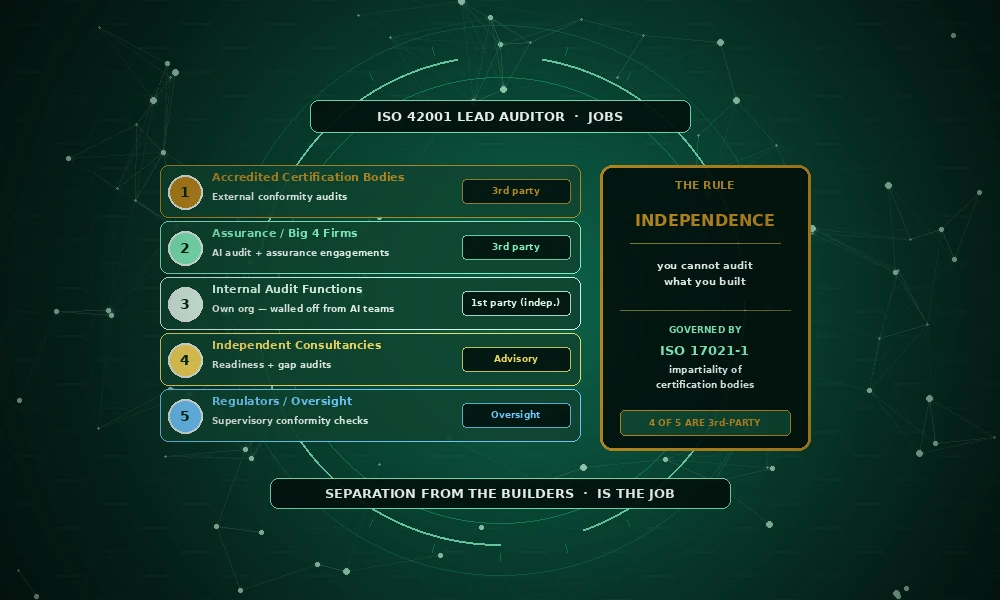
ISO 42001 Lead Auditor jobs cluster wherever independent judgement of AI is needed: accredited certification bodies, assurance and professional-services firms, internal audit functions and consultancies. The common thread is separation from the people who built the AI.
Where ISO 42001 Lead Auditor jobs actually sit
Because the role is built on independence, the jobs concentrate in a handful of settings rather than spreading evenly across every company. Five settings account for most of the market:
|
Where the job sits |
What the auditor does there |
Independence |
|---|---|---|
|
Accredited certification bodies |
Conducts external audits so client organizations can earn the ISO/IEC 42001 certificate |
Third party |
|
Assurance and professional-services firms |
Delivers AI audit and assurance engagements to client organizations |
Third party |
|
Internal audit functions |
Audits the organization's own AI management system, kept separate from the teams that build the AI |
First party, independent |
|
Independent consultancies |
Runs readiness and gap audits to prepare clients for certification |
Advisory |
|
Regulators and oversight bodies |
Assesses AI governance and conformity as part of supervision |
Oversight |
The pattern to notice is that four of these five are outside the organization whose AI is being judged, and the fifth, internal audit, is deliberately walled off from the AI teams it reviews. This is not an accident of the market; it is a requirement.
Certification auditing runs under ISO/IEC 17021-1, which demands impartiality from the bodies that certify. An auditor who helped build or run a management system cannot then certify it. That rule is precisely why the jobs exist as a distinct profession rather than an extra duty bolted onto an engineering role.
This independence rule also creates a fork that trips up newcomers, so it is worth stating plainly. The same person or firm cannot both help an organization build its AI management system and then certify that same system, because that would mean auditing your own work. In practice this splits the market into two separate tracks.
On one side sit advisory and readiness auditors, who help a client get ready and run gap audits but do not award the certificate. On the other sit certification auditors, who are kept at arm's length and grant the certificate itself. Both are genuine ISO 42001 Lead Auditor jobs, but you generally choose a lane, and mixing them for the same client is not allowed.
Knowing which lane a posting belongs to tells you far more about the job than the title does, and it prevents the common mistake of applying for a certification-body role while describing yourself as a hands-on implementer.
What you are actually hired to do
It helps to be clear about the job's real purpose, because it is easy to imagine an auditor as a fault-finder hunting for wrongdoing. The classic description of the role, from a much older branch of auditing, still fits exactly:
|
"He is a watchdog, but not a bloodhound." Lord Justice Lopes, Re Kingston Cotton Mill Company (No. 2), 1896 |
The line is more than a century old, yet it captures the ISO 42001 Lead Auditor's job precisely. You are not hired to assume an organization is hiding something, nor to tear its AI apart looking for wrongdoing. You are hired to watch: to check, with reasonable professional care, whether the AI management system genuinely does what the standard requires, and to say so plainly.
That temperament, sceptical but fair, is what employers are really buying. It is also why the job attracts a particular kind of person, and why interviews probe judgement far more than they probe technical trivia.
The fork that shapes your whole career: internal or independent
Early on, one choice quietly shapes everything that follows: whether you work as a third-party auditor for a certification body or firm, or as a first-party auditor inside a single organization's internal audit function.
Both are real ISO 42001 Lead Auditor jobs, but they feel different day to day. The third-party auditor sees many organizations, travels across industries, and signs conclusions that external parties rely on. The internal auditor goes deep into one organization, knows its AI intimately, and helps it stay ready between external audits.
Neither is superior; they suit different temperaments. People who like variety and independence lean third party, while those who prefer depth and influence within one organization lean internal. Knowing which you are saves you from taking the wrong first job.
The job-title reality: what the posting actually says
Here is the practical problem the opening hinted at. If you search only for the literal words Lead Auditor 42001, you will miss most of the market, because the function hides inside broader titles. Learn to recognise these, and the number of relevant jobs multiplies:
|
A posting you will actually see |
The Lead Auditor function inside it |
|---|---|
|
AI Management System Auditor |
External or internal auditing of an AIMS against the standard |
|
AI Governance or Assurance Auditor |
Client-facing or internal assurance over AI governance |
|
ISO 27001 and 42001 Lead Auditor |
Combined information-security and AI auditing in one role |
|
AI Risk and Controls Auditor |
Internal audit of AI controls within a risk function |
|
Responsible AI Assurance Lead |
Audit-led assurance over responsible AI practices |
Two lessons follow.
First, the ISO 42001 credential is often a requirement or a strong preference inside these roles even when it is not in the title, so name it prominently on your profile.
Second, the frequent pairing with ISO 27001 is a genuine signal: many employers want one person who can audit both information security and AI, which is why experienced security auditors are moving into this work fastest. If that describes you, the crossover roles are the most abundant entry point on the board.
Who is hiring, and why the demand is climbing
The reason these jobs are multiplying is not hype; it is structural. As the EU AI Act moves organizations toward demonstrating, rather than merely asserting, that their AI is governed, independent audit becomes the mechanism that provides the proof.
Certification that is recognised across borders through the international mutual-recognition system is turning into a procurement expectation, and every organization that wants the certificate needs auditors to grant it and, often, internal auditors to keep it.
The heaviest early demand is where AI decisions carry the most consequence and the most regulation: financial services, healthcare, and the large technology providers that both build AI and sell it to regulated customers.
When a buyer starts requiring proof of AI governance from its suppliers, demand for auditors ripples out through the whole supply chain, which is exactly what is beginning to happen now.
Because pay is a question in its own right and varies widely by region, seniority, and employer type, this guide does not cover numbers. For that, read our dedicated breakdown of the salary, which treats it properly rather than in a single misleading figure.
How to position yourself for these jobs
Getting hired into an audit role is less about a single certificate than about a credible combination, and the good news is that most people already have part of it. Three things move you from candidate to hire: a recognised Lead Auditor credential that proves you can audit an AIMS; demonstrable audit or controls experience, even from an adjacent field such as information security or internal audit; and enough fluency in how AI systems work and fail to ask the questions that matter.
The credential is the part you can act on quickest, and it is often the part that unlocks the interview. The experience you may already have; the AI fluency you build alongside the certification. Candidates who present all three, rather than any one in isolation, are the ones who convert applications into offers.
If you are coming from an existing audit background, lean into it. Employers value audit discipline highly and will teach the AI specifics to someone who already knows how to run an audit.
If you are coming from AI or governance without audit experience, the missing piece is the skills the role demands, the audit craft itself, which is learned by practising rather than reading, so seek roles or training that let you audit under supervision.
Either way, the destination is the same, and the wider set of the roles in AI governance shows where an auditing job can lead once you are established.
An honest picture of an early market
It would be misleading to present this as a mature job market with thousands of tidy openings. It is early. Titles are still settling, some employers are only now building their AI audit teams, and a share of the work today is bundled into broader governance or security roles rather than advertised as pure AI auditing. That has two implications worth weighing honestly.
The risk is that the number of jobs labelled exactly ISO 42001 Lead Auditor is still modest. The opportunity, which is larger, is that entering early means you grow with the field and build the track record that later hires will lack. For people who are comfortable with a role that is still taking shape, that is an advantage rather than a drawback.
Frequently asked questions
Are there real ISO 42001 Lead Auditor jobs yet?
Yes, though many are bundled inside broader titles rather than advertised with the exact phrase. The work sits mainly in certification bodies, assurance and professional-services firms, internal audit functions, and consultancies. Searching only for the literal job title will hide most of the market.
Who employs ISO 42001 Lead Auditors?
Accredited certification bodies and assurance firms that audit clients, internal audit functions within large enterprises, independent consultancies that run readiness audits, and, increasingly, regulators. The common thread is independence from the teams that build the AI, which is a requirement of certification auditing, not a preference.
What job titles should I search for?
Beyond Lead Auditor, look for AI Management System Auditor, AI Governance or Assurance Auditor, combined ISO 27001 and 42001 Lead Auditor, AI Risk and Controls Auditor, and Responsible AI Assurance Lead. The ISO 42001 credential is often required inside these roles even when the title does not say so.
Do I need audit experience to get one of these jobs?
It helps a great deal, because employers value audit discipline and will teach the AI specifics to someone who can already run an audit. Existing information-security and internal auditors are moving into this work fastest. Those without audit experience should prioritise gaining supervised audit practice alongside the certification.
Is the job market for these roles big yet?
It is early and still forming. Demand is rising with regulation and procurement requirements, but many roles are currently bundled into wider governance or security jobs. Entering now means growing with the field rather than joining a mature market.
Turn the credential into the job
The fastest way into these roles is to hold the credential employers look for and to be able to demonstrate audit judgement.
AIGCI's Lead Auditor certification is built to prove both. Once you are weighing offers, read our detailed guide to the salary so you can judge them fairly, and for the full picture of the role behind these jobs, read the complete Lead Auditor guide.
To see how the institute structures its certifications, read more about the institute.