A certificate is only as good as the auditor who signs it. When an organization earns certification to ISO/IEC 42001:2023, the AI management system standard usually shortened to ISO 42001, what stands behind that certificate is a person who looked at the evidence and reached a defensible conclusion. That is the work an ISO 42001 Lead Auditor performs, and it is what turns a pile of policies into genuine AI assurance.
Doing it well takes a specific set of skills and here is the part most descriptions miss: those skills come in two distinct layers, not one. This guide from the AI Governance Certification Institute (AIGCI) sets out both layers, shows how they combine on a real engagement and explains how you build them.
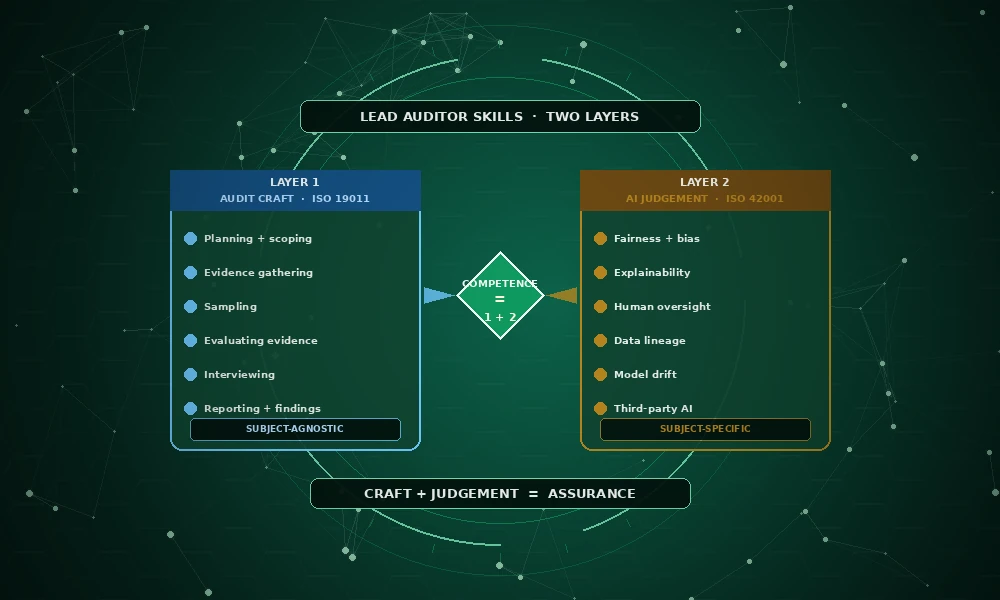
A Lead Auditor's skills sit in two layers: the timeless audit craft defined by ISO 19011 and the AI-specific judgement that an AI management system uniquely demands. Competence is the point where the two meet.
Why audit skills come in two layers, not one
It is tempting to treat auditor skill as a single thing you either have or do not. In practice it splits cleanly. The first layer is the craft of auditing itself, the discipline of planning, gathering evidence and reaching a fair conclusion, which the international guideline ISO 19011 has codified across decades of management-system auditing.
This layer is subject-agnostic: a seasoned ISO 27001 auditor already owns most of it. The second layer is what is new when the subject is artificial intelligence: the judgement to tell whether a model is genuinely fair, genuinely explainable and genuinely under human control. Neither layer is sufficient alone.
A brilliant data scientist who cannot audit will miss nonconformities in plain sight; a veteran auditor who does not understand machine learning will accept AI evidence that a specialist would question. The Lead Auditor role exists at the intersection and the sections below take each layer in turn.
Layer one: the audit craft ISO 19011 defines
This is the portable skill set, the reason auditing is a profession rather than a checklist. Six abilities do most of the work, and each takes on a particular shape when the thing being audited is an AI management system:
|
Core audit skill |
What it looks like in an AIMS audit |
|---|---|
|
Planning and scoping |
Deciding which AI systems, controls, and processes the audit will examine, and what would count as sufficient evidence |
|
Evidence gathering |
Obtaining records, model documentation, decision logs, and risk assessments rather than relying on what people describe |
|
Sampling |
Choosing which models and decisions to examine closely when testing everything is impossible, and defending that choice |
|
Evaluating evidence |
Judging whether a control actually operates, not merely whether a document describing it exists |
|
Interviewing |
Drawing out how governance really works from data scientists, product owners, and risk staff who each see a different slice |
|
Reporting |
Writing findings and nonconformities so they are precise, evidence-backed, and impossible to wave away |
Underneath these sits something ISO 19011 is unusually explicit about: the auditor's personal behaviour. The standard expects an auditor to be ethical, open-minded, observant, perceptive, tenacious and decisive, able to reach a timely conclusion on the evidence and stand behind it. These are not soft extras.
An auditor who is easily talked out of a finding or who cannot stay objective under pressure from a client who wants to pass, has a skills gap as real as any technical one. The craft layer is where audit becomes trustworthy and it is the reason experienced auditors adapt to AI faster than newcomers expect.
Layer two: the AI-specific judgement an AIMS demands
The second layer is what the standard's authors added because AI behaves unlike anything auditors examined before. A model can be accurate on average and unjust to a minority; it can be documented perfectly and still opaque in practice; it can be signed off by a human who never truly had the power to say no.
Auditing that reality calls for judgement in areas a traditional management-system auditor has rarely needed:
- Fairness and bias. Recognising when a model's outcomes differ across groups in ways the organization has not tested for or justified.
- Transparency and explainability. Telling the difference between documentation that describes a model and evidence that anyone can actually understand its decisions.
- Human oversight. Judging whether a human reviewer has genuine authority and capacity to intervene or is merely a rubber stamp on the process.
- Data quality and lineage. Following where training and input data came from, and whether its limits are known and managed.
- Model lifecycle and change. Understanding that a model can drift after deployment, so a control that worked at launch may not work now.
This layer maps onto the risk-based controls in the standard itself and onto external frameworks auditors are expected to recognise, such as the NIST AI Risk Management Framework, which gives a shared vocabulary for the harms an AI system can cause. The skill is not to become a machine-learning engineer; it is to know enough to ask the question that exposes whether a control is real and to recognise a weak answer when you hear one.
That is judgement and it is the layer that makes an AI auditor more than a generic one.
The skill that separates a good auditor from a great one
If you had to name the single skill that most divides competent auditors from exceptional ones, it would not be technical knowledge. It is professional scepticism: the trained instinct to treat every claim as unproven until the evidence settles it, without tipping over into cynicism that assumes bad faith. The distinction matters.
A cynical auditor wastes everyone's time chasing problems that are not there; a credulous one signs off things that later fail. The skilled auditor holds a narrow middle line, granting nothing on trust yet staying genuinely open to being convinced.
Scepticism is harder to hold with AI than with almost anything else auditors examine, because AI systems are persuasive. A polished dashboard, a confident data-science team, and a model that performs well in a demo all pull toward a yes.
The great auditor resists that pull and keeps asking the plain question underneath: how do we know this control works when it matters, not just when it is being shown to us. That is a skill you build by practising, and it is the one that most reliably improves with real audit experience.
Skills in action: one control, three levels of auditor
The clearest way to see these skills is to watch three auditors examine the same control. Suppose an organization claims meaningful human oversight of a high-impact model and points to a signed oversight procedure as evidence. Here is how each level responds:
|
Auditor level |
How they handle the same evidence |
|---|---|
|
Novice |
Reads the oversight procedure, sees it is signed and current, and records the control as conforming. The document existing is treated as the control working. |
|
Competent |
Asks for records showing oversight actually happened. Pulls a sample of decisions, checks that a human reviewed them, and confirms the procedure was followed in practice, not just written down. |
|
Expert |
Tests whether the oversight is meaningful at all. Asks whether the reviewer can genuinely override the model, whether any override was ever exercised, what happened the last time the model was wrong and whether the human has the time and information to intervene rather than rubber-stamp. Concludes on whether the control protects anyone, not whether it exists. |
The same document produced three different audit outcomes and only the third is real assurance. Notice that the expert did not need deeper machine-learning knowledge than the competent auditor; they needed sharper judgement about what the control is for.
This is why the two layers matter together: the craft tells you to seek evidence and sample decisions and the AI-specific judgement tells you which questions actually expose whether a model is under control.
Take either layer away and the audit falls back to the novice's answer, which is the answer that lets bad AI through with a certificate attached.
The underrated skills: interviewing and writing the finding
Two skills get less attention than they deserve, and both decide whether an audit lands. The first is interviewing. Much of an AIMS audit's real evidence lives in people's heads, and it surfaces only if the auditor can ask open questions, listen for what is not said, and follow a thread without leading the witness.
A defensive data scientist will volunteer little to an interrogator and a great deal to someone who is plainly trying to understand. The second is writing the finding. A nonconformity that is vague or overstated gets argued away; one that names the requirement, the evidence and the gap precisely does not.
Auditors who cannot write clearly lose findings they were right about, which is one of the quieter ways good audit work fails to become assurance.
How these skills add up to AI assurance
Put the layers together and you get the thing the whole exercise is for: assurance, a conclusion that a third party can rely on. That is precisely why the market is moving toward independent audit. As the EU AI Act pushes organizations to demonstrate, not just assert, that their AI is governed, the people who can produce a trustworthy conclusion become valuable.
A Lead Auditor's skills are the raw material of that trust; applied at scale and depth, they become a distinct specialism. If you want to see where this leads as a career, the wider field of AI assurance work builds directly on the audit skills described here, extending them into ongoing evaluation rather than point-in-time certification.
How to build these skills and how long it takes
The two layers are built differently and knowing that saves wasted effort. The AI-specific judgement can be taught relatively quickly to a capable learner, because much of it is knowledge and structured thinking that a good course can transfer in weeks.
The audit craft is slower, because it is a practised skill rather than a body of facts. You learn to gather evidence, sample sensibly and hold scepticism by doing it, ideally under an experienced lead auditor who challenges your conclusions.
This is why the fastest route in differs by background: existing auditors focus on the AI layer and add it in weeks, while those new to auditing need to invest in the craft through practice, not reading alone.
Formal training and certification accelerate both, because they force you to apply the skills to realistic scenarios rather than absorb theory. A well-designed Lead Auditor programme is essentially a supervised rehearsal of the two layers working together. It will not, on its own, make you an expert; expertise comes from audits.
But it gives you the framework and the practised reps to start and it signals to employers that you have both layers rather than only one, which is exactly the combination that is scarce.
Where a Lead Auditor's skills stop
It is worth being honest about the edges of this skill set, because overclaiming helps no one. A Lead Auditor is trained to judge whether an AI management system conforms to a standard, not to re-engineer a model or run a deep technical red-team of it. Those are adjacent specialisms with their own skills.
The auditor's expertise is in evidence, judgement and conformity; when an audit surfaces a problem that needs deep technical investigation, the skilled auditor knows to flag it and call in the right expert rather than bluff.
Knowing the boundary of your own competence is itself an ISO 19011 behaviour and it is one of the marks of an auditor worth trusting.
Frequently asked questions
What skills does an ISO 42001 Lead Auditor need?
Two layers. The audit craft defined by ISO 19011, which is planning, evidence gathering, sampling, interviewing, evaluating evidence and reporting, plus the personal behaviours that keep an audit objective. And AI-specific judgement, which covers fairness, transparency, human oversight, data quality and model lifecycle risk. Competence is where both meet.
Do I need to be a data scientist to audit AI?
No. You need enough understanding of how AI systems work and fail to ask the right questions and recognise a weak answer. The core skill is audit judgement, not model building. When an issue needs deep technical investigation, a good auditor flags it for a specialist rather than attempting it themselves.
Which is harder to learn, the audit craft or the AI knowledge?
For most people the audit craft, because it is a practised skill built through real audits rather than a body of knowledge you can study. The AI-specific layer can be taught relatively quickly to a capable learner. This is why experienced auditors often adapt to AI faster than technical experts learn to audit.
What is professional scepticism in auditing?
It is the trained habit of treating every claim as unproven until evidence settles it, without assuming bad faith. It is widely regarded as the skill that most separates competent auditors from exceptional ones and it is harder to hold with AI because AI systems tend to be persuasive.
How do I build ISO 42001 Lead Auditor skills?
Learn the AI-specific layer through structured training and build the audit craft through supervised practice on realistic scenarios and real audits. A Lead Auditor certification programme rehearses both layers together and signals to employers that you have the full combination, but expertise itself comes from doing audits.
Build both layers with AIGCI
Audit skills are learned by doing, not by reading about them. AIGCI's Lead Auditor certification is built around realistic AI audit scenarios, so you practise the craft and the AI-specific judgement in the same motion rather than one after the other.
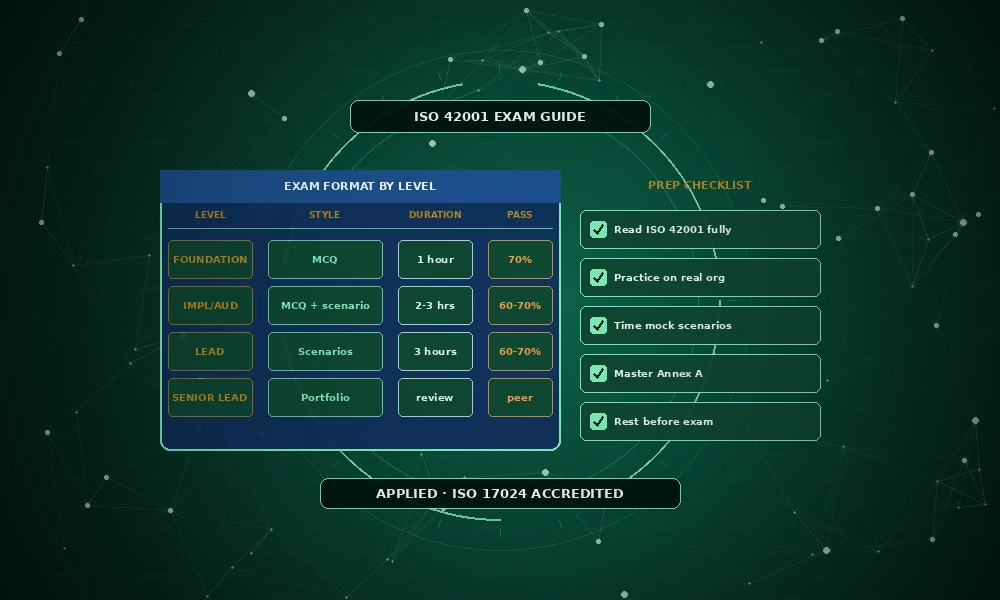
For the complete picture of the role these skills unlock, its value and where it leads, read the full guide, and to see how the exam tests these same skills under pressure, read our guide to the Lead Auditor exam.
To learn how the institute structures its certifications, read more about the institute.