Behind every ISO 42001 credential sits an exam, and most people prepare for the wrong version of it in their heads. They picture a test of memory, when the real thing is a test of judgement.
Certification against ISO/IEC 42001:2023, the AI management system standard, requires passing an exam, and the exams share a defining trait across every level: they are built to see whether you can apply the standard, not whether you can recite it.
This pillar guide from the AI Governance Certification Institute (AIGCI) explains what the ISO 42001 exams have in common, how they differ by level, and what that means for how you prepare. It is the map; the detailed prep, practice, and difficulty guides branch off from it.
|
"Knowing is not enough; we must apply." Johann Wolfgang von Goethe |
Goethe could have been describing these exams. Knowing the standard is the price of entry, but the exam is only interested in the next step: whether you can take that knowledge and use it to reach a sound decision.
Every ISO 42001 exam tests application, not recall
If you remember one thing from this guide, make it this. The ISO 42001 exams are not memory tests, and preparing for them as if they were is the most common mistake candidates make.
The questions are designed to place you in a situation and ask what you would do, or what the standard requires here. Reciting a clause earns little; applying it to the case in front of you earns the mark. This is deliberate, because the credential is meant to certify people who can actually govern AI, not people who can memorise a document.
That single principle shapes everything else, from how the questions are written to how you should study. Hold it firmly, and the rest of this guide follows naturally.
The exams differ by level, not by nature
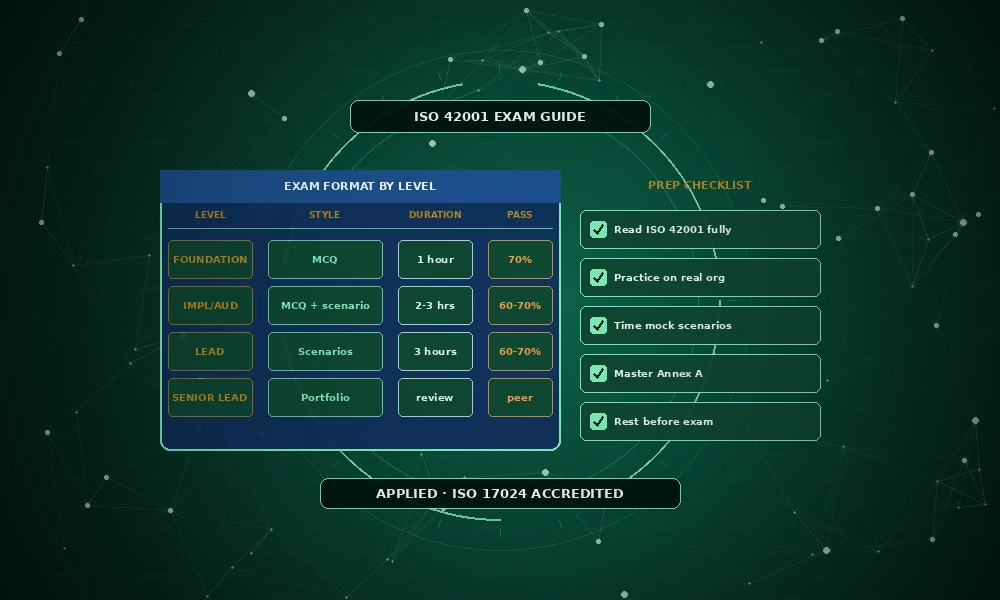
ISO 42001 has several credentials, each with its own exam, but they are variations on the same applied theme rather than different species. The table sets them side by side, which no single-level guide can do:
|
Exam |
What it tests |
Question style and format |
|---|---|---|
|
Foundation |
Understanding of ISO 42001 and how an AI management system works |
Mostly multiple choice, shorter, concept-focused |
|
Lead Implementer |
Whether you can build and run an AI management system |
Scenario-based and applied, longer, often open book |
|
Lead Auditor |
Whether you can independently audit an AI management system |
Scenario-based and applied, longer, often open book |
The Foundation exam sits slightly apart, checking understanding before application, while the two professional exams are squarely applied. The precise domains, timings, and pass marks belong to each level's own guide, so for the specifics see the Lead Implementer exam and the Lead Auditor exam guides. This page stays on what unites them.
Which exam is right for you
If you are unsure which exam to aim at, match it to what you need to do rather than to which sounds most impressive.
Choose the Foundation exam if you need a solid understanding of AI governance without building or auditing. Choose the Lead Implementer exam if you will design and run an AI management system. Choose the Lead Auditor exam if you will independently assess one. The exam follows the role, not the other way around.
Because all three share the same applied nature, the way you prepare is broadly similar even though the depth and focus differ by level.
It also helps to see the exams as a ladder rather than a set of separate hurdles. Many people begin at Foundation to build the understanding the applied exams assume, then move to a professional exam once they are ready to be tested on doing rather than knowing. You do not have to climb every rung, but knowing the ladder exists helps you start on the right one.
Scenario questions reward decisions, not definitions
Because the exams are applied, the scenario question is their signature format, and it rewards a particular way of thinking.
A scenario gives you a situation, an organization, a control, a piece of evidence, and asks what you would conclude or do. The strong answer reasons from the standard to a decision. The weak answer restates a definition and stops. Two candidates can know the same clause and score very differently, because one applies it and the other only recalls it.
The practical lesson is to practise deciding, not just reading. Every time you study a clause, ask yourself what you would actually do with it in a real organization, because that is the muscle the exam measures.
A scenario in miniature
To see what applied really means, consider a question in miniature.
You are told an organization trains its staff on AI risks and keeps a training record. A recall-style answer accepts the record and moves on. An applied answer asks the next question: did the training actually change how people handle AI, and where is the evidence that it did? The exam rewards the second, because that is what governing AI genuinely requires.
Multiply that single instinct across a whole paper, and you have the difference between a pass and a fail on these exams.
Open book rewards knowing where to look
Many ISO 42001 exams, especially at the professional levels, are open book, and candidates routinely misread what that means.
Open book does not make the exam easier; it changes what is being tested. When you can consult the standard, no one needs to test your memory of it, so the questions push harder on application and the clock rewards knowing exactly where to look. A candidate who tries to read everything during the exam runs out of time on the scenarios that carry the marks.
So the goal of preparation is fluency, not memorisation. You want to know the standard well enough to navigate it fast, then spend your time reasoning rather than searching.
What every ISO 42001 exam expects of you
Across all levels, a few expectations hold, and knowing them tells you how to prepare regardless of which exam you sit:
-
Reason from the standard. Start from what ISO 42001 requires and apply it, rather than answering on general opinion.
-
Decide under ambiguity. Scenarios rarely have a single obvious answer; the exam wants a defensible judgement.
-
Manage the clock. Applied questions take time, so pacing is a skill the exam quietly tests alongside the content.
-
Show your reasoning. Where answers are written, the path to the conclusion matters as much as the conclusion itself.
Common exam-day mistakes
A handful of avoidable errors cost otherwise capable candidates their marks:
-
Reciting clauses instead of applying them to the scenario in front of you.
-
Treating open book as time to look everything up, then running short on the scenarios that carry the marks.
-
Answering on general opinion rather than reasoning from what the standard requires.
-
Leaving no reasoning trail, where a written answer needs to show how you reached the conclusion.
Why passing a rigorous exam is worth the effort
It is fair to ask why the exams are made this demanding. The answer is that a credential is only valuable if the exam behind it is hard to fake, and applied exams are much harder to game than memory tests. That rigour is protected by standards for fair, secure assessment such as ISO/IEC 17024, which governs the bodies that certify people.
The payoff is real. In its Future of Jobs Report 2025, the World Economic Forum found that workers with proven AI skills already command a wage premium of around 56 percent, and a scenario-based exam is precisely the kind of proof employers trust, because it demonstrates applied ability rather than attendance.
Why the exams matter beyond your career
The rigour also serves something larger than any individual. As the EU AI Act pushes organizations to prove their AI is governed, the credentials behind that proof have to mean something, and they only do if the exams are genuinely hard to pass without the underlying ability.
So an applied, scenario-based exam is not bureaucratic cruelty. It is what keeps the whole chain of trust intact, from the professional who passes it, to the organization that relies on their judgement, to the people affected by the AI they govern.
How to prepare, and where to go next
Because this is the pillar, the detailed roads branch off here. Three of them matter most:
-
To build a study plan, follow how to prepare for it, which shows how to study by applying the standard rather than rereading it.
-
To test yourself under time, work through practice questions, because pacing on scenarios is a skill of its own.
-
To set expectations, read how difficult it is, so you prepare for the real level of challenge rather than a guessed one.
Treat the exam as a rehearsal for the job
The most useful way to hold all of this together is to stop seeing the exam as a hurdle and start seeing it as a rehearsal. Everything it tests, applying the standard, deciding under ambiguity, reasoning from evidence, is exactly what the job itself will demand of you.
Prepare that way and the exam stops being something to survive and becomes the first time you do the work for real. Pass it on those terms, and you are not just certified; you are ready.
Common questions about the ISO 42001 exams
Are ISO 42001 exams multiple choice or scenario based?
It depends on the level. The Foundation exam is mostly multiple choice and concept-focused, while the Lead Implementer and Lead Auditor exams are scenario-based and applied. Across all of them, the emphasis is on applying the standard rather than reciting it.
Are the ISO 42001 exams open book?
The professional-level exams often are, though this varies by provider. Open book does not make them easier; it shifts the test toward application and rewards knowing the standard well enough to navigate it quickly, rather than memorising it.
What is the difference between the exams at each level?
They differ by what they test, not by their applied nature. Foundation checks understanding of the standard and AI management systems; Lead Implementer tests whether you can build and run one; Lead Auditor tests whether you can independently audit one. The detailed formats live in each level's own guide.
How should I prepare for an applied exam?
By practising application, not rereading. Study each clause by asking what you would do with it in a real organization, rehearse scenario questions under time, and build enough fluency with the standard to navigate it quickly. A dedicated preparation guide sets out the method in full.
Why are the exams scenario based rather than memory tests?
Because the credential certifies people who can govern AI in practice, not people who can memorise a document. Scenario-based exams are harder to fake and better evidence of real ability, which is what makes the credential worth holding to employers and clients.
Prepare for the exam by doing the work
The best preparation for an applied exam is a course that makes you apply the standard, not just study it. AIGCI's Lead Implementer certification is built around implementing a real AI management system, so the exam feels like familiar work. See every option among the ISO 42001 courses, and to learn how the institute designs its assessments, read more about the institute.