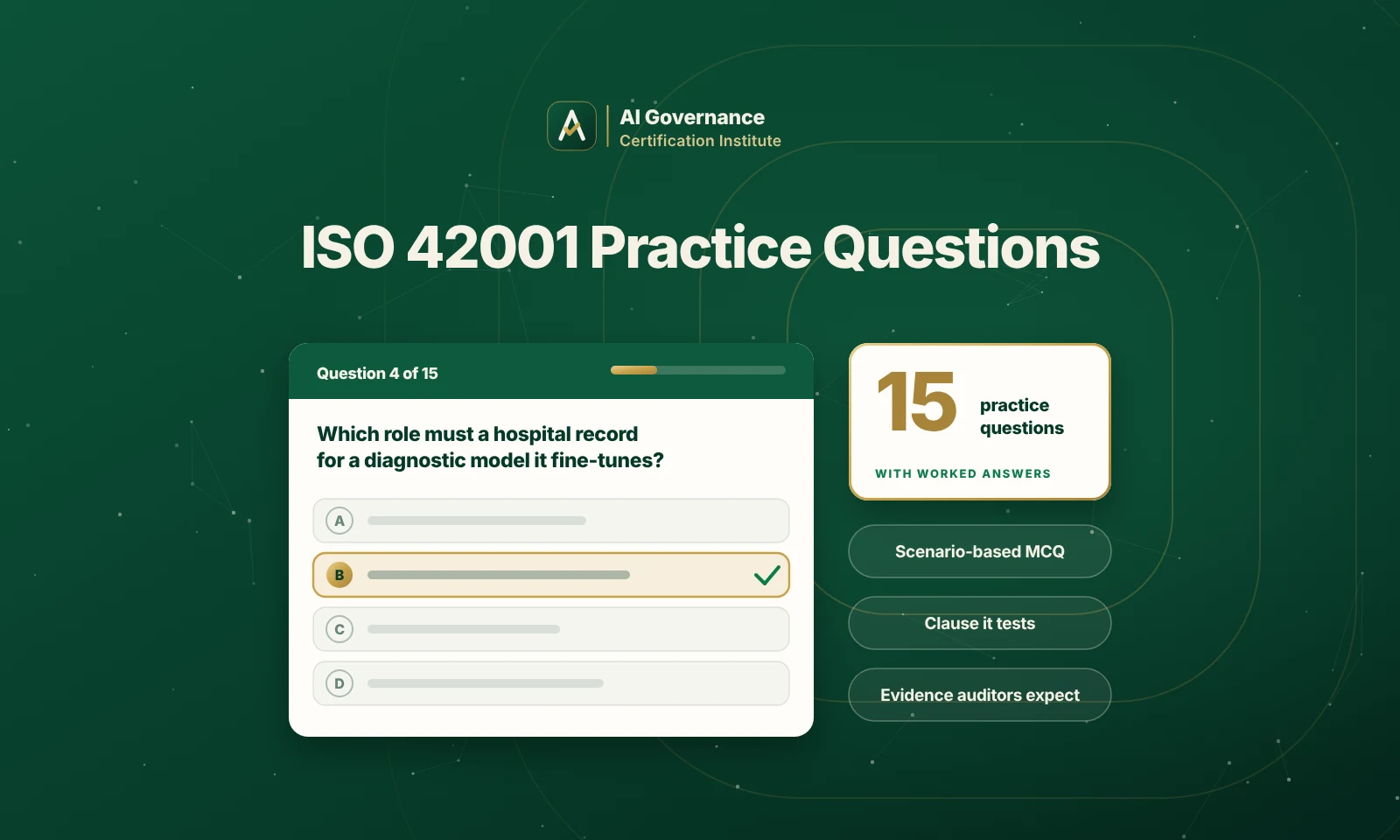
A good ISO 42001 practice question is not a trivia card. It rehearses the one move the exam tests over and over: read a situation, decide which clause governs it, and name the evidence that would prove you are right. Build that habit and the exam stops being a memory test and starts to feel like familiar work.
That is why every question below shares the same shape. A workplace scenario sits on top, a clause of ISO/IEC 42001:2023, the AI management system standard, sits beneath it, and a record, the thing an auditor would actually ask to see, sits at the bottom. Scenario, clause, record: once you can trace that line, you can reason through almost anything the exam presents.
A note on where these come from. We wrote all fifteen ourselves, purely for practice, and none is lifted from a live exam or a question bank. The point of writing fresh ones is that you learn more from a question built to teach than from a leaked item built to trip you up. So each question does more than mark you right or wrong: it walks through the reasoning for the best option, shows where the other three fall down, and ties the whole thing back to the clause it comes from and the evidence an auditor would expect to see.
Work through them honestly, score yourself against 70 percent, and use the result to find your weak clauses before you book. Treat this as a diagnostic, not a prediction of your real score.
How This Mock Test Compares With the Real ISO 42001 Exam
The design mirrors the real exam on purpose, a single best answer drawn from a realistic situation, only fewer of them. Treat it as a way to surface the clauses you are shaky on, not as a dress rehearsal that predicts your final mark.
|
Feature |
This Mock Test |
The Real ISO 42001 Exam |
|
Questions |
15 original items |
Commonly around 60 scenario questions |
|
Format |
Multiple choice, four options, one best answer |
Scenario-based and often open book |
|
Pass line |
11 of 15, about 73 percent |
Commonly around 70 percent |
|
Coverage |
Clauses 4 to 10 and Annex A themes |
Set by the provider syllabus |
|
Purpose |
Find weak clauses before you book |
Certify applied competence |
For how the full exam is scored and timed, see the full exam guide. The clause numbers below were checked against the standard's table of contents, and the answers paraphrase its requirements rather than reproducing its text.
Where the questions touch AI-specific risk, such as bias, drift, and explainability, the ideas align with the NIST AI Risk Management Framework, and the regulatory backdrop that makes this exam matter is the EU AI Act.
What Every Question Is Really Testing
Before you start, it is worth seeing the pattern the questions share, because the real exam uses the same one. Each item is a short chain of three linked things, and what is really being tested is whether you can follow that chain.
First comes the scenario, a decision someone in an organization has to make. Beneath it sits the requirement that governs the decision, which is usually a numbered clause from 4 to 10, sometimes an Annex A control brought into play through the Statement of Applicability, and occasionally a point of guidance from an informative annex. At the end sits the record, the documented evidence an auditor would sample to confirm the decision was made properly.
Those three are one connected idea, not three separate facts: a clause requires an activity, the activity produces a record, and the record is what an auditor inspects. Hold that in mind and a guessing game becomes a method:
• Spot the decision. Name what the scenario is actually asking someone to decide.
• Find the clause. Ask which requirement of ISO 42001 governs that decision.
• Choose by the clause, not the vibe. Pick the option that satisfies the requirement, not the one that merely sounds responsible.
• Check the record. Confirm your answer would produce the evidence an auditor expects to see.
Two related standards sit quietly behind this pattern. The roles a scenario turns on, such as AI provider or AI user, are defined in ISO/IEC 22989, and the evidence-based way an auditor reads your records follows ISO 19011. You do not need to memorise either to pass, but knowing they exist explains why the questions keep returning to roles and to records.
Context and Leadership Questions (Clauses 4 and 5)
These lay the foundations of an AI management system: your roles toward each AI system, a defensible scope, an AI policy, and clear authority, the groundwork that a Lead Implementer builds.
1. Which Role Must a Hospital Record for a Diagnostic Model It Fine-Tunes?
A hospital buys a diagnostic model from a vendor and fine-tunes it on its own patient data before use. While setting up its AIMS, what must it determine under clause 4.1?
• A. Only the vendor's certification status, which decides whether the system is in scope
• B. Its role or roles toward the system, recognising that fine-tuning can make it a developer as well as a user, recorded against the system
• C. Nothing, because it did not build the model from scratch
• D. Which Annex A controls to exclude, because it is mainly a user
Answer: B. Clause 4.1 requires the organization to determine its roles across the AI systems it develops, provides, or uses, and fine-tuning adds a developer role to its existing user role.
Why the Other Options Are Wrong:
• A. A vendor's certificate does not define your role or your scope.
• C. The standard applies to any organization that provides or uses AI, not only to developers.
• D. Control exclusions come from risk treatment under clause 6.1.3, not from the role alone.
Clause Tested: 4.1. Record Involved: AI System Register (role per system).
2. What Makes a Partial AIMS Scope Defensible?
A bank wants to scope its AIMS to its fraud-detection model and leave out its customer chatbot. What makes that partial scope defensible to an auditor?
• A. Defining the scope boundaries and justifying the exclusion against the organization's activities and risks, not convenience
• B. Excluding anything that is not already certified
• C. Setting scope by the size of each team
• D. Leaving the scope undefined to stay flexible
Answer: A. Clause 4.3 requires the organization to determine the boundaries and applicability of the AIMS, and any exclusion must be justified rather than arbitrary.
Why the Other Options Are Wrong:
• B. Certification status has nothing to do with scope.
• C. Team size is not a basis for scoping an AIMS.
• D. Scope must be determined and documented, not left open.
Clause Tested: 4.3. Record Involved: AIMS Scope Statement.
3. Which Clause Fails When a Role Has Responsibility but No Authority?
An organization names an AI ethics lead but gives them no power to halt a non-compliant launch. Which requirement is not met?
• A. Clause 7.2, because the person lacks competence
• B. Clause 9.2, because no internal audit was run
• C. Clause 5.3, because responsibilities must be assigned together with the authority to act on them
• D. Clause 8.1, because operational control was skipped
Answer: C. Clause 5.3 requires top management to assign both responsibilities and authorities; responsibility without authority is a governance gap.
Why the Other Options Are Wrong:
• A. Competence is about ability, not about the authority to act.
• B. Internal audit checks conformity; it is not what is missing here.
• D. Operational control depends on authority first being assigned.
Clause Tested: 5.3. Record Involved: Roles, Responsibilities, and Authorities Matrix.
AI Risk, Impact Assessment, and Objectives Questions (Clause 6)
These sit at the planning heart of the standard, assessing AI risk consistently, judging a system's impact on people, and treating risk through documented controls, which is the material the Lead Implementer exam probes most heavily.
4. Why Do Two Assessors Score the Same AI Risk Differently?
Two staff assess the same model and reach very different risk ratings. What does clause 6.1.2 require to prevent this?
• A. A rule to always take the higher of the two scores
• B. Removing whichever assessor disagrees
• C. Skipping assessment for lower-value models
• D. A defined, repeatable AI risk assessment process with consistent criteria that produce comparable results
Answer: D. Clause 6.1.2 requires an AI risk assessment process that is consistent and produces valid, comparable results, which means defined criteria rather than individual judgement alone.
Why the Other Options Are Wrong:
• A. Defaulting to the higher score hides the real problem, which is an undefined process.
• B. Removing a dissenting assessor does nothing to make the process repeatable.
• C. All in-scope AI systems need assessment, not only the high-value ones.
Clause Tested: 6.1.2. Record Involved: AI Risk Assessment Criteria and Results.
5. What Does the Standard Require When a Recommender Is Extended to Minors?
A retailer extends a recommendation model to under-18 users for the first time. The model weights are unchanged. What does the standard require?
• A. Nothing, because the model itself was not retrained
• B. An AI system impact assessment that considers the effects on individuals and groups, including the new population
• C. Only a cybersecurity review of the model
• D. A sign-off from the marketing team
Answer: B. Clause 6.1.4 requires assessing the potential impacts of the AI system on individuals, groups, and society, and a new and more vulnerable population changes that impact profile even if the model does not change.
Why the Other Options Are Wrong:
• A. The use context changed, which is exactly what an impact assessment exists to catch.
• C. Impact is broader than security; it includes fairness and effects on people.
• D. Marketing approval is not a governance control.
Clause Tested: 6.1.4. Record Involved: AI System Impact Assessment.
6. What Must Happen After You Choose Controls From Your Own Framework?
An organization selects its AI controls from an internal framework it already trusts. Under clause 6.1.3, what must it still do?
• A. Compare its controls against Annex A and produce a Statement of Applicability justifying inclusions and exclusions
• B. Nothing further, because its own framework is enough
• C. Apply for certification immediately
• D. Delete Annex A, since it chose its own controls
Answer: A. Clause 6.1.3 requires the organization to determine its controls, compare them with those in Annex A to confirm none needed is omitted, and document a Statement of Applicability.
Why the Other Options Are Wrong:
• B. The comparison with Annex A and the Statement of Applicability are required steps.
• C. Certification cannot precede a completed risk treatment and Statement of Applicability.
• D. Annex A is the reference list you must compare against, not something to discard.
Clause Tested: 6.1.3. Record Involved: Statement of Applicability.
Support and Operation Questions (Clauses 7 and 8)
These check whether the system can actually run: competent people, controlled documents, and controlled changes to the AI it operates. This operational detail is a large part of what makes the exam feel hard.
7. What Competence Evidence Will an Auditor Ask For?
An auditor asks how the organization knows the people running its AIMS are competent. What evidence satisfies clause 7.2?
• A. A signed attendance sheet from a single workshop
• B. A copy of the organization's AI policy
• C. Records showing competence on the basis of appropriate education, training, or experience for the AIMS work people do
• D. The organization's risk register
Answer: C. Clause 7.2 requires determining the necessary competence, ensuring people have it, and retaining documented evidence of that competence.
Why the Other Options Are Wrong:
• A. Attending a session is not the same as being competent, and attendance alone is weak evidence.
• B. The AI policy sets direction; it does not evidence competence.
• D. The risk register records risk, not people's competence.
Clause Tested: 7.2. Record Involved: Competence Evidence (training and experience records).
8. Which Requirement Breaks When an Approved Procedure Is Edited Without Version History?
A reviewer finds that an approved AIMS procedure was changed with no record of the version, the change, or who approved it. Which requirement is broken?
• A. Clause 6.2, on setting AI objectives
• B. Clause 4.2, on interested parties
• C. Clause 10.1, on continual improvement
• D. Clause 7.5, which requires documented information to be controlled, including version, change, and approval control
Answer: D. Clause 7.5 requires documented information to be identified, approved, version-controlled, and protected from uncontrolled change.
Why the Other Options Are Wrong:
• A. Objectives are unrelated to how documents are controlled.
• B. Interested parties concern context, not document control.
• C. Improvement is a separate requirement from controlling documents.
Clause Tested: 7.5. Record Involved: Controlled Document Register and Version History.
9. What Must the AIMS Ensure When a Vendor Swaps the Underlying Model?
A supplier quietly replaces the model behind a service the organization uses, with no notice. What must the AIMS ensure under clause 8?
• A. Nothing, because it is the vendor's model and the vendor's responsibility
• B. That changes are controlled and externally provided AI is managed, so the change triggers a reassessment
• C. Immediate decertification of the organization
• D. Approval from the marketing function
Answer: B. Clause 8 requires the organization to control planned changes and to manage externally provided processes, products, and services, so a changed model must trigger reassessment of risk and impact.
Why the Other Options Are Wrong:
• A. You remain accountable for the AI you use, regardless of who built it.
• C. A controlled change is managed, not grounds for decertification.
• D. Marketing approval is not an operational control.
Clause Tested: 8.1. Record Involved: Change Control and Supplier Management Records.
Performance Evaluation and Improvement Questions (Clauses 9 and 10)
These check whether the system stays honest over time, through monitoring that means something, independent internal audit, and corrective action done properly, the same audit lens the Lead Auditor exam tests in depth.
10. What Does Clause 9.1 Expect Beyond a Live Dashboard?
A team points to a real-time dashboard as evidence of monitoring. Why might an auditor still raise a finding under clause 9.1?
• A. Because 9.1 requires the organization to determine what to monitor and measure, the methods, when, and who evaluates the results
• B. Because dashboards are not allowed as evidence
• C. Because monitoring must be an annual survey instead
• D. Because monitoring stops being required once certified
Answer: A. Clause 9.1 requires defined monitoring and measurement, including what, how, and when, and the evaluation of the results, not merely a display of data.
Why the Other Options Are Wrong:
• B. Dashboards are fine; the gap is the absence of defined methods and evaluation.
• C. An annual survey is narrower than what 9.1 requires.
• D. Monitoring is a continuing requirement, not a one-time gate.
Clause Tested: 9.1. Record Involved: Monitoring and Measurement Results.
11. Can the Implementer Audit Her Own AIMS Work?
The person who built the AIMS offers to run its internal audit, arguing she knows it best. Is that acceptable under clause 9.2?
• A. Yes, because she understands the system better than anyone
• B. Only if the organization is already certified
• C. No, because internal auditors must be objective and must not audit their own work, and audits run at planned intervals
• D. No, because only external auditors are permitted to audit an AIMS
Answer: C. Clause 9.2 requires internal audits at planned intervals conducted so as to ensure objectivity and impartiality, which means auditors do not audit their own work.
Why the Other Options Are Wrong:
• A. Knowing the system best is exactly why she cannot audit it objectively.
• B. Certification status does not change the objectivity requirement.
• D. Internal audit is required and is performed by internal, objective auditors, not only external ones.
Clause Tested: 9.2. Record Involved: Internal Audit Programme and Reports.
12. Can a Missing Approval Date Be Fixed by Backdating It?
An internal audit finds an approval record with no date. A manager suggests simply writing in the date it was probably approved. Is that acceptable?
• A. Yes, because the approximate date is close enough
• B. No action is needed, because it is only a date
• C. The record should be deleted to avoid the finding
• D. No, because the organization should raise a nonconformity and correct it with an accurate date and corrective action
Answer: D. Clause 10.2 requires nonconformities to be addressed through correction and corrective action; backdating falsifies a record and undermines the whole system.
Why the Other Options Are Wrong:
• A. Writing in a guessed date falsifies the record.
• B. A missing approval date is a genuine nonconformity, not a trivial detail.
• C. Destroying the record is worse, removing the evidence an auditor needs.
Clause Tested: 10.2. Record Involved: Nonconformity and Corrective Action Log.
Annex A and Statement of Applicability Questions
These show how the controls and the Statement of Applicability actually work, including what you may exclude and what counts as a requirement rather than guidance.
13. How Will an Auditor Read a Supplier-Control Exclusion in the Statement of Applicability?
An organization marks a supplier-related control as not applicable in its Statement of Applicability, with no reason given. How will an auditor read that?
• A. As automatically acceptable, since the organization chose it
• B. As requiring a documented justification tied to risk, so an unexplained exclusion is a finding
• C. As grounds to fail the organization outright
• D. As irrelevant, since the Statement of Applicability is optional
Answer: B. Exclusions in the Statement of Applicability must be justified against the organization's risk treatment; a justified exclusion is legitimate, but an unexplained one is a nonconformity.
Why the Other Options Are Wrong:
• A. An exclusion is only acceptable when it is justified.
• C. Justified exclusions are legitimate, so an exclusion is not an automatic failure.
• D. The Statement of Applicability is a required output, not optional.
Clause Tested: 6.1.3 and Annex A. Record Involved: Statement of Applicability Justification.
14. What Does a Data-Quality Control in Annex A Require You to Show?
An auditor examines how the organization governs the data behind an AI system. What does an Annex A data-quality control expect to see?
• A. Evidence that the data used by the AI system is managed for quality and is relevant to the system's intended purpose
• B. Evidence that all data is deleted every year
• C. Evidence that the data is encrypted and nothing more
• D. Evidence that the system uses no data at all
Answer: A. Annex A data controls expect the organization to manage the quality, provenance, and relevance of the data an AI system relies on for its intended purpose.
Why the Other Options Are Wrong:
• B. A retention schedule is not the same as managing data quality.
• C. Encryption is a security measure, separate from data quality.
• D. An AI system that used no data would not function.
Clause Tested: Annex A (data management). Record Involved: Data Management Records.
15. Is Annex B of ISO 42001 Normative or Informative?
A candidate assumes Annex B must be followed exactly, like the controls. Is Annex B normative or informative in ISO/IEC 42001:2023?
• A. Normative, because every annex is mandatory
• B. It does not exist in ISO 42001
• C. Informative, because it offers implementation guidance rather than auditable requirements
• D. Identical in status to Annex A
Answer: C. In ISO/IEC 42001:2023 the Annex A controls become auditable requirements through the Statement of Applicability, while Annex B provides implementation guidance and is informative.
Why the Other Options Are Wrong:
• A. Not every annex is mandatory; status varies by annex.
• B. Annex B does exist and provides guidance.
• D. Annex A and Annex B differ in status, one auditable and one guidance.
Clause Tested: Annex B. Record Involved: Knowledge item (no record).
Answer Key With the Clause Behind Each Question
Mark your answers, then check them here. The clause column tells you where to revise if you got one wrong.
|
Question |
Answer |
Clause |
Theme |
|
1 |
B |
4.1 |
Roles toward an AI system |
|
2 |
A |
4.3 |
Defensible scope |
|
3 |
C |
5.3 |
Responsibility with authority |
|
4 |
D |
6.1.2 |
Consistent risk assessment |
|
5 |
B |
6.1.4 |
AI system impact assessment |
|
6 |
A |
6.1.3 |
Statement of Applicability |
|
7 |
C |
7.2 |
Competence evidence |
|
8 |
D |
7.5 |
Documented information control |
|
9 |
B |
8.1 |
Change and supplier control |
|
10 |
A |
9.1 |
Monitoring and measurement |
|
11 |
C |
9.2 |
Internal audit objectivity |
|
12 |
D |
10.2 |
Corrective action, not backdating |
|
13 |
B |
6.1.3 and Annex A |
Justified exclusions |
|
14 |
A |
Annex A (data management) |
Data quality |
|
15 |
C |
Annex B |
Guidance versus requirement |
The correct answers are spread across the options on purpose, as they are on the real exam, so read every question on its own merits rather than looking for a pattern in the letters.
How to Score Your ISO 42001 Practice Test
Give yourself one mark per question, with no partial credit, because the real exam asks for a single best answer. Then read your score against the pass line.
Eleven of fifteen is about 73 percent, the first score at or above the common 70 percent pass mark, so treat 11 as your working target here. Below that, the gap is usually concentrated in one or two clause areas rather than spread evenly, which is good news, because it tells you exactly where to revise.
A low score is a map, not a verdict. The gap it exposes is usually concentrated in one or two clause areas rather than spread evenly, which tells you exactly where to revise next instead of sending you back through the whole syllabus.
What to Do With Your Practice Test Results
The point of a mock test is what you do next, not the number itself. Turn each wrong answer into a targeted action:
Group your misses by clause using the answer key, then revise the clause, not the question. Memorising why one option was right for question seven helps little; understanding clause 7.2 helps everywhere. From there, build a plan around your weak clauses. A clause-by-clause method is set out in how to prepare, which turns a list of wrong answers into a sequence of things to study.
Finally, practise more under time. One short mock test cannot cover a whole syllabus, so if you want full-length, exam-style practice, an ISO 42001 Lead Implementer course with full mock exams gives you the volume and the timing that a single set cannot.
Frequently Asked Questions
Should You Rely on ISO 42001 Exam Dumps?
It is a bad idea. Sites that promise genuine exam content put your certification at risk if the reuse is ever detected, and they are often wrong or out of date in any case. Worse, they train you to spot a memorised question instead of reasoning through a scenario, which is precisely the skill the real exam measures. Practice that explains its reasoning, as these questions do, serves you far better.
Is There an ISO 42001 Practice Questions PDF?
This set is designed to be read and worked through here, with the answer and clause beside each question. You can copy it into your own notes, but be cautious with PDF question banks from unknown sources, which are often low quality or lifted from exams. Favour practice that explains its reasoning over a bare list of answers.
Is There a Free ISO 42001 Mock Test?
This page is a free, 15-question mock test with full explanations. It is deliberately smaller than the real exam, which commonly runs to around 60 scenario questions, so use it to find weak clauses rather than to simulate the full sitting. For full-length practice under time, a course with an exam simulator is the better fit.
What Practice Score Means I Am Ready to Book the Exam?
On this set, 11 of 15 is the first score at or above the common 70 percent pass mark, so reaching that consistently, across different questions rather than once by luck, is a reasonable signal. Readiness also depends on doing it under time and on understanding the clauses behind your correct answers, not just landing on them.
Are These Taken From the Actual Exam?
No. We wrote every one of them from scratch for practice, and nothing here is drawn from a real sitting. They follow the same scenario style and clause coverage as the exam, which is what makes them useful preparation, but they are study items rather than leaked content.
Do Lead Auditor Practice Questions Help With the Lead Implementer Exam?
Partly. Both exams draw on the same clauses of ISO/IEC 42001:2023, so auditor questions reinforce the shared core. They diverge on emphasis, as the auditor exam leans on audit process and ISO 19011, while the implementer exam leans on building and running the system. Use whichever matches the exam you are sitting, and treat cross-practice as a supplement.
Practise the Way the Exam Tests
A scenario-based exam rewards people who have practised reasoning, not memorising. When you are ready for full-length, timed practice, AIGCI's Lead Implementer certification is built around real scenarios, so the exam feels like familiar work rather than a test. To see every option at a glance, browse the ISO 42001 courses.