Ask around and you will hear the ISO 42001 Lead Implementer described as anything from straightforward to tough. The honest answer sits in between. It is a substantial certification, because ISO/IEC 42001 is a full management system standard rather than a short awareness course, but its difficulty is conceptual rather than technical, and that makes it very learnable for the right person. This page explains what actually makes it demanding, what makes it manageable, and how to tilt the odds in your favour.
How hard is the Lead Implementer, really?
For most professionals, the Lead Implementer is challenging but achievable, on the level of a serious professional qualification rather than a university exam or a coding test. The difficulty is not about raw intelligence or technical skill. It is about holding a broad subject in your head and being able to apply it, rather than recite it. If you can learn a structured body of material and reason about how it applies to real situations, you can pass, and the work you do to get there is exactly the work the role demands.
What makes it demanding
Three things give the certification its weight, and it helps to know them in advance so none of them surprises you.
-
Breadth. An AI management system spans policy, roles, risk, impact assessment, controls, audit, and improvement. There is a lot of connected material, and you need to understand how the parts fit, not just what each one is.
-
Application, not recall. The assessment is designed to test whether you can apply the standard to a real scenario, so memorising definitions is not enough. You have to reason like an implementer.
-
The shift from knowing to doing. Foundation-level study is about understanding; the Lead Implementer asks you to construct a working system. That step up is where people feel the jump in difficulty.
What makes it manageable
The same certification has real handholds, which is why so many people from non-technical backgrounds pass it comfortably.
-
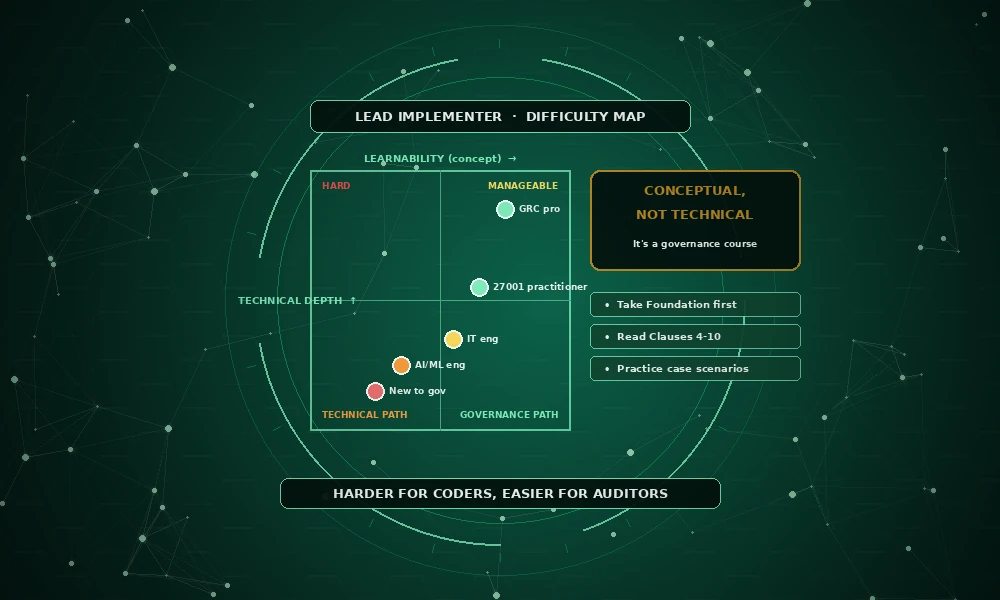
No coding or maths. You govern AI, you do not build it. There is no programming, no statistics, and no model training involved.
-
Transferable skills. If you have worked with risk, policy, audit, or any management system, much of the thinking is already familiar and simply applied to AI.
-
A structured path. The material is organised and teachable, and building on a foundation first turns the breadth from daunting into sequential.
Difficulty depends on your starting point
The same certification feels different depending on what you bring to it. None of these starting points is a barrier; they simply change how much of a stretch the material is and where to focus your effort.
|
Your starting point |
How much of a stretch |
Where the effort goes |
|---|---|---|
|
ISO 27001 or management-system background |
Lower |
Learning the AI-specific parts; the structure is familiar |
|
Risk, compliance, or governance background |
Moderate |
Mapping familiar risk work onto the AI lifecycle |
|
Project or delivery background |
Moderate |
Absorbing the standard, then applying your delivery skill |
|
New to governance and management systems |
Higher |
Build the base first, then the breadth becomes sequential |
The Lead Implementer Difficulty Map
To see where the challenge actually sits, it helps to break the certification into parts. Each part carries a different level of demand, and each has a clear way to reduce it. The map below is available as a one-page download.
|
Part of the certification |
Demand |
Why, and what lowers it |
|---|---|---|
|
Understanding the standard |
Moderate |
Broad but structured; a foundation first flattens the curve |
|
Applying it to scenarios |
Higher |
Judgement is tested, not recall; practise with realistic cases |
|
Breadth of topics |
Moderate |
Many areas, each learnable; pace study rather than cram |
|
Technical or coding demand |
Low |
None exists; the role governs AI, it does not build it |
|
Implementation reasoning |
Moderate |
Transfers from any risk, audit, or delivery experience |
How to make it easier
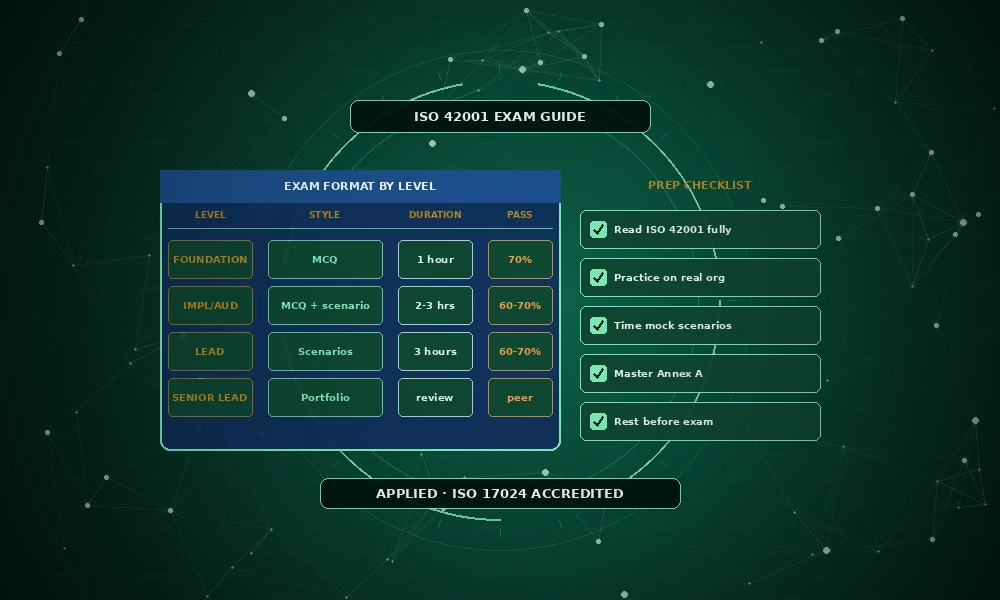
Difficulty is not fixed; preparation changes it. Two moves make the biggest difference. First, know the assessment: the exam format tells you exactly what to expect, so you can practise the right way rather than over-studying the wrong things. Second, prepare deliberately rather than by reading alone; the guide on how to prepare sets out a study approach built around applying the standard to scenarios, which is what the assessment rewards. Building a foundation before you start, and pacing the breadth over time, turns the certification from intimidating into a series of manageable steps.
Frequently asked questions
Is the ISO 42001 Lead Implementer certification hard?
It is challenging but achievable, comparable to a serious professional qualification. The difficulty is conceptual, holding a broad subject in your head and applying it, rather than technical. There is no coding or maths, so people from non-technical backgrounds pass it regularly.
What makes the Lead Implementer difficult?
Mainly its breadth and the fact that the assessment tests applied judgement rather than memorisation. You need to understand how the parts of an AI management system fit together and how to apply them to real scenarios, which is a step up from foundation-level understanding.
Do I need to be technical to pass?
No. The role governs AI rather than building it, so there is no programming, statistics, or model training. Experience with risk, policy, audit, or any management system is far more useful than a technical background.
How can I make the certification easier?
Build a foundation first, learn the exact exam format so you practise the right way, and prepare by applying the standard to scenarios rather than only reading. Pacing the breadth over time also turns it from daunting into sequential.
Is it harder than Foundation?
Yes, because it asks you to construct a working system rather than understand one. That said, if you take Foundation first, the step up is gradual, and the two together are designed to build on each other.
The honest verdict
The ISO 42001 Lead Implementer is demanding enough to be worth holding and manageable enough that most committed professionals pass it. Its difficulty comes from breadth and applied judgement, not from technical complexity, which means preparation and pacing matter more than raw ability. If you are ready to build that capability, the ISO 42001 Lead Implementer certification rewards the effort with a skill organizations genuinely need, and starting from the Foundation certification makes the climb noticeably gentler.