ISO/IEC 42001 was built on the same harmonized structure as ISO 27001 and ISO 9001, so it fits into the way organizations already manage security, quality, and risk. That design is the reason the Lead Implementer certification asks for a background in IT, risk, or governance rather than AI engineering: the skills that transfer are the ones you already use to run a management system.
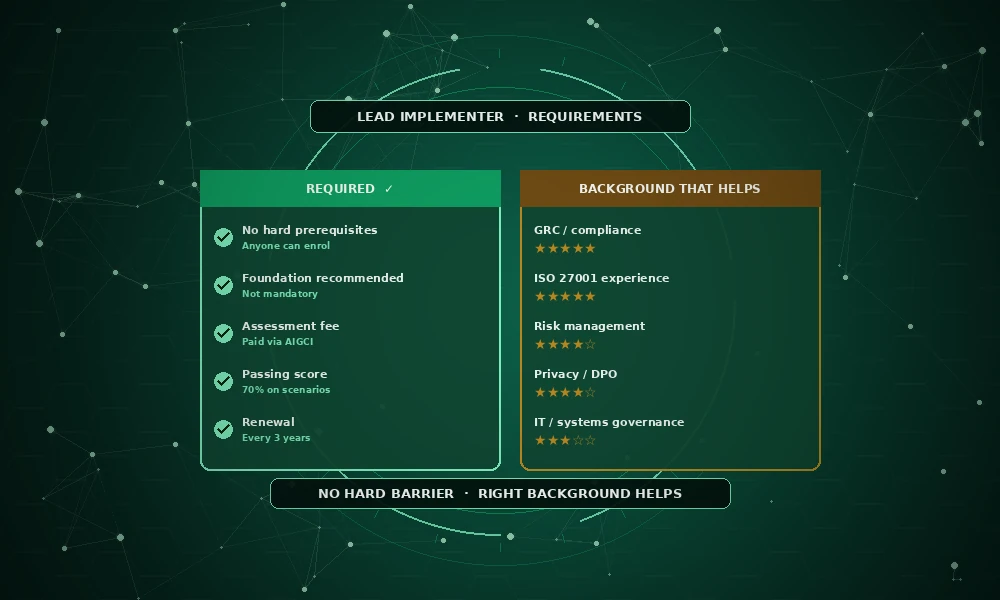
So what does the certification actually require? The short version is that there is no hard barrier to entry. The AI Governance Certification Institute recommends a background in IT, risk management, or a standard like ISO 31000, along with a foundation-level understanding of AI governance, but none of these is a strict gate. This page sets out what is recommended, what is not required, and how to close any gap.
What the Lead Implementer certification requires
The Lead Implementer is a professional-level certification, so it assumes more than a complete beginner brings, but it does not demand a specific degree, licence, or number of years. What it really asks for is readiness to do implementation work: comfort with risk, familiarity with how policies and controls operate, and the shared language of AI governance. In practice that means one recommended precursor and one recommended type of background, neither of which is a barrier if you approach them in the right order.
The background that helps most
The certification recommends, rather than requires, a working background in a few areas. Each transfers directly into implementing an AI management system, which is why they are recommended in the first place.
|
Recommended background |
Why it transfers to the Lead Implementer role |
|---|---|
|
IT or technology governance |
You already understand how systems, access, and controls are managed |
|
Risk management, including ISO 31000 |
Implementation is largely risk work: identifying, assessing, and treating AI risk |
|
Governance, compliance, or audit |
Policy, evidence, and accountability are the core of a management system |
|
Project or programme delivery |
Building an AIMS is a structured project with stakeholders and milestones |
|
Information security, including ISO 27001 |
The same management-system structure and controls logic carry straight over |
None of these is mandatory, and you do not need all of them. One relevant strand is usually enough to make the certification comfortable, and the concepts you do not yet have are learnable rather than gatekept.
Should you take Foundation first?
For most people, yes, and it is the smoothest route. Taking the Foundation certification first builds the shared language of AI governance and the essentials of an AI management system, which the Lead Implementer then puts into practice. If you already work in AI governance or hold a closely related management-system qualification, you may be ready to start directly at Lead Implementer, but when in doubt, Foundation first is the safer and more rewarding path.
What the certification does not require
It is worth being just as clear about what is not needed, because assumptions here stop capable people from starting.
-
No AI or coding experience. The role governs AI; it does not build it. You will not be asked to train a model or write code.
-
No specific degree. There is no required field of study. Relevant professional experience matters more than academic background.
-
No fixed number of years. The recommendation is about the type of background, not a minimum tenure, and it is guidance rather than a gate.
The Lead Implementer Readiness Matrix
Rather than a pass-or-fail checklist, use this matrix to see where you already meet the recommendation and where to shore up before you start. Each row is a recommended strength and a concrete way to close the gap if you do not have it yet.
|
Recommended strength |
Why it matters |
If you do not have it yet |
|---|---|---|
|
Foundation-level understanding |
The shared language the certification builds on |
Start with the Foundation certification |
|
Risk management comfort |
Implementation is largely identifying and treating risk |
Lean on any governance or compliance work; the concepts transfer |
|
Systems, policy, or controls experience |
You will design and operate real controls |
Project, audit, or IT experience all count |
|
Structured delivery ability |
Building an AIMS is a project to run |
Delivery experience from any field applies |
Read honestly, the matrix usually shows that a capable professional already meets most of the recommendation, and that the remaining gaps are quick to close rather than reasons to wait.
How to meet the requirements and start
The practical path is simple: build the shared language, confirm your background covers the recommended strengths, then enrol. For the complete picture of the credential, its scope, exam, and value, see the full guide. When you are ready, the ISO 42001 Lead Implementer certification is the step that turns your background into the ability to build an AI management system, and the Foundation certification is the natural place to begin if you want the groundwork first.
Frequently asked questions
What are the prerequisites for the ISO 42001 Lead Implementer?
There is no hard prerequisite. A background in IT, risk management, governance, or a standard like ISO 31000 is recommended, along with a foundation-level understanding of AI governance, but none of these is a strict gate. Relevant professional experience matters more than any formal qualification.
Do I need to complete Foundation before Lead Implementer?
It is recommended and, for most people, the smoothest route, because Foundation builds the shared language the Lead Implementer applies. If you already work in AI governance or hold a closely related management-system qualification, you may be able to start directly at Lead Implementer.
Do I need AI or coding experience?
No. The Lead Implementer governs AI rather than building it, so you will not be asked to train models or write code. Governance, risk, compliance, IT, and project experience are far more relevant and transfer directly.
Does an ISO 31000 or ISO 27001 background help?
Yes. ISO 31000 gives you the risk-management thinking that implementation relies on, and ISO 27001 shares the same management-system structure and controls logic as ISO 42001. Either is a strong foundation for the Lead Implementer role.
Is there a minimum number of years of experience?
The recommendation is about the type of background rather than a fixed tenure, and it is guidance rather than a rule. What matters is that you are comfortable with risk, controls, and structured delivery, which many professionals reach well before any particular year count.
The bottom line
The ISO 42001 Lead Implementer certification is more open than its professional level suggests. It recommends a background in IT, risk, or governance and a foundation-level grounding, but it gates on none of them. If you can manage risk, work with policies and controls, and run a structured piece of work, you already meet most of what it asks, and the rest is straightforward to build.