For governance, risk, and compliance teams, artificial intelligence stopped being someone else's problem some time ago. It is now sitting squarely in the GRC remit, and it arrived faster than most functions could equip themselves for it.
The evidence is uncomfortable. A 2025 GRC practitioner survey found that while nearly half of respondents recognised AI's value, only around 14 percent had fully integrated AI into their GRC frameworks, even as AI climbed into the ranks of the top enterprise risks for 2026.
That gap is the real backdrop to a question many GRC professionals are now asking: does my existing toolkit cover AI, or do I need something built for it? Usually the comparison lands on two credentials, CISM and ISO/IEC 42001:2023, the AI management system standard.
This guide from the AI Governance Certification Institute (AIGCI) compares them specifically for GRC work, maps exactly where each one reaches, and shows why, for the AI part of the mandate, they are not really equivalent.
AI landed in the GRC remit faster than the tools did
Before comparing credentials, it helps to see the shape of the problem, because it explains why a security credential alone no longer covers the ground.
Ownership of AI governance is still fragmented across most organizations. In the same body of survey work, risk functions, security, and internal audit each claim a share of the responsibility, with little agreement on who truly owns it. AI has become everyone's concern and no one's clear mandate.
For GRC professionals, that fragmentation is both a burden and an opening. Someone has to bring structure to AI governance, and GRC is the natural home for it. But bringing structure requires the right competence, and this is where the choice of credential starts to matter.
The ground under GRC is shifting fast
Two more numbers show how quickly the terrain is moving beneath GRC teams.
Shadow AI is already widespread. A January 2026 survey found that almost half of employees, around 49 percent, were using AI tools their employer had not sanctioned. That is ungoverned AI risk entering through the side door, and it lands on GRC to address.
At the same time, governance is formalising at the top. One data set shows that 76 percent of organizations now have a Chief AI Officer, up from just 26 percent a year earlier, a sign that AI oversight is becoming a named, accountable function rather than an afterthought.
For GRC professionals, both trends point the same way. AI governance is fast becoming a defined responsibility, and the people who can actually perform it remain in short supply.
What CISM equips a GRC professional to do
CISM, the Certified Information Security Manager credential from ISACA, is a strong, established qualification for governing information security. It builds command of security governance, risk management, program development, and incident management.
For a GRC professional, that is genuinely valuable, because much of AI risk does have a security dimension: protecting models and data, controlling access, responding to incidents. A CISM holder brings real strength to those questions.
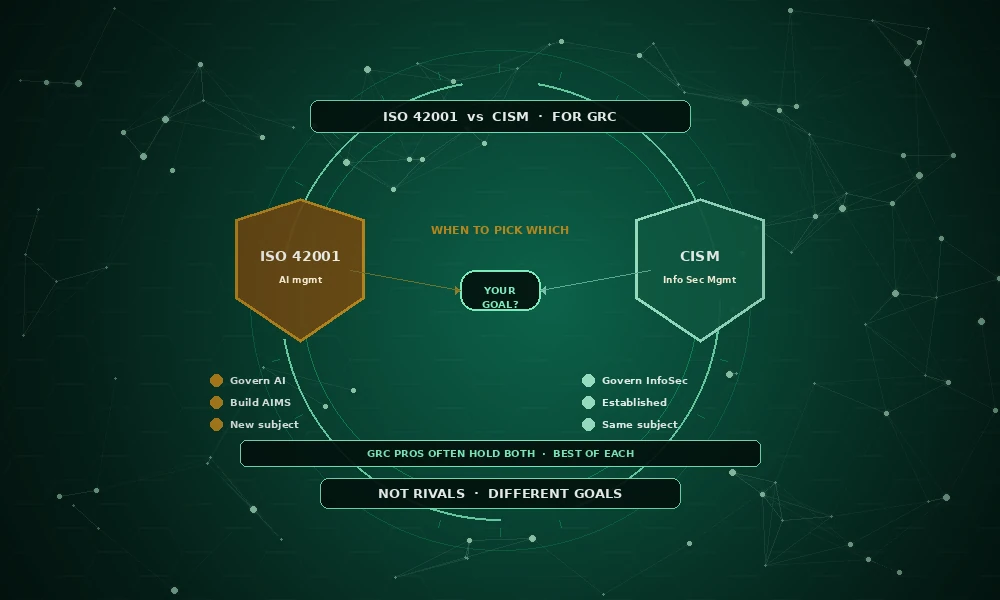
What CISM was never designed to cover is the governance of AI as AI. Its subject is information security, so the risks specific to AI systems sit outside its frame. That is not a flaw in CISM; it is simply the edge of what it was built to do.
What ISO 42001 equips a GRC professional to do
ISO 42001 begins exactly where AI-specific governance does. It is built to manage the risks that make AI different: bias and fairness, transparency and explainability, human oversight, and the way a model behaves and drifts across its lifecycle.
It gives a GRC professional a structured way to govern those risks, with a policy, controls, and accountability across the AI lifecycle, drawing on the same risk vocabulary as frameworks like the NIST AI Risk Management Framework. Where CISM secures the system, ISO 42001 governs the intelligence inside it.
For the AI slice of the GRC mandate, this is the purpose-built tool. It addresses the very rows a security credential leaves blank, which is easiest to see laid out directly.
The coverage map: where each credential reaches
Rather than rank the two, it is more useful for a GRC professional to see which responsibilities each one actually equips you to handle. Read down the AI-specific rows, because that is where the gap appears:
|
GRC responsibility for AI |
CISM equips you? |
ISO 42001 equips you? |
|---|---|---|
|
Information security of AI systems |
Yes, its core strength |
Partly, as one input |
|
Security program and incident response |
Yes |
Not its focus |
|
AI-specific risk, including bias and fairness |
No |
Yes |
|
Transparency and explainability of decisions |
No |
Yes |
|
Meaningful human oversight of AI |
No |
Yes |
|
Governing the AI system across its lifecycle |
No |
Yes |
|
Building a certifiable AI management system |
No |
Yes |
The pattern is plain. The two credentials barely overlap; they cover adjacent territory. CISM owns the security rows, ISO 42001 owns the AI-governance rows, and a GRC professional responsible for AI needs the second set covered whether or not they already hold the first.
Why this matters for GRC specifically
GRC exists to make sure risks are owned and obligations are met, and AI has quietly become both a major risk and a growing obligation. As the EU AI Act pushes organizations to demonstrate that their AI is governed, the AI-governance rows above stop being optional and become compliance requirements a GRC function must answer for.
A GRC professional who can only speak to the security rows will find themselves accountable for AI risks they are not equipped to govern. That is an uncomfortable place to stand, and it is exactly the exposure ISO 42001 is designed to close.
So for GRC, the comparison is less about which credential is more prestigious and more about which gaps you can afford to leave open. Given where regulation is heading, the AI-governance gap is not one to leave open for long.
What leaving the AI rows blank actually costs
It is worth being concrete about the cost of an uncovered gap, because it is not abstract.
A GRC function that governs only the security of AI can still be blindsided by a model that discriminates against a protected group, a decision no one can explain to a regulator, or an oversight step that exists on paper but not in practice. Each of these is an AI-governance failure, not a security failure, and none is caught by security controls alone.
Under tightening regulation, those failures carry real consequences, from failed audits to compliance breaches. Covering the AI rows is how a GRC function avoids being held accountable for risks it could not even see.
Choosing for your GRC role
Reduced to a decision, the choice depends on how much of your remit is now AI, and what you already hold:
-
If AI governance is a real and growing part of your remit, ISO 42001 fills the gap that a security credential leaves, and should be the priority.
-
If you already hold CISM, you have the security rows covered; ISO 42001 extends you into the AI rows without discarding anything.
-
If your work is still purely information security, CISM remains your core credential, and AI can wait until it enters your mandate.
-
If you advise across the whole GRC landscape, holding both gives you the security and the AI dimensions in one profile.
Sequencing the two on a limited budget
Few professionals can pursue everything at once, so the order matters as much as the choice.
If you already hold a security credential such as CISM, the higher-return next step is usually the AI-governance layer, because it covers ground you currently cannot. If you hold neither and your remit is genuinely AI-focused, starting with ISO 42001 addresses the most exposed part of your mandate first, and a security credential can follow when that dimension becomes central to your role.
The principle is simply to close your most exposed gap first. For most GRC professionals moving into AI, that gap is AI governance, not security.
How the two fit together in a GRC function
It is worth stressing that this is rarely a permanent either-or, because inside a real GRC function the two credentials do different jobs at the same time.
CISM-grade thinking keeps the security of AI systems sound, while ISO 42001 governs whether those systems are fair, transparent, and overseen. A mature GRC function needs both dimensions covered, whether by one person who holds both or by a team that splits them.
For an individual GRC professional, the practical implication is simple: identify which dimension your role is missing, and close that one first. For most, given the security background common in GRC, the missing dimension is AI.
Where a GRC professional should land
For most GRC professionals in 2026, the honest conclusion is that CISM and ISO 42001 answer different halves of the mandate, and the AI half is the one currently exposed. If you must choose where to invest next, and your remit includes AI, ISO 42001 is the credential that closes the gap the data keeps pointing to. In a mandate that now includes AI, covering that gap is less a matter of preference than of a job catching up with what it has quietly become.
None of this diminishes CISM, which remains excellent for what it governs. It simply was not built for AI, and AI is now the part of GRC growing fastest. To place both against the wider field of options, the best AI governance certifications set them in context, and the specifics of the move are laid out in AI governance for GRC professionals.
Questions GRC teams are asking
Does CISM cover AI governance?
Only partly, and only the security dimension. CISM governs information security, so it covers protecting AI systems and responding to incidents, but not AI-specific risks such as bias, transparency, human oversight, or lifecycle governance. Those sit outside what CISM was built to address.
Is ISO 42001 a replacement for CISM?
No. They cover adjacent territory rather than the same ground. CISM owns the security rows of AI risk; ISO 42001 owns the AI-governance rows. For a GRC professional, ISO 42001 extends coverage into AI rather than replacing a security credential.
Which should a GRC professional get first?
It depends on your remit. If AI governance is now part of your responsibilities, ISO 42001 should come first, because it closes the gap regulation is making urgent. If your work is still purely information security, CISM remains the priority until AI enters your mandate.
Why is AI governance a GRC responsibility at all?
Because AI is now both a significant risk and a growing compliance obligation, and owning risks and obligations is what GRC does. Surveys show ownership is still fragmented, which is precisely why GRC functions are being pulled in to bring structure to it.
Can one person cover both security and AI governance?
Yes, and many GRC professionals aim to, by adding an AI-governance credential to a security background. A mature GRC function needs both dimensions covered, whether by one person holding both or by a team that divides them between members.
Close the AI gap in your GRC toolkit
If AI now sits in your remit, the fastest way to cover it is a credential built for governing AI. AIGCI's Lead Implementer certification is aligned to ISO 42001 and built around delivering a real AI management system, so it slots directly into a GRC function. For the wider move, read AI governance for GRC professionals, explore the full range of ISO 42001 courses, and learn how the institute designs them by reading more about the institute.