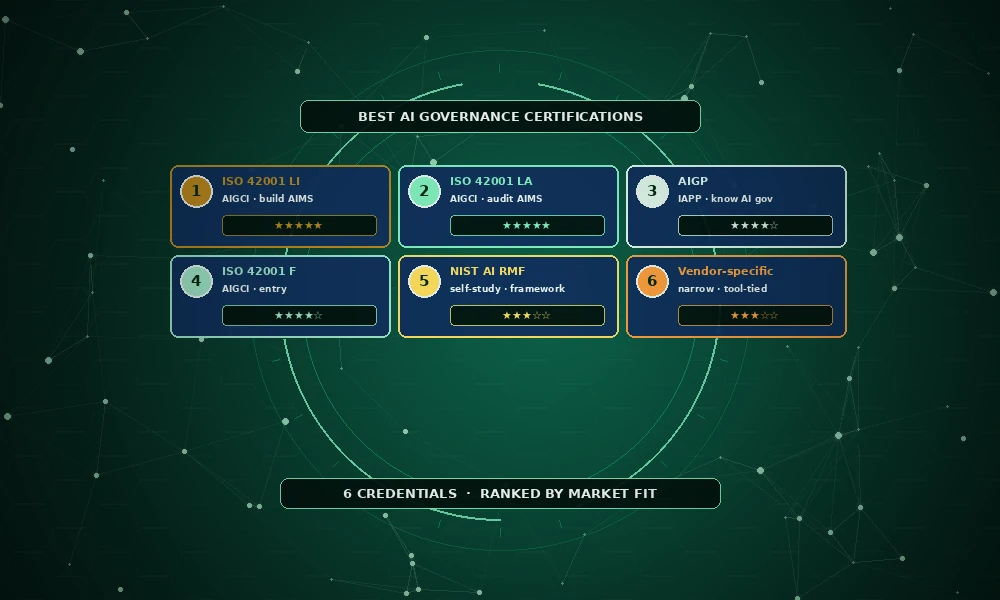
Search for the best AI governance certification and you will find a dozen ranked lists that quietly disagree with each other. The reason is simple: there is no single best, and any list that claims one is answering the wrong question.
What actually exists is a small set of credential families, each strong for a different goal. The most established anchor around two names the whole market recognises: ISO/IEC 42001:2023, the AI management system standard, and the AIGP, the individual governance credential from the IAPP.
This guide from the AI Governance Certification Institute (AIGCI) maps the families rather than forcing a ranking, shows the market data behind the choice, and helps you pick the one that fits your role. One honest note up front: no certificate opens the AI governance door on its own, so treat every option here as a complement to real experience.
There is no single best, only the best for your goal
The instinct to want a number-one pick is understandable, but it leads people astray, because these credentials are not competing for the same job.
One certifies an organization; another certifies a person's knowledge; another extends a security professional into AI. Ranking them against each other is like ranking a driving licence against a road map. The useful question is not which is best, but which is best for what you are trying to do.
So this guide is organised by goal. Find the row that matches your situation, and the best certification for you is the one sitting in it.
Why this guide does not give a numbered ranking
Most best-of lists hand you a number one. This one deliberately does not, and the reason is editorial honesty.
A numbered ranking implies the credentials compete on a single scale, when they do not. Ranking ISO 42001 above or below the AIGP would be like ranking a passport against a professional licence: both valuable, neither a replacement for the other. The ranking would look decisive and mislead you.
What serves you better is a map of what each family does and a clear way to match it to your goal, which is what this guide provides instead.
The two anchors: a provable standard and a professional credential
Two credentials dominate the conversation, and for good reason. They are the most recognised, and they answer the two most common needs.
ISO 42001 is the only certifiable AI management system standard, which means an organization can be independently audited and certified against it, and individuals can be credentialed to build or audit that system. It is the choice when the goal is to build, run, prove, or audit AI governance.
The AIGP is the leading individual credential for understanding AI governance, its laws, and its frameworks. Launched in 2024, it has already certified more than 5,000 professionals worldwide, a sign of how quickly the profession is forming. It is the choice when the goal is broad regulatory and governance literacy.
Because these two answer different questions, they are more often paired than pitted against each other. The full comparison is worth reading on its own, in our ISO 42001 vs AIGP head to head.
What makes a certification actually credible
Before choosing a family, it helps to know how to judge quality, because the word certification is unregulated and uneven.
Four things separate a credible credential from a hollow one. It is anchored to a recognised standard or body of knowledge rather than one provider's opinion. It is issued by an established, accountable organization. It is assessed rigorously enough that passing means something. And it is respected by the people you need to convince, whether employers, auditors, or clients.
Run any certification through those four tests and the field narrows quickly. The families this guide treats as load-bearing are the ones that pass on all four.
Red flags worth avoiding
The same unevenness means a few warning signs are worth watching for:
-
No recognised anchor. A certificate tied to nothing but its own course teaches a vocabulary that may not travel.
-
A promise of a job or salary. No credential opens the door alone, and any that guarantees it should be treated with suspicion.
-
Assessment in name only. If passing asks little of you, the certificate proves little to anyone else.
-
Marketing that outweighs substance. Prestige language is not the same as recognition by the people who actually hire.
The families of AI governance certification
Beyond the two anchors, the market sorts into a handful of families. Seeing them as categories, rather than a jumble of brand names, makes the field far easier to navigate:
|
Certification family |
What it certifies |
Best for |
|---|---|---|
|
Organizational AI standard (ISO 42001) |
That an organization runs a conforming AIMS, plus those who build or audit it |
Builders, auditors, and organizations seeking certification |
|
Individual governance credential (AIGP) |
That a professional understands AI governance, law, and policy |
Privacy, legal, compliance, and policy roles |
|
Security-adjacent AI credentials (bodies such as ISACA and IEEE) |
AI security and risk competence, often building on existing security certifications |
Security professionals extending into AI |
|
AI ethics and responsible-AI micro-credentials |
Awareness of ethical and responsible-AI principles |
Newcomers and broad organizational literacy |
|
Vendor and platform certifications |
Governing or securing AI within a specific tool or platform |
Teams standardized on one vendor's stack |
The first two families are the load-bearing ones for a governance career. The others are valuable in context: a security professional may add an ISACA AI credential to an existing certification, while ethics micro-credentials and vendor certifications suit awareness and tool-specific needs rather than a core governance role.
How to choose the best one for you
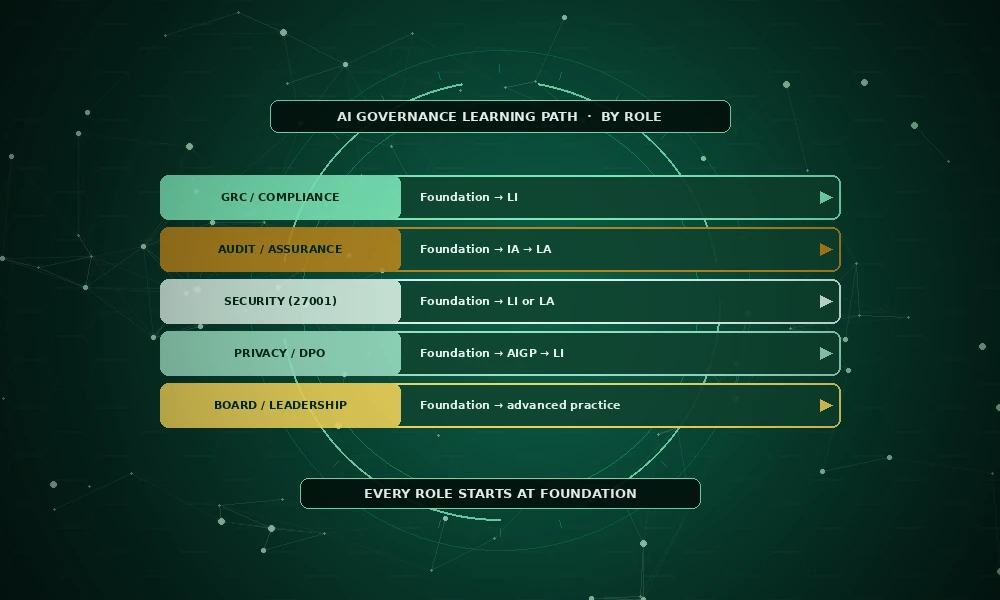
Matched to a goal, the choice becomes straightforward. Find yourself below:
-
You will build, run, or audit an AI management system: ISO 42001 credentials are the most directly useful, and the most provable.
-
Your organization wants a recognised certificate: only ISO 42001 can certify an organization, so that is the route.
-
You need broad command of AI laws and frameworks: the AIGP is built for that landscape view.
-
You are a security professional moving into AI: a security-adjacent AI credential extends what you already hold.
-
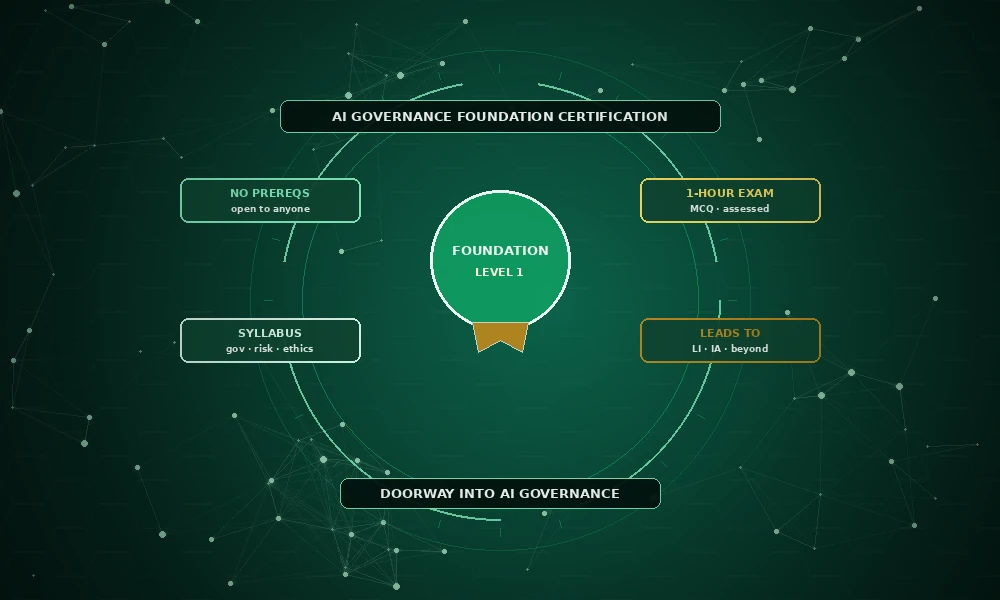
You need general AI literacy across a team: a foundation or responsible-AI micro-credential fits, without overinvesting.
The best certification by career stage
Your stage matters as much as your role, because the right credential shifts as you grow.
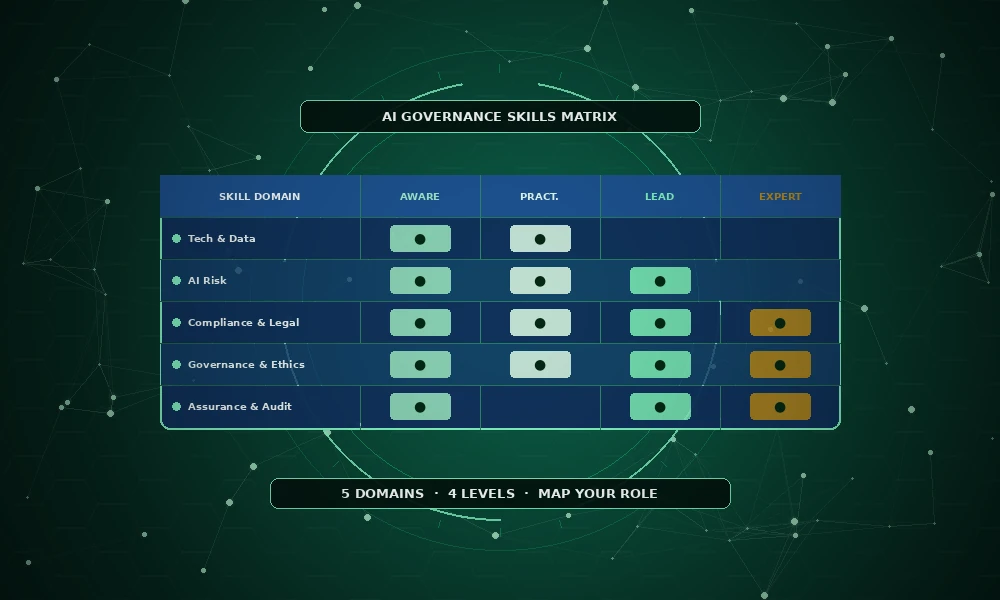
Newcomers are usually best served by a foundation or responsible-AI credential that builds literacy without overreaching. Mid-career professionals moving into governance benefit most from a credential that proves capability, typically an ISO 42001 route or the AIGP, depending on whether they build or advise. Senior professionals often hold more than one, pairing a provable systems credential with the regulatory breadth of the AIGP.
So the best certification is partly a moving target. What fits you now may not be what fits you in three years, which is a feature of a healthy career path rather than a flaw in the choice.
Why the choice matters more than it used to
Certifications matter now because employers are actively hiring for the skills behind them. Analyses of the market count roughly 2,000 United States job postings seeking an AI governance profile, with new postings appearing steadily week after week rather than in seasonal bursts.
That demand is being driven by regulation. As the EU AI Act pushes organizations to demonstrate that their AI is governed, the credentials that prove real capability, rather than mere awareness, are the ones rising fastest in value. Choosing well is no longer cosmetic; it shapes whether your credential is one the market is actually asking for.
Matching cost and effort to the payoff
Certifications differ enormously in what they ask of you, so it is worth matching the investment to your goal rather than your enthusiasm.
Individual credentials are, broadly, a course and an exam: a personal investment of study time and fees. Organizational certification against a standard is a different order of undertaking, a programme that involves building and proving a system over months. Confusing the two leads people either to over-invest in a credential their goal never required, or to under-invest in the one it did.
The sensible rule is to spend in proportion to the return your goal actually needs, and no more than that, because an unused credential returns nothing however prestigious it looked.
The honest caveat: no certificate is enough by itself
Any guide worth trusting has to say this plainly. A certification is a door-opener, not a substitute for having done the work.
Employers consistently prioritise demonstrated capability alongside formal credentials, which means the strongest position is a recognised certification backed by real governance experience. The best certification for you is therefore the one you will actually use, on real systems, not the one that looks most impressive unused on a profile.
Read that way, the ranking question dissolves. The best credential is the one that matches your goal and that you will put to work.
Our recommendation for most people
If you want a single, defensible starting point, and your work touches building or proving AI governance in any way, the ISO 42001 route is the strongest first move, because it is the only path that can prove capability to an auditor and an employer alike. Most people begin with the ISO 42001 Lead Implementer, which teaches you to build a real AI management system.
From there, the AIGP is a natural complement for the regulatory breadth it adds, and security professionals can layer in an adjacent AI credential. But if you take only one step, take the one that proves you can do the work, because that is the credential the market rewards most reliably.
Common questions about AI governance certifications
What is the best AI governance certification?
There is no single best; it depends on your goal. ISO 42001 credentials are best for building, auditing, or certifying an AI management system, while the AIGP is best for broad regulatory and governance knowledge. Choose by what you need to do, not by a ranking.
Which AI governance certification is most recognised?
ISO 42001 carries the authority of an accredited international standard and is the only one that can certify an organization. The AIGP is the most recognised individual governance credential. Together they are the two names the market consistently acknowledges.
Do I need more than one?
Not necessarily. Many people are well served by one credential matched to their role. Senior professionals who both advise on regulation and lead or audit systems often hold two, typically ISO 42001 plus the AIGP, but that is a choice driven by scope, not a requirement.
Are AI governance certifications worth it?
They are, provided you pair them with experience. Demand for AI governance skills is rising and employers are hiring for them, but no certificate opens the door alone. A recognised credential backed by real work is what carries weight.
Which should I get first?
For most people whose work involves building or proving AI governance, an ISO 42001 credential is the strongest first step because it demonstrates capability. If your role centres on regulatory interpretation, the AIGP may come first instead. Match the first credential to your most immediate need.
Start with the credential that proves capability
If you want a first certification that demonstrates you can actually govern AI, the ISO 42001 route is the most provable place to begin. AIGCI's Lead Implementer certification is built around delivering a real AI management system, and you can see the full range of options among the ISO 42001 courses. To learn how the institute designs its programmes, read more about the institute.