Most teams know they need AI governance skills. Very few can say precisely who has which of them, at what depth, and where the dangerous gaps are. A skills matrix is the tool that turns that vague worry into a concrete map.
A skills matrix maps competencies against roles and proficiency levels, so you can see, at a glance, the difference between the skills a role needs and the skills the person in it actually holds. That difference is the gap, and finding it is the whole point.
This guide from the AI Governance Certification Institute (AIGCI) gives you a ready-to-use AI governance skills matrix, explains the proficiency model behind it, and shows how to use it for yourself and your team. It builds on the competency framework, which defines the competencies this matrix then maps.
What a skills matrix does that a skills list cannot
A list of skills tells you what matters. A matrix tells you who has them, and that difference is everything when you are trying to close a gap.
The power of a matrix is that it holds two things at once: the level a role requires, and the level a person has. Lay those side by side across every competency and the gaps stop hiding. You can see the auditor who is strong on assurance but light on AI risk, or the team that has no one at expert level in AI law.
That is why a matrix is a planning instrument, not a poster. It converts a general sense that skills are missing into a specific, addressable list of who needs to develop what.
Who should own it
A matrix that belongs to no one quietly goes stale, so ownership matters from the start.
In most organizations the AI governance lead or the GRC function owns the matrix, keeping it current and using it in planning, while managers supply the evidence behind each rating and individuals own their own development against it. The point is that it is a shared, living instrument, not a one-off exercise that is filed and forgotten.
The proficiency levels: Aware, Working, Expert
A matrix needs a shared scale, or its ratings mean different things to different people. This one uses three levels, which is enough to be useful without becoming bureaucratic:
|
Level |
What it means |
How to recognise it |
|---|---|---|
|
Aware |
Understands the concept and why it matters |
Can discuss it and knows when to bring in an expert |
|
Working |
Can apply it competently in normal situations |
Performs the task reliably, with occasional guidance |
|
Expert |
Leads, judges hard cases, and sets the approach for others |
Handles ambiguity and is the person others consult |
One discipline makes these levels trustworthy: rate on evidence, not impressions. A rating should rest on observable behaviour and concrete examples, not on how confident someone sounds. Established skills frameworks such as SFIA take the same evidence-based approach across many levels of responsibility.
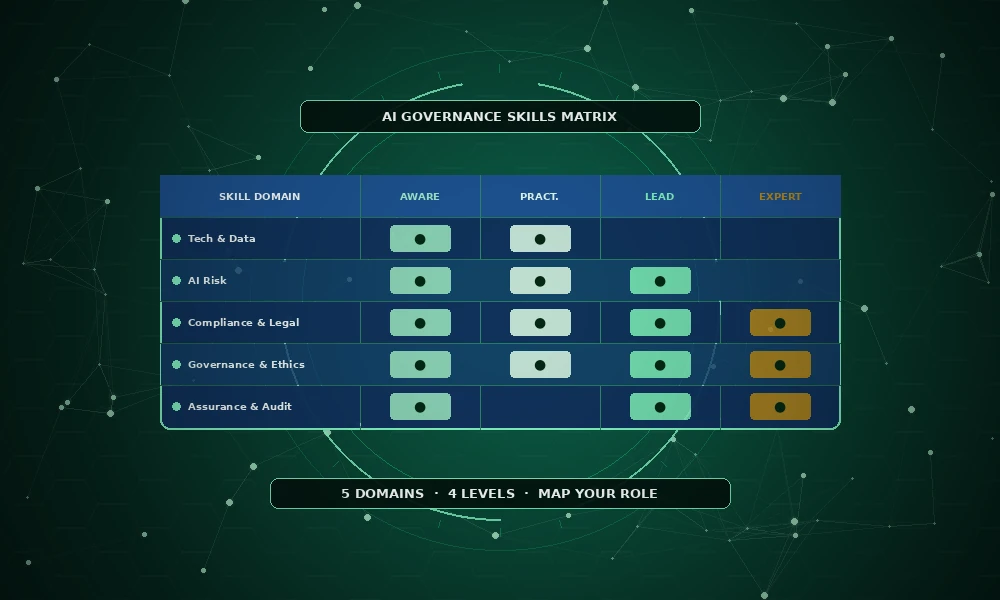
The AI governance skills matrix
Below is the matrix itself: eight core competencies mapped against four common AI governance roles, showing the proficiency each role typically needs. Read A as Aware, W as Working, and E as Expert. Treat it as a starting template to tailor, not a verdict.
|
Competency |
Lead Impl. |
Lead Auditor |
Gov. Officer |
GRC / Risk |
|---|---|---|---|---|
|
AI risk assessment and treatment |
E |
W |
E |
E |
|
Responsible AI and ethics |
W |
W |
E |
W |
|
AI management systems (ISO 42001) |
E |
E |
W |
W |
|
AI law and regulation |
W |
W |
E |
E |
|
Technical AI literacy |
W |
W |
W |
A |
|
Data governance |
W |
W |
W |
W |
|
Audit and assurance |
A |
E |
W |
W |
|
Leadership, communication, and change |
W |
A |
E |
W |
The competencies themselves are defined in detail elsewhere, so the matrix stays focused on the mapping rather than the definitions. What matters here is the shape it reveals.
How to read the matrix
Patterns emerge the moment you read across and down, and they are more instructive than any single cell.
Read across a row and you see how a competency spreads across roles. AI risk assessment, for instance, is needed at a high level almost everywhere, which marks it as a shared backbone skill. Read down a column and you see the profile of a role: the Lead Auditor peaks on assurance and AI management systems, while the Governance Officer peaks on law, ethics, and leadership.
The most useful cells are often the low ones. A role that only needs Awareness in a competency tells you where not to over-invest, which is as valuable as knowing where to build.
A worked example: reading one person's profile
It helps to see the matrix applied to a single person, because that is where it earns its keep.
Imagine a capable Lead Implementer rated Expert in AI management systems and Working in AI risk, responsible AI, data governance, and leadership, but only Aware in AI law. Against the target profile for their role, most cells are met, and one stands out: they sit a level short on AI law, where their role wants Working.
That single amber cell is worth more than a glowing overall impression. It names exactly what to develop next, turning a vague sense that someone is strong into a precise step, and it does so without diminishing everything they already do well.
How to use the matrix for yourself
As an individual, the matrix becomes a personal development map in three simple steps.
-
Pick your target role and read down its column to see the proficiency each competency requires.
-
Rate yourself honestly against each one, using evidence from real work rather than how you feel about it.
-
Mark the gaps where your level sits below the target, and you have a focused development plan rather than a vague ambition.
The discipline that makes this work is honesty. A matrix flattered by generous self-ratings maps a person who does not exist, and closes no real gap.
How to use the matrix for a team
At team or organizational level, the same tool answers harder questions that a list never could.
Populate the matrix for everyone in your AI governance function and three things surface. You see coverage, whether every required competency is held by someone at the right level. You see concentration risk, the single points of failure where only one person holds an expert skill. And you see hiring priorities, the gaps no amount of internal development will close quickly enough.
This turns workforce planning from guesswork into evidence. Instead of arguing about whether to hire or train, you can point at the cells that are empty and decide accordingly.
Which gaps to close first
A full matrix can reveal more gaps than you can close at once, so prioritisation matters as much as detection.
Three tests help you rank them. Close shared backbone gaps first, the competencies almost every role needs, such as AI risk assessment, because their impact is broad. Then address concentration risks, where one person is your only expert in something essential. Finally, close the role-critical gaps that stop someone doing the core of their job, such as an implementer who cannot yet apply ISO/IEC 42001:2023 in practice.
Ranking gaps this way keeps development focused on what protects the organization most, rather than on whatever happens to be easiest to train.
Why the gaps the matrix reveals are so common
If your matrix comes back full of holes, you are in the majority, and the data explains why. In its Future of Jobs Report 2025, the World Economic Forum found that the skills gap is the single biggest barrier to business transformation, cited by 63 percent of employers, ahead of every other obstacle.
The ground is also moving underfoot. The same research expects 39 percent of workers' core skills to change by 2030, which means an AI governance matrix is never finished. It is a living document that has to be revisited as both the field and the regulation around it evolve.
That churn is precisely why a matrix beats a one-time training push. Frameworks like the NIST AI Risk Management Framework keep redefining what good AI governance requires, and a matrix is how you keep your people mapped against a moving target rather than a fixed one.
What the matrix is not
A tool this tidy invites overconfidence, so a few honest limits are worth stating.
-
It is not a substitute for judgement. A grid of letters cannot capture the experience that turns Working into Expert.
-
Its levels are indicative, not universal. Tailor the target ratings to your own roles and risk, because no template fits every organization.
-
It measures skills, not outcomes. A well-skilled team can still fail if it lacks the mandate or resources to act.
Used with those caveats in mind, the matrix is a map. Like any map, it is invaluable for planning a route and useless as a substitute for the journey.
From matrix to development plan
A completed matrix is only worth the action it drives. The natural next step is to turn each gap into a development choice: train, hire, or reassign, matched to how urgent and how deep the gap is. The broader picture of how these skills fit together sits in the skills hub, which places the matrix within the wider field.
The sequence, then, is simple to say and demanding to do. Map first, then move. A matrix that reveals a gap and changes nothing is just a tidier way of not fixing the problem, whereas one that drives a plan is among the most useful tools an AI governance function can own, because it aims scarce development effort exactly where the organization is most exposed.
Common questions about the skills matrix
What is an AI governance skills matrix?
It is a tool that maps AI governance competencies against roles and proficiency levels, so you can compare the skills a role requires with the skills a person holds. The difference between the two is the gap, and revealing that gap precisely is what the matrix is for.
What competencies belong in it?
Common ones include AI risk assessment, responsible AI and ethics, AI management systems, AI law and regulation, technical AI literacy, data governance, audit and assurance, and leadership and change. The competency framework defines each in detail; the matrix maps them to roles and levels.
How many proficiency levels should I use?
Three, Aware, Working, and Expert, are usually enough to be useful without becoming bureaucratic. Whatever scale you choose, rate people on observable evidence and real examples rather than impressions, or the matrix will map confidence instead of competence.
How is a skills matrix different from a competency framework?
A competency framework defines what the skills are; a skills matrix maps who holds them, at what level, against which role. The framework is the vocabulary, and the matrix is the assessment built on top of it. You need the first to use the second well.
How often should the matrix be updated?
Regularly, because the field changes fast. With a large share of core skills expected to shift within a few years, treat the matrix as a living document reviewed at least annually, and sooner when regulation or your AI footprint changes materially.
Close the gaps the matrix reveals
Once your matrix shows where the gaps are, the fastest way to close the biggest ones is structured training that builds real capability. AIGCI's Lead Implementer certification develops several of the core competencies at once, and the full range of options sits among the ISO 42001 courses. To learn how the institute designs its programmes, read more about the institute.