AI and big data rank as the fastest growing skills for 2025 to 2030 in the World Economic Forum Future of Jobs Report 2025, yet few professionals can connect those skills to a working governance system. An AI governance competency framework closes that gap. It sets out the specific skills an organization needs to build, run, and prove an AI management system, and it groups them into six domains: technical and data, AI risk, compliance and legal, governance and ethics, implementation, and assurance and audit. The AI Governance Certification Institute (AIGCI) uses this framework to structure its ISO 42001 certifications, so each level builds a defined block of capability rather than a loose collection of topics.
An AI governance competency framework is a structured map of the knowledge, skills, and responsibilities required to govern artificial intelligence across its lifecycle, organized so that individuals and teams can be assessed, trained, and certified against it.
Key facts at a glance
|
Attribute |
Detail |
|---|---|
|
What it is |
A structured map of AI governance skills across six domains |
|
The six domains |
Technical and data, AI risk, compliance and legal, governance and ethics, implementation, assurance and audit |
|
Anchored to |
ISO/IEC 42001, the international AI management system standard |
|
Proficiency levels |
Aware, Practitioner, Lead, Expert |
|
Who it serves |
Individuals planning a career path, and organizations building AIMS capability |
|
Certifies against |
AIGCI ISO 42001 Foundation, Lead Implementer, Lead Auditor, Internal Auditor |
Why a competency framework, and why now
A framework is not paperwork. It answers a question regulators and standards now ask directly: can you show that the people governing your AI are competent to do so? ISO/IEC 42001 Clause 7.2 on competence requires an organization to determine the competence needed for anyone whose work affects AI performance or the effectiveness of the AI management system, to ensure that competence through education, training, or experience, to act where gaps exist, and to keep documented evidence of it. A competency framework is how you satisfy that requirement in a repeatable way.
Regulation reinforces the point. Under Article 4 of the EU AI Act, applicable since 2 February 2025, providers and deployers must ensure a sufficient level of AI literacy among staff and anyone operating AI on their behalf, whatever the risk level of the system. Together these turn AI skills from a nice to have into a documented obligation, and a framework gives you the shared vocabulary to meet it.
The six competency domains
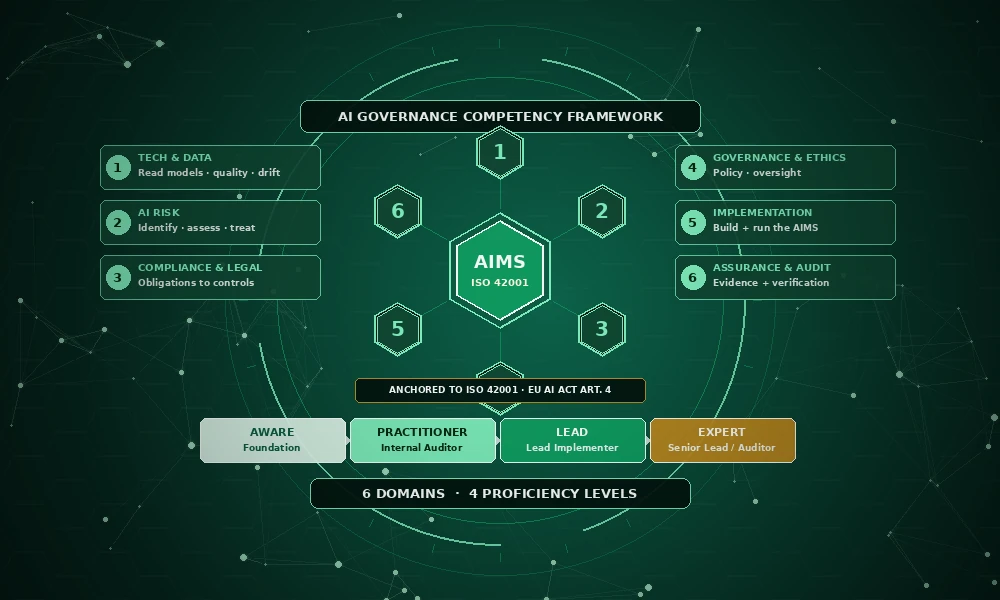
A credible framework spans far more than technical skill. The NIST AI Risk Management Framework makes the same case: its Govern function assigns AI risk roles across engineering, product, legal, risk, and business, because homogeneous teams miss risks that affect people unlike themselves. The six domains below sit around one shared object, the AI management system you govern to ISO/IEC 42001.
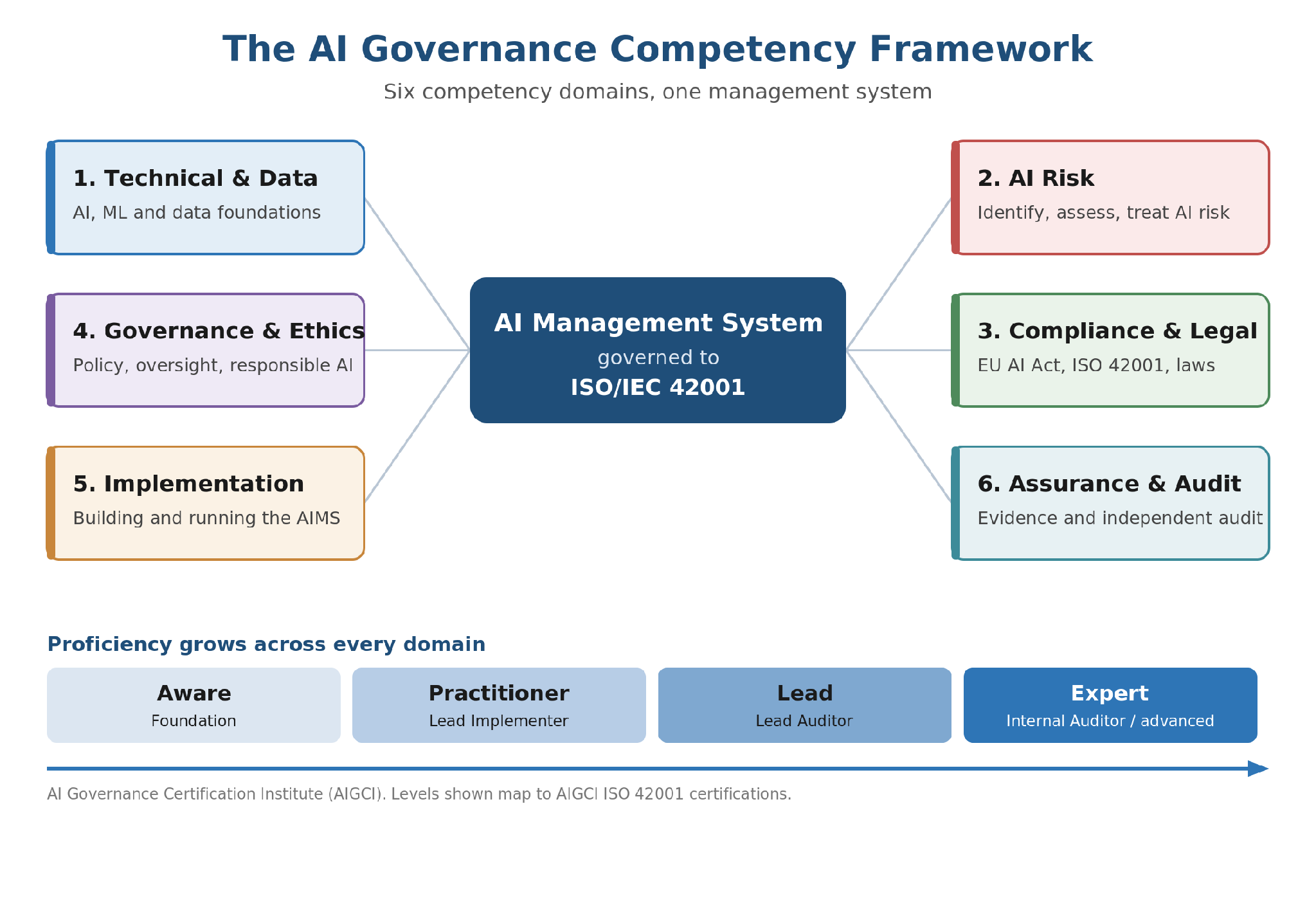
Figure 1. The six competency domains map to one AI management system and grow across four proficiency levels.
Technical and data competence underpins every judgement
You do not need to build models, but you do need to read them. This domain covers how AI and machine learning systems work, where data comes from, and how quality, bias, and drift arise. It lets a governance professional ask the right questions of an engineering team and understand the answers.
AI risk competence turns uncertainty into managed decisions
This domain covers identifying AI specific risks, assessing their likelihood and impact, and choosing treatments. It is the discipline that connects a vague worry about an AI system to a documented, owned, and monitored decision.
Compliance and legal competence maps obligations to controls
The EU AI Act, ISO/IEC 42001, sector rules, and data protection law each place duties on AI. This domain translates those duties into concrete controls and evidence, so obligations become something the organization can demonstrate rather than assert.
Governance and ethics competence sets the guardrails
Policy, oversight structures, accountability, and responsible AI principles live here. This domain decides who approves what, how issues escalate, and where the organization draws its ethical lines before a system goes live.
Implementation competence builds and runs the AIMS
Turning policy into a running management system is its own skill: scoping the AIMS, writing procedures, embedding controls into daily work, and keeping records current. This is the domain the Lead Implementer path develops most deeply.
Assurance and audit competence proves the system works
Finally, someone has to check that the system does what it claims. This domain covers gathering evidence, running internal audits, and preparing for external certification audits, using the same audit discipline that mature management systems rely on.
The competency matrix, from aware to expert
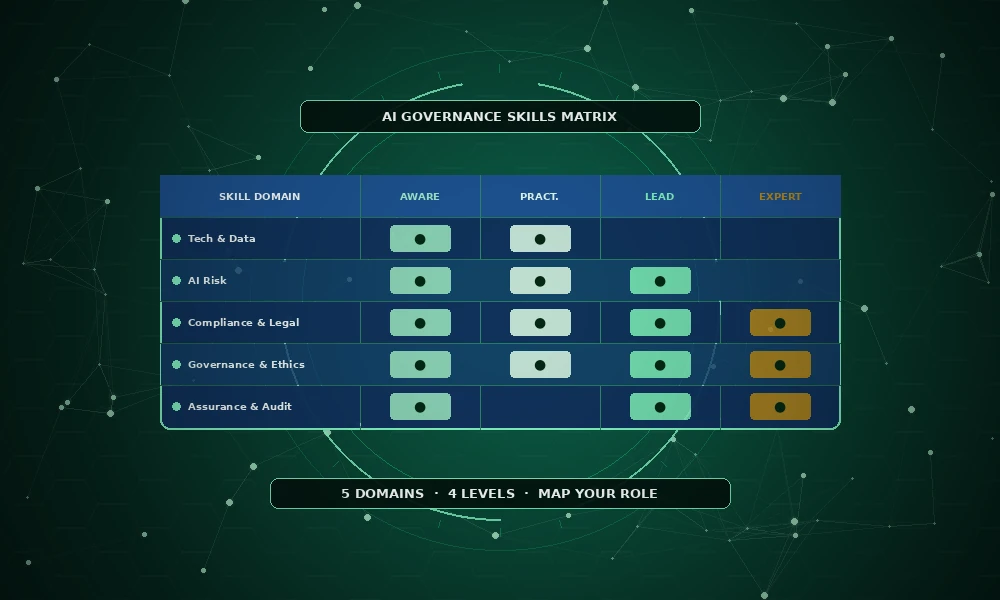
Every domain is developed in stages. The matrix below shows what each level looks like in practice, so an individual can locate where they stand today and an organization can see where its capability thins out. For a role by role version you can score a team against, see the skills matrix.
|
Domain |
Aware |
Practitioner |
Lead |
Expert |
|---|---|---|---|---|
|
Technical and data |
Reads AI and data basics |
Evaluates model and data risk |
Sets data governance standards |
Advises on complex AI systems |
|
AI risk |
Knows the risk vocabulary |
Runs AI risk assessments |
Owns the risk method |
Shapes enterprise risk strategy |
|
Compliance and legal |
Names the key obligations |
Maps rules to controls |
Leads a compliance programme |
Interprets emerging AI law |
|
Governance and ethics |
Understands the principles |
Applies policy to decisions |
Designs the governance model |
Chairs oversight and ethics review |
|
Implementation |
Follows the procedures |
Builds parts of the AIMS |
Leads full AIMS implementation |
Optimises AIMS across the enterprise |
|
Assurance and audit |
Understands why audit matters |
Gathers audit evidence |
Leads internal audits |
Directs certification and assurance |
How the framework maps to roles and certifications
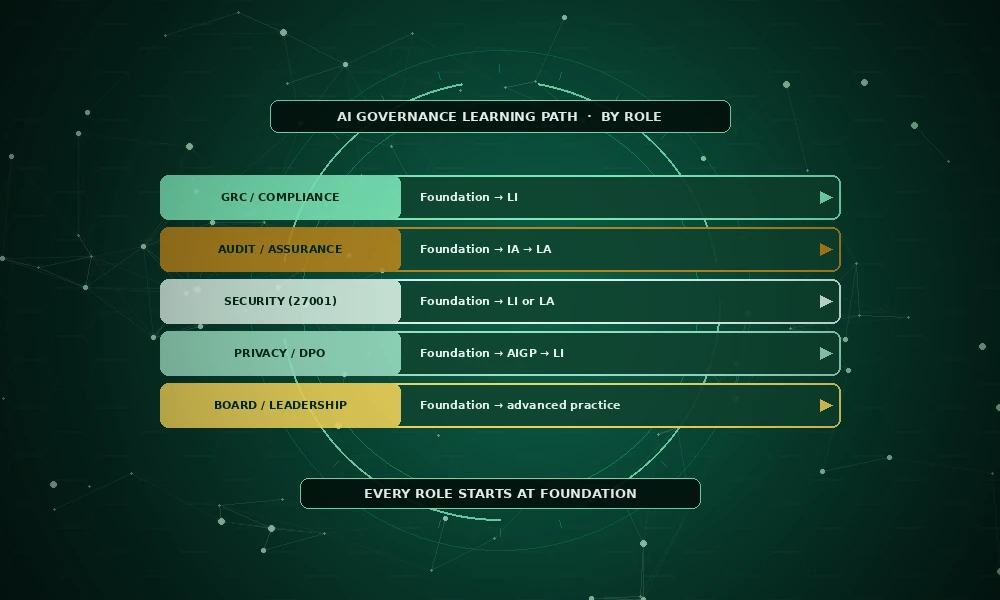
Because the domains are explicit, they line up cleanly with roles and with the certifications that build them. The mapping below is the backbone of the body of knowledge and it drives the learning path by role, so a professional can move from a job title to a defensible development plan.
|
Strongest domain |
Typical role |
Builds toward |
|---|---|---|
|
Technical and data |
AI or data lead informing governance |
Foundation |
|
Governance and ethics |
AI governance or policy owner |
Foundation, then Lead Implementer |
|
Implementation |
AIMS implementer or project lead |
Lead Implementer |
|
AI risk |
Risk and compliance manager |
Lead Implementer |
|
Compliance and legal |
Compliance, privacy, or legal counsel |
Foundation, then Lead Implementer |
|
Assurance and audit |
Internal or external auditor |
Lead Auditor or Internal Auditor |
Putting the framework to work
In the implementations we see, the hardest gap is rarely technical. Teams can describe their models. What stalls them is connecting risk, compliance, and audit into one defensible system that an external auditor would accept. That is the gap this framework is built to close, by making each capability visible so it can be assigned, trained, and evidenced. The demand is real: the IAPP AI Governance Profession Report 2025 finds that access to trained AI governance talent is one of the field's binding constraints, which is exactly why mapping and certifying capability has become a priority rather than an afterthought.
Used well, the framework becomes a planning tool. An individual scores themselves across the six domains, finds the two or three that matter most for their target role, and picks the certification that develops them. An organization runs the same exercise across a team, spots the domain where it is thinnest, and closes that gap before its first audit. The competency framework is the map; ISO/IEC 42001 is the destination, and the skills matrix, body of knowledge, and learning path are the routes between them.
Frequently asked questions
Do I need a technical background to work in AI governance?
No. Four of the six domains, risk, compliance, governance, and audit, are not technical build skills. A working understanding of how AI systems behave is enough for most governance roles, and the Foundation level develops it.
How does the framework relate to ISO 42001?
It operationalizes the competence requirement in Clause 7.2 of ISO/IEC 42001. The standard says people must be competent and that competence must be evidenced; the framework defines what that competence actually is, domain by domain.
Which domain should I start with?
Most people start with governance and ethics and with implementation, because those are the domains that carry a new AI management system. The Foundation certification introduces all six before you specialise.
Is the framework only for large organizations?
No. A small team may hold several domains in one or two people. The framework still helps, because it shows which capabilities those individuals need rather than leaving the gaps hidden.
How is proficiency measured?
Against four levels, from aware to expert, evidenced through certification and practical work. The matrix in this article gives the descriptor for each level so progress can be judged consistently.
Build the competencies that matter
The fastest way to develop these domains in a structured, certified sequence is through the ISO 42001 certification courses from AIGCI, which are built directly on this framework. Start with Foundation for full coverage of all six domains, then specialise where your role needs depth. To see how AIGCI structures the wider programme, read more about the institute.