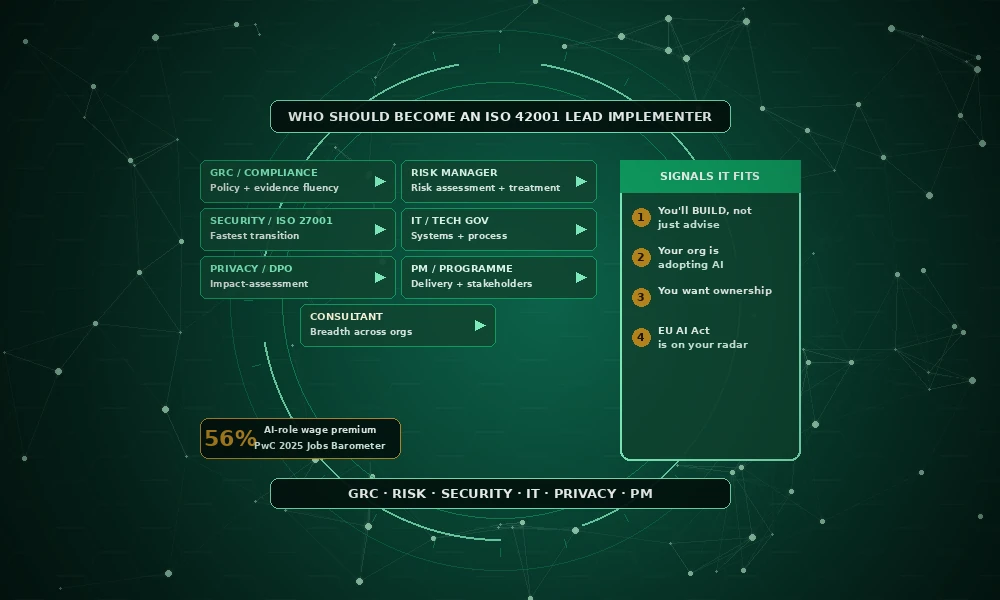
Jobs that require AI skills now pay a 56% wage premium over comparable roles, up from 25% a year earlier, according to PwC's 2025 Global AI Jobs Barometer, its analysis of close to a billion job ads. Few of those skills are scarcer, or more valued, than the ability to actually govern AI. The ISO 42001 Lead Implementer is the certification that builds that ability, so the real question is not whether it is worth having, but whether it fits you.
This page is about audience fit rather than eligibility. It sets out the professional roles the Lead Implementer is built for, how your current role maps to it, the signs it is right for you, and who is better served by starting somewhere else first.
The people the Lead Implementer is built for
The Lead Implementer is for professionals who will build and own AI governance, not just understand it. In practice, AI governance is landing on the people already closest to risk and controls: governance, risk, and compliance teams, security and IT professionals, and privacy specialists. These are the roles that turn a policy into a working system, and they are exactly the roles the certification is designed to equip. For the detail of what the position involves day to day, see the roles it suits, which breaks the responsibilities down in full.
How your current role maps to the Lead Implementer
Most people who thrive as Lead Implementers arrive from an adjacent role and bring a specific advantage with them. The profiles below show how a current role translates into the certification, and the edge you already hold. You do not need to match a profile exactly; one close fit is enough.
|
If your role is |
Why the Lead Implementer fits |
The edge you bring |
|---|---|---|
|
GRC or compliance professional |
You already run governance, policy, and evidence; the certification adds the AI dimension |
Policy and audit fluency |
|
Risk manager |
Implementing an AI management system is largely risk work |
Risk assessment and treatment |
|
Security or ISO 27001 practitioner |
ISO 42001 shares its structure with ISO 27001, so the transition is fastest |
Controls and management-system experience |
|
IT or technology governance lead |
You already manage systems, access, and process |
Systems and process knowledge |
|
Privacy or data protection professional |
AI governance overlaps with data governance and impact assessment |
Impact-assessment experience |
|
Project or programme manager |
Building an AIMS is a structured delivery project |
Delivery and stakeholder skills |
|
Consultant or advisor |
Clients increasingly need help implementing an AIMS |
Breadth across organizations |
Signs it is the right certification for you
Beyond your job title, a few situational signs point strongly toward the Lead Implementer. If several of these are true, it is likely the right step.
-
You will build, not just advise. Your role involves setting up governance and controls, not only commenting on them.
-
Your organization is adopting AI. There is real AI in use or on the way, and someone needs to bring it under control.
-
You want ownership. You are aiming to lead an AI governance program rather than contribute at the edges.
-
Regulation is on your radar. Obligations such as the EU AI Act mean your organization must show documented oversight, and you want to be the person who can deliver it.
Who should start somewhere else first
The certification is not the right first step for everyone, and saying so is part of pointing you well. If AI governance is entirely new to you, start with Foundation, which builds the shared language the Lead Implementer then applies; you will get far more from the professional level with that base in place. If your work is primarily about evaluating governance rather than building it, an auditor pathway will fit better. And if you only need working awareness rather than the ability to implement, Foundation alone may be all you require. None of these is a step down; each is simply the better-matched place to begin.
The bottom line
You should become an ISO 42001 Lead Implementer if you will own the building of AI governance and you come from, or are moving into, a governance, risk, compliance, security, IT, or privacy role. The demand is real and the skills are rewarded, and the credential turns an adjacent professional into the person who can actually deliver an AI management system. For the complete picture of the certification, read the full guide, and when you are ready, the ISO 42001 Lead Implementer certification is the step that fits.
Frequently asked questions
Who is the ISO 42001 Lead Implementer certification for?
It is for professionals who will build and own AI governance, typically coming from governance, risk, compliance, security, IT, or privacy roles. If your work involves setting up policies, controls, and oversight rather than only advising on them, the certification is designed for you.
Is it suitable for someone from a security or ISO 27001 background?
Very much so. ISO 42001 shares its management-system structure with ISO 27001, so security and ISMS practitioners often make the fastest transition. Your controls and audit-readiness experience transfers directly to building an AI management system.
Can privacy or GRC professionals become Lead Implementers?
Yes, and they are among the most natural fits. AI governance overlaps heavily with privacy, impact assessment, and governance, risk, and compliance work, so professionals in those fields already hold much of the thinking the role requires.
Should a complete beginner take the Lead Implementer?
Usually it is better to start with Foundation first, which builds the shared language the Lead Implementer applies. Beginners get far more from the professional level once they have that grounding, and the two levels are designed to build on each other.
Is it worth becoming a Lead Implementer given the demand for AI skills?
Demand for people who can govern AI is strong and growing, and roles requiring AI skills carry a significant wage premium according to PwC's 2025 analysis. The Lead Implementer targets one of the scarcer of those skills, the ability to actually implement AI governance.