The fastest way to choose between these two is to notice they answer different questions. Pick the question you actually need answered, and the credential chooses itself.
A credential in ISO/IEC 42001:2023, the AI management system standard, answers a doing question: can we build, run, or prove a system that meets the standard? The AIGP, the Artificial Intelligence Governance Professional credential, answers a knowing question: what do the laws and frameworks actually require?
The tracker frames them as alternatives, and for a single decision they often are. But the sharper truth is that they solve different problems, and most people have one problem that is more pressing than the other right now.
This guide from the AI Governance Certification Institute (AIGCI) compares them from the doing side first, shows the data that shapes the choice, and explains when ISO 42001 should come before anything else.
Start from your problem, not the acronym
The comparison gets easier the moment you stop asking which credential is better and start asking what you are trying to accomplish.
Most people arrive with one of two problems. Either they need to make AI governance real and provable inside an organization, or they need to understand the rules well enough to advise on them. Name your problem honestly, and the rest of this comparison becomes mostly confirmation of a choice you have already half made.
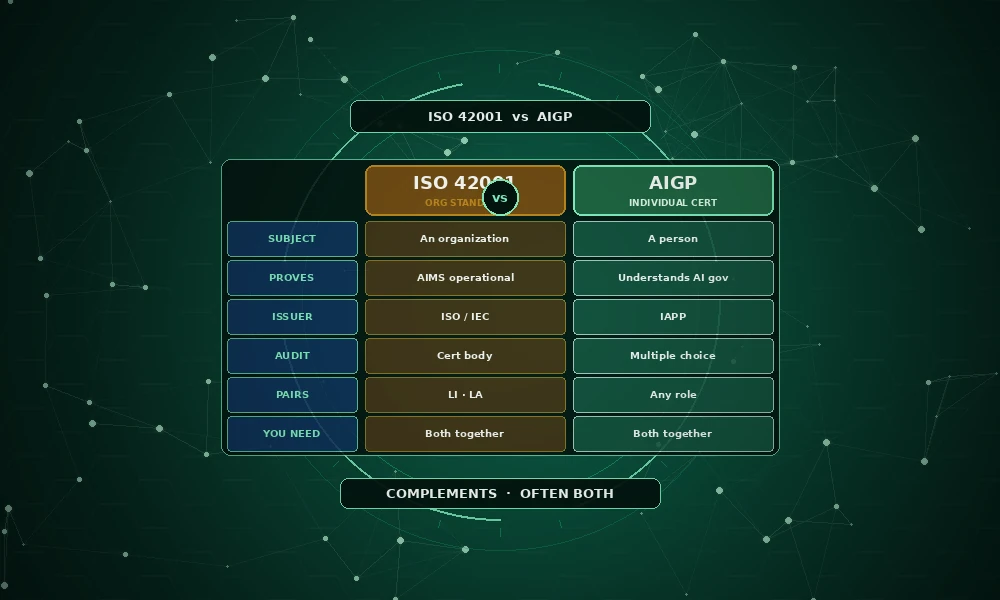
ISO 42001 certifies an organization; AIGP certifies a person
The first difference is structural, and it settles more than it seems to. These two credentials attach to different things entirely.
ISO 42001 is the only certifiable AI management system standard, which means an organization, not just a person, can be certified against it after an independent audit. It also carries individual credentials, such as Lead Implementer and Lead Auditor, for the people who build and check that system.
The AIGP attaches only to a person. It certifies that an individual understands AI governance, its laws, and its frameworks. There is no such thing as an organization that is AIGP certified, because the credential was never designed to certify one.
So before comparing content, fix this in mind: one can prove an organization, the other can only prove a professional. If you need the first, the choice is already narrowing.
ISO 42001 answers 'prove it'; AIGP answers 'what is required'
Beneath the structure sits a difference in mindset, and it is the most useful lens for choosing.
People who hold an ISO 42001 credential tend to ask a systems question: does our management system meet the standard, and where are the gaps? Their instinct is to build, test, and evidence.
People who hold the AIGP tend to ask a landscape question: what does the regulation require, and how should we think about it? Their instinct is to interpret, advise, and map the rules.
Neither instinct is superior, but they are not interchangeable. If your work is to make governance real and provable, you need the first. If your work is to understand and navigate the rules, you need the second.
ISO 42001 builds evidence; AIGP builds understanding
A single example shows how differently the two operate on the very same obligation.
Suppose the rules require meaningful human oversight of a high-impact model. An AIGP holder can explain what that obligation means, where it comes from, and why it matters. An ISO 42001 implementer produces the thing an auditor will accept as proof: a documented oversight procedure, records that it was followed, and evidence that the human can genuinely intervene.
Understanding and evidence are both necessary, but they are not the same output. The AIGP ends at knowing what is required; ISO 42001 ends at proving it was actually done.
ISO 42001 and AIGP, side by side
Set against the factors that actually drive a decision, the two separate cleanly. Read the certifiable row first, because it is the one that decides many cases outright:
|
Decision factor |
ISO 42001 |
AIGP |
|---|---|---|
|
What gets certified |
An organization's AI management system, plus the people who build or audit it |
An individual's AI governance knowledge |
|
What it proves |
You can build, run, or audit a conforming system |
You understand AI laws, frameworks, and responsible AI |
|
Certifiable at organization level |
Yes, the only certifiable AI management system standard |
No, individual only |
|
Typical investment |
Organization certification reported at roughly 15,000 to 50,000 dollars, plus individual course fees |
An individual course and exam fee |
|
When it is needed |
To prove governance under procurement or regulatory pressure |
When a role needs broad regulatory and governance literacy |
|
Best suited to |
Builders, auditors, and organizations seeking certification |
Compliance, legal, and policy professionals |
The investment row makes the difference concrete. ISO 42001 can be an organizational programme with a five-figure certification cost, while the AIGP is a personal exam. They are not competing for the same budget line, which is a clue that they are not really competing at all.
The EU AI Act rewards both credentials
Regulation is the force lifting both, which is why framing them as rivals misses the moment. As the EU AI Act moves organizations toward demonstrating, not merely asserting, that their AI is governed, it creates demand on two fronts at once.
It rewards people who understand what the rules require, which is the AIGP's territory, and it rewards organizations that can prove a working system, which is ISO 42001's territory. The same regulatory pressure that makes one valuable makes the other valuable too.
That shared tailwind is the strongest argument against treating this as a simple either-or. The market is expanding both, not choosing between them.
Lead Implementer builds the system AIGP describes
The clearest way to see how the two connect is through the implementer. The AIGP describes, in principle, what responsible AI governance should look like. The ISO 42001 Lead Implementer route is how someone actually builds it.
An AIGP holder can explain why a model needs oversight and what the law expects; a Lead Implementer turns that into a policy, a control, and evidence an auditor will accept. One names the destination, the other lays the road.
This is why senior professionals increasingly hold both. But if you can only pursue one now, ask which half of that pair your work actually requires, because that is the half worth buying first.
How a team actually uses both
Inside a mature organization, the two credentials tend to sit in different chairs.
AIGP-minded professionals often sit in legal, policy, or compliance, translating regulation into positions the business can adopt. ISO 42001 practitioners sit closer to the systems, turning those positions into controls, running the management system, and preparing for audit. The first group decides what good looks like; the second makes it real and keeps it that way.
Seen like this, an organization rarely chooses between them at all. It staffs both, which is another reason the individual choosing a credential should pick by the chair they want to sit in.
Choose by your goal, not by reputation
Reduced to a decision, the choice follows your goal with little ambiguity:
-
Building, running, or auditing an AIMS? ISO 42001 is the credential that proves you can, so start there.
-
Getting an organization certified? Only ISO 42001 can do that, because the AIGP cannot certify a company.
-
Advising on the regulatory landscape across frameworks? The AIGP is built for that breadth of knowledge.
-
Operating at both the policy and systems level? The combination is increasingly common among senior governance leaders.
Common mistakes when choosing between them
A few predictable errors send people to the wrong credential:
-
Buying the AIGP to certify an organization, which it cannot do at all.
-
Expecting ISO 42001 to teach the whole regulatory landscape, when its focus is the management system.
-
Choosing by prestige or acronym rather than by the problem in front of you.
-
Assuming you must pick one forever, when many professionals end up holding both.
When ISO 42001 should come first
For a large share of readers, ISO 42001 is the one to earn first, and the reason is practical rather than partisan. Employers and buyers increasingly want proof that governance works, not only that someone understands it, and proof is what ISO 42001 is built to provide.
If your organization uses AI in ways that attract scrutiny, or if your role is to deliver or audit governance rather than to opine on it, ISO 42001 answers the more urgent question. The AIGP then becomes a valuable complement, deepening the regulatory context around a system you can already build. For the full field of options set against each other, the best AI governance certifications overall place both in context.
One credential is often enough
It is worth saying plainly, because the industry loves to sell both: many people never need the second.
If your entire role is to build and prove AI management systems, ISO 42001 alone can carry a career, and the AIGP would mostly confirm context you already absorb on the job. If your role is purely to advise on regulation and never to build, the reverse holds just as firmly. The both option is real, but it suits people whose work genuinely spans policy and systems, not a default everyone must reach for.
So treat holding both as an eventual possibility, not an obligation. Start with the one your work needs now, and let the second earn its place only if your work grows to demand it.
The bottom line
ISO 42001 versus AIGP is best settled by the question you need answered. If you must build, audit, or certify a system, ISO 42001 is the credential that proves it, and for most people with a doing problem it comes first.
If you must understand and navigate the rules, the AIGP is built for that, and the two together are stronger than either alone. Choose the one your work demands now, and add the other when your work grows into it.
Frequently asked questions
Is ISO 42001 or AIGP better?
Neither is universally better; they answer different questions. ISO 42001 proves you can build, run, or certify an AI management system, while the AIGP proves you understand AI laws and frameworks. The better choice is the one that matches whether your problem is doing governance or understanding it.
Can AIGP certify my organization?
No. The AIGP is an individual credential only. If you need to certify an organization's AI governance, ISO 42001 is the answer, because it is the only certifiable AI management system standard, awarded after an independent audit.
Which should I get first?
For most people with a doing problem, building, auditing, or certifying a system, ISO 42001 comes first, because it proves capability the market increasingly demands. If your role centres on regulatory interpretation across frameworks, the AIGP may come first instead.
How much does each cost?
They sit on different scales entirely. Organization-level ISO 42001 certification is a five-figure programme cost, while individual credentials, including the AIGP, are course-and-exam fees. Because they are different kinds of investment, comparing their prices directly can mislead more than it informs.
Do professionals hold both?
Increasingly, yes. Senior governance leaders and consultants who must both advise on the rules and lead or audit real systems often hold both, because each covers a half the other does not. If you can only pursue one now, let your current work decide which.
Prove it with the credential that builds it
If your problem is doing governance, building, running, or certifying an AI management system, the credential that proves it is ISO 42001. AIGCI's Lead Implementer certification is built around delivering a real system, not describing one. To weigh every option in one place, read the best AI governance certifications overall, explore the full range of ISO 42001 courses, and learn how the institute designs them by reading more about the institute.