Framing this as Foundation versus Lead Implementer suggests a choice between rivals, but the two certifications are not alternatives. They are steps. Foundation certifies that you understand AI governance and ISO/IEC 42001; the Lead Implementer certifies that you can build the management system the standard defines. One leads to the other, so the real question is not which to pick, but how far along the path you need to go.
Foundation and Lead Implementer are steps, not rivals
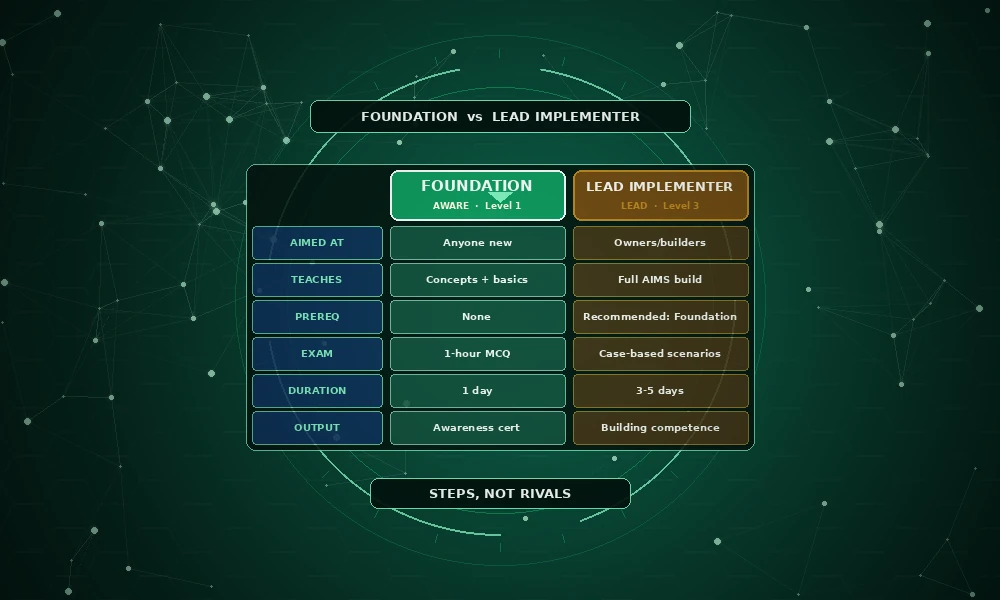
The clearest way to think about the two is as a sequence. Foundation comes first and builds the shared language of AI governance, including what an AI management system is, what the standard requires, and the responsibilities involved. The Lead Implementer comes next and turns that understanding into the ability to establish, run, and improve the system in a real organization. Foundation is the recommended precursor to the Lead Implementer, which is why the honest comparison is less about winner and loser and more about where you should stop or continue.
Foundation vs Lead Implementer, side by side
Set against each other on the dimensions that matter, the difference becomes concrete. Notice that the two are complementary rather than competing: each certifies a different thing.
|
Dimension |
Foundation |
Lead Implementer |
|---|---|---|
|
What it certifies |
Understanding of AI governance and ISO/IEC 42001 |
The ability to build and run an AI management system |
|
Level |
Entry, foundation tier |
Professional tier |
|
Depth |
Understand the standard |
Apply and implement the standard |
|
Best for |
Anyone needing the shared language, including beginners |
Those who will implement and own the AIMS |
|
Duration |
Around two days of equivalent learning |
Around four days of equivalent learning |
|
Prerequisite |
None |
Foundation recommended, plus a relevant background |
|
What you can do after |
Contribute to governance and choose your next step |
Establish, run, and improve an AI management system |
When Foundation on its own is enough
Foundation is the right stopping point for more people than you might expect. If your role is to understand and contribute to AI governance rather than to build it, Foundation gives you what you need: the language to take part in decisions, review policies with understanding, and work alongside implementers and auditors. Executives, legal and privacy colleagues, and cross-functional team members often need exactly this and no more. Choosing to stop at Foundation is not settling for less; it is matching the certification to the responsibility you actually hold.
When you need the Lead Implementer
You need the Lead Implementer when you will construct the system, not just understand it: designing the policy, assigning roles, treating risk, operating controls, and preparing for audit. This is also where the market is moving. According to PwC's 2025 Global AI Jobs Barometer, roles requiring AI skills grew 7.5% even as total job postings fell 11.3%, and the ability to implement AI governance is among the scarcer of those skills. If your work involves building oversight, or obligations such as the EU AI Act mean your organization must show it, the Lead Implementer is the level that equips you to deliver.
Foundation vs Lead Implementer at a glance
The short version is a simple decision. Everyone benefits from Foundation. Continue to the Lead Implementer if you will build and own the system; stop at Foundation if you need to understand and contribute. The one-page summary below captures the comparison for quick reference, and is available as a download.
|
If this is you |
The right level |
|---|---|
|
New to AI governance, or you need shared language to take part |
Foundation |
|
You will design, build, and run the AI management system |
Foundation, then Lead Implementer |
|
You advise, review, or contribute rather than implement |
Foundation is likely enough |
|
You own or lead the AI governance program |
Foundation, then Lead Implementer |
The recommended sequence
For most people the answer is not either or, but in order. Begin with the Foundation certification to build the shared language, then continue to the Lead Implementer when you are ready to build the system; the two are designed to work together, and the step up is gentler with the base in place. For the full detail of the professional level, see the Lead Implementer guide, and when you are ready to enrol, the ISO 42001 Lead Implementer certification is the next step after Foundation.
Frequently asked questions
Should I take Foundation or Lead Implementer first?
Foundation first, in almost every case. It builds the shared understanding the Lead Implementer applies, so taking it first makes the professional level more manageable and more valuable. The two are sequential steps rather than competing choices.
Is Foundation required before the Lead Implementer?
It is strongly recommended rather than an absolute rule, and it is the smoothest route. Foundation is the recommended precursor because the Lead Implementer builds directly on it, though people with a closely related background sometimes start at the professional level.
What is the main difference between the two?
Foundation certifies that you understand AI governance and ISO/IEC 42001; the Lead Implementer certifies that you can build and run an AI management system. One is about understanding the standard, the other about applying it.
Is Foundation enough on its own?
For many roles, yes. If you need to understand and contribute to AI governance rather than implement it, Foundation gives you the language and grounding you need. You only need the Lead Implementer if you will actually build the system.
Which is better for my career?
They serve different purposes rather than one being better. Foundation is the essential grounding; the Lead Implementer is the credential that lets you build AI governance, a capability in growing demand. Most careers in implementation move through both, in that order.
The bottom line
Foundation versus Lead Implementer is the wrong frame. Foundation is where nearly everyone should begin, and the Lead Implementer is where you go if you will build and own the AI management system. Decide by the responsibility you hold: understand and contribute, and Foundation is enough; build and lead, and the Lead Implementer is the step that follows. In both cases the path runs through Foundation first.