Most people prepare for this exam backwards. They chase the format, hunt for question banks, and try to memorise clause numbers, when the exam for ISO/IEC 42001:2023, the AI management system standard usually shortened to ISO 42001, is built to test something memorisation cannot deliver: whether you can apply the standard to build a working AI management system.
Preparation improves exam success only when it mirrors that. The most reliable way to prepare, then, is to study the standard the way it is actually built, and to practise using it rather than reciting it.
This guide from the AI Governance Certification Institute (AIGCI) gives you a clause-by-clause study map, a phased plan, and the honest list of mistakes that quietly sink well-intentioned candidates.
The Lead Implementer exam tests application, not recall, so the strongest preparation follows the standard's own architecture: learn the clause structure, then practise implementing it on a real organization until the decisions feel routine.
|
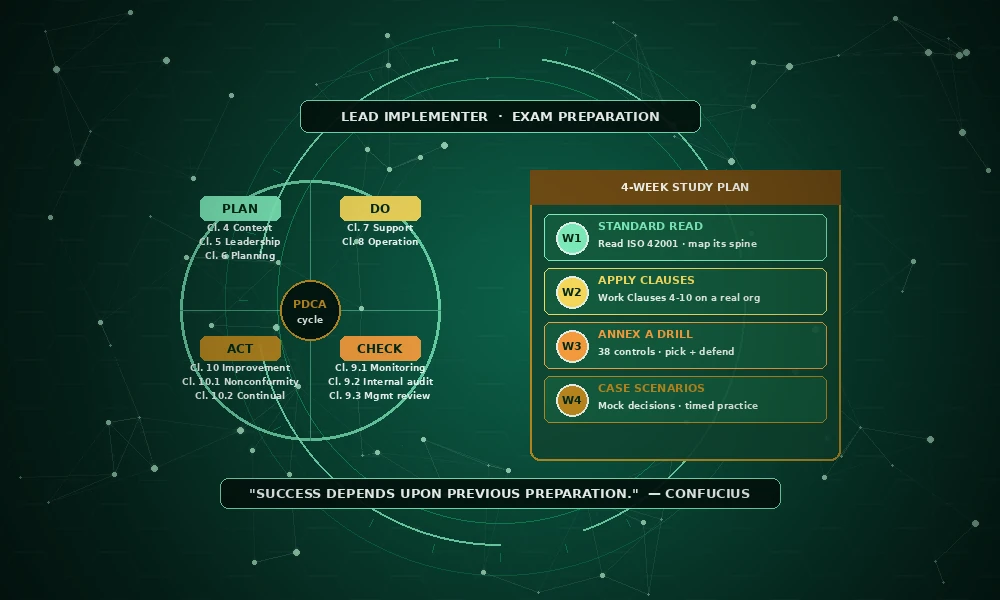
"In all things, success depends upon previous preparation, and without such preparation there is sure to be failure." Confucius, the Doctrine of the Mean |
The line is more than two thousand years old, and it still describes this exam better than any modern study tip. The exam does not reward last-minute effort; it rewards the quiet, structured preparation done in advance. What follows is how to make that preparation count, so that on the day the questions feel like familiar decisions rather than surprises.
First, be clear about what you are preparing for
Before building a study plan, fix the target in your mind, because preparing for the wrong thing wastes weeks. The Lead Implementer exam checks whether you can put an AI management system in place: define its scope, lead it, assess AI risk, operate controls, and improve the system over time. It is an applied exam, which is why rote learning underperforms.
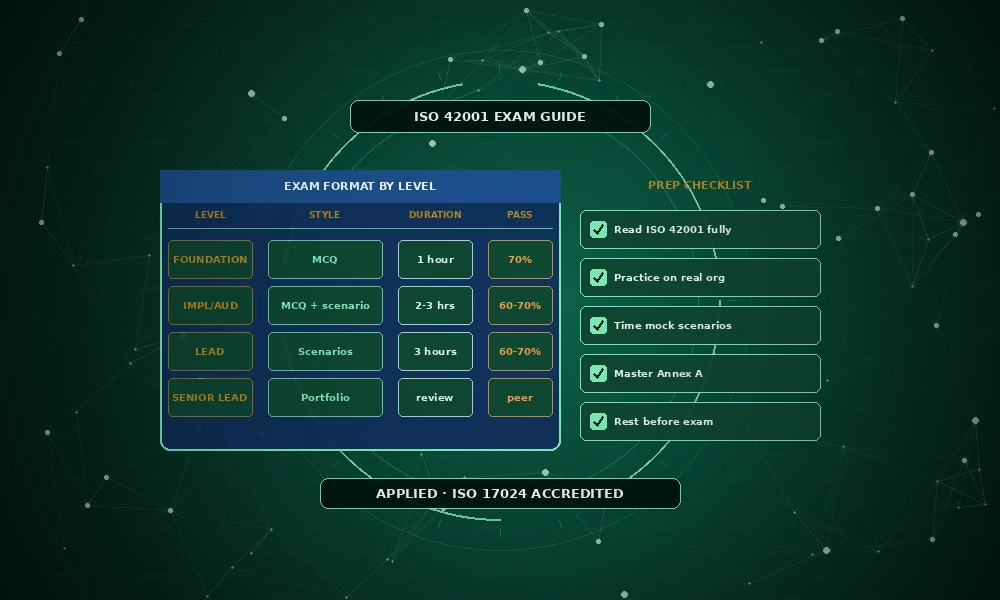
The precise question count, duration, and whether it is open book vary by provider, so confirm those against the exam format rather than assuming them here. What matters for preparation is the nature of the test: it asks what a competent implementer would do in a given situation, and your job is to make that judgement automatic before you sit down.
The study map: learn the standard by its own spine
ISO 42001 is organised around a simple improvement cycle, Plan, Do, Check, Act, that runs through its clauses. Learn the standard along that spine and two things happen at once: the structure becomes memorable, and you see how the parts connect rather than treating each clause as an isolated fact.
Use the map below as the backbone of your preparation, and notice that the right-hand column is where the real learning happens, because it turns reading into doing.
|
Cycle |
Clauses |
What to master |
How to practise it |
|---|---|---|---|
|
Plan |
4 to 7 |
Context and scope, leadership and AI policy, AI risk and impact assessment, objectives, competence and support |
Take a fictional organization and define its AIMS scope, draft its AI policy, and run one AI risk assessment |
|
Do |
8 |
Operational planning, putting controls into effect, treating AI risks, running impact assessments |
Decide which Annex A controls that organization needs and how you would operate each one |
|
Check |
9 |
Monitoring and measurement, internal audit, management review |
Design how the organization would know its AIMS is working, and what management would review |
|
Act |
10 |
Nonconformity, corrective action, continual improvement |
Trace how one failure would be caught, corrected, and stopped from recurring |
This map is deliberately different from the way the exam is scored, which is organised into competency domains rather than clauses. You will meet that scoring structure when you study the exam format and it is worth knowing.
But for learning the material, the standard's own architecture is the better teacher, because it mirrors how you would actually build a system in practice. Master the spine, and the exam's domains become a familiar view of ground you already know.
Give Annex A the attention it deserves
One part of the standard rewards focused effort out of proportion to its length: the Annex A controls. Candidates often skim them as a list to memorise, which is exactly the wrong instinct. The controls are a toolkit, and the exam tends to ask which control fits a situation and why, not whether you can recite them in order.
Prepare by grouping them by the objective they serve, then practising selection: given an organization that trains its own models on customer data, which controls apply, and what would good implementation look like. This is also where external frameworks help you reason.
The NIST AI Risk Management Framework gives you a vocabulary for the AI harms these controls exist to manage, which makes it far easier to judge which control a scenario is really pointing at.
A phased plan that builds in the right order
Preparation works best in stages, each one depending on the last. Rushing to practice questions before you understand the structure produces confident wrong answers. Move through three stages instead:
|
Stage |
Goal |
Core activity |
|---|---|---|
|
1. Build the map |
Know the standard's architecture cold |
Read the full standard once, then redraw the clause structure and the Plan-Do-Check-Act cycle from memory |
|
2. Apply it |
Move from knowing to doing |
Implement the AIMS for one fictional organization, clause by clause, making real decisions at each step |
|
3. Rehearse |
Perform under exam conditions |
Work timed scenario questions, then review every miss until you understand why the right answer is right |
Notice that only the third stage involves questions, and it comes last for a reason. Question practice is a way to test and sharpen understanding, not to build it. When you are ready for that stage, work through a bank of practice questions under a timer, because pacing is a skill of its own and many capable candidates lose marks simply by running out of time on the scenarios.
One technique ties the whole plan together: carry a single fictional organization through every stage. Invent one company, give it a couple of real AI systems, and make it the setting for everything you study, from defining its scope in Clause 4 to correcting a nonconformity in Clause 10.
Because the standard is a connected system, using one running case forces you to see how each clause feeds the next, and it turns abstract requirements into concrete decisions you can remember. When a scenario question appears in the exam, you will answer it the way you have already answered dozens for your own imaginary company, which is exactly the fluency the exam is trying to measure.
How to study, not just what to study
The method matters as much as the material, and a few principles reliably separate efficient preparation from busy-looking effort:
- Apply, do not reread. Explain a clause by using it on a real case. Rereading feels productive but builds little lasting recall.
- Space your sessions. Short, frequent study beats one long cram, because memory consolidates between sessions, not during a marathon.
- Teach it back. If you can explain how Clause 6 planning leads into Clause 8 operation in plain words, you understand it. If you stumble, you have found your gap.
- Rehearse decisions, not definitions. The exam asks what you would do, so practise making the call, then check it, rather than memorising what the clause says.
Common preparation mistakes, and what to do instead
Most preparation failures are predictable, and knowing them in advance is half the cure. The recurring ones:
- Memorising clause numbers instead of understanding what each clause achieves. The exam cares about the second, not the first.
- Living in summaries and never reading the standard itself, so the nuance that questions turn on never registers.
- Passive rereading that mistakes familiarity for knowledge. If you have not tested yourself, you do not yet know it.
- Saving scenario practice for the final days, when it is the very skill the exam rewards and needs the most rehearsal.
- Treating Annex A as a list to recite rather than a toolkit to apply to a situation.
A readiness self-check before you book
Rather than guessing whether you are ready, test it. You are prepared to sit when you can honestly do each of these without notes:
- Sketch the clause structure, from Clause 4 to Clause 10, and place each in the Plan-Do-Check-Act cycle.
- Explain how an AI risk assessment feeds into risk treatment and the choice of controls.
- Given a described organization, decide which Annex A controls it needs and justify each.
- Complete a set of scenario questions within the time limit, and explain your reasoning for each.
If you can do all four, you are ready. If one is shaky, you have just found exactly where the last days of preparation should go, which is a far better use of time than another pass through material you already know.
The final week and why this preparation pays twice
In the last week, resist the urge to cram new material. Consolidate instead: revisit your weakest clause, run a final timed scenario set, and rest before the day so your judgement is sharp. The deeper reward is that this style of preparation pays twice.
Because you prepared by implementing rather than memorising, the same understanding that passes the exam is the understanding you will use on your first real AI management system. That matters more every year, as the EU AI Act and similar rules push organizations to demonstrate genuine AI governance rather than paperwork.
An implementer who learned the standard as a set of decisions, not a set of definitions, is ready for both the exam and the job it leads to, which is the whole point of preparing well. For the full picture of the role and where it goes next, read the complete guide.
Frequently asked questions
How long does it take to prepare for the Lead Implementer exam?
Plan for several weeks of structured preparation rather than a few days, weighted toward applying the standard rather than reading it. Candidates with management-system or governance experience often need less, because much of the structure is already familiar and they mainly add the AI-specific content.
Do I need to read the whole ISO 42001 standard?
Reading the full text at least once is strongly worthwhile, because summaries skip the nuance that scenario questions turn on. Read it to understand the clause structure and how the parts connect, then use application and practice to make that understanding usable under time pressure.
What is the best way to study for an applied exam like this?
Study by applying the standard, not by rereading it. Implement an AI management system for a fictional organization clause by clause, practise selecting Annex A controls for scenarios, and rehearse decisions rather than definitions. Save timed question practice for the final stage, once your understanding is solid.
How much should I focus on Annex A controls?
A good deal, but as a toolkit rather than a memory test. Group the controls by the objective they serve and practise choosing the right ones for a described situation. The exam tends to ask which control fits and why, not whether you can list them in order.
When am I ready to book the exam?
When you can sketch the clause structure from memory, explain how risk assessment leads to control selection, choose controls for a described organization, and complete scenario questions within the time limit. If any of those is shaky, focus your remaining preparation there before booking.
Prepare with a course built around doing
The fastest way to prepare by applying the standard is to learn it in a setting that makes you apply it. AIGCI's Lead Implementer certification is structured around implementing an AI management system rather than memorising clauses, so your preparation and the exam pull in the same direction.
Pair it with practice questions for timing, confirm the current exam format before you book, and read more about the institute to see how its certifications are built.