A certificate proves you passed an exam; the skills behind it are what you actually carry into work. Becoming a Lead Implementer for ISO/IEC 42001:2023, the AI management system standard usually shortened to ISO 42001, develops a specific and unusually portable set of capabilities.
The headline skill is building an AI management system, or AIMS, but the real return is a cluster of abilities that outlast any single project and transfer well beyond this one standard.
This guide from the AI Governance Certification Institute (AIGCI) sets out exactly what you learn, groups it into five families you can put on a profile, and shows where each family carries once you have it.
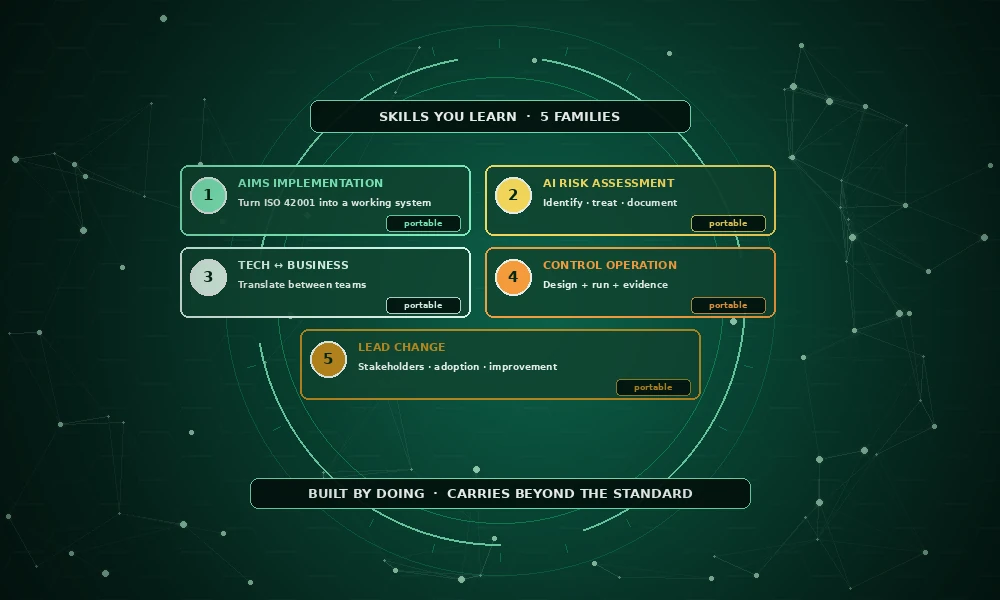
A Lead Implementer develops AIMS implementation skills: the ability to turn ISO 42001 into a working system, to assess and treat AI risk, to translate between technical and business teams, to operate controls and to lead the change. Most of these skills transfer far beyond the standard itself.
|
"For the things we have to learn before we can do them, we learn by doing them." Aristotle, Nicomachean Ethics, Book II |
Aristotle's observation is the key to this whole topic. These are not skills you absorb by reading the standard once; they form by implementing it, by making real decisions and living with the consequences. That is why the list below describes capabilities you build through practice, not facts you memorise, and why the way you learn them matters as much as what they are.
The core skill: turning a standard into a working system
Before the families, name the central skill plainly, because everything else hangs off it. A Lead Implementer learns to take an abstract standard and turn it into something an organization actually runs: a scope, a policy, a set of controls, and a rhythm of monitoring and improvement.
This is harder than it sounds, because a standard tells you what must be true, not how to make it true in your particular organization with its particular AI. Learning to close that gap, repeatedly and under real constraints, is the skill the whole certification exists to build. Everything that follows is a facet of it.
Five families of skill you come away with
The capabilities sort cleanly into five families. The third column is the one worth reading twice, because it shows how little of this is trapped inside ISO 42001:
|
Skill family |
What you learn to do |
Where it transfers |
|---|---|---|
|
Management-system skills |
Set context and scope, write policy and objectives, document decisions, run internal audits, and improve the system continually |
Any management-system standard, from information security to quality |
|
AI risk skills |
Turn vague AI concerns into assessed, owned, and treated risks, and run an AI system impact assessment |
Any risk or assurance role facing emerging technology |
|
Translation skills |
Move fluently between data scientists, executives, and legal teams, converting technical detail into decisions |
Product, compliance, and leadership roles where AI meets the business |
|
Control and assurance skills |
Select the right controls for a system and make them operate: data governance, transparency, human oversight, bias management |
Privacy, security, and responsible-AI functions |
|
Leadership and change skills |
Secure top-management commitment, build awareness and competence, and drive adoption across teams |
Any role that has to change how an organization works |
Five families, one theme: almost none of this is throwaway knowledge. You could leave AI governance entirely and still use most of what this list contains, which is the strongest argument for why the credential is worth more than the paper it prints. The next sections take the three families people underestimate most and show what learning them actually feels like.
The skill people underestimate: translation
Ask experienced implementers which skill surprised them and many name the same one: translation. An AI management system only works if data scientists, executives, risk officers, and lawyers can act on the same decisions, and those groups speak different languages. The Lead Implementer becomes the person who turns a model's technical limitation into a business risk a board can weigh, and a legal obligation into a control an engineer can build.
You learn to ask a data science team the question that exposes a governance gap, then to explain that gap to leadership without either jargon or alarm. This is a rare skill and a durable one, because every organization adopting AI needs someone who can stand in the middle and make the parts understand each other. It is also the hardest to fake, which is why it commands attention long after the exam is forgotten.
Turning fuzzy AI risk into concrete controls
The second underrated family is risk reasoning, and it is where the standard's connected entities come to life. You learn to run an AI risk assessment that names what could go wrong with a model and an AI system impact assessment that weighs the technical, social and legal effects on individuals, groups and society, the analysis the standard calls for in its planning clause.
You learn to record those findings in a risk register that assigns an owner rather than leaving risk as a worry no one holds.
Then you learn to treat each risk by selecting from the Annex A controls and documenting your choices in a Statement of Applicability, so that every control is there for a reason you can defend.
Along the way you draw on wider guidance, using ISO/IEC 23894 for AI risk management method and the NIST AI Risk Management Framework for a shared vocabulary of AI harms.
The dedicated guidance for impact assessment, ISO/IEC 42005, gives that particular skill its own reference point. The result is a capability that generalises: once you can convert a fuzzy fear into an assessed risk with a named owner and a working control, you can do it for any technology, not only AI.
Running the system, not just standing it up
Many people picture implementation as a one-time build, but a large part of what you learn is how to keep a system alive. You develop the skills of the check and act half of the cycle: monitoring whether controls still work, running internal audits that find real problems, preparing a management review that turns findings into decisions, and handling a nonconformity through corrective action so it does not recur.
You also learn the operational disciplines that keep AI trustworthy over time, including data governance, meaningful human oversight, transparency about how systems decide and attention to bias as models and data drift.
A useful modern habit you pick up is documenting an AI bill of materials, a record of the models and dependencies a system relies on, so that oversight has something concrete to track.
These are the skills that separate a system that passes an audit once from one that stays worthy of trust, and they transfer to the governance of anything that has to be maintained rather than merely launched.
Sitting beneath all of this is the habit the standard names continual improvement: treating every audit finding, incident, and model change as an input that makes the system a little better next quarter rather than a problem to file away.
Learning to run that loop, instead of declaring a project finished and walking away, is one of the quietly most valuable skills you take with you, because it applies to any process an organization wants to keep improving long after the particular AI system has changed beyond recognition.
What you bring, and what you build
How much of each family is new depends on where you start, which is worth knowing before you begin so you can aim your effort. The pattern is consistent:
|
If you come from |
You already bring |
You mainly build |
|---|---|---|
|
Information security or ISO 27001 |
Management-system and audit discipline |
The AI-specific risk and control knowledge |
|
Data science or ML engineering |
Technical understanding of models |
The governance, documentation, and risk discipline |
|
Governance, risk, and compliance |
Risk reasoning and stakeholder skills |
The AI subject matter and the AIMS structure |
|
Legal, policy, or audit |
Regulatory and evidence reasoning |
The operational how of building a system |
Read your own row and you can see the shape of your learning curve in advance. No background arrives with everything, and none arrives with nothing, which is why the certification suits people converging on AI governance from very different starts.
The skill you build hardest is usually the one your background never demanded, so that is where to spend your attention.
Where these skills take you next
Because the families transfer, the credential opens more doors than its title suggests. The same abilities support roles in responsible AI, risk, privacy and audit and they compound as regulation such as the EU AI Act makes demonstrable AI governance a business requirement rather than a nicety.
To see how an implementer's abilities sit within the wider picture, the full AI governance skill set maps how these capabilities connect to the broader field and its roles. And when you are ready to put the skills to work on a real programme, the implementation guide shows how they come together step by step on an actual AI management system.
The point is not that the skills lead to one destination, but that they equip you for many, which is unusual for a single certification.
How these skills are actually learned
Since these are practised capabilities, the way you learn them decides whether they stick. Reading the standard builds awareness, but the skills form only when you implement: when you scope a real system, argue a real risk, and defend a real control choice to people who push back.
That is why the strongest learning comes from doing the work under guidance rather than studying it in the abstract and why a course built around implementing an AI management system, rather than describing one, produces skills you can use on day one. Learn them by building, exactly as Aristotle suggested and they become yours in a way no exam result on its own can make them.
Frequently asked questions
What is the main skill you learn as an ISO 42001 Lead Implementer?
The central skill is turning the standard into a working AI management system: defining scope and policy, selecting and operating controls, and running the monitoring and improvement that keep the system alive. Every other skill you learn is a facet of making that happen in a real organization.
Are the skills useful outside ISO 42001?
Yes, and that is their strongest feature. Management-system discipline, risk reasoning, translation between technical and business teams, control and assurance work, and leading change all transfer to privacy, security, quality, and broader governance roles. You could leave AI governance and still use most of what you learned.
Do I learn technical AI skills, like building models?
No. You learn to govern AI, not to build it. That means understanding how models work and fail well enough to assess their risks and select controls, and being able to talk credibly with the people who do build them. The skill is judgement and coordination, not model engineering.
What skill is hardest to learn?
It depends on your background, because you build hardest the skill your previous work never demanded. Technical people often find governance and documentation discipline the steepest climb, while non-technical people work hardest on understanding AI risk. Translation between the two worlds challenges almost everyone.
How are these skills best developed?
By doing the work, not only reading about it. The skills form when you implement a system, assess real risks, and defend real control choices. Courses that make you build an AI management system, rather than describe one, develop skills you can apply immediately.
Learn the skills by building the system
The surest way to acquire these skills is to practise them under guidance. AIGCI's Lead Implementer certification is built around implementing an AI management system, so you leave with capabilities rather than only a result.
For the wider view of the role these skills belong to, read the Lead Implementer guide, and to see how the institute designs its certifications, read more about the institute.