The most common misunderstanding about this role is that the Lead Implementer does everything. They do not, and a good one never tries to. The Lead Implementer for ISO/IEC 42001:2023, the AI management system standard usually shortened to ISO 42001, is responsible for making an AI management system, or AIMS, actually happen, but the work is distributed across the whole organization.
Their real job is to own the outcome and orchestrate the people who own the parts. That single distinction, owning the outcome while distributing the work, explains almost every responsibility that follows.
This guide from the AI Governance Certification Institute (AIGCI) sets out those responsibilities across the system's lifecycle, clarifies who is accountable when the Lead Implementer is merely responsible, and maps the roles they must work through to succeed.
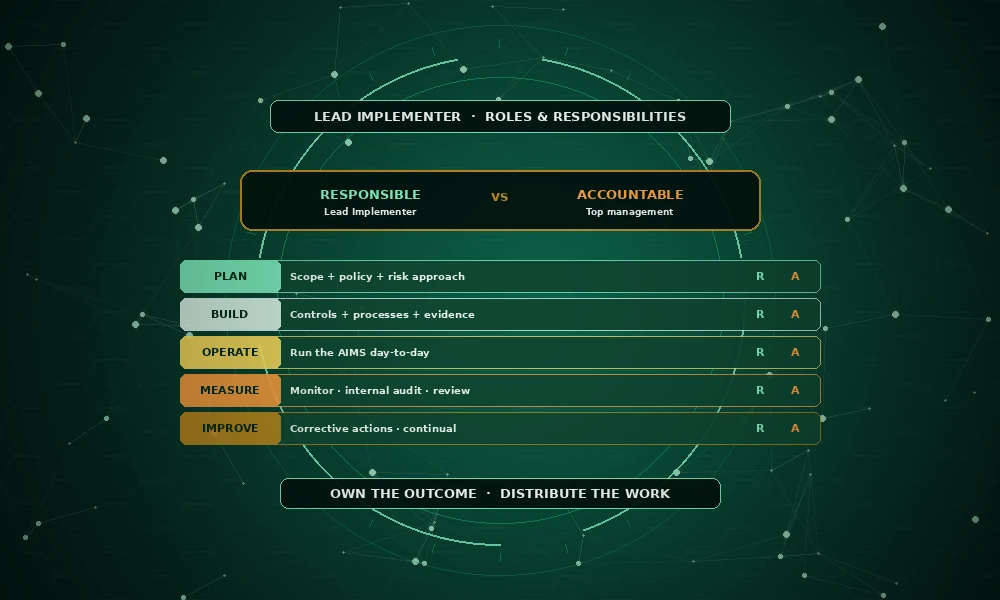
A Lead Implementer performs AIMS implementation: they plan, coordinate, and deliver the AI management system, while top management remains accountable for it. Understanding that split between responsible and accountable is the key to the whole role.
The one responsibility everything hangs on
State the core duty plainly first. A Lead Implementer is responsible for turning the standard into a running system: a defined scope, an approved policy, a set of operating controls, and a working cycle of monitoring and improvement.
This is what sets the role apart from its neighbours. A consultant advises on how to do it, and an auditor later checks whether it was done, but only the Lead Implementer is responsible for the system existing and functioning day to day.
Every specific responsibility below is a way of discharging that one duty, which is why losing sight of it, and drifting into doing other people's jobs, is the fastest way for an implementer to fail.
Where the responsibility begins: the gap analysis and the roadmap
Before any lifecycle duty can start, the Lead Implementer carries a first responsibility that shapes all the others: establishing where the organization actually stands. This begins with a gap analysis, an honest comparison of current AI practices against what the standard requires, which converts a vague ambition to become certified into a concrete list of what is missing.
From that analysis the implementer builds the implementation roadmap, a sequenced plan that decides what happens first, who is needed and by when, so the work is paced deliberately rather than attempted all at once.
Getting this right is quietly decisive, because a roadmap built on a shallow gap analysis commits the organization to the wrong work in the wrong order.
It is also where the implementer earns early trust, since a credible plan presented to top management is what unlocks the resources and authority the rest of the role depends on.
The responsibility here is not to promise a fast certificate but to promise an accurate one, grounded in what the organization genuinely needs to change.
Responsible or accountable: where the buck actually stops
Before the duties themselves, settle the question that quietly derails implementations: who carries ultimate accountability. The answer is not the Lead Implementer, and a famous desk sign captures why it must sit clearly with someone:
|
"The buck stops here." Harry S. Truman, from the sign on his desk |
Truman's motto is the principle the standard builds in. ISO 42001 places accountability for the AI management system with top management: leadership must show commitment, own the AI policy and provide the resources, and that responsibility cannot be delegated to the person implementing the system.
The Lead Implementer is responsible for delivery; top management is accountable for the whole. Far from weakening the role, this makes one of its most important duties explicit: the Lead Implementer must ensure that roles, responsibilities and authorities are assigned across the organization, so that for every AI risk and control there is a named owner where the buck stops.
An implementer who leaves accountability vague has failed at the very task the standard singles out, no matter how good the paperwork looks.
Responsibilities across the system's lifecycle
The clearest way to see the role is to follow the AI management system from first idea to ongoing improvement. At each stage the Lead Implementer carries a specific responsibility, and each one is discharged through other people rather than alone:
|
Stage |
What the Lead Implementer is responsible for |
Who they work through |
|---|---|---|
|
Set the context |
Defining the AIMS scope and the AI systems it covers, and reading the internal and external context |
Top management and system owners |
|
Set direction |
Drafting the AI policy and objectives, and getting roles and authorities formally assigned |
Top management, who own the policy, and legal |
|
Assess risk |
Running AI risk assessments and AI system impact assessments, then planning risk treatment |
Risk, data science, legal, affected stakeholders |
|
Enable the system |
Securing resources, building competence and awareness, and establishing documented information |
HR, training, and top management |
|
Operate controls |
Putting the selected Annex A controls into effect and treating risks in practice |
System owners, IT, data governance, procurement |
|
Check performance |
Arranging monitoring, internal audit, and management review, then reporting status upward |
Internal audit and top management |
|
Improve |
Driving corrective action and continual improvement from what those checks reveal |
Every owner of an affected process |
Read down the middle column and the pattern is unmistakable: the Lead Implementer is the connective tissue of the system, present at every stage but rarely the sole actor at any of them. The right-hand column is not a footnote; it is the job.
Reporting status to leadership deserves special mention, because it is how top management exercises the accountability the standard assigns it and a Lead Implementer who reports honestly, including bad news, is doing one of the role's most valuable duties.
The roles the Lead Implementer works through
Because the work is distributed, much of the role is knowing who owns what and holding each owner to it. These are the interfaces that decide whether an implementation succeeds:
|
Role |
What they own in the AI management system |
|---|---|
|
Top management |
Accountability for the AIMS: approving the policy, setting direction, and providing resources |
|
AI governance committee or board |
Steering decisions and resolving trade-offs between innovation and risk |
|
AI system and model owners |
The risks and controls for the specific systems they run |
|
Data and machine-learning teams |
Implementing technical controls and producing the evidence that they work |
|
Risk, legal, and privacy |
Judging obligations, acceptable risk, and where the law draws lines |
|
HR and procurement |
Competence and awareness for people, and governance of AI acquired from suppliers |
The Lead Implementer sits at the centre of this web without owning most of its threads, which is why influence matters as much as authority in the role.
The standard supports this with its requirement to assign roles and authorities, and external frameworks such as the NIST AI Risk Management Framework reinforce the same idea, that AI risk is managed by clear ownership rather than by a single hero.
A capable implementer spends much of their time making sure each owner in this table knows, accepts and acts on their part.
The line that trips teams up: responsible is not accountable
It is worth dwelling on the distinction the Truman sign points to, because confusing it is a frequent and costly mistake. In the language of responsibility mapping, the Lead Implementer is usually responsible, the one doing or coordinating the work, while top management or a system owner is accountable, the one answerable for the result.
When these blur, two failures follow. Either the implementer is quietly made accountable for risks they do not control, which is unfair and unsafe or accountability is left with no one, so difficult decisions stall.
Part of the Lead Implementer's job is to prevent both by making the mapping explicit for every significant control and risk, so that the organization always knows who does the work and who answers for it.
This clarity is not bureaucracy; it is what lets an AI management system hold up when something goes wrong.
What the role is not
Defining the role by its edges is as useful as defining it by its duties, and it prevents the drift that overloads implementers. The Lead Implementer is not:
- The AI builder. They govern how AI is built and used; they do not develop the models themselves.
- The auditor of their own work. Independence matters, so the person who implements the system should not be the one who certifies it.
- The sole owner of risk. Risks belong to the system owners who run them; the implementer ensures they are assessed and owned, not that they personally absorb them.
- A one-time project manager. The responsibility continues after go-live, because an AI management system has to be maintained and improved, not merely launched.
Holding these boundaries is itself a responsibility. An implementer who takes on all of these ends up accountable for everything and effective at nothing, which is the opposite of what the standard intends.
Where this responsibility leads
Carrying end-to-end responsibility for an AI management system is unusually good preparation for what comes next, because it exercises judgement, coordination and accountability at once.
Implementers who do it well tend to grow into senior implementation, AI governance leadership, and programme-level roles, especially as regulation such as the EU AI Act makes demonstrable governance a standing obligation rather than a project.
The responsibilities described here are also what build the capabilities you carry forward, which is why the skills the work builds map so closely onto this list of duties.
For a wider view of the destinations this role opens, the roles this leads to show how implementation experience becomes a career rather than a single assignment.
Frequently asked questions
What is the main responsibility of an ISO 42001 Lead Implementer?
To make the AI management system exist and function: defining scope and policy, assessing and treating AI risk, putting controls into operation, and running the monitoring and improvement that keep it alive. They own the outcome while coordinating the many people who own the individual parts.
Is the Lead Implementer accountable for the AIMS?
No. Under ISO 42001, top management holds accountability for the AI management system, including owning the policy and providing resources. The Lead Implementer is responsible for delivering it. A key duty of the role is making sure accountability is clearly assigned so that every risk and control has a named owner.
How is the Lead Implementer different from an auditor or consultant?
A consultant advises on how to implement, and an auditor later verifies whether the system conforms, but only the Lead Implementer is responsible for the system being built and running. For independence, the person who implements the system should not be the one who audits or certifies it.
Who does the Lead Implementer work with?
Top management, an AI governance committee, AI system and model owners, data and machine-learning teams, and risk, legal, privacy, HR, and procurement functions. The role sits at the centre of this web, holding each owner to their part rather than doing all the work alone.
Does the responsibility end once the system is certified?
No. An AI management system must be maintained and improved continually, so the Lead Implementer's responsibility continues after go-live through monitoring, internal audit, management review, and corrective action. Treating implementation as a one-time project is a common and serious mistake.
Take on the role with confidence
Carrying these responsibilities well starts with knowing the standard deeply enough to lead others through it. AIGCI's Lead Implementer certification is built around delivering an AI management system, not just describing one, so you learn the role by practising it.
For the full picture of the position and where it fits, read the complete guide, and to see how the institute designs its certifications, read more about the institute.