Worth it is the wrong question if you expect a single yes or no, because the honest answer is that it depends on three things you can actually assess.
The Lead Implementer certification for ISO/IEC 42001:2023, the first management system standard for artificial intelligence, published in 2023, carries value only where a real market rewards it, where the credential itself is credible and where your own timing and situation let you capture the return.
This certification exists to validate career-advancing skills, so its worth is really the worth of those skills in a market that is still forming. Rather than sell you a verdict, this guide from the AI Governance Certification Institute (AIGCI) gives you a framework and the current data to answer the question for yourself.
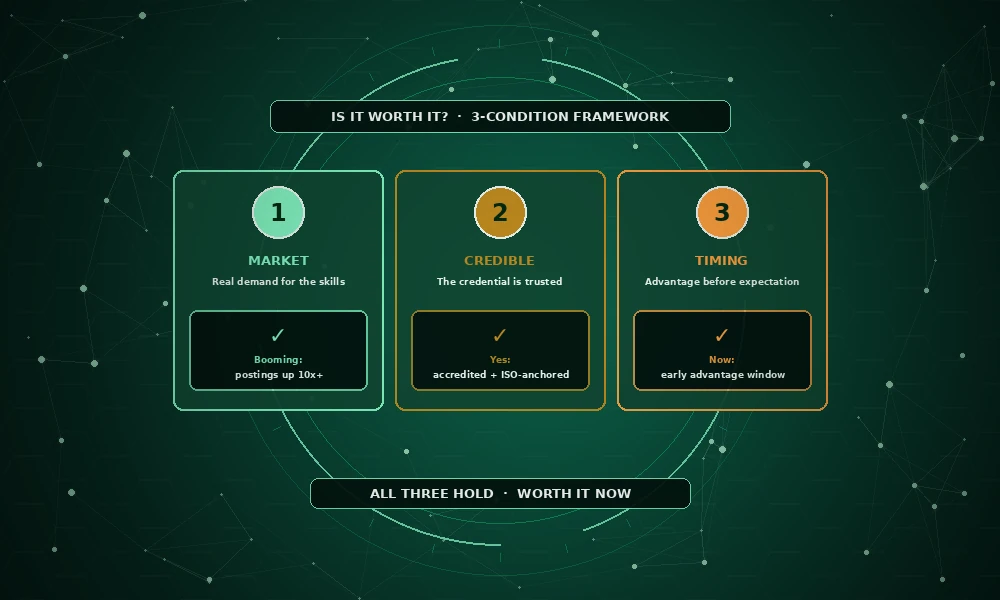
The certification is worth it when three conditions hold: the market genuinely demands the skills it validates, the credential is credible enough to be trusted, and your timing lets you use it before it becomes an expectation rather than an advantage.
First question: is the market even real?
A credential is only worth what the market will pay for the skills behind it, so start there, with evidence rather than optimism.
The independent data from the Stanford HAI AI Index 2025 and the McKinsey State of AI points the same way: artificial intelligence is now mainstream, its risks are rising, regulation is accelerating and organizations are not yet ready to govern any of it.
Read the four figures below together and the demand for AI governance skills stops looking speculative.
|
What the data shows |
Source |
Why it matters for worth |
|---|---|---|
|
78 percent of organizations used AI in 2024, up from 55 percent a year earlier |
Stanford HAI, 2025 |
The thing that must be governed is now almost everywhere |
|
AI incidents rose to a record 233 in 2024, an increase of 56 percent |
Stanford HAI, 2025 |
The harms AI governance exists to prevent are growing, not hypothetical |
|
United States agencies introduced 59 AI-related regulations in 2024, more than double the year before |
Stanford HAI, 2025 |
Regulation is accelerating, and rules create demand for people who can meet them |
|
Only 28 percent of firms say their CEO owns AI governance, and 17 percent their board |
McKinsey |
A clear capability gap that trained implementers are positioned to fill |
Notice how the four numbers connect into a single story. AI has spread almost everywhere, the incidents it causes are climbing, governments are responding with rules, and yet ownership of governance at the top of most organizations is thin.
That gap between how much AI companies now run and how little they govern it is precisely the space a Lead Implementer is trained to fill. On the market test, then, the answer is clear: the demand the credential points at is real and growing.
Second question: what does worth actually weigh?
Worth is never value alone; it is value set against cost. On one side sits what you gain: validated skills, access to work the market needs, a credible trust signal and the advantage of moving early.
On the other sits what you spend: a fee, study time, real effort and the risk that any credential can lose its edge.
This page deliberately does not quote pay or price figures, because those deserve their own honest treatment. For the money side, weigh the salary it commands against what it costs and for the opportunity side, look at the jobs it opens.
What this page does is weigh the returns and the risks themselves, so the numbers you find there have a frame to sit in.
The returns, weighed honestly
Four returns make up most of the value, and each comes with a caveat that the hype usually omits. Read the third column as carefully as the first:
|
What you gain |
Why it has value now |
The honest caveat |
|---|---|---|
|
Validated skills |
The market rewards proven AI governance ability, and demand is rising |
A credential validates skills but does not replace real experience |
|
Access to the work |
It signals you can do what employers increasingly need done |
Access still depends on the wider job market, which is early and uneven |
|
Credibility and trust |
An accredited, standard-aligned credential is a recognised trust signal |
Only if the credential is credible; a vanity certificate signals little |
|
First-mover timing |
Holding it while few others do is a genuine differentiator |
That edge narrows as the credential becomes common |
The through-line is that every return is real but conditional. The skills matter because the skills it validates are genuinely transferable, not because a certificate is magic. Credibility matters only if the credential is trustworthy, which is why the standard behind it,
and whether the certifying body is serious, changes the entire calculation. Judge the worth of a specific certification, not of certification in the abstract, because those are very different questions.
The costs and risks, weighed honestly
A fair answer has to name what sits on the other side of the ledger, without flinching:
- The fee and the time. This is a real investment of money and study hours, not a formality you can breeze through.
- The effort. It is a demanding credential that asks you to understand and apply a whole standard, which is the point but also the price.
- The dilution risk. Value depends on the credential staying credible and not being flooded by low-quality alternatives, so the issuer matters.
- The experience gap. A certificate opens the door, but your track record is what keeps you in the room once you are through it.
None of these is a reason to avoid the certification. They are the reasons to go in clear-eyed, choosing a credible credential and pairing it with real work rather than expecting the paper to carry you.
But could I just learn the standard myself?
A fair challenge to the whole idea is that the standard is public, so why pay to be taught it. The honest reply is that reading a standard and being able to implement it are different achievements and only the second is what the market rewards.
Self-study can build knowledge, but on its own it cannot produce the validated proof an employer or client will trust, nor the structured practice of applying the standard to real decisions under guidance.
What you are paying for is not access to the text; it is the guided practice that turns the text into capability and the recognised credential that lets others rely on your judgement without having to test it from scratch themselves.
Why timing changes the answer
Here is the insight the yes-or-no framing hides: the worth of this credential is partly a function of when you get it.
Right now, because AI adoption has outrun AI governance, holding a recognised implementer credential marks you as someone who can close that gap and relatively few people hold it.
As regulation such as the EU AI Act makes demonstrable governance a standing requirement, that same credential will gradually shift from a differentiator into a baseline expectation, in the way information-security certifications did before it.
The practical consequence is that the certification is most worth it for those who move while the gap is wide, capturing the premium of scarcity before it compresses. Waiting until the credential is universal means paying a similar cost for a fraction of the distinction, which is the opposite of a good investment.
Who gets the most value from it
Worth also depends on who you are, because the same credential returns more to some people than others. It tends to pay off most for those already working in or moving toward governance, risk, security or data roles, where it formalises and extends what they can already do.
It returns less, at least immediately, to someone with no adjacent experience and no near-term path into the work, for whom it may be early rather than wrong.
Because fit is so decisive, it is worth checking honestly against who it suits before you commit, since matching the credential to your situation is most of what separates a worthwhile investment from a premature one.
How to make sure it is worth it
Worth is not only discovered; it is partly decided by the choices you make around the credential. Three decisions do most of the work:
- Choose a credible credential. Favour one that is genuinely aligned to ISO 42001 and issued by a serious body, because credibility is where most of the value lives.
- Pair it with real implementation. Use it on an actual AI management system as soon as you can, so the certificate is backed by evidence you can point to.
- Move before it is table stakes. Capture the scarcity premium while the gap between adoption and governance is still wide.
Do these three things and you convert a certificate from a hopeful line on a profile into a defensible claim about what you can deliver, which is what makes it worth the investment.
The verdict, honestly
So, is it worth it? For the right person at the right time, the evidence says yes, and clearly. The market the credential points at is real and widening, the skills it validates are transferable and in demand and the window in which holding it is a differentiator is open now.
For someone with no adjacent path into the work, the more accurate answer is not yet, rather than never.
The honest verdict is therefore conditional by design, which is more useful than a blanket yes, because it tells you exactly what has to be true for the certification to pay off: a credible credential, real experience alongside it and the judgement to move while the advantage still exists.
Frequently asked questions
Is the ISO 42001 Lead Implementer certification worth it in 2026?
For those in or moving toward governance, risk, security, or data roles, the evidence points to yes. AI adoption has outpaced governance, incidents and regulation are rising, and few people yet hold a recognised implementer credential, so the skills it validates are in demand and the timing still favours early movers.
What makes an AI governance certification actually valuable?
Credibility and demand. The credential must be genuinely aligned to a recognised standard and issued by a serious body, and the market must reward the skills it certifies. A vanity certificate fails the first test; a credible one that meets real demand passes both. Judge the specific certification, not certification in general.
Will the certification lose value over time?
Its value as a differentiator will likely soften as AI governance becomes a standard expectation, much as information-security certifications did. That is an argument for acquiring it while the gap between AI adoption and governance is wide, when holding it still sets you apart rather than merely meeting a baseline.
Is the certificate enough on its own?
No. A credential validates skills and opens doors, but it does not replace real experience. The strongest position combines a credible certification with actual work implementing an AI management system, so your claim is backed by evidence an employer or client can verify.
Who should think twice before getting it?
Someone with no adjacent experience and no near-term route into governance, risk, security, or data work may find it premature rather than wrong. Because fit drives the return, it is worth checking the certification against your situation and goals before committing the time and money.
Make it worth it
The surest way to make the certification pay off is to choose a credible one and learn it by doing the work. AIGCI's Lead Implementer certification is aligned to ISO 42001 and built around implementing a real AI management system, so the credential is backed by capability rather than theory.
To weigh the decision fully, read the jobs it opens and the salary it commands, and to see how the institute designs its certifications, read more about the institute.