Most comparisons of these two treat them as rivals fighting for the same slot on your profile, and that framing quietly misleads you. The AIGP and ISO/IEC 42001:2023 are not the same kind of thing at all. The AIGP, the Artificial Intelligence Governance Professional certification, is an individual credential that proves a person understands AI governance, law, and policy.
ISO 42001 is an organizational standard that an entire company is certified against, with separate Lead Implementer and Lead Auditor credentials for the people who build and check that system. Comparing them directly is a little like comparing a driving licence to a set of road-safety rules: related, both valuable, but not interchangeable.
This guide from the AI Governance Certification Institute (AIGCI) clears up the category confusion, sets the two side by side on the attributes that matter, and shows why the real answer is often both rather than either.
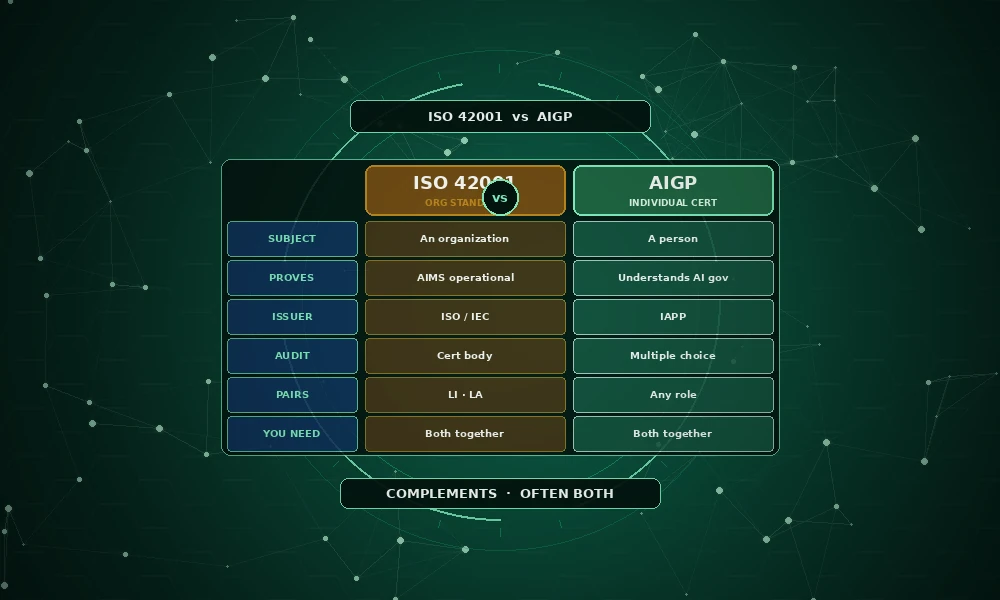
The AIGP certifies what an individual knows about AI governance; ISO 42001 certifies how an organization manages AI, and qualifies the people who implement or audit that system. One proves understanding, the other proves operational capability, which is why they so often work together.
The mistake in the question: a credential against a standard
Start by naming what each one actually is, because the whole comparison turns on it. The AIGP is issued by the IAPP, the professional body best known for privacy certifications and it validates a person's grasp of the AI governance landscape: the laws, the frameworks, and the responsible-AI concepts that shape how AI should be overseen. ISO 42001, by contrast, is a management system standard published by ISO and IEC.
An organization does not pass ISO 42001 the way a person passes an exam; it builds an AI management system and is audited against the standard by an accredited body. The individual credentials attached to ISO 42001, Lead Implementer and Lead Auditor, certify that a person can respectively build or audit that system.
So one side of this comparison is a person's knowledge credential, and the other is an organizational standard plus the professional credentials that operate it. Hold that distinction and every other difference falls into place.
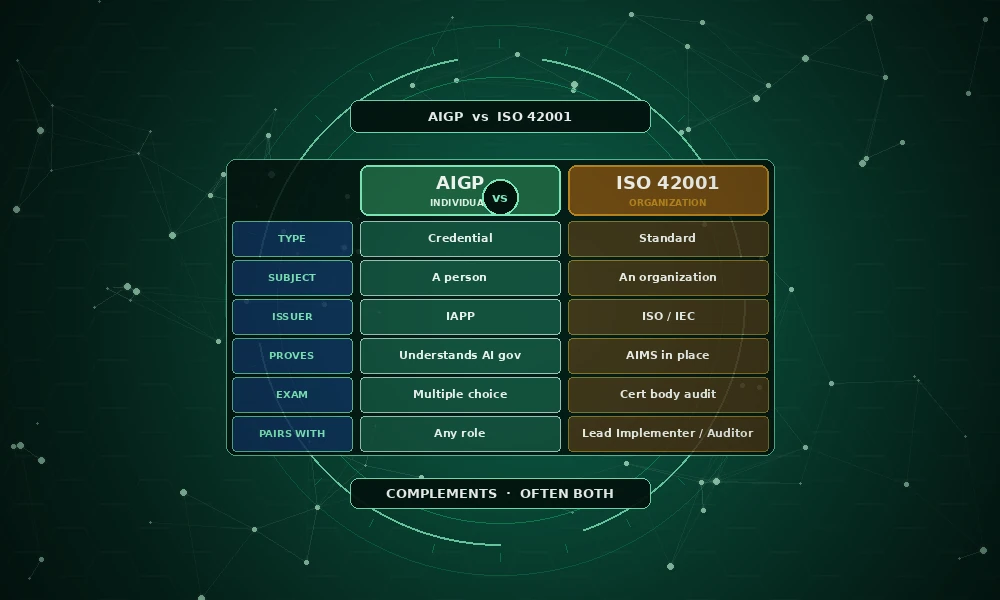
AIGP and ISO 42001 at a glance
Set against the attributes that actually decide a choice, the two separate cleanly. Read the table as a whole rather than row by row, because the pattern is the point:
|
Attribute |
AIGP |
ISO 42001 and its credentials |
|---|---|---|
|
What it is |
An individual professional certification |
An organizational management system standard, with Lead Implementer and Lead Auditor credentials built on it |
|
Who issues it |
The IAPP |
ISO and IEC, with certificates issued by accredited bodies |
|
What it certifies |
That a person understands AI governance, law, and policy |
That an organization runs a conforming AIMS, or that a person can implement or audit one |
|
Centre of gravity |
Laws, frameworks, and responsible-AI concepts |
Building and operating a management system with controls |
|
How it is earned |
A knowledge exam |
For organizations, an audit; for individuals, a course and exam tied to doing the work |
|
Best suited to |
Privacy, legal, compliance, and policy roles |
People who will build or audit an AIMS, and organizations seeking certification |
|
What it proves |
You know the landscape |
You, or your organization, can actually run or audit the system |
The last row is the sharpest divide. AIGP proves you understand AI governance; the ISO 42001 credentials prove you can operate it. Neither claim is superior in the abstract, because they answer different questions an employer might ask, but confusing them leads people to buy the wrong thing for their goal.
What the AIGP is really for
The AIGP is, at heart, a certification of fluency in the AI governance landscape. Its body of knowledge is organised into four domains: the foundations of AI governance, how laws and frameworks such as the EU AI Act and the NIST AI Risk Management Framework apply to AI, governing AI development, and governing AI deployment and use.
Notably, it does not teach you to build AI systems or to run a management system; it teaches you to reason about oversight, risk, compliance, and ethics across the AI lifecycle. That makes it a natural fit for privacy, legal, compliance, and policy professionals who need to understand the rules of the road rather than pave it.
If your value to an organization lies in knowing what responsible AI requires and what the law expects, the AIGP speaks directly to that.
What ISO 42001 is really for
ISO 42001 answers a different need: proving that AI is actually being governed, not merely understood. The standard defines how an organization sets up an AI management system, with a policy, risk and impact assessments, and a set of Annex A controls that are operated and improved over time.
When a company is certified, an accredited auditor has verified that the system genuinely works. The people who make that happen hold the operational credentials: the Lead Implementer who designs and runs the system, and the Lead Auditor who independently checks it.
If your role is to turn governance principles into a working, auditable system, that is the terrain ISO 42001 covers, and the Lead Implementer path is where most professionals enter it. This is capability you can point to in evidence, not just knowledge you can describe.
Why it is usually and not or
Here is where the standard comparisons stop short. Framed as a contest, the question misses that the two credentials cover complementary halves of the same job. A well-known observation about tools explains the risk of choosing only one:
|
"If the only tool you have is a hammer, you tend to see every problem as a nail." Abraham Maslow, on the law of the instrument |
Maslow's warning fits precisely. Someone who holds only the AIGP understands the law and the frameworks but may lack the operational skill to build the system that satisfies them, so every problem starts to look like a policy question.
Someone who holds only the ISO 42001 Lead Implementer credential can build a compliant system but may be shakier on the wider regulatory landscape that decides what compliant even means. Together they close the gap: the AIGP supplies the regulatory and conceptual fluency, and the ISO 42001 credentials supply the operational capability to act on it.
For many people moving into AI governance seriously, the strongest position is not choosing between them but sequencing them, gaining the understanding and the ability to execute rather than one without the other.
Choosing by your goal
The right choice follows from what you actually need to do, so match the credential to the job rather than to its reputation:
- If your work is policy, law, privacy, or compliance and you need broad command of AI governance, the AIGP fits your goal directly.
- If you will design and run an AI management system, the ISO 42001 Lead Implementer credential is the one that proves you can.
- If you will independently check those systems, the ISO 42001 Lead Auditor credential is the match, not the AIGP.
- If your organization wants a recognised certificate, that is ISO 42001 certification for the organization; the AIGP cannot certify a company.
- If you need both the regulatory fluency and the ability to execute, the two together are stronger than either alone, sequenced by whichever you need first.
How employers read each credential
It also helps to know how a hiring manager reads these two lines on a profile, because they signal different things. The AIGP tells an employer you can be trusted to understand what AI regulation and responsible-AI practice require, which reassures legal, privacy, and compliance functions that you will not miss an obligation.
An ISO 42001 Lead Implementer or Lead Auditor credential signals something more operational: that you can be handed a real system to build or to check and will produce evidence it works.
In short, the first answers whether this person can advise us correctly, and the second answers whether this person can do the work. Knowing which signal your target role is looking for is often a faster route to the right choice than comparing syllabuses line by line.
Why the choice matters more each year
The pressure making both credentials valuable is regulation with real teeth. Under the EU AI Act, penalties for the most serious violations reach up to 35 million euros or 7 percent of global annual turnover, calculated on worldwide revenue rather than European sales alone, and its obligations for higher-risk systems are phasing in over the coming years.
A rule of that weight changes the calculation for professionals and organizations alike. Understanding what the law demands, the AIGP's territory and being able to build a system that demonstrably meets it, ISO 42001's territory, are no longer nice-to-haves competing for attention; they are two parts of the same survival skill. That is the deeper reason the either-or framing fails: the market increasingly needs people who can do both, which is precisely why treating these credentials as rivals leaves value on the table.
The bottom line
So which should you choose? Choose by the question you need to answer. If you need to prove you understand AI governance and its laws, the AIGP is built for that. If you need to prove that you, or your organization, can actually operate and stand behind an AI management system, ISO 42001 and its credentials are the answer.
And if, like a growing number of professionals, you need to do both, treat them as partners rather than alternatives and sequence them to your situation. The worst outcome is not picking the wrong one; it is picking either while believing it does the other's job. For a wider view of how these fit among the options, the best AI governance certifications set both in the full landscape.
Frequently asked questions
Is AIGP better than ISO 42001?
Neither is better, because they do different jobs. The AIGP certifies that a person understands AI governance and law, while ISO 42001 certifies that an organization runs a conforming AI management system and qualifies the people who build or audit it. The right one depends on whether you need to understand governance or to operate it.
Can AIGP certify my organization?
No. The AIGP is an individual credential only. If an organization wants a recognised certificate for its AI governance, that is ISO 42001 certification, awarded after an accredited body audits the organization's AI management system. The AIGP cannot serve that purpose.
Should I get AIGP or ISO 42001 first?
It depends on your role. If your work centres on law, policy, privacy, or compliance, the AIGP may come first. If you will build or audit an AI management system, an ISO 42001 credential should. Many professionals eventually pursue both, sequencing them by whichever their immediate work demands.
Do the two credentials overlap?
They meet at the concept of AI governance but approach it differently. The AIGP emphasises understanding laws, frameworks, and responsible-AI principles; ISO 42001 emphasises building and operating a management system with controls. The overlap is small enough that they complement rather than duplicate each other.
Which is more recognised?
They are recognised in different circles. The AIGP is well known in privacy, legal, and compliance communities, while ISO 42001 carries the global authority of an accredited international standard for organizations. Recognition depends on your audience, so match the credential to the people you need to convince.
Choose the credential your goal needs
If your goal is to prove you can build and run an AI management system, AIGCI's Lead Implementer certification is aligned to ISO 42001 and built around doing the work.
To weigh every option side by side, read the best AI governance certifications, and to see how the institute designs its programmes, read more about the institute.