If you hold CISM and keep seeing ISO 42001 mentioned, you are right to wonder how they relate. The short answer is that they are not competitors, and treating them as a straight either-or misses the more useful point.
CISM, the Certified Information Security Manager credential, proves you can govern information security. ISO/IEC 42001:2023 is the management system standard for artificial intelligence. One governs security; the other governs AI.
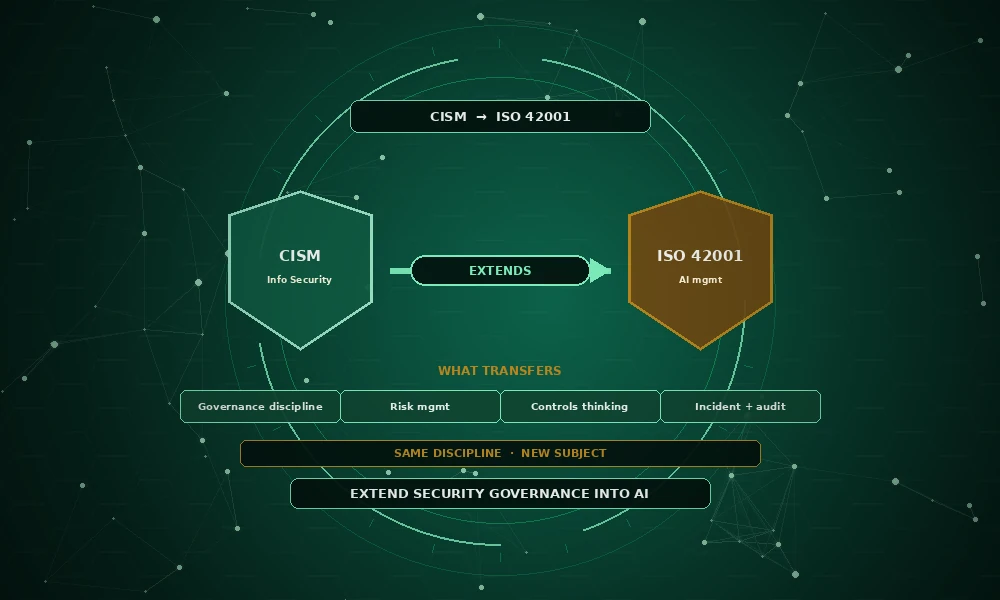
The real relationship is an extension. The governance discipline that CISM certified in you is exactly what ISO 42001 asks for, only pointed at a new and harder subject. This guide from the AI Governance Certification Institute (AIGCI) shows how the two differ, and how ISO 42001 extends your CISM into AI governance rather than replacing it.
CISM certifies a person's information security management; ISO 42001 certifies an organization's AI management system and the people who build it. The bridge between them is governance itself, which transfers cleanly from security to AI.
Before you compare, name the problem you are solving
Before weighing the two, get clear on what you are actually trying to do, because that decides everything that follows.
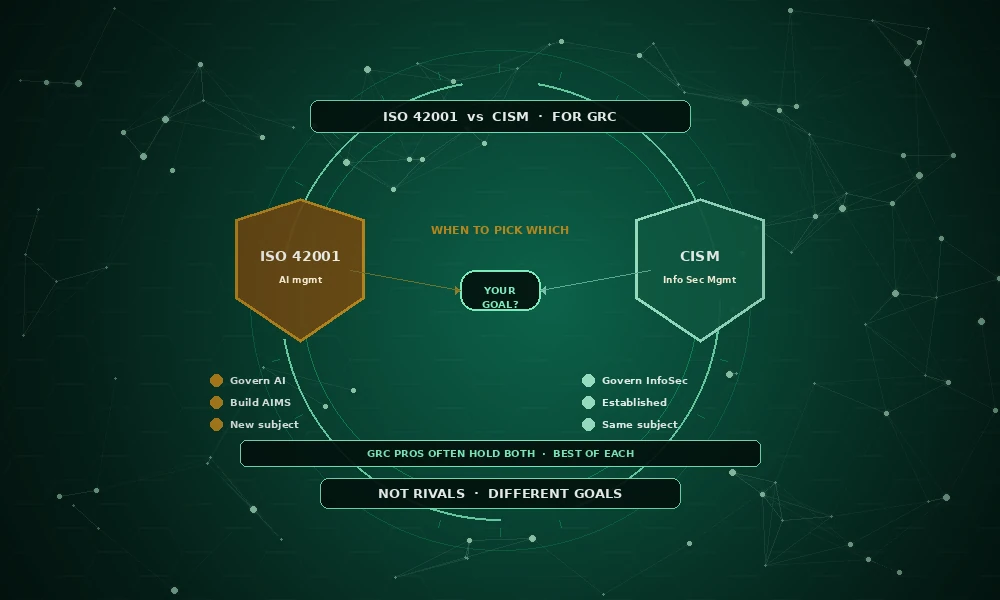
If your aim is to lead information security better, you are asking a CISM question. If your aim is to govern how your organization builds and uses AI, you are asking an ISO 42001 question.
Many people conflate the two because both involve risk and governance, then feel torn between credentials that were never really competing. Naming your goal first turns a confusing comparison into a simple sequence: keep what proves your security leadership, and add what proves your AI governance.
What CISM is, in one breath
CISM is issued by ISACA and has certified security managers since 2002. More than 107,000 professionals now hold it, which makes it one of the most established credentials in security leadership.
Its body of knowledge covers four domains: information security governance, risk management, security program development and management, and incident management. In short, it certifies that you can lead a security program, not merely operate the tools inside it.
What ISO 42001 is, in one breath
ISO 42001 is not a personal exam in the same sense. It is a standard that an organization builds an AI management system against and is audited on by an accredited body.
It also carries individual credentials for the people who make it work, chiefly the Lead Implementer who designs and runs the system and the Lead Auditor who checks it. Introduced in 2023, it is the reference standard for managing AI.
Crucially, it reaches beyond security. ISO 42001 adds AI-specific concerns that CISM never had to cover: bias, transparency, explainability, human oversight, and the way a model changes across its lifecycle.
Comparing them is about domains, not rivalry
The cleanest way to see the difference is by what each one governs. CISM governs information security. ISO 42001 governs artificial intelligence.
The logic underneath is shared. Both rest on the same management-system idea: set policy, assess risk, run a program, monitor it, and improve it continually. That shared spine is why moving from one to the other feels less like starting over than like applying a familiar method to a new problem.
This is what the tracker calls an extension rather than an alternative. ISO 42001 takes the governance instinct CISM built and stretches it to cover risks that are unique to AI.
Where the two genuinely overlap
Many CISM holders reach ISO 42001 through a familiar door: the world of information security management systems. If you already think in terms of an ISMS, the shape of an AI management system will feel immediately recognisable.
Both are built on the same harmonised structure of context, leadership, planning, support, operation, evaluation, and improvement. Some controls even rhyme, as access control, logging, and supplier oversight reappear in the AI world, now extended to cover models and training data. That shared ground is why a security governance background does not merely help; it measurably shortens the climb.
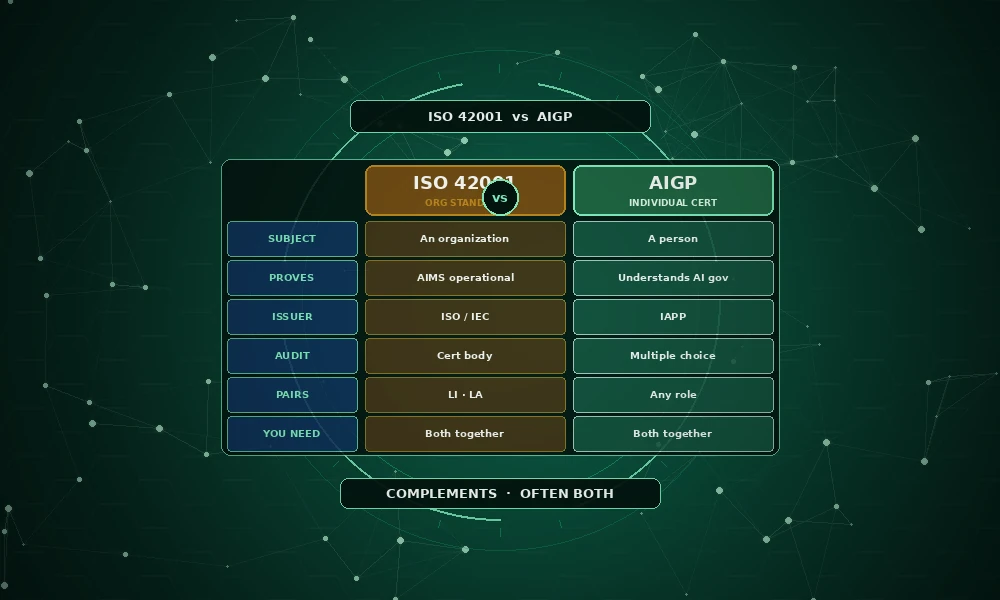
CISM and ISO 42001 side by side
Set against the attributes that decide a choice, the two separate clearly. Read the maturity and domain rows together, because that is where the story sits:
|
Attribute |
CISM |
ISO 42001 and its credentials |
|---|---|---|
|
What it is |
An individual security-management certification |
An AI management system standard, with Lead Implementer and Lead Auditor credentials |
|
Who issues it |
ISACA |
ISO and IEC, certified by accredited bodies |
|
What it governs |
Information security |
Artificial intelligence |
|
Level |
A person's expertise |
An organization's system, plus the people who run it |
|
Focus |
Governance, risk, program, and incident management for security |
Operating an AI management system with AI-specific controls |
|
Maturity |
Established in 2002 and widely held across security leadership |
Introduced in 2023 as the standard for AI management |
|
Best suited to |
Security managers and leaders |
People extending into AI governance, and organizations seeking certification |
|
What it proves |
You can lead a security program |
You, or your organization, can govern AI |
The maturity row is worth pausing on. CISM is a settled, widely held credential, while ISO 42001 is early and scarce, which is precisely why adding it now carries an advantage that will not last forever.
Why your CISM is a head start, not a sunk cost
Security professionals sometimes worry that AI governance makes their existing expertise obsolete. The opposite is closer to the truth, and a line from a futurist captures why:
|
"The illiterate of the 21st century will not be those who cannot read and write, but those who cannot learn, unlearn, and relearn." Alvin Toffler |
Toffler's point is that value now lies in adapting what you know, not clinging to it. Your CISM is not something to unlearn; it is the foundation you relearn upon.
The governance, risk, and program skills it certified transfer directly. What you add for AI is a new layer of subject matter, not a new profession from scratch.
How ISO 42001 extends your CISM
The extension is concrete, not vague. Each CISM domain has a direct counterpart in AI governance that ISO 42001 formalises:
-
Security governance becomes AI governance. Setting policy, direction, and accountability transfers straight across, now aimed at AI systems.
-
Security risk management becomes AI risk management. Your risk discipline extends to AI-specific risks such as bias, opacity, and model failure.
-
Program management becomes AIMS operation. Running a security program maps onto running and improving an AI management system.
-
Incident management becomes AI incident response. Handling breaches extends to handling AI harms, from a biased decision to an unsafe output.
The one genuinely new element is the subject matter of AI itself, and even there frameworks help you cross over. The NIST AI Risk Management Framework gives a security-minded professional a familiar, risk-based vocabulary for the harms an AI system can cause.
Governing AI is not the same as securing AI
One distinction matters more than any other for a security professional making this move. Securing an AI system and governing one are different jobs, and ISO 42001 is about the second.
Securing AI means protecting models and data from attack, which is the natural home of a security mindset. Governing AI means ensuring the system is fair, transparent, overseen, and used responsibly, which reaches into ethics and impact that security training rarely covers.
So the extension asks you to widen your definition of risk. A model can be perfectly secure and still cause harm through bias or an unaccountable decision, and ISO 42001 exists to catch precisely that kind of failure.
Why security leaders are extending into AI now
Timing favours the move for a simple reason: demand is high and qualified people are scarce.
The security profession is already stretched. The ISC2 Cybersecurity Workforce Study puts the global cybersecurity workforce gap at more than 3.4 million unfilled roles, so the people who can govern technology risk are in short supply before AI is even added to their plate.
AI governance widens that gap further, because it needs the same scarce governance skill applied to a newer, less understood risk. A CISM holder who can also govern AI sits at the meeting point of two shortages at once.
That is the practical case for extending now. The scarcer the combination, the more it is worth, and few professionals yet hold both sides of it.
What a CISM holder should watch out for
Crossing over is an advantage, not a free pass, so a few honest cautions are worth naming before you start:
-
Risk is broader here. AI risk includes ethical and societal harm, not only confidentiality, integrity, and availability.
-
Evidence looks different. Governing a model means judging fairness and oversight, not only confirming that a control is present.
-
The subject keeps moving. Models drift and change after deployment, so AI governance is continuous in a way some static security controls are not.
Choosing your next step
What you do next should follow your direction of travel, not a ranking of the credentials. Match the move to your goal:
- Staying focused on information security? CISM remains your core credential, and there is no urgency to change that.
- Extending into AI oversight? An ISO 42001 credential is the natural next step, and the Lead Implementer path is where most security professionals enter it.
- Responsible for an organization's certification? That is ISO 42001 for the organization, audited by an accredited body, which CISM cannot provide.
- Working across governance, risk, and compliance? See how the pieces fit in AI governance for GRC professionals, which maps the wider move.
The bottom line
CISM versus ISO 42001 is the wrong framing once you see the relationship clearly. CISM proves you can govern security; ISO 42001 lets you govern AI with the same discipline.
For a security leader, the two are a foundation and its extension. Keep the credential that proves your governance judgement, and add the one that points it at the risk every organization is now racing to manage.
Held together, they say something few profiles yet can: that you can govern both the systems protecting the business and the AI now reshaping it.
Frequently asked questions
Is ISO 42001 replacing CISM?
No. They govern different domains. CISM certifies information security management, while ISO 42001 governs AI. For a security professional, ISO 42001 extends existing governance skills into AI rather than making CISM obsolete.
Can a CISM holder move into AI governance easily?
Usually yes. The governance, risk, program, and incident skills CISM certifies transfer directly to AI. The main new element is the subject matter of AI itself, including risks like bias and model behaviour, which an ISO 42001 credential formalises.
Which should I get first, CISM or ISO 42001?
If your work is squarely in information security, CISM comes first. If you are moving toward governing AI, or already hold CISM, an ISO 42001 credential is the natural next step. Many security leaders end up holding both.
Does CISM cover AI-specific risks?
Only indirectly. CISM centres on information security, so AI-specific concerns such as bias, transparency, explainability, and human oversight sit outside its core. ISO 42001 is built to address exactly those.
Can CISM certify my organization for AI governance?
No. CISM is an individual credential. Organizational certification for AI governance comes from ISO 42001, awarded after an accredited body audits the organization's AI management system.
Extend your governance into AI
If you are ready to point your governance skills at AI, AIGCI's Lead Implementer certification is aligned to ISO 42001 and built around doing the work, so your CISM foundation carries straight into it.
To see how the move fits a governance career, read AI governance for GRC professionals, and to learn how the institute designs its programmes, read more about the institute.