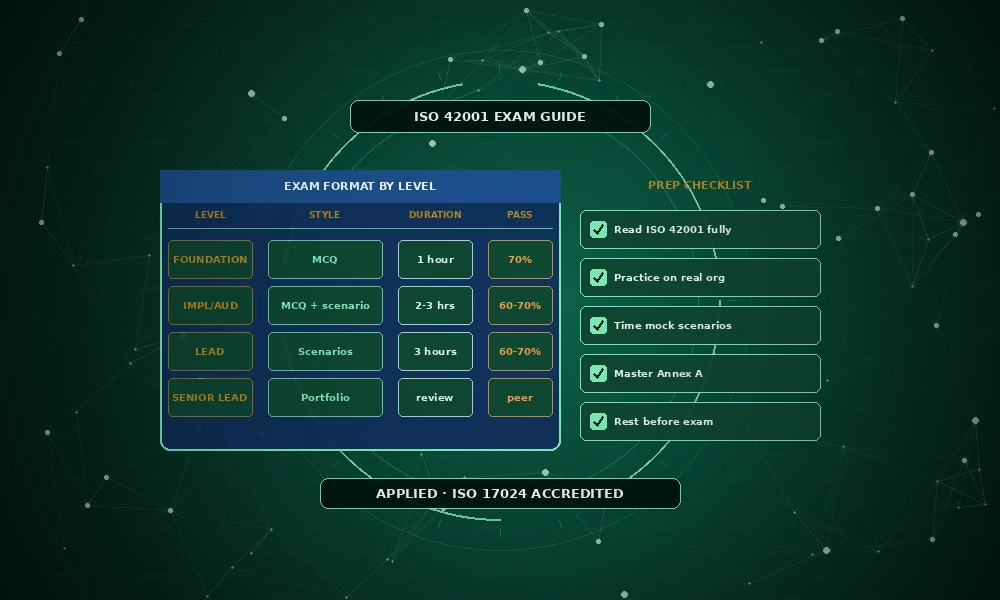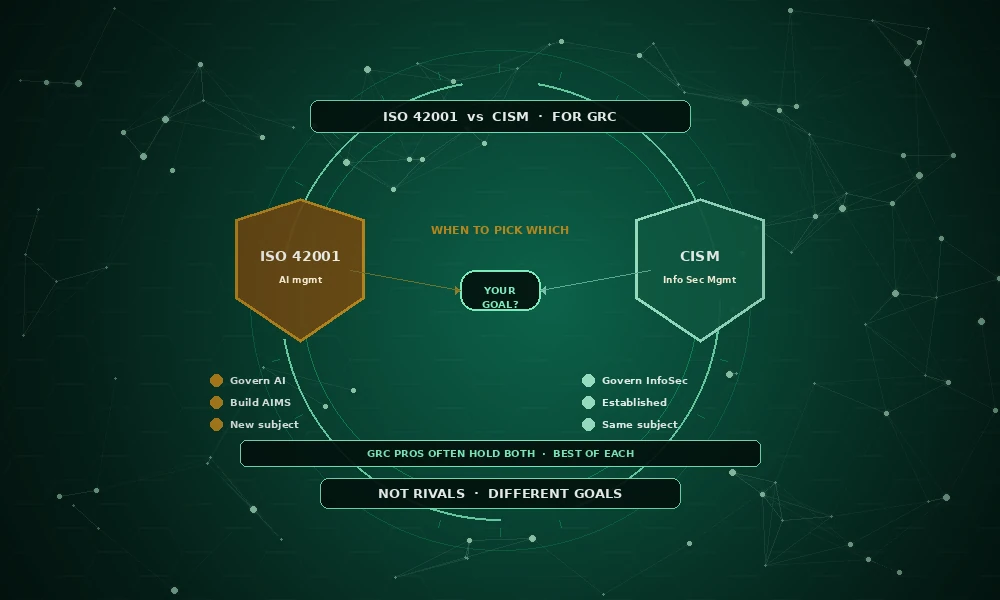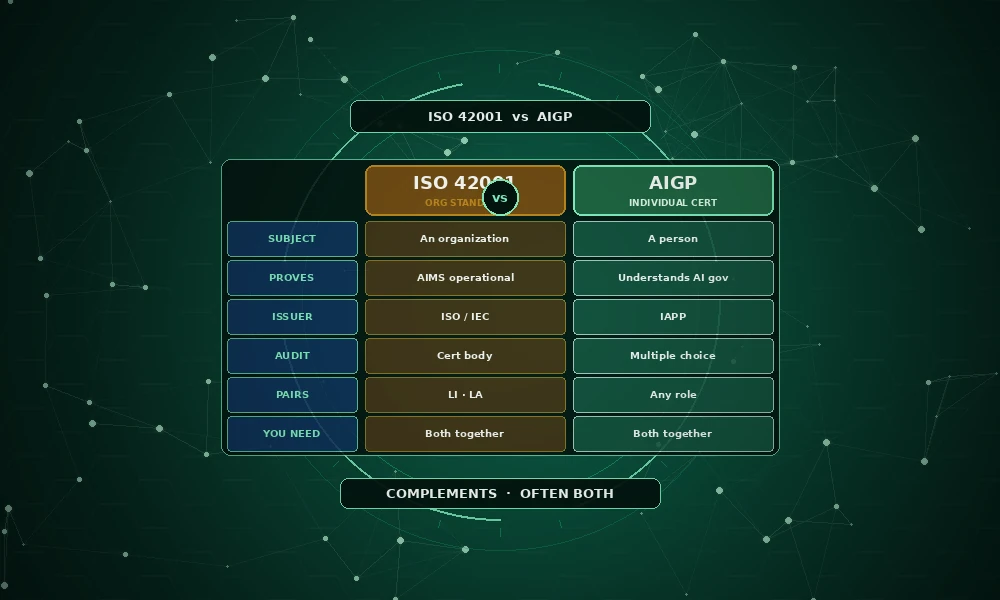
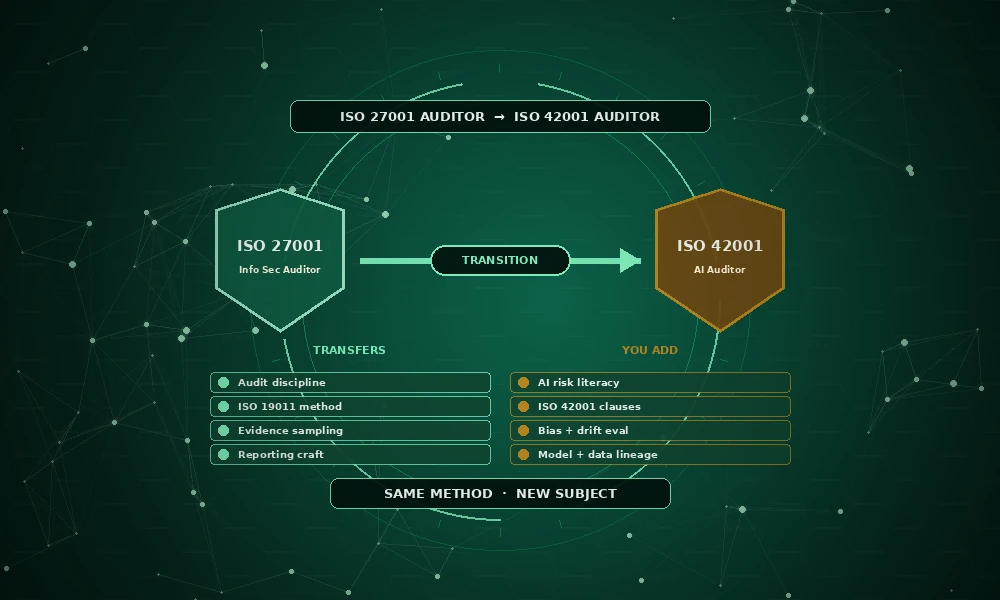
If you already audit ISO 27001, you are far closer to auditing AI than you probably think. The move is a transition, not a fresh start.
The reason is simple. Most of what makes you an auditor is standard-agnostic, and it carries straight into ISO/IEC 42001:2023, the AI management system standard. What changes is the subject you point that skill at.
So the honest way to frame this is a ratio. Roughly the bulk of your craft transfers untouched, and a smaller, sharper portion is genuinely new. The auditors who struggle are the ones who assume the new portion is zero.
This guide from the AI Governance Certification Institute (AIGCI) separates the two precisely: what carries over from your ISO 27001 work, what you must add for AI, and the practical path across.
An ISO 27001 auditor transitions to ISO 42001 auditing by keeping the audit method intact and expanding the subject matter. The craft transfers; the risks, the requirements, and the evidence change.
The good news: most of your skill transfers
Both standards are built on the same skeleton. ISO management system standards share a common high-level structure, so context, leadership, planning, support, operation, evaluation, and improvement appear in ISO 42001 exactly as they do in ISO 27001.
Your audit method transfers as well. The discipline set out in ISO 19011, planning an audit, gathering evidence, sampling, forming findings, and reporting, is the same whether the subject is information security or artificial intelligence.
In other words, you do not relearn how to audit. You already know how to test a management system against a standard, and that is the hard, slow skill to build. It comes with you intact.
Will my ISO 27001 experience still count?
This is the first worry most auditors have, and the answer is reassuring: it counts for a great deal.
Your years of audit practice are the expensive, slow-built asset, and none of it is discarded. Qualification routes for ISO 42001 typically recognise prior management-system audit experience, so you carry credit into the transition rather than beginning at zero.
What you add is narrow and learnable. That is a very different proposition from retraining for a new profession, and it is why the move rewards experience rather than erasing it.
What transfers, and what you must add
The clearest way to plan your transition is to sort your existing capability into what carries over and what changes. Read the right-hand column as your study list:
|
Audit capability |
Carries over? |
What changes for ISO 42001 |
|---|---|---|
|
The audit method (ISO 19011) |
Fully |
Nothing; planning, sampling, evidence, and reporting are identical |
|
Management-system structure |
Fully |
Same skeleton of clauses, a new subject inside it |
|
Risk-based thinking |
Yes |
Risk now includes AI-specific harm: bias, opacity, safety, and societal impact |
|
Operational requirements |
Partly |
New duties appear: AI risk treatment, AI system impact assessment, lifecycle, and data management |
|
Controls and their evidence |
Method only |
You cannot reuse ISO 27001 controls; the controls and the evidence for them are different |
|
Subject-matter knowledge |
No |
You must learn how AI systems work, and how they fail |
There is a large community ready to make exactly this move. The ISO Survey recorded 96,709 valid ISO/IEC 27001 certificates worldwide in its 2024 edition, each one audited by someone whose method already transfers. Yet ISO 42001, published only in 2023, is audited by comparatively few. That gap between a large pool of capable auditors and a small pool of AI-qualified ones is the opportunity this transition captures.
The part that is genuinely new
The new material is concentrated, which is good news, because you can target it. Most of it lives in the operational clause and in the subject itself.
Where ISO 27001 asks you to audit information security risk treatment, ISO 42001 adds requirements built for AI: treating AI-specific risk, running an AI system impact assessment that weighs effects on people and society, governing the AI system across its lifecycle, and managing the data that trains and feeds it.
These are not cosmetic additions. An AI system impact assessment has no direct equivalent in an information security audit, so it is a genuinely new object you must learn to evaluate.
The subject matter is the other new frontier. You need enough understanding of how models are built, behave, and drift to ask the right questions, and frameworks help you get there. The NIST AI Risk Management Framework gives an auditor a structured vocabulary for the harms an AI system can cause.
Why you cannot audit AI the way you audit security
Here is the trap that catches experienced auditors, and it is worth naming plainly. Treating an AI system like an information asset produces an audit that looks complete and proves nothing.
In information security, much of your evidence concerns configuration and control: is access restricted, is data encrypted, is logging on. Those questions still matter, but they do not tell you whether a model is fair, explainable, or safely overseen.
A model can be perfectly secure and still discriminate, mislead, or make an unaccountable decision. So the evidence shifts from how the system is protected to how the system behaves and who answers for it.
That shift, from auditing protection to auditing behaviour and accountability, is the real conceptual leap of the transition. Master it and the rest is detail.
A concrete example: same data, a different question
An example makes the shift tangible. Suppose you are auditing how a system handles personal data.
As an ISO 27001 auditor, you check that access is controlled, the data is encrypted, and activity is logged. Those questions confirm the data is protected.
As an ISO 42001 auditor, you go further. You ask whether the model trained on that data treats different groups fairly, whether its decisions can be explained, and whether a human can meaningfully overrule it.
Same data, same organization, a different question entirely. The security audit asks whether the data is safe; the AI audit asks whether the system using it is trustworthy. Learning to ask the second question, on top of the first, is the heart of the transition.
Common first-audit mistakes to avoid
A few predictable errors trip up experienced auditors on their first AI engagement, and knowing them in advance is most of the cure:
-
Treating AI risk as only a security risk, and missing bias, opacity, and societal harm.
-
Accepting documentation of a control without testing whether the model actually behaves as claimed.
-
Reusing ISO 27001 controls and evidence, which were never designed for AI-specific requirements.
-
Overlooking the AI system impact assessment, which has no equivalent in an information security audit.
The transition path, step by step
A sensible route builds on what you have rather than starting over. Five steps take most ISO 27001 auditors across:
-
Recognise what already transfers. Your audit method and management-system fluency are the foundation, so do not relearn them.
-
Close the AI knowledge gap. Learn how AI systems are built, how they fail, and what bias, opacity, and drift actually look like.
-
Master the ISO 42001 requirements. Study the new operational duties and the Annex A controls, focusing on what has no ISO 27001 equivalent.
-
Take a Lead Auditor qualification. A dedicated course formalises the transition, and many routes credit your existing audit experience toward the requirement.
-
Get AI audit repetitions. Practise on real or simulated AI management systems, because judgement about models is built by doing, not reading.
Qualification requirements vary by scheme, and several expect a few years of audit experience. The useful news is that your ISO 27001 work typically counts toward it, which is why the Lead Auditor certification is a step across rather than a climb from the bottom.
How long the transition takes
How long the crossing takes depends mostly on your starting familiarity with AI, not on your audit skill.
An experienced auditor with some AI exposure can often be ready after a few weeks of focused study and a qualification course. Someone entirely new to how models work should plan for longer, because the subject matter, not the audit method, is the real learning curve.
Either way, you are adding to a foundation rather than building one, which is why the timeline is measured in weeks and months, not years.
Lead Auditor or internal auditor first?
You do not have to jump straight to external certification work, and for many the gentler entry is wiser.
If you audit for a certification body or want to, the Lead Auditor route is the target. If you want a lower-stakes way to build AI audit judgement inside your own organization first, the internal auditor route lets you apply the new knowledge before you carry it into third-party audits.
Both draw on the same transferable craft. The difference is only the setting in which you practise it, and either one moves you meaningfully into AI assurance.
Why this transition is well timed
Demand is arriving faster than qualified auditors are. As the EU AI Act pushes organizations toward independent assessment of their AI, the need for auditors who can credibly judge an AI management system is climbing, while the supply of them is still thin.
That imbalance rewards the auditors who move early. You already hold the scarce, slow-built half of the skill set, and you are adding the fast-built, in-demand other half at exactly the moment the market is asking for it.
The bottom line
Moving from ISO 27001 to ISO 42001 auditing does not restart your career; it extends it. The method that took you years to master comes with you, and you add a focused layer of AI knowledge on top.
Keep the craft, expand the subject, and respect the genuinely new parts rather than assuming AI is just security with a different label. Do that, and you become something the market currently has too few of: an auditor who can stand behind a judgement about AI.
Frequently asked questions
Can an ISO 27001 auditor become an ISO 42001 auditor?
Yes, and the transition is well supported. Because both standards share a common structure and the same audit method, your existing skills transfer directly. You add AI-specific knowledge and the new ISO 42001 requirements rather than starting from scratch.
Does my ISO 27001 audit experience count toward ISO 42001?
Usually yes. Requirements vary by scheme, but many Lead Auditor routes credit prior management-system audit experience toward their qualification criteria, which is why the move is treated as a transition rather than a fresh certification from the beginning.
What is actually different about auditing AI?
The subject and the evidence. ISO 42001 adds duties with no direct ISO 27001 equivalent, such as the AI system impact assessment, and shifts the focus from how a system is protected to how it behaves and who is accountable for it. A secure model can still be unfair or unaccountable.
Can I reuse ISO 27001 controls when auditing ISO 42001?
No. The audit method transfers, but the controls do not. ISO 42001 has its own controls for AI-specific risks, and they require new evidence and testing. Reusing security controls would miss exactly the risks the AI standard exists to manage.
Should I do the Lead Auditor or internal auditor path first?
It depends on your goal. The Lead Auditor route suits those auditing for certification bodies, while the internal auditor route offers a lower-stakes way to build AI audit judgement inside your own organization before moving to third-party work.
Make the move with a course built for it
If you are ready to formalise the transition, AIGCI's Lead Auditor certification is aligned to ISO 42001 and built around auditing real AI management systems, so your ISO 27001 experience carries straight in. To understand the destination role fully, read the full Lead Auditor role guide and to see how the institute designs its programmes, read more about the institute.