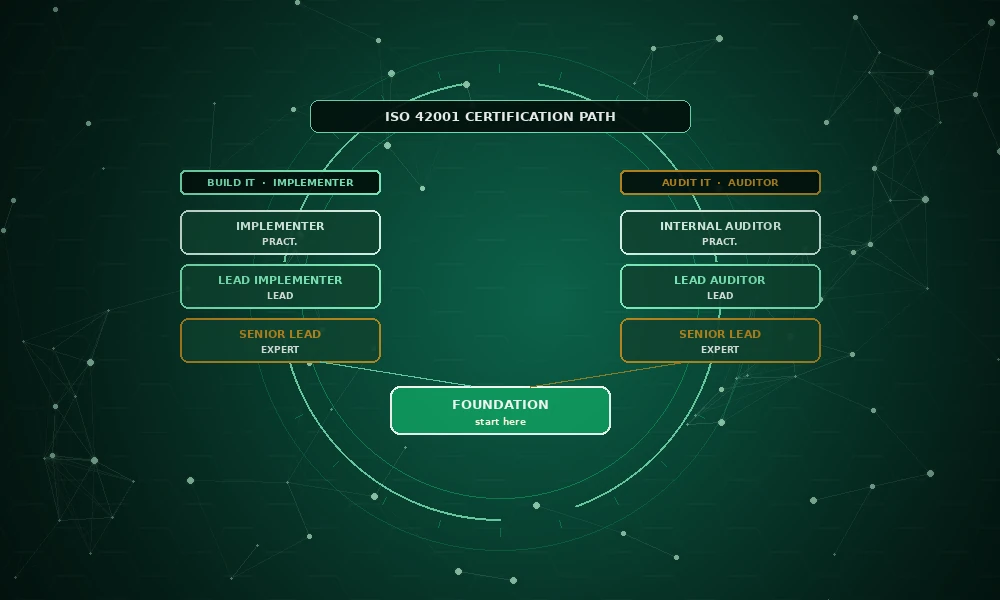
People ask for the ISO 42001 certification path as if there were only one. There is not, and pretending otherwise is why so many end up on the wrong one.
A professional certification in ISO/IEC 42001:2023, the AI management system standard, has levels, and the levels connect into a few distinct routes. Which route is right depends entirely on where you want to end up.
This pillar guide from the AI Governance Certification Institute (AIGCI) lays out the whole map: the individual credential ladder, the separate route an organization takes, and a simple way to choose the path that fits your destination rather than someone else's.
|
"Would you tell me, please, which way I ought to go from here? That depends a good deal on where you want to get to." Alice and the Cheshire Cat, in Lewis Carroll's Alice's Adventures in Wonderland |
The Cheshire Cat gives the only honest answer to the certification-path question. The right way forward is decided by your destination, so this guide starts there, with where you are trying to get to, and works back to the route.
First, separate the two journeys people confuse
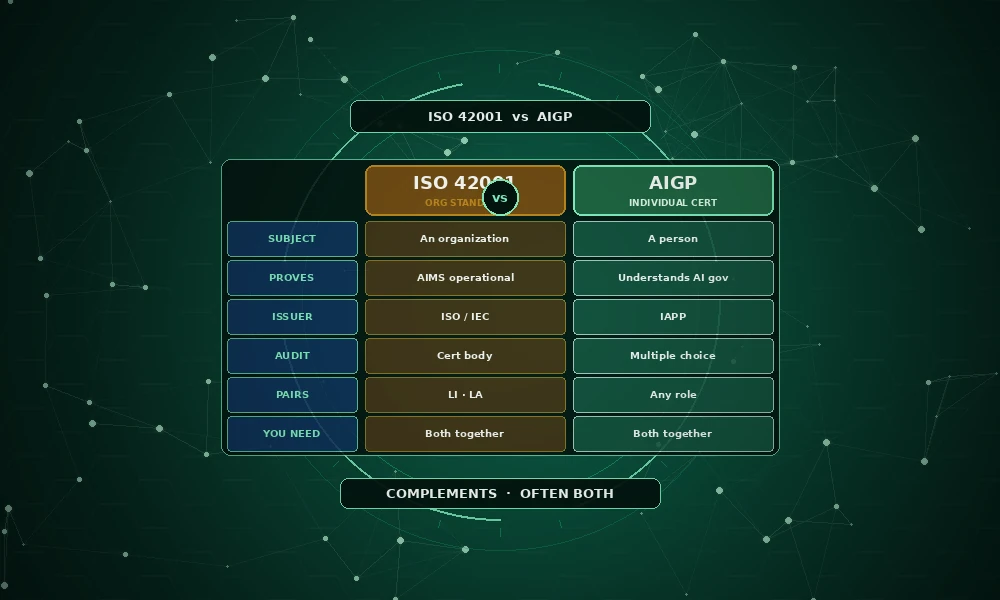
Before any ladder makes sense, untangle a confusion that derails many searches. The phrase ISO 42001 certification hides two very different journeys.
The first is the individual path. A person earns a credential, such as Foundation, Lead Implementer, or Lead Auditor, by learning the standard and passing an exam.
The second is the organizational path. A company is not examined; it builds an AI management system and is audited against ISO 42001 by an accredited body, which then issues the certificate.
These journeys are related but not the same, and mixing them up is the single most common mistake. Keep them separate, and the whole picture becomes clear.
The individual credential ladder
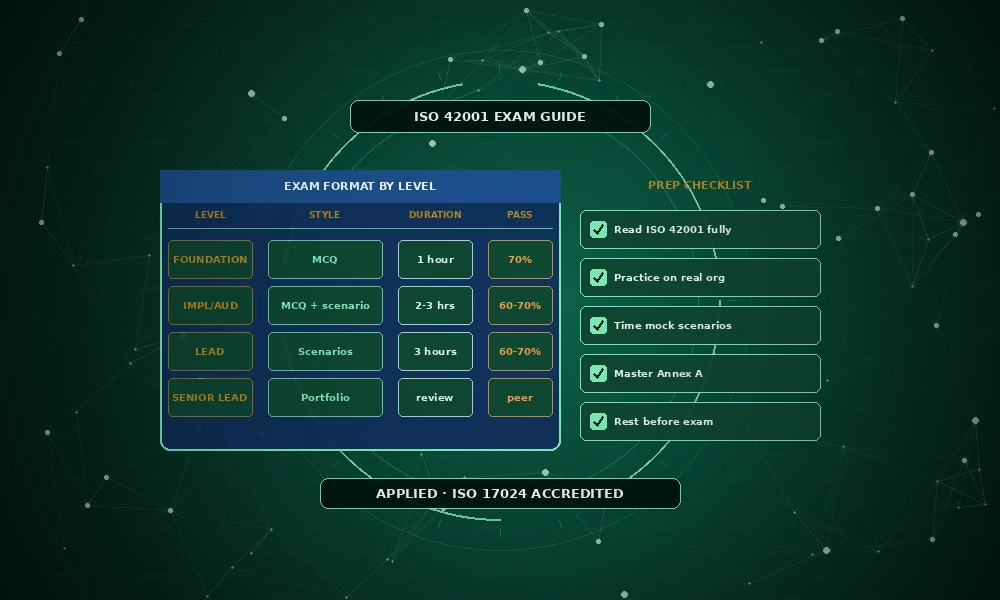
The personal path is a short ladder of credentials, each built for a different kind of work. Here is what each rung is for and who it suits:
|
Credential |
What it is for |
Best suited to |
|---|---|---|
|
Foundation |
Understanding ISO 42001 and how an AIMS works, without building or auditing one |
Newcomers, leaders, and team members who need literacy |
|
Lead Implementer |
Designing, building, and running an AI management system |
Those who will own or deliver an AIMS |
|
Lead Auditor |
Independently assessing whether an AIMS conforms to the standard |
Auditors and those moving into assurance |
|
Internal Auditor |
Auditing an AIMS from inside the organization that runs it |
Staff checking their own organization's system |
This is the map at a glance, not the fine detail. For a fuller breakdown of each rung and how they compare, all the levels are explained separately, so this guide can stay focused on the routes rather than the definitions.
Choose your route by your destination
With the ladder in view, the path becomes a matter of matching your goal to a route. Five destinations cover almost everyone:
|
Your destination |
Your route |
The anchor credential |
|---|---|---|
|
Understand AI governance |
Foundation, and stop there for now |
Foundation |
|
Build and run an AIMS |
Foundation if new, then Lead Implementer |
Lead Implementer |
|
Independently audit AI systems |
Foundation if new, then Lead Auditor |
Lead Auditor |
|
Check your own organization's AIMS |
Foundation, then Internal Auditor |
Internal Auditor |
|
Get your organization certified |
Implement, then external audit by an accredited body |
Organizational certification |
Two forks on this map deserve their own reading, because they are where most people hesitate. Whether to stop at Foundation or continue to build is covered in Foundation vs Lead Implementer, and whether to build or to audit is covered in Lead Implementer vs Lead Auditor. Settle those two questions and your route is essentially decided.
Common wrong turns on the path
Because the map has several routes, a few predictable detours catch people out, and naming them keeps you on the road that fits your goal:
-
Collecting credentials for their own sake, rather than the ones your destination actually needs.
-
Confusing the two journeys, and expecting a personal exam to certify a whole organization.
-
Starting too high, skipping the grounding that would have made the advanced levels far easier to absorb.
-
Choosing by prestige, picking Implementer or Auditor by which sounds more senior, when the real question is simply build or assess.
Where to start: do you need Foundation first?
The most common starting question is whether Foundation is a required first step. It usually is not, though it often helps.
If you are new to management systems or to AI, Foundation gives you the shared vocabulary that makes the higher levels far easier to absorb. It lowers the climb rather than adding to it.
If you already audit or run management systems, you can often begin directly at Lead Implementer or Lead Auditor, because the structural thinking is already familiar. Your background, not a rule, decides this.
The organization's certification path
The organizational route is a different journey entirely, and it is where most path guides fall silent. A company does not sit an exam; it earns a certificate by proving its system works.
The route runs in a recognisable order:
-
Build the AI management system, closing the gap between current practice and what the standard requires.
-
Run it, then check it internally through an internal audit and a management review, so problems surface before an external auditor finds them.
-
Pass a two-stage external audit by an accredited certification body, covering the documentation first and the working system second.
-
Maintain the certificate through periodic surveillance audits and a full recertification after about three years.
This route is governed by rules for the auditors themselves, chiefly ISO/IEC 17021-1, which is why an accredited certificate carries weight that a self-declaration does not. The organizational path is slower and more demanding than any individual exam, because it certifies reality, not knowledge.
How the individual and organizational paths meet
The two journeys are not parallel lines; they intersect. An organization cannot travel its path without people who hold the individual credentials.
A Lead Implementer builds the system the organization will be certified against. A Lead Auditor, working for an accredited body, is the one who assesses it. The personal ladder and the corporate route are the same story told from two sides.
Seeing that connection helps you place yourself. When you choose an individual route, you are also choosing which part of an organization's certification journey you want to own.
What each route ultimately prepares you for
However the routes diverge, they lead to one underlying capability: governing AI against a recognised standard and being able to prove it.
Whichever credential anchors your path, you end up fluent in the same core ideas of AI risk, controls, and human oversight that wider frameworks such as the NIST AI Risk Management Framework also describe. The standard gives you the management system; those frameworks give you a shared language for the risks it exists to manage.
That common foundation is why the paths, though they separate, are not truly different destinations. They are different entrances to a single discipline, making AI trustworthy and demonstrating that it is.
A sensible sequence for most people
If you want a default rather than a decision tree, here is the sequence that fits the largest number of people, adjusted for where you start.
Most newcomers begin with Foundation for grounding, then move to Lead Implementer if they want to build or Lead Auditor if they want to assess. Experienced practitioners often skip Foundation and start at the level their work demands.
Many eventually add the second professional credential, because holding both the builder and auditor perspectives is unusually valuable, even though the two roles must stay independent on any single engagement.
Whatever the order, the principle is the same: let your destination set the sequence, and add levels as your goals grow rather than collecting them for their own sake.
How long the path takes
Timelines differ sharply between the two journeys, and setting expectations early prevents frustration later.
An individual credential is measured in weeks: a focused course and an exam, with preparation scaled to your background. Adding a second professional level afterwards is a smaller step than the first, because the structural thinking already transfers.
The organizational path is measured in months. Building and proving a working AI management system takes real time, and the external audit only happens once the system genuinely runs. Patience on that route is not delay; it is the whole point, because the certificate is meant to certify reality.
Why this path is worth walking now
Timing rewards those who move early, because this is genuinely new ground. ISO 42001 was published only in 2023, and organizations certified as recently as early 2026 were still among the first hundred in the world, as ISO itself describes in its explanation of the standard.
That novelty is the opportunity. As the EU AI Act and similar rules push AI governance from optional to expected, the people and organizations already on the path will be the ones ready when it becomes a requirement rather than a choice.
The bottom line
There is no single ISO 42001 certification path, only the right route for your destination. Decide whether you want to understand, build, audit, or certify, and the path names itself.
Keep the two journeys straight, choose your route by where you want to arrive, and add levels in the order your goals require. That is the whole map, and it is simpler than the number of options first suggests. Once your destination is fixed, the path stops feeling like a maze of certificates and reads instead like a single clear line from where you are to where you want to be.
Frequently asked questions
What is the ISO 42001 certification path?
There are two paths, not one. Individuals climb a credential ladder of Foundation, Lead Implementer, Lead Auditor, and Internal Auditor, chosen by their goal. Organizations follow a separate route of building an AI management system and being audited against ISO 42001 by an accredited body.
Do I have to start with Foundation?
Not necessarily. Foundation helps newcomers by building shared vocabulary, but experienced auditors or management-system professionals can often start directly at Lead Implementer or Lead Auditor. Your background decides this, not a fixed rule.
Should I become a Lead Implementer or a Lead Auditor?
It depends on whether you want to build systems or independently assess them. Lead Implementer suits those who will own or deliver an AIMS; Lead Auditor suits those moving into assurance. The choice is about role and independence, not seniority.
How does an organization get certified, and is that the same as a personal credential?
No, they are different. An organization is not examined; it builds an AI management system and passes a two-stage audit by an accredited certification body, then maintains the certificate through surveillance audits. A personal credential certifies a person's knowledge or ability, not an organization's system.
Can I hold both Lead Implementer and Lead Auditor?
Yes, and many professionals do, because the two perspectives reinforce each other. The one rule is independence: the person who implements a specific system should not be the one who audits or certifies that same system.
Start on the right route
Once you know your destination, the next step is the credential that anchors your route. AIGCI offers the Foundation certification for grounding, the Lead Implementer certification for those who will build an AIMS, the Lead Auditor certification for those who will assess one, and the Internal Auditor certification for checking your own organization. To compare them in one place, see all the ISO 42001 courses, and to learn how the institute designs them, read more about the institute.