Ask what an ISO 42001 Lead Auditor earns and you will be handed a dozen different figures, often far apart, and most of them are technically true. That is the first thing to understand, because it explains the confusion. There is no single salary for auditing ISO/IEC 42001:2023, the AI management system standard usually shortened to ISO 42001.
What exists instead is a premium: an uplift that stacks on top of whatever you already earn as an auditor or governance professional. Treat the credential as a standalone salary and the numbers look chaotic. Treat it as a multiplier on an existing career and they suddenly make sense.
This guide from the AI Governance Certification Institute (AIGCI) sets out the premium stack that decides your number, shares reported ranges by region with the honesty they deserve, and shows how to climb the range.
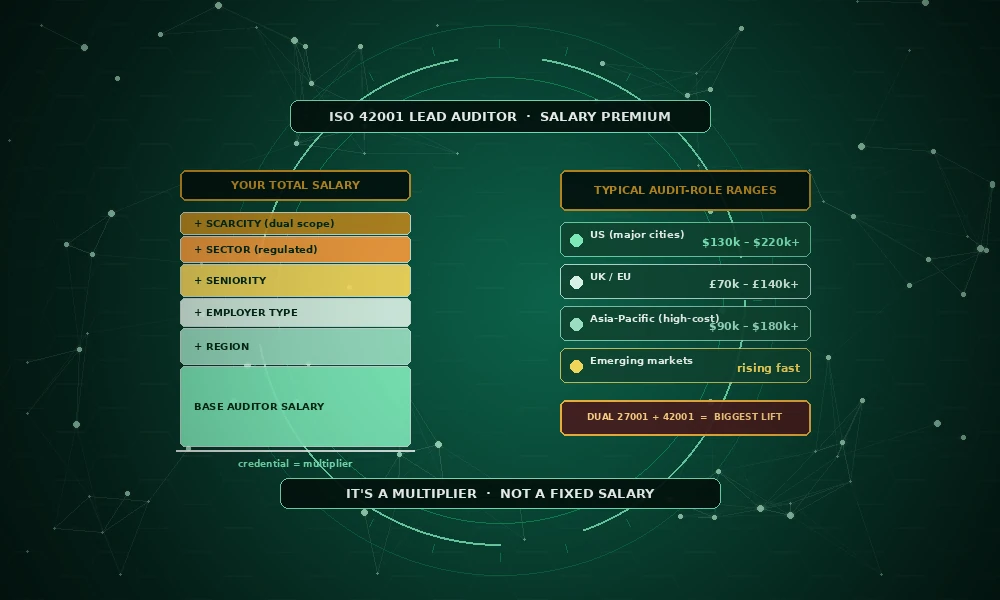
An ISO 42001 Lead Auditor salary is not a fixed figure but a premium that stacks on an existing auditor or governance salary. Region, employer, seniority, scope, and scarcity each move the number, which is why quoted figures vary so widely.
Why there is no single Lead Auditor salary
The reason the figures scatter is that a salary is set by a whole person, not by one line on a certificate. Two people can both hold the Lead Auditor credential and earn very different amounts, because one is a senior information-security auditor in a high-cost city and the other is early in their career in a lower-cost market.
The credential did not fail the second person; it simply multiplied a smaller base. This is the single most useful idea on this page: the certificate raises your value as an auditor, but the size of that raise depends on what you were already worth, where you work, and how scarce your combined skill set is. Every honest salary discussion has to start there, or the numbers mislead.
The premium stack: what actually sets your number
Rather than one salary, think of your pay as a stack of factors, each of which nudges the figure up or down. These are the levers that matter most:
|
Factor |
How it moves your salary |
|---|---|
|
Your existing profession |
The credential multiplies an auditor, risk, or governance salary; it does not create one from nothing |
|
Region |
High-cost markets pay the most in absolute terms; emerging markets pay less but are rising fast |
|
Employer type |
Large enterprises and specialist assurance firms tend to pay more than small consultancies |
|
Seniority |
Lead and senior audit roles, and officer-level governance titles, sit at the top of the range |
|
Dual scope |
Auditors who cover both ISO 27001 and ISO 42001 command more than single-standard auditors |
|
Sector |
Regulated, high-consequence sectors such as finance and healthcare pay a premium for assurance |
|
Scarcity |
Because qualified AI auditors are still rare, early movers capture a scarcity premium that will narrow over time |
Read the stack top to bottom and a strategy appears. You cannot change your region overnight, but you can add dual scope, target a higher-paying sector, and move into more senior audit work, and each of those is a lever you control.
The people at the top of the range are rarely there because of the certificate alone; they are there because they stacked several of these factors at once. That is the difference between asking what the salary is and asking how to raise mine.
Reported ranges, caveated honestly
With that framing in place, here are the figures the market is actually reporting. Treat them as indicative, not authoritative: the pool of pure AI auditors is still small, much of the public data comes from a handful of sources, and roles are often bundled into broader governance titles. Each figure below appears once, and none should be read as a promise.
|
Region |
What the market is reporting (indicative) |
|---|---|
|
United States |
Experienced AI-focused auditor roles commonly reported around 130,000 to 190,000 US dollars, with senior AI governance officer titles reported higher still, into the low 200,000s |
|
India |
Specialist AI governance and audit packages reported roughly 14 to 48 lakh per annum, with top roles above that band |
|
United Kingdom and Europe |
Public data is sparser; experienced auditors typically sit between senior GRC pay and dedicated AI-specialist pay, with capital cities and dual-standard roles at the upper end |
The gap between regions is real but easy to misread. A larger absolute figure in one market does not always mean more once cost of living is accounted for, and a fast-growing market can offer a better trajectory than a mature one at a higher starting point.
The sensible reading is directional: AI auditing pays a clear premium over generalist auditing everywhere it is measured, and the size of that premium is still being set by supply and demand rather than by any settled benchmark.
Why the market pays the premium at all
It is worth understanding where the premium comes from, because that tells you whether it will last. A useful way to see it comes from someone who thought hard about wages:
|
"It is not the employer who pays the wages. Employers only handle the money. It is the customer who pays the wages." Henry Ford |
Ford's point applies directly. Auditors are paid well for AI work because the market beyond the employer, the customers and regulators demanding proof of AI governance, is willing to pay for that assurance.
As the EU AI Act pushes organizations to demonstrate their AI is governed, and certification recognised across borders through the international mutual-recognition system becomes a condition of doing business, the demand for people who can grant that assurance rises faster than the supply of them.
The premium is a scarcity signal. It will soften as more auditors qualify, which is an argument for entering while the gap is wide rather than waiting for the market to mature and the premium to compress.
Salaried or day rate: two ways to be paid
How you are paid matters as much as how much. Two models dominate, and they suit different people. A salaried role, whether at a certification body, an assurance firm, or inside an internal audit function, trades a slightly lower headline number for stability, benefits, and a clear path to seniority.
Independent or contract auditing, billed as a day rate, can convert scarce skills into a higher effective income, with reported consulting day rates for AI governance work landing in the low thousands, but it carries the usual freelance risks of gaps between engagements and no employer safety net. Neither is better in the abstract.
Early in a career, salaried roles build the track record and supervised experience that make later contracting credible; established specialists often move toward contracting once their name carries its own demand.
The uplift is on your salary, not from zero
This is where many salary articles mislead by accident. Quoting a large AI-auditor figure to someone earning a general IT-audit salary implies the certificate alone closes the gap, when in truth the figure assumes an experienced auditor who added AI to an already strong profile.
If you are already an auditor or a governance professional, the credential can move you meaningfully up your existing band, because it adds a scarce specialism to skills you already have. If you are new to auditing, the honest picture is different: you first need the audit foundation, and the AI premium stacks on top of that once it exists.
Understanding which of these you are prevents both disappointment and undervaluing yourself. It also explains why the same credential produces such different outcomes, and why the range of the jobs you are eligible for shapes your number as much as the certificate does.
How to move up the range
If the stack sets your number, then raising it is a matter of adding levers deliberately rather than hoping the certificate does the work. The moves that reliably help:
- Add dual scope. Becoming credible on both ISO 27001 and ISO 42001 makes you a one-person solution employers pay more for.
- Go where the stakes are. Regulated, high-consequence sectors pay more for assurance because a failure costs them more.
- Earn seniority, not just tenure. Leading audits and, later, managing an audit programme moves you into the upper band.
- Shift from readiness to certification work. Independent certification auditing tends to be valued above advisory-only readiness work.
Each of these is a concrete step rather than a wish, and they compound. An auditor who covers two standards, works in a demanding sector, and leads engagements is drawing on several premiums at once, which is exactly how people reach the top of the reported ranges.
For a wider view of where an auditing role can lead and what it connects to, the roles across AI governance show the paths that carry the biggest long-term uplift.
A realistic word on the numbers
It would be easy, and dishonest, to present precise salary figures as settled fact. They are not. This is a young field with a thin evidence base, figures that vary by source and method, and job titles that are still consolidating.
Any single number you see, including the ones reported above, should be held loosely and checked against live listings in your own market at the moment you are looking. The durable truth is not a figure but a direction: AI assurance skills are scarce, the demand for them is structural rather than faddish, and that combination supports a premium for the foreseeable future.
Use the ranges to orient yourself, not to anchor a negotiation on a number someone published a year ago.
Frequently asked questions
What is the average ISO 42001 Lead Auditor salary?
There is no reliable single average, because pay depends on your existing profession, region, seniority, and scope. What the data consistently shows is a clear premium over generalist auditing. Treat any single average figure with caution and check live listings in your own market.
Does the certification guarantee a salary increase?
No credential guarantees a raise. The Lead Auditor certification adds a scarce specialism that can move an existing auditor or governance professional up their band, but the size of the uplift depends on the other factors in the premium stack, especially your current role and region.
Why do salary figures for this role vary so much?
Because the figures describe different people. A senior auditor in a high-cost market and a newcomer in a lower-cost one can both hold the credential and earn very differently. The market is also early, so the data itself is thin and inconsistent between sources.
Do contractors earn more than salaried auditors?
Contract or day-rate auditing can produce a higher effective income by converting scarce skills into premium rates, but it carries gaps between engagements and no employer benefits. Salaried roles trade some upside for stability and a clearer path to seniority. Which pays more depends on demand and how consistently you are booked.
Will the salary premium last?
The premium is driven by scarcity, so it will likely soften as more auditors qualify. It is unlikely to disappear soon, because demand is structural, tied to regulation and procurement rather than hype. Entering while the gap is wide captures more of the premium than waiting does.
Earn the credential the premium rewards
The premium goes to auditors who can prove they can do the work, and that begins with a recognised credential. AIGCI's Lead Auditor certification is designed to give you that proof.
To see the range of roles the credential opens and where they are advertised, read our guide to the jobs, and for the full picture of the role behind the pay, read the complete Lead Auditor guide. To learn how the institute structures its certifications, read more about the institute.