
The surest way to prepare for the ISO 42001 exam is to make your preparation look like the exam. The test is scenario-based and weighted toward particular domains, so preparation that copies that shape beats preparation that simply rereads the standard from front to back.
Mirroring the exam does two things at once. It rehearses the single move the exam rewards, taking a clause of ISO/IEC 42001:2023 and applying it to a situation, and it spends your study time in proportion to how the exam weights its domains. Every step below is built on that one idea.
What follows is a step-by-step method, an honest view of how long preparation takes, and the mistakes that quietly cost people marks. Work through it in order, because each step sets up the next.
Prepare the Way You Will Be Tested
Most preparation advice tells you to read the standard and take a course. That is necessary but not sufficient, because neither, on its own, trains the skill the exam actually measures.
The exam does not ask you to recall a clause; it asks you to apply it to a workplace scenario and reach a defensible decision. So the core of good preparation is practicing that application, over and over, until it is automatic. Reading builds the knowledge; applying builds the skill, and only the second is tested under pressure.
Keep that distinction in view as you move through the steps. Anything that only adds knowledge is preparation half done; anything that makes you apply knowledge is preparation that counts.
A Step-by-Step Method to Prepare for the ISO 42001 Exam
Step 1. Confirm Your Exam's Exact Format First
Formats differ sharply between providers, in question count, duration, whether the exam is open or closed book, and the pass mark. Preparing for the wrong format wastes weeks, so pin down the specifics before anything else. Confirm them against your provider and against the exam guide, which explains how the exams are structured across levels.
Write down four things: how many questions, how long, open or closed book, and the pass mark. Everything that follows is tuned to those four facts.
Step 2. Diagnose Before You Study
Do not start by studying; start by finding out where you stand. Take a short set of practice questions untimed, score yourself by domain, and mark any area below roughly 60 percent as a priority. A diagnostic turns a vague plan to study everything into a focused plan to study the right things.
This single step saves more time than any other, because it stops you reviewing what you already know and points you at the clauses you do not.
Step 3. Read the Standard Once, With a Notebook
Read ISO 42001 through at least once, slowly, with a notebook beside you. The goal is not to memorize it but to learn its structure and to notice the clauses where you cannot yet picture what compliance would look like in a real organization.
Every clause that makes you pause is a question waiting to happen. Note it, because those are the places the exam will probe and the places your later practice should concentrate.
Step 4. Weight Your Time to the Exam's Domains
The exam does not treat every clause equally, and neither should you. Providers publish a blueprint that weights the domains, typically giving the most marks to the planning and implementation work in the middle clauses, with Annex A controls and, for auditors, ISO 19011 audit method close behind. Spend your hours in that same proportion.
Mirroring the weighting is the heart of preparing like the exam. An hour spent on a heavily weighted domain is worth several spent on a lightly weighted one, so let the blueprint, not your comfort zone, decide where your time goes.
Step 5. Practice by Applying, Not Memorizing
This is where preparation becomes the exam. For each clause, do not recite it; use it. Take a scenario, decide which clause governs it, choose the response that satisfies the clause, and name the record an auditor would want to see. That scenario, clause, record habit is exactly how the questions are built, and a large share of them, by some counts more than half, reward judgment rather than recall.
If you are preparing specifically for the implementer exam, a clause-by-clause study plan for the Lead Implementer walks through this application for each part of the standard, so you are never practicing in the abstract.
Step 5 in Miniature: One Question, Done Right
Here is the habit in a single example. A scenario tells you a company deployed a hiring model and kept no record of who approved it.
Reading for recall, you might reach for a definition of accountability and stop. Applying the standard, you ask which clause governs the decision, recognize it as the assignment of roles and authorities under clause 5.3 and the control of documented information under clause 7.5, choose the option that restores a proper approval record, and name that record, a dated, authorised approval. Scenario, clause, record, in under a minute. Practice enough questions that way and the pattern becomes reflex, which is exactly what the exam is timing you on.
Step 6. Rehearse Under Time, Especially if the Exam Is Open Book
An open-book exam is not an easier exam; it is a faster one. When you can consult the standard, the questions push harder on application and the clock becomes the real constraint, because you will not have time to look up every answer.
So practice under time, and prepare the book itself. Mark it up, add your own notes, and learn where key concepts live so you can retrieve them in seconds. The AI-specific risk ideas you will meet, such as bias and drift, map to the NIST AI Risk Management Framework, and knowing that landscape helps you place a question quickly.
Step 7. Shore Up the Clauses People Neglect
Candidates reliably lose easy marks on the later management-system clauses, performance evaluation and improvement, because they feel less exciting than risk and controls. The exam does not share that bias.
Give monitoring, internal audit, management review, and corrective action the same attention as the headline clauses. These are often where a borderline pass is won or lost, precisely because others skip them.
Step 8. Consolidate in the Final Week
In the last week, stop adding new material. Revisit your weakest domain, run one timed practice set end to end, and rest before the day so your judgment is sharp rather than frazzled.
Preparation that peaks a week early and coasts into the exam beats preparation that crams the night before, because applied judgment performs best when it is rested, not saturated.
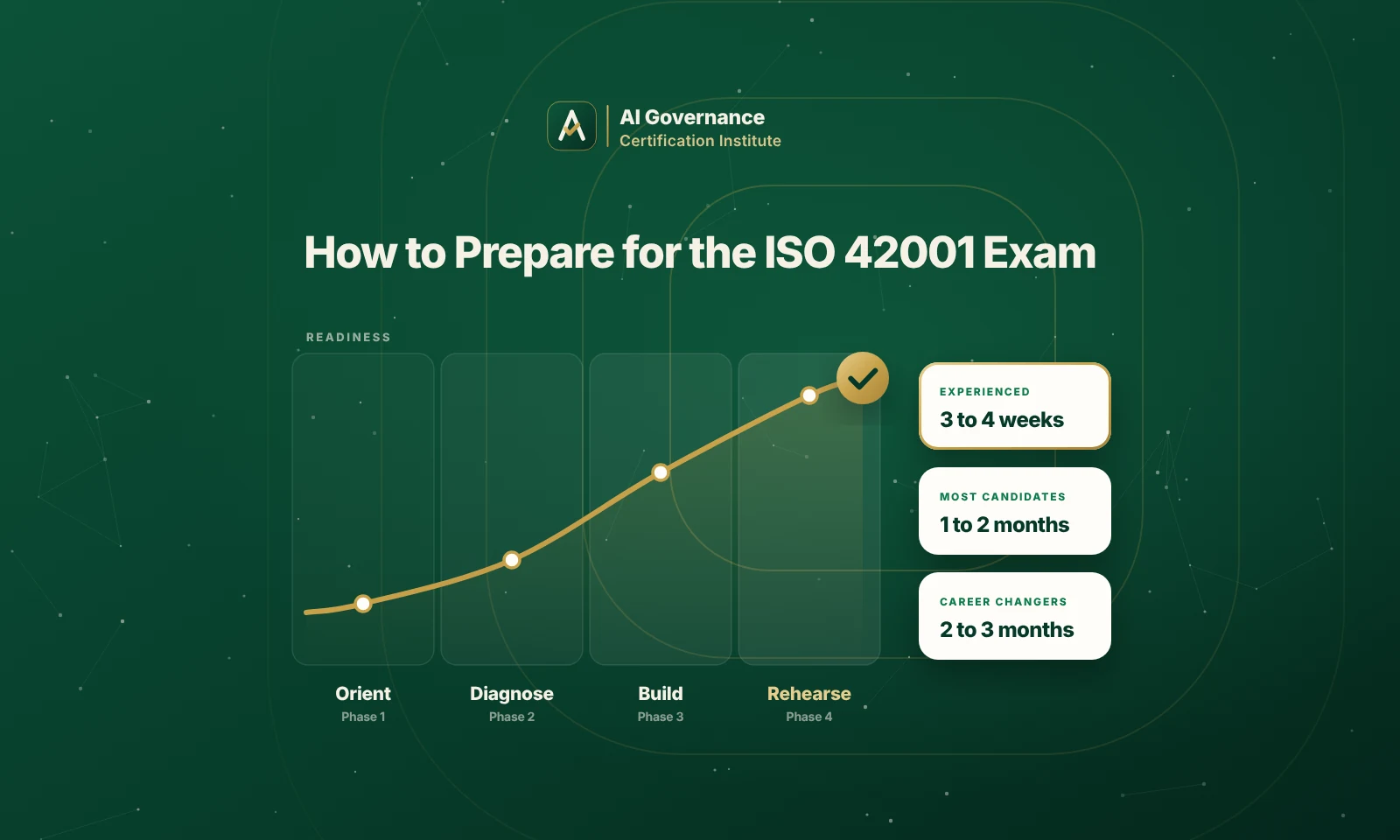
A Simple Four-Phase Plan
If you prefer the method as a schedule, compress it into four phases and scale each to your own timeline:
|
Phase |
Focus |
What You Actually Do |
|
1. Orient |
Format and structure |
Confirm the exam format, then read ISO/IEC 42001:2023 once for its shape |
|
2. Diagnose |
Find the gaps |
Take an untimed practice set and score it by domain |
|
3. Build |
Apply, weighted to the blueprint |
Work scenarios clause by clause, spending the most time on the heaviest domains |
|
4. Rehearse |
Perform under time |
Run timed, full-length practice and fix each miss by clause |
The phases are the same for everyone; only their length changes with your background. An experienced professional may spend days on each, while a newcomer spends a week or two, but nobody should skip a phase.
Tools That Help, and One to Avoid
A few simple tools do most of the work, and one popular shortcut does more harm than good.
• A single running case study. Invent one organization and carry it through every clause, so your practice is always concrete rather than abstract.
• Timed practice sets. The only reliable way to build pacing, which matters most on an open-book exam.
• A marked-up copy of the standard. Your own tabs and notes turn the book into something you can navigate in seconds.
• The one to avoid, exam dumps. They put your certification at risk, are often wrong, and train recall instead of the judgment the exam actually rewards.
How Long Should You Prepare?
Timelines depend far more on your background than on a fixed syllabus, so treat any single number with caution. As a rough guide drawn from reported study plans:
• Experienced management-system professionals often prepare in around three to four weeks, because the structure is already familiar and they mainly add the AI-specific content.
• Most candidates land somewhere around one to two months at a steady few hours a week.
• Career changers with no audit or governance background should plan for two to three months, since they are learning both the method and the subject at once.
Those are indicative ranges, not promises. If you want an honest sense of the challenge before you commit, read how hard the exam really is, then set a timeline to your own starting point rather than someone else's.
Common Preparation Mistakes
Most preparation that fails fails in predictable ways. Watch for these:
• Rereading instead of applying. Highlighting the standard feels productive but does not train the skill the exam tests.
• Ignoring the domain weighting. Spreading time evenly across clauses the exam does not weight evenly wastes effort.
• Treating open book as a safety net. If you rely on looking things up, the clock will beat you.
• Skipping timed practice. Pacing is a skill of its own, and the only way to build it is under time.
• Neglecting clauses 9 and 10. The least glamorous clauses are where easy marks hide.
Frequently Asked Questions
How Long Does It Take to Prepare for the ISO 42001 Exam?
It depends on your background. Experienced management-system professionals often need around three to four weeks, most candidates one to two months, and career changers two to three months. Weight your plan toward applying the standard to scenarios rather than only reading it, and adjust the timeline to your own starting point.
Do I Need to Read the Whole ISO 42001 Standard?
Reading it through once is strongly worthwhile, because summaries skip the nuance that scenario questions turn on. Read it for structure, with a notebook, and mark every clause where you cannot yet picture real compliance. Then use practice to turn that reading into applied skill.
The Exam Is Open Book, So How Should I Study?
Study for speed, not memorisation. Know the standard well enough to find anything in seconds, mark up your copy during preparation, and practice under time. Open book shifts the test toward application and pacing, so rehearsing retrieval under the clock matters more than memorizing passages.
Is Practicing Questions Enough on Its Own?
No, but it is the most important ingredient. Questions without underlying understanding teach you to guess; understanding without timed practice leaves you slow and unsure. Combine reading for structure, applying clauses to scenarios, and timed question practice, and weight the mix toward application.
How Do I Build a Study Plan?
Diagnose first with a short practice set, note your weak domains, then build a plan that weights your time to the exam blueprint and concentrates on your weak areas. Finish with timed, full-length practice. In short, mirror the exam in both what you study and how heavily you study each part.
Prepare by Doing the Work
A scenario-based exam rewards people who have practiced reasoning under time, not those who have only read. AIGCI's Lead Implementer certification is built around implementing a real AI management system and practicing against timed, exam-style scenarios, so your preparation and the exam pull in the same direction. To compare every option at a glance, browse the ISO 42001 courses. And because the EU AI Act is turning demonstrable AI governance into an expectation, the skills this exam tests are worth preparing for properly; read more about the institute to see how it builds them.