
The first thing to know is reassuring: failing the ISO 42001 exam is rarely the end of the road. Almost every provider lets you retake it, and many include a free second attempt. The second thing is less convenient: there is no single retake policy, because each certification body sets its own.
So the useful question is not whether you get a retake, but how any retake policy works and how to make your second attempt count. This guide from the AI Governance Certification Institute (AIGCI) breaks a retake policy for ISO/IEC 42001:2023, the AI management system standard, down to the three variables that define it, shows the pattern most providers follow, and lays out what to do between attempts.
Treat a failed attempt as information, not a verdict. Handled well, a retake is simply a second, better-aimed run at an exam you now understand far more about.
There Is No Single Retake Policy, and Why That Matters
Retake rules are set by the certification body behind your exam, not by the ISO standard itself. ISO 42001 defines the subject; the provider defines the exam and everything around it, including what happens when you do not pass.
That is why the rules differ so much from one provider to another. The frameworks that govern how a body runs personnel certification, chiefly ISO/IEC 17024, require a fair and consistent process, but they leave the specifics of attempts, timing, and fees to each body. The practical consequence is simple: check your own provider's candidate handbook before you book, because the policy you read on another site may not be yours.
With that caveat set, the policies still rhyme. Almost all of them reduce to the same three variables, and once you know those, you can read any provider's rules in a minute.
The Three Things Every Retake Policy Comes Down To
Strip away the wording and every retake policy answers three questions: how many attempts you get, how long you wait between them, and what each one costs. A fourth and fifth condition often sit alongside. Here is what to check and why each matters:
|
What to Check |
Typical Range |
Why It Matters |
|
Attempts included |
Often one free retake; some packages include two attempts |
Decides whether a second try costs you anything at all |
|
Waiting period |
From none up to around 30 days between attempts |
Sets how soon you can retake and how long you have to improve |
|
Retake fee |
First retake often free; later attempts at a discounted or full fee |
Drives the real cost of certification if you need more than one try |
|
Annual cap |
Commonly two to three attempts within twelve months |
Limits how many tries you get before a new registration is needed |
|
Course condition |
A free retake often requires the training to be completed first |
A condition people overlook until the moment they need the retake |
Read a policy against these five rows and you will know, quickly, exactly what a fail will cost you in money and in time. Those two numbers, not the pass mark alone, are what you should weigh before booking.
Before You Book: Confirm Your Retake Policy in Five Questions
You can read any provider's retake rules in about a minute by asking five questions, one for each variable above:
• How many attempts does my registration include?
• Is the first retake free, and does it depend on completing the training?
• How long must I wait between attempts?
• What does a further retake cost once my included attempts are used?
• How many attempts am I allowed within a twelve-month period?
Write the answers down before you register. Knowing them in advance turns a fail from a nasty surprise into a step you already planned for, and lets you budget the real cost of certification rather than just the headline price.
What a Typical Retake Looks Like
Although the details vary, a common pattern runs through many providers, and it is worth knowing as a baseline to compare yours against.
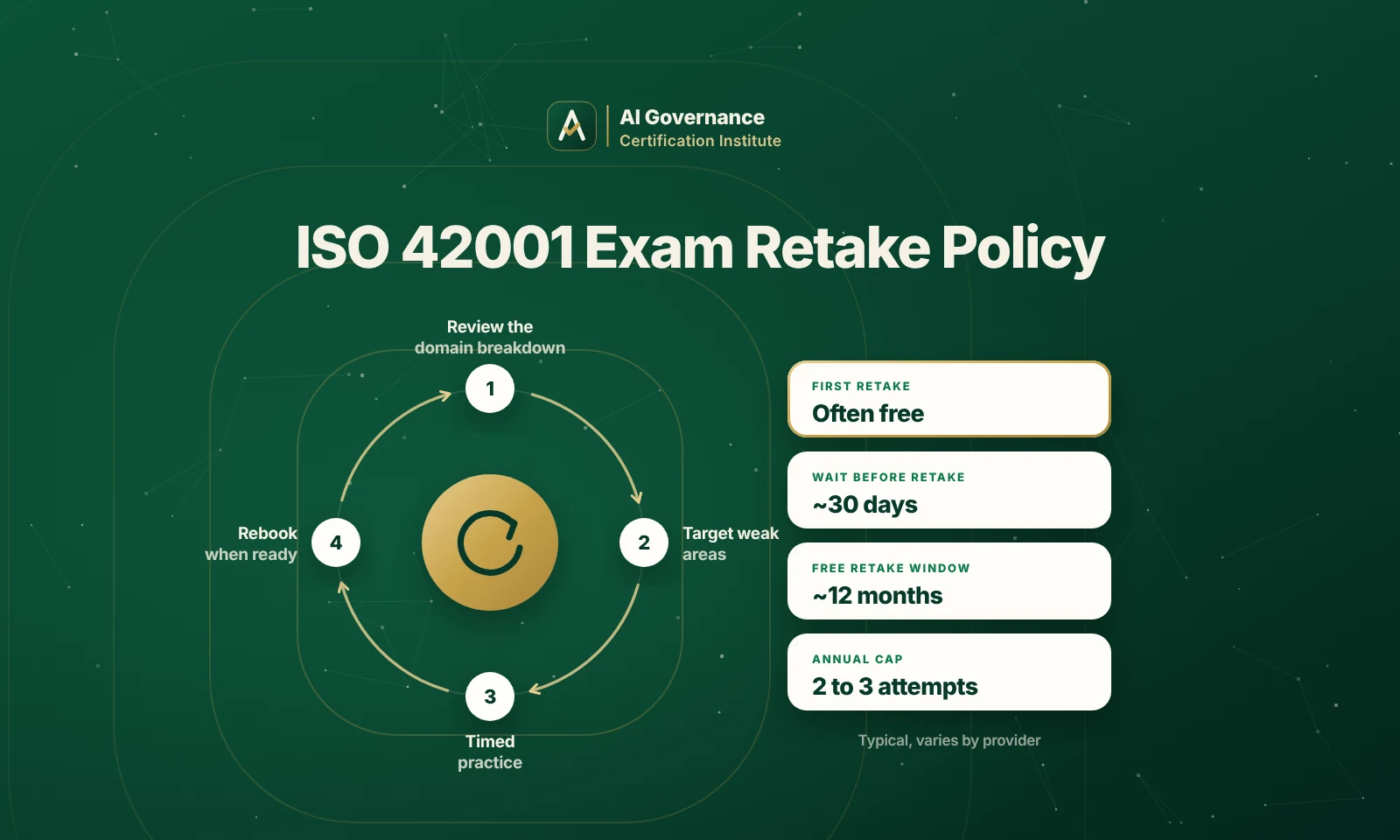
Most commonly, your registration covers one attempt, with one free retake available within about twelve months if you completed the required training. A waiting period of roughly thirty days usually applies between attempts, and once your included attempts are used, further tries are charged, either at a discounted re-examination fee or by buying a new registration. Many providers also cap you at two or three attempts within a year.
Because the fees are the part that stings, factor them into your budget from the start. Our guide to what the exam costs covers the headline price, and the retake fee is the hidden line item to add to it if there is any chance you will need a second attempt.
What Counts as Failing, and the Margins That Matter
Before planning a retake, it helps to understand what failing actually means, because not all fails are equal.
Most ISO 42001 exams pass at around 70 percent, so a fail can range from a near miss in the high sixties to a wide gap far below. The two call for very different responses. A near miss usually points to one or two weak domains and a short, targeted fix. A wide gap usually means the applied skill the exam tests, reasoning from a clause of ISO/IEC 42001:2023 to a decision, has not formed yet and needs rebuilding rather than patching.
The AI-specific parts tend to trip people up most. Concepts such as bias, drift, and explainability, which map to the NIST AI Risk Management Framework, are where candidates from a non-technical background most often lose marks, so read your result with that pattern in mind.
A Retake Is a Second Data Point, Not a Second Guess
Here is the reframe that changes how people approach a retake. A failed exam is the most specific feedback you will ever get about your own weak spots, and wasting that information is the real mistake, not the fail itself.
Most providers return a result broken down by domain or topic, which tells you precisely where you fell short. That breakdown is a map. The person who glances at the fail, books the next slot, and studies the same way again is guessing twice. The person who reads the breakdown, targets the weak domains, and changes how they prepare is running a second, smarter attempt. For a sense of why the exam defeats people in the first place, our view of how hard the exam really is is an honest place to start.
What to Do Between Attempts
The waiting period is not dead time; it is your best chance to turn a fail into a pass. Use it with a short, deliberate plan:
• Read your domain breakdown first. Let the result, not your hunch, decide what you study.
• Target the weak domains, rather than rereading everything evenly and repeating the first attempt.
• Practice under time again, because pacing failures are as common as knowledge gaps and need their own rehearsal.
• Rebook when you are ready, not when you are merely allowed, since an early retake taken cold often repeats the first result.
Two of our other guides do the heavy lifting here. Work through a set of practice questions to find and drill your weak areas, and follow a preparation method that mirrors the exam so your second run is better aimed than your first. A retake rewards targeting, not repetition.
Common Retake Mistakes
Most of the value in a retake is lost to a few avoidable errors:
• Rebooking cold, retaking at the earliest allowed date without changing anything.
• Ignoring the domain breakdown, which is the single most useful piece of feedback you will get.
• Missing the course condition, and forfeiting a free retake you were actually entitled to.
• Forgetting the fee, and being surprised by the cost of a third attempt.
• Studying the same way, which tends to reproduce the same result.
Why Retaking Is Worth the Effort
It is natural to wonder, after a fail, whether the credential is worth the second push. In almost every case it is, because the value of the qualification is rising. As the EU AI Act turns demonstrable AI governance into a business expectation, a credential that proves you can govern AI is becoming more valuable, not less.
Set against that, a retake fee and a few more weeks of study are a small, one-time cost. Abandoning the attempt after a single fail forfeits everything you already invested in getting that far, which is usually the more expensive choice by a wide margin.
If you are still early in the journey and want the full picture of how the exams work before you commit, the full exam guide sets out the format, the levels, and what each one tests.
If You Run Out of Included Attempts
Using your included attempts without passing does not lock you out; it simply means starting a fresh registration.
A new registration restores your attempts, though it carries the full fee again, and any annual cap resets on the provider's terms. This is the most expensive route to the credential, which is exactly why the earlier attempts are worth treating seriously rather than as casual tries. If you reach this point, pause and change your preparation substantially before spending again, because a third or fourth attempt made the same way rarely ends differently.
Frequently Asked Questions
Do I Get a Free Retake If I Fail the ISO 42001 Exam?
Often, but not always. Many providers include one free retake within about twelve months, usually on the condition that you completed the required training. Some packages include two attempts outright, and a few charge for every retake. Check your provider's candidate handbook, because this is the variable that differs most.
How Long Do I Have to Wait Before Retaking?
It ranges from no waiting period at all to around thirty days between attempts, depending on the provider. Rather than treating the minimum wait as a target, use whatever time you have to study your weak domains, so the retake is better aimed than the first attempt.
How Many Times Can I Retake the Exam?
Most providers cap attempts at two or three within a twelve-month period, after which you register again. The exact limit and whether later attempts carry a fee are set by your certification body, so confirm both before you plan a sequence of retakes.
Does Failing Once Affect My Certification or Record?
No. A failed attempt does not appear on the credential you eventually earn; certification records the pass, not the path to it. The only practical effects of a fail are the time and any fee involved in retaking, which is why making the second attempt count matters more than the first result.
Should I Retake Immediately or Wait?
Wait long enough to act on your domain breakdown. Retaking immediately with the same preparation tends to reproduce the same result. A short, targeted study period aimed at your weak areas, followed by timed practice, gives a far better return than rushing back in.
Is the Retake the Same Exam?
Usually the format is identical, but the specific questions are drawn from a bank, so you will not simply see the same paper again. That is another reason memorizing individual questions is a poor strategy and understanding the clauses is a durable one, since the second attempt tests the same competence in different words.
Plan for a Pass, and a Backup
The best retake policy is the one you never need to use, and the surest way there is preparation built around real, timed practice. AIGCI's Lead Implementer certification is designed around implementing a real AI management system and rehearsing exam-style scenarios, which lowers the odds of needing a second attempt in the first place. To compare every option, browse the ISO 42001 courses and to see how the institute builds its programs, read more about the institute.