
Most people choosing ISO 42001 training ask how long the course is. The more useful question is what you keep when it ends. Two programs can run for the same four days and leave you with completely different things: one a set of memories, the other a set of tools you use for years.
Training for ISO/IEC 42001:2023, the AI management system standard, varies widely in what it actually includes. This guide from the AI Governance Certification Institute (AIGCI) sorts those inclusions into three buckets, shows where the real value sits, and gives you a short checklist to compare any two programs before you pay.
The short version: the course and the certificate are table stakes. What separates strong training from a slideshow is the third bucket, the reusable assets you take into real work.
The Three Buckets of What You Get
Whatever the provider, the contents of ISO 42001 training fall into three groups, and it helps to judge a program by all three rather than the first alone:
• The learning. The curriculum, the format, the duration, and how long you can access it.
• The proof. The certificate and badge, and, where the program is exam based, the exam and its retake terms.
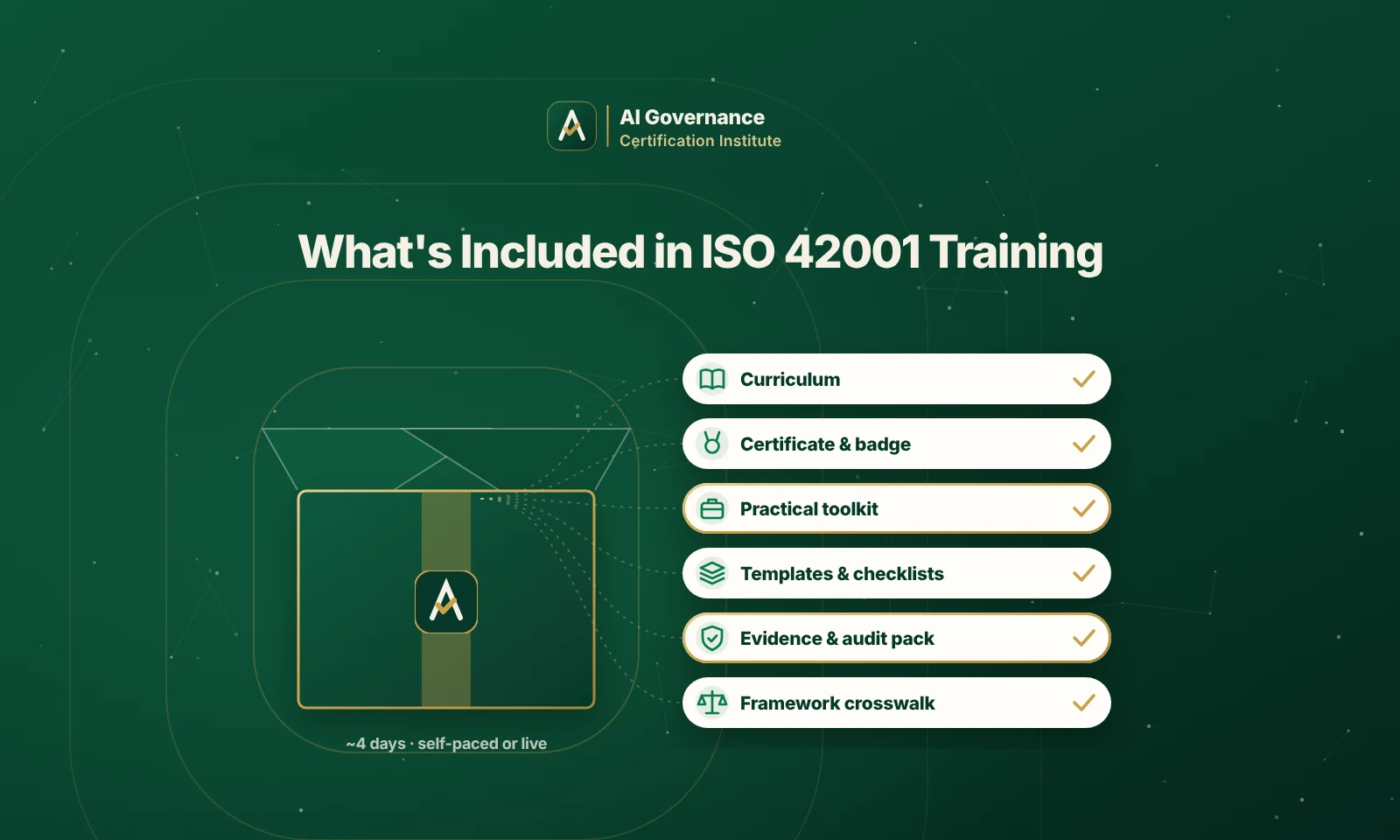
• The keepers. The reusable assets, templates, toolkits, crosswalks, and evidence packs, that you still have long after the course is over.
Most marketing stops at the first two. The third is where a program either saves you weeks of work or leaves you to start from a blank page, so it deserves the closest look.
Bucket One: The Learning
The learning is the part everyone expects, but its shape still varies in ways worth checking.
A complete curriculum covers the whole standard, from the context and leadership clauses through planning, operation, performance evaluation, and improvement, which in ISO 42001 means clauses 4 to 10 plus the Annex A controls. A thin course that skips the later clauses leaves exactly the gaps an exam, or a real implementation, will expose.
Then there is format and access. Training may be self-paced or instructor-led, delivered over roughly four days of equivalent learning, and pitched at a foundation or an intermediate level. Access matters just as much: time-limited access disappears when you are busiest, while lifetime access lets you return to a module the week you actually need it. Check the format, the level, the duration, and whether access expires.
Bucket Two: The Proof
The proof is what you can show afterward, and here an honest distinction matters more than the marketing suggests.
Some programs issue a course completion certificate, which recognizes that you finished structured learning. Others are exam based and lead to an accredited, examination certificate. Neither is wrong, but they signal different things, so know which you are buying. If a program is exam based, two further inclusions matter: how the exam works, set out in the full exam guide, and what happens if you do not pass the first time, which is governed by the retake policy.
A digital badge usually comes with either model, and it is a small but genuine inclusion, because it lets you show the credential across professional channels without attaching a document.
Bucket Three: The Keepers, Where the Real Value Is
This is the bucket that separates training you use from training you merely attend. The keepers are the reusable assets that turn knowledge into work you can ship.
The centerpiece is usually a practical implementation toolkit: an editable AI policy, a Statement of Applicability, an Annex A control mapping, and a working risk register you tailor rather than build from nothing. These are the artifacts a real AI management system is made of. A good program hands them over as a starting point, which is the heart of the practical toolkit.
Around that toolkit sit three more keepers worth looking for. The first is a library of the templates and checklists that cover the repeatable documents, so you are not formatting from scratch. The second is an evidence and audit readiness pack, the exact records to collect for internal audit and management review, which is where most teams stall. The third is the case studies that show how other organizations turned the same clauses into working systems.
The most underrated keeper is a framework crosswalk. A good one maps ISO/IEC 42001:2023 to the NIST AI Risk Management Framework, the EU AI Act, and the OECD AI Principles, so a single management system answers several sets of expectations at once. For anyone whose organization faces more than one framework, that mapping alone can justify the training.
What to Check Before You Buy
Run any program through these six checks and you will see past the headline price to what you actually receive:
|
Inclusion |
Why It Matters |
Question to Ask |
|
Curriculum coverage |
Decides whether you learn the whole standard |
Does it cover clauses 4 to 10 and the Annex A controls? |
|
Format and access |
Decides how, and how long, you can learn |
Self-paced or instructor-led, and does access expire? |
|
Certificate type |
Decides what the credential signals |
Course completion, or an accredited, exam-based certificate? |
|
Reusable assets |
Decides whether you keep anything of value |
Do I get editable templates, a toolkit, and an evidence pack? |
|
Exam and retake |
Decides the real cost if an exam is included |
Is an exam included, and what is the retake policy? |
|
Support |
Decides whether you are left on your own |
Is there any advisor, roadmap, or update included? |
The reusable-assets row is the one buyers most often skip and most often regret skipping, because it is the difference between leaving with capability and leaving with a certificate.
How to Tell Real Inclusions From Padding
Not every listed inclusion carries the same weight, and a quick test separates substance from filler.
A real inclusion is editable, specific to ISO 42001, and something you will use in actual work: a policy you can adapt, a control mapping tied to Annex A, an evidence list an auditor would recognize. Padding is generic and passive: a stock AI ebook, a recording of a webinar, a glossary you could find anywhere. When you compare programs, count only the inclusions that are both standard-specific and reusable, and treat the rest as marketing weight rather than real value.
Why the Keepers Cost More to Build Alone
It is fair to ask whether the assets are worth paying for when you could, in theory, write them yourself. The math usually answers the question. Independent ISO 42001 consultants commonly charge between 800 and 1,500 dollars a day, and a small to mid-size engagement runs roughly five to fifteen days before you have usable policies, a populated risk register, and an audit trail.
Training that hands you those same artifacts on day one, mapped to the standard, costs a fraction of that and is reusable on every AI system you later bring into scope. The toolkit is not a bonus; for many buyers it is the single most economical part of the package.
A Worked Example: What One Toolkit Replaces
To see why the keepers matter, follow a single artifact. Suppose your organization needs an AI policy, a risk register, and a Statement of Applicability before it can even begin an implementation.
From a blank page, each of those is hours of drafting, cross-checking against the standard, and revision, the kind of work that quietly fills several consulting days. From a toolkit, you start with a standard-mapped version and spend your time tailoring it to your own AI systems rather than inventing the structure. The saving is not only money; it is the weeks you would otherwise lose before producing anything an auditor could look at.
Multiply that across a policy, a register, a control mapping, and an evidence pack, and the toolkit is often the part of the training that pays for the whole thing on its own.
Self-Paced or Instructor-Led: What Changes in the Package
The delivery model changes the inclusions in predictable ways, so match it to how you actually learn.
Self-paced training typically includes the full curriculum, the assets, and lifetime access, letting you move at your own speed and return whenever your implementation work advances. Instructor-led training adds live teaching and the chance to ask questions in the moment, often on a fixed schedule, and sometimes at a higher price. The learning content is usually the same; what differs is pace, interaction, and timing. Neither is better in the abstract, so choose by whether you value flexibility or live guidance more.
Corporate and Team Training: What Changes
When training is bought for a team rather than an individual, the package usually grows.
Corporate and team programs typically add group access, coordinated onboarding, and some form of progress reporting for the sponsor, so a whole function can build the same capability against the same standard. The core learning and the assets are the same; what changes is scale and oversight. If you are equipping a team rather than yourself, it is worth asking specifically about corporate and team training options, because the per-person value and the reporting can differ sharply from a single enrollment.
What ISO 42001 Training Usually Does Not Include
Knowing the boundaries protects you from expecting the wrong thing. Three items sit outside most training packages:
• Organizational certification. Training certifies your learning, not your company; certifying an organization is a separate audit process, explained in how to get ISO 42001 certified.
• The official standard document. The ISO/IEC 42001 PDF is sold separately by ISO, and good training paraphrases its requirements rather than reproducing the text.
• Ongoing consulting. Training gives you the method and the assets; hands-on help running your specific implementation is a different, usually pricier, service.
None of these omissions is a flaw. They simply mark where training ends and other services begin, and knowing that keeps your expectations, and your budget, accurate.
Frequently Asked Questions
Does ISO 42001 Training Include the Exam?
It depends on the model. Exam-based programs include an exam and usually a retake allowance, while self-paced programs often issue a course completion certificate without a proctored exam. Confirm which model you are buying, and if an exam is included, check the retake terms before you enroll.
Is a Certificate Included in ISO 42001 Training?
Almost always, but the type varies. You may receive a course completion certificate or an accredited, exam-based certificate, usually with a digital badge. The two signal different things, so check which one a program issues rather than assuming all certificates are equivalent.
What Materials Do I Actually Get?
At minimum, the curriculum and a certificate. The stronger programs add reusable assets: an editable AI policy, a Statement of Applicability, an Annex A control mapping, a risk register, templates and checklists, an evidence pack, and a framework crosswalk. Those assets are where most of the practical value lives.
How Long Do I Have Access to the Training?
This varies from a fixed window to lifetime access. Lifetime access is valuable because AI management system work rarely happens all at once; being able to return to a module and the toolkit when your implementation advances is often worth more than it first appears.
Is the Official ISO 42001 Standard Included?
Usually not. The ISO/IEC 42001 standard is published and sold separately by ISO, and training normally paraphrases its requirements rather than reproducing them. Budget for the standard separately if you want the official text alongside your training.
Does Training Certify My Organization?
No. Training builds the capability of individuals; certifying an organization against ISO 42001 is a separate process carried out by an accredited body through an audit. Training helps your people prepare for that audit, but it does not replace it.
Compare What You Actually Get
Before you choose, look past the course length to the full package, especially the reusable assets. AIGCI's Lead Implementer certification is built around a practical toolkit and lifetime access, so you leave with artifacts you can use immediately, not just a record of attendance. To compare every option side by side, browse the ISO 42001 courses, and to see how the institute designs its programs, read more about the institute.