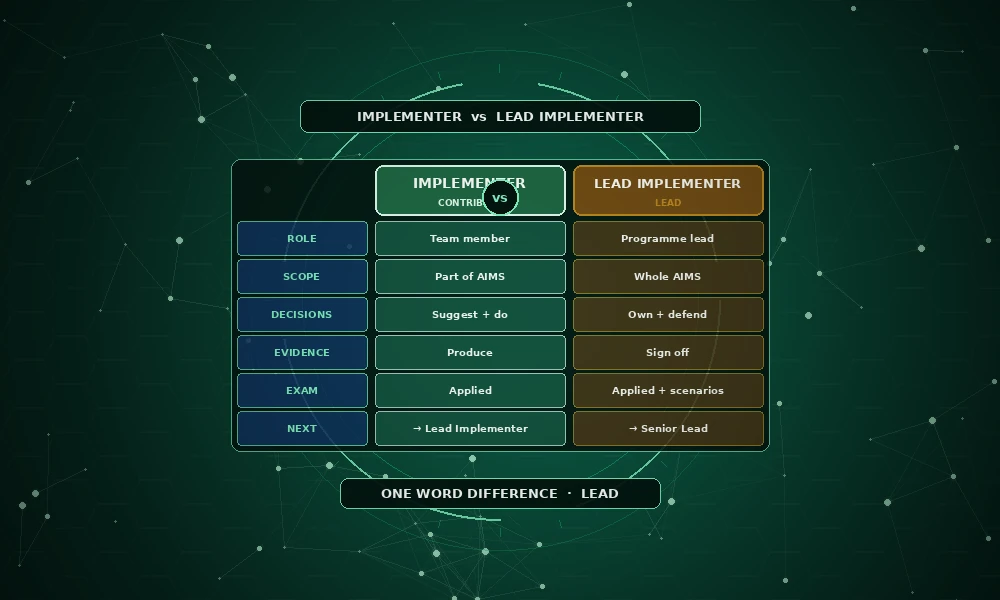
The whole difference lives in one word: lead. Strip it away and you can see what actually separates these two, and it is not how much you know.
An implementer helps build an AI management system for ISO/IEC 42001:2023, the AI management system standard. A lead implementer plans, leads, and owns that build. One contributes to the work; the other is answerable for it.
In the tracker's terms, the implementer sits a tier below the lead implementer. But a tier below is not the same as lesser, because the field needs far more people to contribute than to lead.
This guide from the AI Governance Certification Institute (AIGCI) sets the two side by side, explains what the difference really is, adds the market data that should shape your choice, and helps you decide which role, and which credential, fits where you are.
|
"A leader is one who knows the way, goes the way, and shows the way." John C. Maxwell |
Maxwell's line captures the extra that lead carries. An implementer knows the way and goes it; a lead implementer also shows it to others, taking responsibility for the whole journey rather than a single stretch of it.
What each one means
Start with plain definitions, because the labels are used loosely across the industry.
An implementer is a practitioner. They take part in building and running an AI management system, contributing to specific pieces of it, usually as a member of a team rather than the person directing it.
A lead implementer is an owner. They plan the whole implementation, lead the people delivering it, and are accountable for the finished system working, from the first gap analysis to continual improvement.
Both live on the implementation side of ISO 42001, the building side rather than the auditing side. The difference between them is not what they build, but how much of it they answer for.
Part of the confusion is that the industry uses the word implementer loosely. Some apply it to anyone working on the build, others reserve it for a specific junior credential, and a few use it almost interchangeably with lead implementer. That looseness is exactly why this comparison pins down the role rather than the label, because the role is what you can actually reason about and choose between.
The real difference: contribute or lead
It is tempting to assume the gap is knowledge, as if a lead implementer simply knows more. That misses the point.
The real difference is ownership. A lead implementer holds the scope, the sequence, the team, and the outcome, which means they must understand the full lifecycle and be able to make decisions when the standard leaves room for judgement. An implementer needs deep practical skill in their part, but not the same span of responsibility.
Think of building a house. Skilled trades do essential, expert work, but the site manager owns whether the house gets built, on time and to standard. Implementer and lead implementer map onto exactly that difference, and neither can deliver without the other.
A concrete example: the same project, two roles
Picture one organization implementing an AI management system, and watch what each person actually does.
The lead implementer sets the scope, decides the sequence, runs the gap analysis, and answers to leadership for whether the system will be ready for its certification audit. When a hard call arises, such as which risks to treat first, it lands on their desk.
The implementers do the expert work inside that plan. One drafts parts of the control framework, another runs an AI risk assessment on a specific model, a third prepares documentation. Each owns their piece; none owns the whole.
Same project, two kinds of responsibility. Remove the lead and the pieces do not add up; remove the implementers and there is no one to build the pieces in the first place.
How the two work together
The comparison can make the roles sound like rivals, but on a real build they are partners.
A single lead implementer typically directs several implementers, turning a plan into coordinated work. The lead sets direction and holds the standard; the implementers supply the depth and the hands to meet it. Strip either side away and the implementation stalls.
This is why framing the choice as which is better misleads. The sharper question is which part of this partnership you want to be, because a healthy AIMS build needs both at once.
Implementer and Lead Implementer, side by side
Placed against the attributes that matter, the two separate cleanly. Read the responsibility and leadership rows first, because that is where the real line falls:
|
Attribute |
Implementer |
Lead Implementer |
|---|---|---|
|
Core role |
Helps build and operate the AIMS |
Plans, leads, and owns the whole implementation |
|
Responsibility |
Contributes to parts of the system |
Accountable for the system existing and working |
|
Leadership |
Works within a team, often under a lead |
Leads the team and directs the project |
|
Span of knowledge |
Deep in a task or area |
Across the full lifecycle, gap analysis to improvement |
|
Market recognition |
Less often a named credential |
The credential job descriptions ask for by name |
|
Best suited to |
Those supporting an implementation |
Those owning or directing one |
Notice that the last two rows point in the same direction. Because the lead implementer owns the outcome, it is the title employers name in job postings, which makes it the credential most people ultimately aim for.
A note on the credential itself
There is a practical wrinkle worth being honest about. Not every training scheme offers a separate implementer credential.
In much of the market, the recognised professional credential is the lead implementer, and implementer describes a role or a contribution level rather than a distinct certificate. Where a tiered implementer credential does exist, it usually works as a stepping stone toward the lead level. The wider ladder, and where each rung sits, is set out in all certification levels.
So when you compare the two, compare the roles first and the certificates second. The role you want to play should decide the credential you pursue, not the other way around.
Both roles are in demand, not just the leader
Here is where the data changes the picture, and it argues against assuming you must lead to have a career.
Demand for AI governance skills is rising faster than almost any other specialism. LinkedIn's Skills on the Rise found that demand for AI governance skills grew about 150 percent year over year, one of the fastest climbs it tracks in any category.
The shortage is just as striking. The IAPP reports that almost all organizations, close to 98 percent, say they need more AI governance professionals than they currently have. That gap is felt at every level, not only in leadership.
In fact, analyses of AI governance job postings suggest individual-contributor roles, at around 46 percent of the market, outnumber manager-level roles at roughly 28 percent. The plain reading is that there is ample room to enter as a contributor, not only to lead, which makes the implementer path a real career rather than a mere waystation.
Which should you choose?
The choice follows from the role you actually want, so be honest about that first.
If you want to contribute your expertise to building AI management systems, working within a team and going deep on your part, an implementer-level path fits, and you can grow from there. If you want to own an implementation, lead the people delivering it, and hold the credential the market names, the lead implementer is your target.
For most people who intend to make AI governance implementation their profession, the lead implementer is the stronger long-term investment, because it is recognised and it opens more doors. The full scope of that role is laid out in the Lead Implementer guide, which is worth reading before you commit either way.
Where each path leads
The two are not dead ends but points on a line, and knowing the line helps you plan.
An implementer naturally grows toward the lead implementer role as they take on more responsibility, which is what the tier-below relationship really means: a step on the way up, not a ceiling. A lead implementer, in turn, tends to grow into senior implementation and broader AI governance roles, leading larger programmes over time.
Wherever you start, the direction of travel is the same, from contributing to owning to leading. The only question is where on that line you want to be right now.
Signs you are ready to lead
If you are an implementer wondering when to step up, a few signals show that the tier-below role has taught you what it can:
-
You can see the whole implementation, not just your part of it.
-
Colleagues already bring you the decisions the plan does not settle.
-
You can explain the standard's intent, not only follow its steps.
-
You are comfortable being answerable for an outcome, not only for a task.
When those hold, the move from implementer to lead implementer is less a leap than a recognition of what you already do.
The bottom line
Implementer versus lead implementer is not a contest of knowledge but a choice of role. The implementer contributes to the build; the lead implementer owns and leads it, which is why the market names the second and pays for the responsibility it carries.
With demand this high and the shortage this wide, both roles are worth pursuing. Choose the one that matches how much of the outcome you want to answer for, and let that decide your credential.
Frequently asked questions
What is the difference between an ISO 42001 implementer and a lead implementer?
An implementer helps build and operate an AI management system, usually within a team. A lead implementer plans, leads, and is accountable for the whole implementation. The difference is ownership and leadership, not simply how much each one knows.
Is there a separate implementer certification, or only lead implementer?
It varies by scheme. In much of the market, the recognised professional credential is the lead implementer, and implementer describes a role or contribution level. Where a tiered implementer credential exists, it usually serves as a stepping stone toward the lead level.
Which is better to have, implementer or lead implementer?
Neither is universally better; they suit different goals. If you want to contribute to building AI management systems, an implementer path fits. If you want to own implementations and hold the credential employers name, the lead implementer is the stronger long-term choice.
Do I need to be an implementer before becoming a lead implementer?
Not necessarily. The implementer role is a natural stepping stone, but many people move directly to lead implementer if they already have relevant experience. The tier-below relationship describes a progression, not a strict prerequisite.
Are implementer-level roles actually in demand?
Yes. Demand for AI governance skills is among the fastest growing of any specialism, and organizations report a broad shortage of professionals. Contributor roles make up a large share of the market, so entering as an implementer is a genuine career path, not only a route to leadership.
Choose the role you want to own
If your aim is to lead and own AI management system implementations, the credential the market recognises is the lead implementer. AIGCI's Lead Implementer certification is built around leading a real build from gap analysis to certification. If you are earlier in the journey, the Foundation certification is a sound first step, and you can see every option among the ISO 42001 courses. To learn how the institute designs them, read more about the institute.