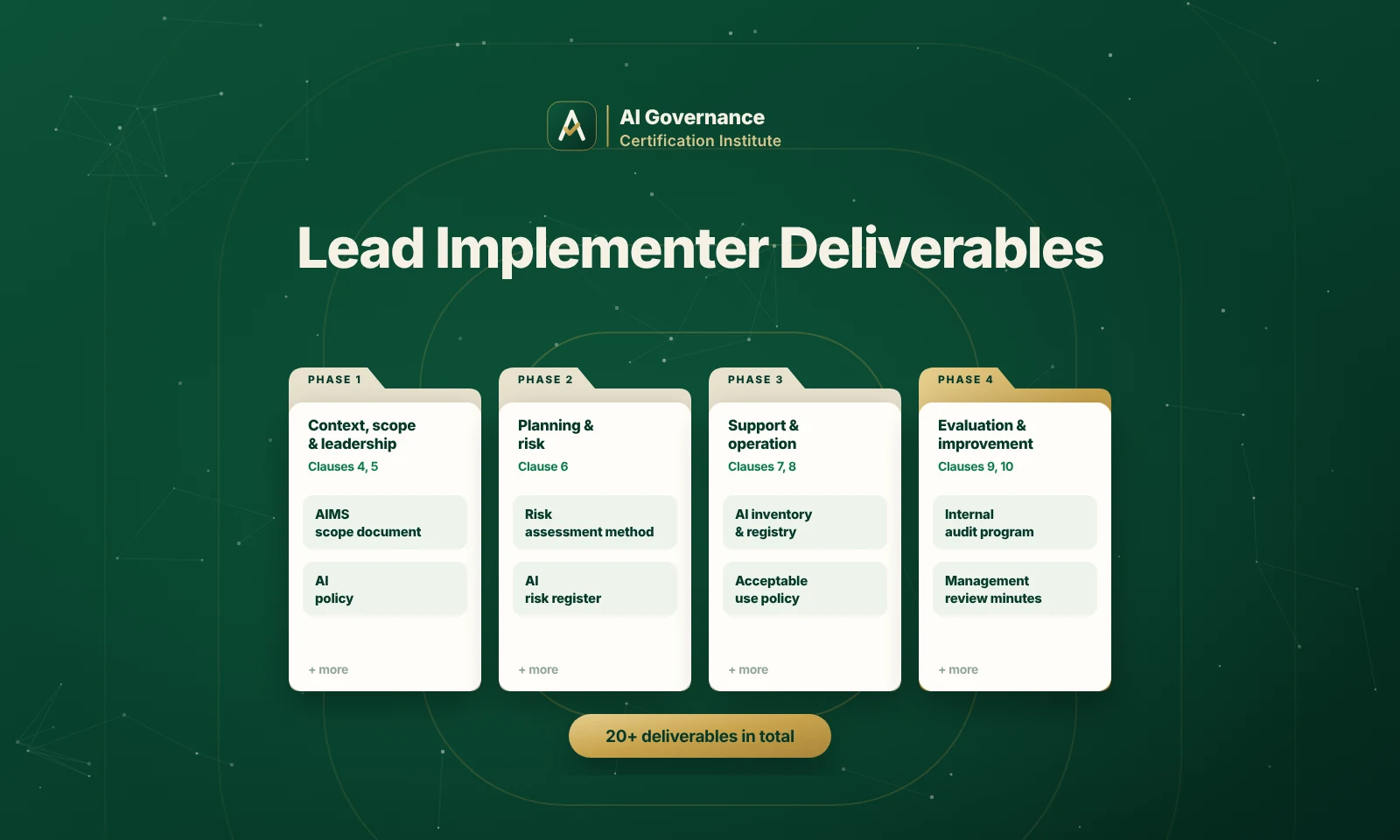
Ask what an ISO 42001 implementation actually produces, and the honest answer is a stack of documents, more than twenty of them, that together prove an AI management system exists and works. The lead implementer’s job is to design and roll out that system, but the visible output, the thing an auditor reads and a manager signs, is the set of deliverables. This page is the map of that set.
Each item below is a deliverable tied to a specific requirement of the standard, and the most useful ones have a detailed guide of their own, linked from here. Think of this as the hub: the overview that shows how the whole documentation set fits together, with a path into each piece when you need to build it.
The deliverables group naturally by the phase of implementation that produces them, which is how they are organized below.
What Counts as a Deliverable
A deliverable is any documented output the standard requires you to produce and maintain, what ISO calls documented information. That spans three kinds of thing: documents that state intent, such as policies and the scope; records that prove activity, such as audit reports and management-review minutes; and registers that track state, such as the AI inventory and the risk register. All three count, and an auditor will ask for all three.
The number catches people out. ISO 42001 requires more than twenty mandatory pieces of documented information, and a mature program produces more still. The point is not to generate paper for its own sake but that each deliverable is the evidence for one part of a working system, which is why a missing deliverable is read as a missing capability.
The Deliverables, by Phase
The set below follows the four phases of implementation. Items with their own guide are linked; build them in roughly this order, because each phase depends on the one before.
Phase 1: Context, Scope, and Leadership (Clauses 4 and 5)
-
AIMS scope document, defining the boundaries and applicability of the AI management system.
-
the AI policy, a high-level statement of management commitment and objectives for responsible AI.
-
Context and stakeholder analysis, documenting internal and external issues and interested parties.
-
Defined governance roles, responsibilities, and authorities for AI decisions.
-
An AI governance charter that formally mandates the program and its authority.
Phase 2: Planning and Risk Management (Clause 6)
-
AI risk assessment methodology, the formal criteria for identifying and evaluating AI risk.
-
the AI risk register, capturing identified risks across systems and the lifecycle.
-
AI risk treatment plan, detailing how each risk is mitigated, transferred, or accepted.
-
An AI system impact assessment, evaluating effects on individuals, groups, and society.
-
A Statement of Applicability, justifying which of the 38 Annex A controls apply and why.
-
An AI control matrix mapping the selected controls to the risks they address.
Phase 3: Support and Operation (Clauses 7 and 8)
-
Competence and training records, proving staff awareness and specialized AI competence.
-
A communication plan for internal and external messages on AI performance and safety.
-
the AI inventory and model registry, cataloging every AI system in scope.
-
An acceptable use policy governing how employees may use AI tools.
-
Operational control procedures spanning the AI lifecycle, from data collection to decommissioning.
-
A vendor and third-party assessment process for external AI suppliers and data providers.
Phase 4: Performance Evaluation and Improvement (Clauses 9 and 10)
-
Internal audit program and reports: schedules, checklists, and findings from AIMS audits.
-
Management review minutes, recording leadership’s evaluation of the system.
-
Nonconformity and corrective action logs, with root causes and fixes.
-
An AI incident response plan for handling AI failures and breaches.
-
A continual improvement plan for refining models, data quality, and governance over time.
Mandatory Versus Supporting Deliverables
Not every document carries the same weight. Some are mandatory: the standard names them as documented information you must have, and their absence is a nonconformity on its own. The scope, the AI policy, the risk assessment and treatment, the Statement of Applicability, the internal audit records, and the management review all sit in this group. Others are supporting: they are not named word for word but are the practical way you evidence a requirement, such as a communication plan or detailed operating procedures.
The distinction matters for sequencing under time pressure. When a deadline looms, the mandatory deliverables are non-negotiable and come first; the supporting ones strengthen the system and can mature over the following cycle. An experienced implementer knows which is which and does not let polish on optional documents delay the ones the certificate depends on.
How the Deliverables Fit Together
The deliverables are not a pile of separate documents; they form a chain. The scope defines what the inventory must cover; the inventory feeds the risk assessment; the risk assessment drives the treatment plan and the Statement of Applicability; the Statement of Applicability determines the control matrix; and the audit and review records prove the whole chain operates. Managed together, often in a document management system, they stay consistent; managed as isolated files, they drift out of sync and contradict each other, which an auditor notices quickly.
This interdependence is why the order of creation matters and why a change to one deliverable ripples through the others. Update the inventory and the risk assessment may change; change the risk treatment and the Statement of Applicability must follow. The set is a system, not a folder.
Who Produces Them
The lead implementer owns the deliverable set but does not write all of it alone. Policies and the charter need leadership input and sign-off; risk and impact assessments need the people who build and run the systems; audit and review records come from the assurance and management functions. The implementer’s role is to design the set, assign each document to the right owner among the governance roles, and ensure the pieces fit together into one coherent system.
This distributed ownership is also why the implementer needs authority, not only skill. Many deliverables depend on input from people who do not report to the implementer and have their own priorities, so producing the set on time is as much a coordination problem as a documentation one. A deliverable with no named owner is the one that silently never gets written, which is why assigning ownership early, document by document, is one of the first real tasks of the role.
How Long the Deliverable Set Takes
Producing the full set is the bulk of an implementation, and the time is dominated by a few heavy documents rather than spread evenly. The risk assessment, the impact assessments, and the inventory take the longest, because they require gathering real information from across the organization rather than drafting from a template. The policies and the charter are faster, because they are statements of intent that leadership shapes and approves. The audit and review records cannot be rushed at all, because they can only exist after the system has operated, which is why they are the last to appear and the ones most likely to be missing when an organization tries to certify too early.
A realistic sequence is to draft the intent documents first, build the registers and assessments next, operate the system for a cycle, and only then generate the audit and review records that prove it works. Teams that try to produce everything at once usually end up with polished intent documents and no evidence of operation, which is the opposite of what a certification audit weighs most heavily.
Common Documentation Mistakes
Deliverable sets fail in recognizable ways. The most common is documents that exist but do not connect, a risk register that names risks the Statement of Applicability never addresses, or a control matrix that maps to controls the risk assessment never raised. The second is writing documents that describe an ideal system rather than the real one, which collapses the moment an auditor compares the document to practice. The third is producing the intent documents, policies and procedures, while neglecting the records that prove they were followed, leaving a system that looks governed on paper but cannot evidence a single decision. The fourth is treating the set as a one-time deliverable rather than living information that has to be kept current as the AI systems change.
Frequently Asked Questions
What Documents Does ISO 42001 Require?
More than twenty mandatory pieces of documented information, including the AIMS scope, the AI policy, a risk assessment methodology and report, a risk treatment plan, AI system impact assessments, the Statement of Applicability, internal audit records, and management review minutes, plus supporting procedures and registers. The exact set depends on your scope.
What Is the Most Important Deliverable?
No single one, because they form a chain, but the risk assessment and the Statement of Applicability are the spine: they justify which controls you operate and why. Get those wrong and every downstream document inherits the error. The audit and review records are what prove the system actually runs.
Who Is Responsible for Producing Them?
The lead implementer owns and coordinates the set, but ownership of individual documents is distributed: leadership for policies and the charter, technical teams for risk and impact assessments, and the assurance and management functions for audit and review records. The implementer designs the set and ensures the pieces cohere.
Do the Deliverables Have to Follow a Template?
No. The standard requires the information, not a particular format. Templates speed the work and improve consistency, but a deliverable is judged on whether it contains what the requirement needs and reflects your real system, not on matching a specific layout.
How Many Deliverables Do I Really Need?
Enough to evidence every requirement in your scope and no more. A narrow scope with few AI systems needs fewer documents than a broad one; the mandatory set is fixed, but the supporting documents should match your actual complexity rather than pad the stack. The right question is never how many documents an auditor expects, but whether every requirement in your scope can be evidenced by something concrete that you can actually produce on request, on the day an auditor asks.
Build the Deliverables, With the Competence Behind Them
A deliverable set is only as good as the understanding behind each document, which is what turns a template into evidence of a real system. The implementation guide shows where each deliverable fits in the build.
Learning to produce them well is what implementer training teaches. You can see every route through the ISO 42001 courses, with the full path in the Lead Implementer certification, so the documents you produce stand up to an audit.