AI governance does not fail because organizations lack good intentions; it fails because no one is clearly responsible. When everyone owns the AI, no one does, and the system quietly drifts. A real AI governance program starts by naming who is accountable for what, from the boardroom down to the individual model.
Clear roles are not a bureaucratic nicety; they are a requirement. ISO 42001 explicitly calls for roles, responsibilities, and authorities to be assigned, and the same principle runs through all corporate governance: accountability has to sit with named people, not with a vague committee or a hopeful culture. This guide from the AI Governance Certification Institute (AIGCI) maps the full set of roles an AI governance program needs, what each one owns, and how they fit together.
It is the pillar for the roles cluster, so where a role needs more depth, it points to the committee that oversees the program, the team that houses these roles, and the matrix that maps them to accountability.
Why AI Governance Needs Defined Roles
AI creates a specific accountability problem. It is built by one group, deployed by another, used by a third, and affects people none of them meet. Without defined roles, responsibility falls through the gaps between them, and when something goes wrong, the answer to who was responsible is everyone and no one.
Defined roles close those gaps. They make it explicit who decides whether a high-risk model ships, who owns the data it learned from, who monitors it in production, and who checks that all of this actually happens. The roles span three broad tiers, strategic leadership, operational oversight, and technical execution, plus an independent assurance layer, and a governance program needs all four.
The Roles at a Glance
Before the detail, the whole set in one view. The table groups the roles by tier and states what each one owns.
|
Tier |
Role |
What They Own |
|---|---|---|
|
Strategic |
Board or executive sponsor |
Ultimate accountability, risk appetite, and funding |
|
Strategic |
Chief AI Officer |
Overall AI strategy, deployment, and risk balance |
|
Strategic |
Chief Data Officer |
Data lineage, quality, privacy, and provenance |
|
Oversight |
AI governance committee |
Reviewing high-risk use cases and approving deployment |
|
Oversight |
Responsible AI program leader |
Day-to-day running of the governance program |
|
Oversight |
Compliance officer |
Regulatory tracking and audit coordination |
|
Execution |
Model owners and engineers |
Building, documenting, and monitoring models |
|
Execution |
Risk and system owners |
Owning the risks and the AI systems in scope |
|
Assurance |
Internal auditor |
Independent checking that the system works |
Strategic Leadership Roles
The top tier owns direction and accountability, and it cannot be delegated away. The board or an executive sponsor holds ultimate accountability for AI governance, sets the organization's risk appetite, and funds the program, because without leadership commitment the rest is theater.
Below the board, two executive roles have emerged. The Chief AI Officer drives the overall AI strategy and deployment while balancing operational risk and compliance. The Chief Data Officer owns the data that AI depends on: its lineage, quality, privacy, and provenance. Not every organization has both titles, but someone has to own each of these responsibilities, title or not.
Oversight and Governance Roles
The middle tier turns strategy into oversight. At its center is the governance committee, a cross-functional body that reviews high-risk AI use cases, arbitrates ethical questions, and approves deployment gates. It is supported by a Responsible AI program leader who runs the program day to day, translating high-level policy into the workflows that bias mitigation, transparency, and fairness actually require.
Alongside them sits a compliance function that tracks evolving regulation, such as the EU AI Act, and coordinates internal and external audits. These oversight roles are where governance stops being a policy document and becomes a set of decisions someone actually makes.
Execution and Technical Roles
The tier that does the work is where governance meets the models. These roles own the AI systems themselves and the evidence that they are governed.
-
Model owners and engineers. Build, document, and test models, maintain model lineage, monitor for performance drift, and run pre-deployment checks.
-
Data owners. Own the quality, provenance, and handling of the data that feeds each system.
-
Risk and system owners. Own the specific risks in the risk register and the AI systems they are responsible for operating.
-
AI security specialists. Defend against adversarial threats such as prompt injection and data poisoning.
This is the first line of accountability: the people who own and run the AI are the ones first responsible for governing it, not a distant committee.
The Assurance Role
One role stands apart from the rest, and its independence is the point. The internal auditor checks that the governance the other roles are supposed to run is actually happening, and reports the truth to leadership.
The reason it is separate is objectivity. An auditor cannot check their own work, so the assurance role has to sit outside the execution and oversight it examines. It is the role that keeps the whole program honest, because it is the one person whose explicit job is to find the gap between what the documents claim and what is really happening in production, and to say so plainly.
Where Role Assignment Commonly Breaks Down
Most AI governance failures trace back to a role that was never really assigned. A few gaps recur across organizations:
-
No owner for monitoring. Models get built and deployed, but no one is clearly responsible for watching them drift in production.
-
A committee that advises but does not decide. An oversight body with no authority to stop a deployment, so its reviews change nothing.
-
An auditor who is not independent. Assurance handed to someone who also builds or runs the systems, which removes the objectivity that is the whole point.
-
No data owner. Everyone uses the data and no one is accountable for its quality or provenance.
-
Accountability that stops below the board. Governance delegated so far down that no one with real authority is answerable for it.
The Three Lines of Defense
The cleanest way to organize all these roles is a model borrowed from risk management: the three lines of defense. The first line owns and manages the risk directly, the model owners, engineers, and system owners who run the AI. The second line oversees and challenges them, the governance committee and compliance function. The third line provides independent assurance, the internal auditor.
The power of the model is that it stops the lines from blurring. When the people who build the AI are also the only ones who check it, oversight collapses, which is exactly the failure the three lines are designed to prevent. Mapping your roles onto the three lines is a fast way to see whether any line is missing or doubled up.
From Roles to Accountability, and to a Team
Naming roles is the start; making accountability unambiguous is the finish. The tool for that is the RACI matrix, which maps every governance activity to who is responsible, accountable, consulted, and informed, so no task is owned by everyone or no one.
How these roles are actually housed, whether as a dedicated function, a federated model, or a hybrid, is a separate design question covered in the team structure. Roles define who owns what; the team defines how those people are organized to work together day to day.
How to Assign the Roles in Practice
You do not need every role filled on day one, but you do need the responsibilities owned. A practical order helps.
Start with the non-negotiables: someone at board level accountable, a program leader running it day to day, named risk and system owners for the AI in scope, and an independent person for assurance. Then layer in the oversight committee and the data and security roles as the program grows. Write each assignment into the AI policy and the roles documentation the standard requires, and map them in a RACI so the boundaries are explicit. The test of a good assignment is simple: for any governance activity, you can name one accountable person without hesitation. Where you cannot name one without hesitation, the role is not really assigned yet, only hoped for.
Frequently Asked Questions
What Roles Are Needed in an AI Governance Program?
Across four tiers: strategic leadership (board or sponsor, Chief AI Officer, Chief Data Officer), oversight (governance committee, Responsible AI program leader, compliance officer), execution (model owners and engineers, data owners, risk and system owners, security specialists), and independent assurance (internal auditor). Titles and org charts vary widely, but every one of these responsibilities needs a clear owner somewhere.
Who Is Ultimately Accountable for AI Governance?
The board or executive leadership. Accountability for AI governance sits at the top, because that is where the authority to set risk appetite, allocate resources, and change direction lives. Leaders can delegate the work, but not the accountability, which is why ISO 42001 makes AI governance a leadership responsibility.
What Does a Chief AI Officer Do?
A Chief AI Officer drives the organization's overall AI strategy, infrastructure, and deployment while balancing operational risk and regulatory compliance. The role is emerging as AI becomes central to strategy, but where there is no such title, its responsibilities still have to be owned by a senior leader.
Do Small Companies Need All These Roles?
They need all the responsibilities, not all the titles. In a small company one person may hold several roles, such as program leader and compliance officer combined, while the board role is the founders. The one separation that must hold even at small scale is independence of the assurance role: no one should audit their own work.
What Does ISO 42001 Require for Roles and Responsibilities?
Can One Person Hold Several AI Governance Roles?
Yes, and in smaller organizations they usually do. Roles are bundles of responsibility, not necessarily separate people, so one person can be program leader and compliance officer at once. The one combination to avoid is making the same person both operate a control and independently audit it, because that collapses the assurance line that keeps the program honest.
ISO 42001 requires that roles, responsibilities, and authorities for the AI management system be assigned and communicated, and that top management own the system. It does not prescribe specific job titles, but it does require that accountability is clear, which is exactly what a defined set of roles delivers.
Define the Roles, Then Build the Capability
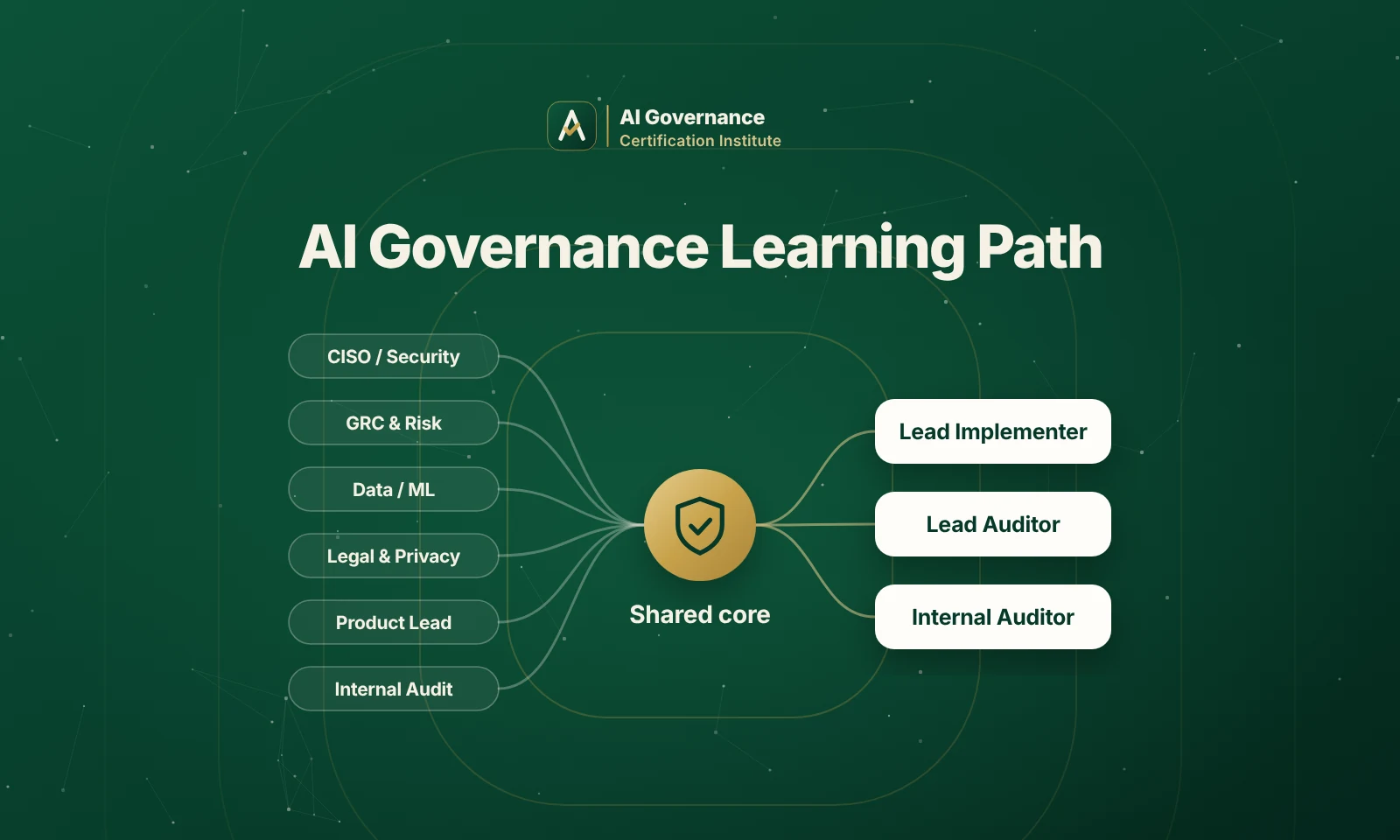
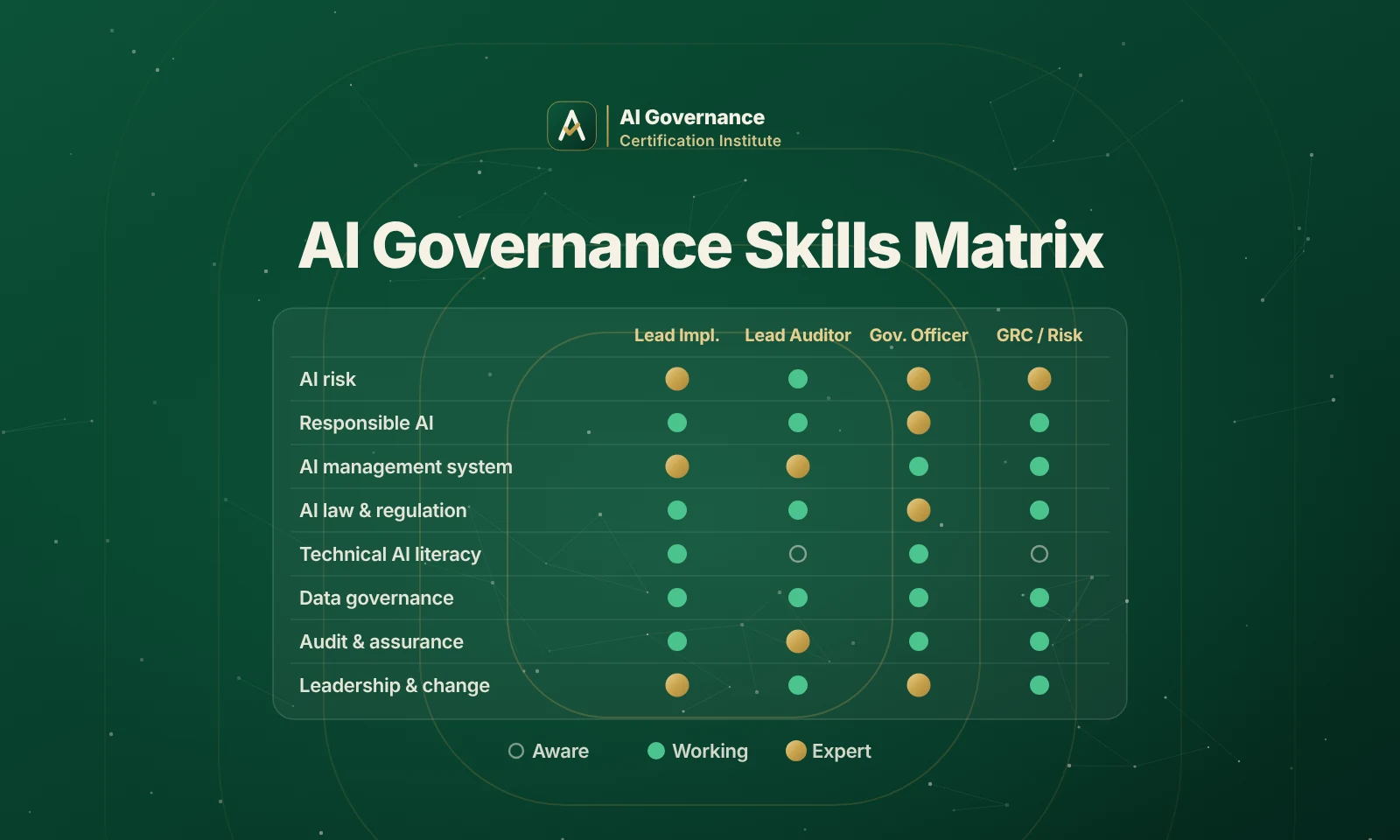
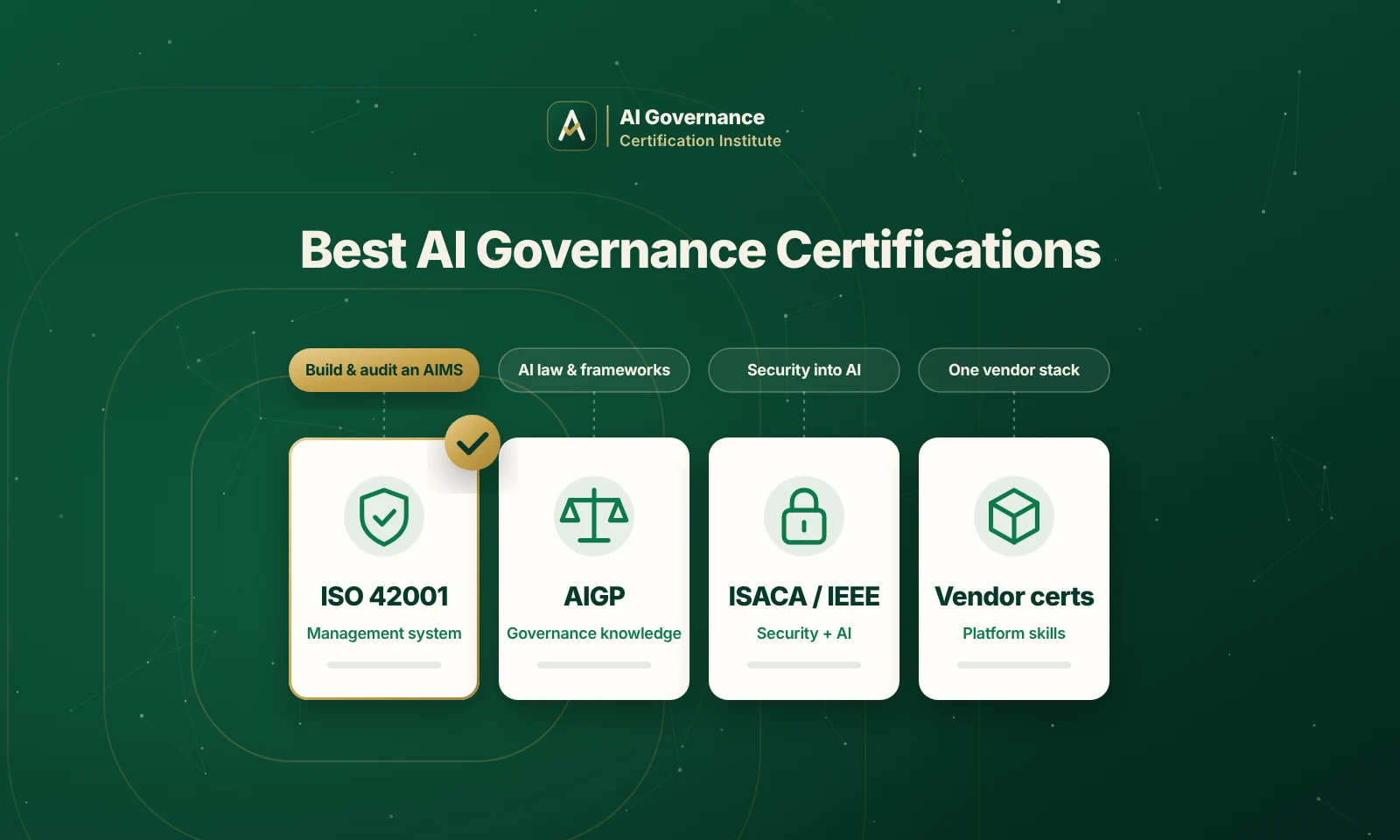
A governance program is only as strong as the people in its roles and their understanding of what good governance requires. Building that capability is what training provides. You can see every route through the ISO 42001 courses, with the implementer path taught clause by clause in the Lead Implementer certification, so the people you make accountable have the competence the roles demand.