You can run an AI management system on spreadsheets, and plenty of organizations start exactly that way. The question AI GRC software answers is not whether governance is possible without it, but at what point the manual version stops scaling, when the risk register has hundreds of entries, the evidence has to be refreshed every quarter, and nobody can say with confidence which of the standard’s controls are actually covered.
AI GRC tools are governance, risk management, and compliance software applied to AI: they hold the policies, the risk register, the control mappings, and the evidence in one place and keep them current. This guide from the AI Governance Certification Institute (AIGCI) is deliberately vendor-neutral. It explains what these tools do, the two categories they fall into, the capabilities that actually matter for ISO 42001, and, just as important, what no tool will do for you.
The aim is to leave you able to judge any product on its merits, rather than to point you at one.
What AI GRC Software Is
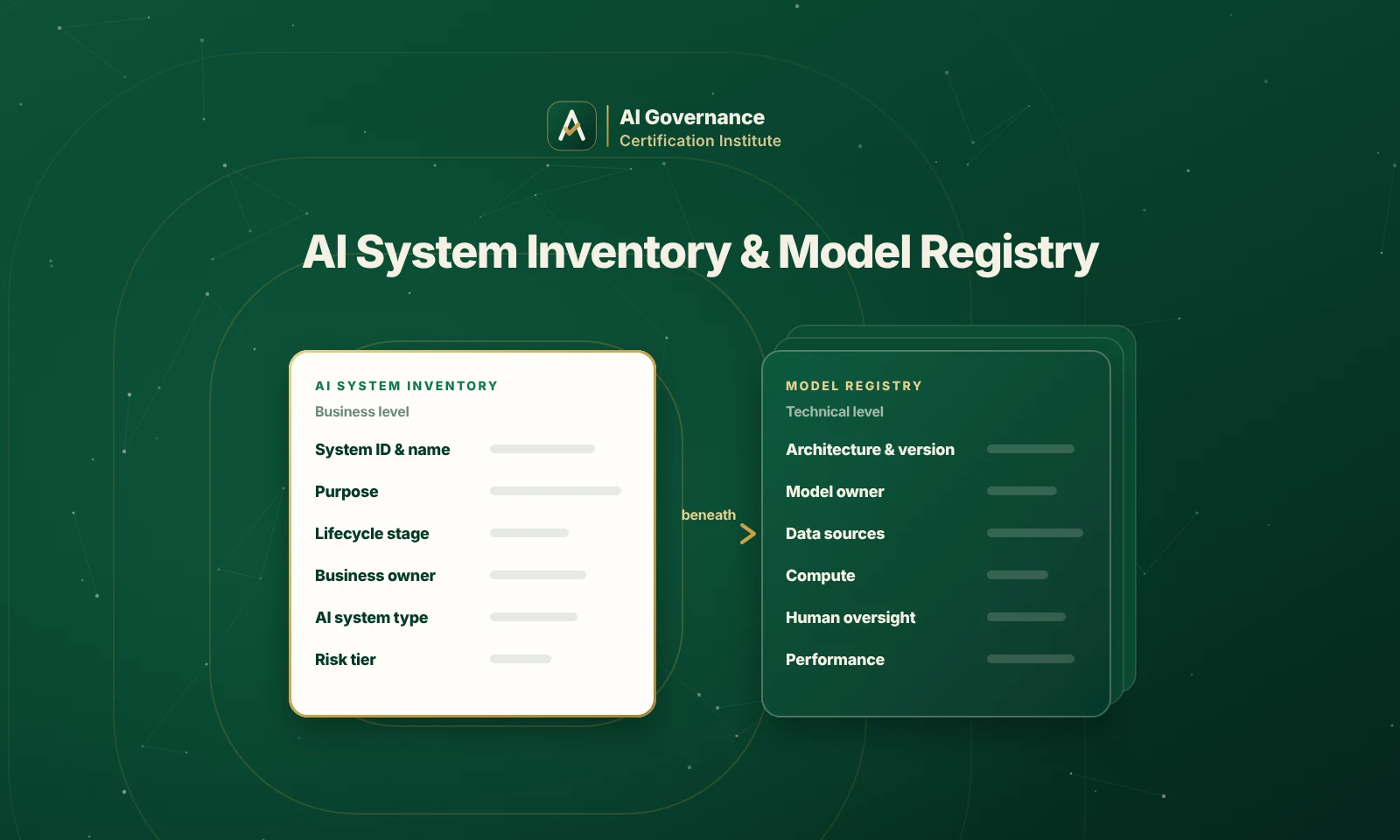
AI GRC software operationalizes an AI management system: it is the system of record for your AI governance. In practice that means holding the AI inventory, the risk and impact assessments, the mapping of your controls to the standard, the policies, and the evidence that all of it is working, then automating the parts that would otherwise be manual. It is a specialized branch of regulatory technology, the broader field of software that helps organizations meet rules efficiently.
The value is not storage; a shared drive can store documents. The value is keeping everything linked and current: when a control changes, the tool knows which risks, policies, and evidence are affected, and it can flag what has gone stale. That living linkage is what spreadsheets lose as a program grows.
Two Categories: Compliance Automation and Specialized AI Tools
AI GRC tools fall into two broad groups, and knowing which you are evaluating prevents a lot of confusion.
The first group is compliance automation platforms: broad, multi-framework engines that treat ISO 42001 as one framework among many they support, alongside security and privacy standards. Their strength is breadth and automated evidence collection across your cloud and code, and they suit organizations that already pursue several certifications and want AI governance to live in the same place. The second group is specialized AI governance tools, built specifically for the problems AI creates, such as model inventories, bias and drift monitoring, and impact assessments. Their strength is depth on AI-specific risk. Some organizations use one, some combine a broad platform with a specialized tool, and many start with neither.
The Core Capabilities to Look For
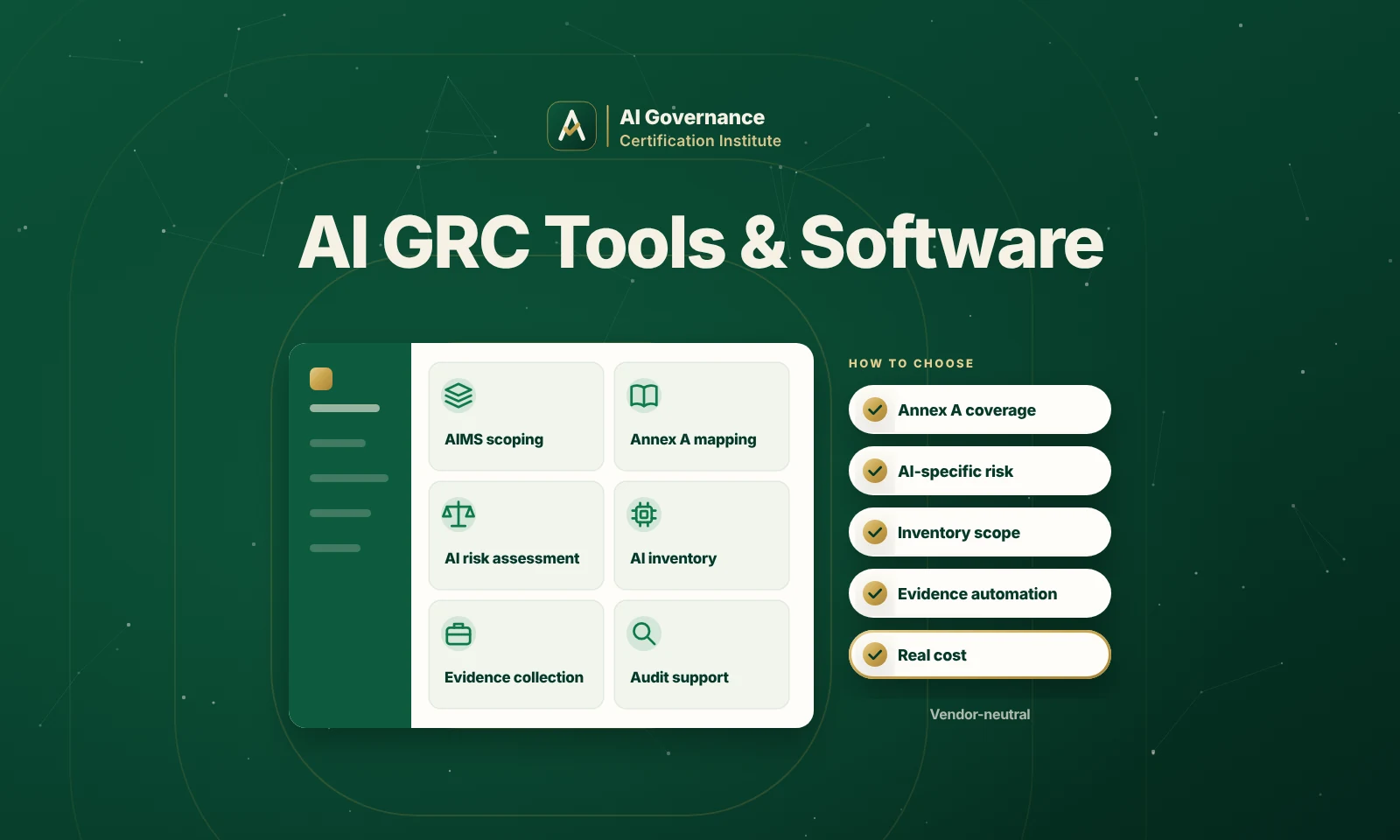
Whatever the category, a tool that genuinely operationalizes ISO 42001 has to support a handful of capabilities. Map any product against the list below before looking at its branding. The control-mapping row refers to the Annex A controls, the standard’s reference set of 38 controls.
|
Capability |
What it must do |
|---|---|
|
AIMS scoping and context |
Define where AI is deployed and the boundaries of the system |
|
Annex A controls mapping |
Map your controls to the 38 Annex A controls and track coverage |
|
AI risk and impact assessment |
Document bias, drift, hallucination, privacy, and security risk per system |
|
AI inventory and model registry |
Catalog every AI system, including third-party and embedded features |
|
Continuous evidence collection |
Pull evidence automatically rather than by manual upload alone |
|
Audit support |
Give an auditor a clean, traceable view of controls and evidence |
A tool strong on evidence automation but weak on AI-specific risk, or the reverse, will leave you doing the hard half by hand. Judge coverage across the whole list, not on the one feature a demo leads with.
Build, Buy, or Spreadsheet: When a Tool Pays Off
There is no universal answer, only a threshold. A small organization with a handful of AI systems and a single framework to meet can run a perfectly credible AIMS in well-structured spreadsheets, and spending on a platform before that point buys complexity it does not need yet.
A tool begins to pay off when the manual version stops scaling: when the inventory and the AI risk register grow past what one person can keep current, when evidence has to be refreshed continuously rather than annually, when several frameworks overlap, or when auditors start asking for traceability that a folder of documents cannot easily show. The honest test is not company size but whether keeping the records accurate has become a job in itself.
What a Tool Will Not Do for You
This is the part vendors understate. Software operationalizes governance; it does not create it. A tool cannot decide your risk appetite, judge whether an AI use case is acceptable, write a policy that reflects your actual values, or supply the competence to interpret the standard. It can hold a risk assessment, but it cannot do the thinking the assessment represents.
Buying a platform before you understand the standard tends to produce an expensive, tidy record of a governance program that does not really exist, because the hard judgments were never made. The sequence that works is the reverse: understand what the standard requires, decide how you will meet it, and then, if the scale justifies it, buy a tool to carry the load. A tool amplifies governance competence; it cannot substitute for it.
How to Evaluate AI GRC Software
When you do evaluate products, judge them against your own requirements rather than their feature lists. Copy the criteria below into a scorecard and rate each candidate.
|
AI GRC TOOL EVALUATION SCORECARD (criteria to copy) - Does it map cleanly to the 38 Annex A controls and Clauses 4 to 10? - Does it handle AI-specific risk: bias, drift, hallucination, impact? - Can it maintain an AI inventory, including third-party and embedded AI? - How much evidence is automated versus manually uploaded? - Does it support the frameworks you actually need (and only those)? - Will an external auditor accept its traceability and reports? - What is the real cost, including implementation and admin time? - Can your team operate it, or does it need a specialist to run? |
AI GRC Versus Traditional GRC
AI GRC is not simply traditional GRC with an AI label. Classic GRC tools track static controls and periodic evidence; AI governance adds moving targets that older tools were never built for. Models drift, so a control that passed last quarter can silently fail this one. Risk is probabilistic rather than binary, so bias and hallucination are matters of degree that need measurement, not a yes or no checkbox. And much of the risk sits in third-party and embedded AI that a traditional asset inventory never captured.
That is why a general-purpose GRC platform may cover the management-system scaffolding of ISO 42001 while missing the AI-specific substance, and why the Annex A controls and impact assessments are the capabilities to probe hardest when a familiar vendor says it now supports AI.
Common Mistakes When Buying AI GRC Software
The most expensive mistake is buying before understanding, treating the purchase as the act of getting governed rather than a way to carry governance you have already designed. A platform bought this way fills with half-finished records that look reassuring and prove nothing. The second is buying for breadth you will not use, paying for a dozen frameworks when you need one, which adds configuration and administration burden without adding value.
A third is being sold on a single headline feature, often a polished dashboard or an automation demo, without checking coverage across the capabilities that actually matter, so the tool automates the easy half and leaves the AI-specific risk work manual. A fourth is underestimating the human cost: a tool that needs a dedicated specialist to operate can cost more in staff time than it saves, especially for a small program. The way to avoid all four is to score candidates against your own requirements, insist on seeing the AI-specific capabilities rather than the generic ones, and be honest about the scale you are actually at.
Frequently Asked Questions
What Are AI GRC Tools?
They are governance, risk, and compliance software applied to AI: platforms that hold the AI inventory, risk and impact assessments, control mappings, policies, and evidence for an AI management system, and automate keeping them current. They operationalize a standard like ISO 42001 rather than replacing the human judgment behind it.
Do I Need a Tool to Get ISO 42001 Certified?
No. Certification requires a working AI management system with evidence, not any particular software. A small organization can certify using well-structured spreadsheets and documents. A tool helps when the volume of controls, evidence, and AI systems grows past what manual methods can keep accurate, but it is a convenience, not a requirement.
What Should an AI GRC Tool Do for ISO 42001?
At minimum: scope the AIMS, map your controls to the 38 Annex A controls and Clauses 4 to 10, maintain an AI inventory, document AI-specific risk and impact assessments, collect evidence with as much automation as possible, and give an auditor a traceable view. A tool missing any of these leaves part of the work manual.
What Is the Difference Between AI GRC and Traditional GRC?
Traditional GRC tracks static controls and periodic evidence; AI GRC must also handle moving risk, model drift that can break a passing control, probabilistic risks like bias and hallucination, and AI that hides in third-party and embedded features. A traditional platform may cover the scaffolding of ISO 42001 but miss the AI-specific substance.
Should I Buy a Tool Before or After Understanding the Standard?
After. Software operationalizes governance but cannot create it; buying before you understand the requirements tends to produce a tidy record of a program that does not really exist. Understand the standard, decide how you will meet it, then buy a tool if the scale justifies it.
Judge the Tools, After You Know the Standard
The best buyer of AI GRC software is someone who already understands what the standard asks, because they can tell a tool that operationalizes governance from one that merely decorates it, and the implementation guide lays out what you are operationalizing, and when the system is ready, the guide to getting certified covers the audit.
That understanding is what training builds. You can see every route through the ISO 42001 courses, with the implementer path in the Lead Implementer certification, so you buy tools to carry governance you already know how to run.