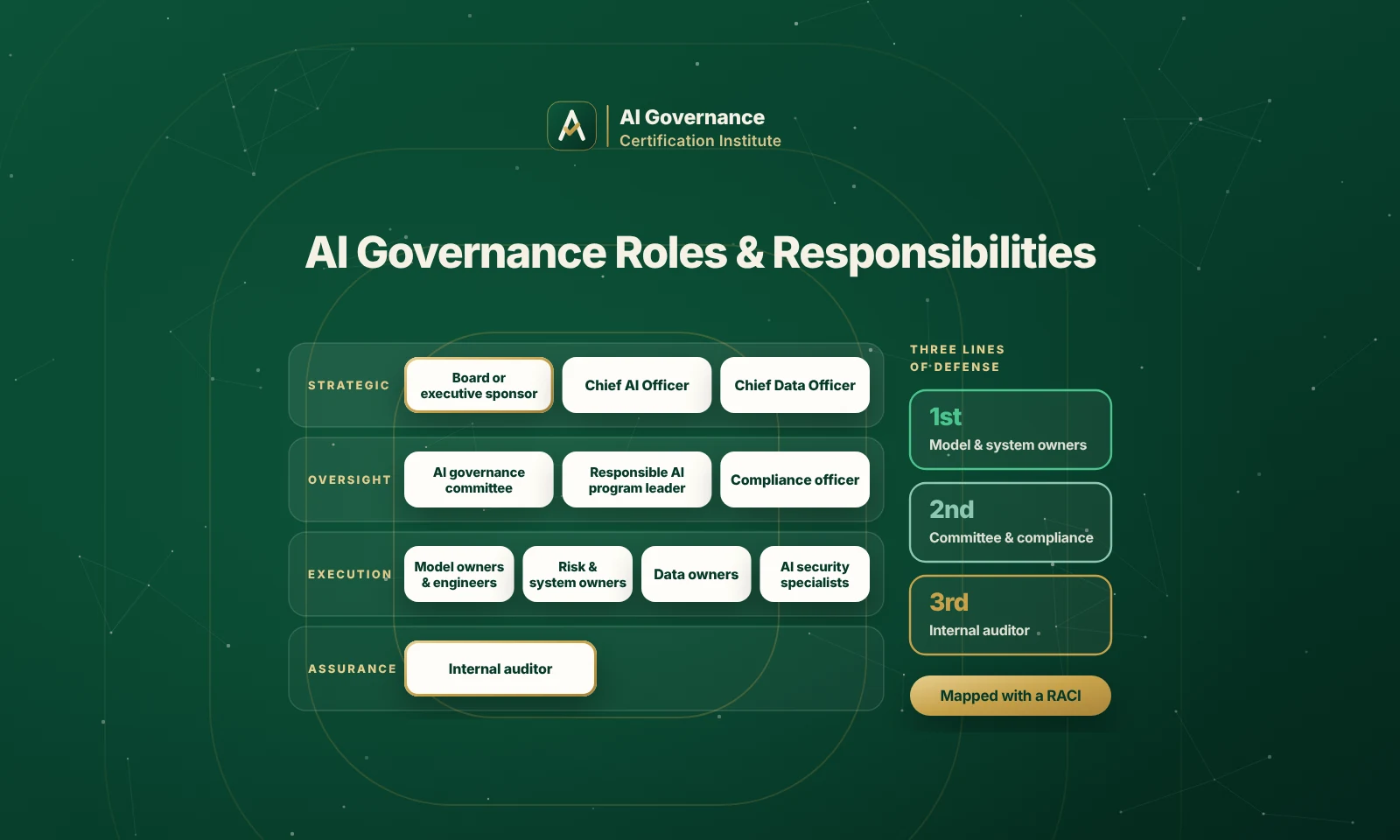
A RACI matrix answers the one question that sinks more AI governance programs than any policy gap: when something goes wrong with an AI system, who was supposed to be watching? In most organizations the honest answer is that everyone assumed someone else was, which is exactly the gap a RACI matrix closes. It takes every task in the AI lifecycle and names, for each one, who does the work, who answers for the outcome, who gets asked first, and who just needs to know.
This page gives you a ready-to-copy AI governance RACI matrix, from the AI Governance Certification Institute (AIGCI), along with how to read it, how to adapt it, and the mistakes that quietly void it. It is a responsibility assignment matrix applied to AI, and it is one of the most useful single artifacts a governance program can produce.
Use it as a starting point, not a finished answer. The roles and the letters below reflect a common, defensible pattern; your job is to adapt the names to your own structure and then keep the matrix alive as your use of AI grows.
What a RACI Matrix Is: The Four Letters
RACI is an initialism for four kinds of involvement a role can have in a task. The distinction that matters most is between the first two: being accountable is not the same as doing the work. Here is what each letter means.
|
Letter |
What it means |
|---|---|
|
R - Responsible |
The role that does the work to complete the task. There can be several. |
|
A - Accountable |
The single role that answers for the outcome and signs off. Exactly one per task. |
|
C - Consulted |
Roles whose input is sought before the task is done. Two-way dialogue. |
|
I - Informed |
Roles told the outcome after the fact. One-way communication. |
The whole method hangs on that single A. If two roles are accountable for the same task, neither really is, because each can point to the other when it fails. One accountable role per task is the rule that gives a RACI matrix its power.
Why AI Governance Needs a RACI Matrix
AI sits across more functions than almost any other technology: data science builds it, IT runs it, legal and risk judge it, the business owns the outcome, and leadership answers for it. That spread is exactly the condition under which responsibility diffuses and no one owns the hard calls. A model drifts, a biased output reaches a customer, a regulator asks who approved a high-risk use case, and the organization discovers that ownership was never actually assigned.
A RACI matrix forces the question to be answered in advance, in writing, task by task. It is also how you satisfy a specific governance requirement: management system standards expect roles, responsibilities, and authorities to be assigned and communicated, and a RACI matrix is the cleanest evidence that you have done so. It turns a vague intention to govern AI into a specific, auditable map of who owns what. It is also the backbone of model risk management, giving frameworks such as the NIST AI Risk Management Framework a named owner for each control they call for.
The AI Governance RACI Matrix: Copy This
Below is a worked AI governance RACI matrix across the AI lifecycle. Copy it, rename the columns to match your organization, and adjust the letters where your structure differs. Note how accountability shifts: the product owner is accountable through build, while the board takes accountability at the audit and deployment gate, where independence matters most.
|
Lifecycle task |
Exec / Board |
Product Owner |
ML Eng |
Risk / Legal |
IT / Sec |
Business |
|---|---|---|---|---|---|---|
|
Use-case ideation and ethical screening |
I |
A |
C |
R |
I |
C |
|
Data collection and privacy assessment |
I |
A |
R |
C |
C |
I |
|
Model training and bias testing |
I |
A |
R |
C |
I |
I |
|
Risk categorization (high or low tier) |
I |
A |
C |
R |
I |
I |
|
Pre-deployment independent audit |
A |
I |
C |
R |
C |
I |
|
Final go or no-go deployment approval |
A |
R |
I |
C |
C |
I |
|
Production monitoring and drift detection |
I |
A |
R |
C |
R |
I |
|
Incident response and model rollback |
I |
A |
R |
C |
R |
C |
Read any row across to see, for that task, who signs off (A), who does the work (R), who is asked (C), and who is kept in the loop (I). Read any column down to see everything a single role owns. The pattern to copy is not the exact letters, which you should challenge, but the discipline of assigning one A to every row.
How to Read and Use the Matrix
A RACI matrix is only useful if the four letters are applied with discipline. Four reading rules keep it honest.
-
One A per row. Every task has exactly one accountable role. A row with two As is a row where accountability will be dodged; a row with none is a task no one owns.
-
R is the doer, A is the owner. The responsible role does the work; the accountable role answers for whether it was done right. They are often different people, and keeping them separate is the point.
-
Consulted is two-way, Informed is one-way. If you need a role's judgment before acting, they are C. If they only need to hear the result, they are I. Confusing the two either slows everything down or leaves key people blindsided.
-
Every role should have at least one A or R. A column that is all Cs and Is describes a spectator, not a stakeholder, and probably does not belong on the matrix.
The Roles Down the Columns
The columns are the roles that recur in AI governance. In brief: the executive or AI board holds top-level accountability and owns the policy and deployment sign-offs; the AI product owner drives the use case and owns delivery; the ML engineers and data scientists build, train, and run the models; risk, compliance, and legal judge bias, privacy, and regulatory alignment; IT and security own infrastructure and secure operation; and the business or operations teams use the output and feel its impact. Each of these is defined in full in the program roles.
Keep the column list short. A RACI matrix with a dozen roles becomes unreadable and invites the overloading of Cs and Is that creates organizational drag. Group related functions into one column unless a real decision depends on telling them apart.
How to Build Your Own
Adapting the matrix to your organization takes five steps. Work through them with the actual people who will hold the roles, not in isolation.
-
List the tasks down the side. Use the AI lifecycle as your spine: ideation, data, training, risk tiering, audit, deployment, monitoring, incident response. Add tasks specific to your context.
-
List the roles across the top. Use real roles in your organization, grouped so the matrix stays readable.
-
Assign one A to every task first. Decide who answers for each task before you assign anything else. This is the hardest and most valuable step.
-
Fill in R, then C and I. Name who does the work, then who must be consulted and who informed, keeping the last two lean.
-
Review it with the room. Walk every row past the people named in it, because a responsibility someone has not accepted is not really assigned.
Start from the blank template below.
|
AI GOVERNANCE RACI TEMPLATE (blank, to copy) Task | Board | PO | Eng | Risk | IT | Biz Use-case ideation and screening | | | | | | Data and privacy assessment | | | | | | Model training and bias testing | | | | | | Risk categorization | | | | | | Pre-deployment audit | | | | | | Deployment go or no-go | | | | | | Production monitoring and drift | | | | | | Incident response and rollback | | | | | | Rule: exactly one A per row; R does the work; keep C and I lean. |
Common RACI Mistakes That Void the Matrix
A RACI matrix fails in a handful of predictable ways, and each one hollows it out while leaving it looking complete.
The first is multiple accountable roles on one task. Shared accountability is no accountability, because each party assumes the other has it. The second is the everyone-consulted matrix, where so many roles are tagged C that every decision drags through endless sign-offs and the program slows to a crawl. The third is the matrix no one updates: it is drawn once for an audit, filed, and never revisited, so within months it describes an organization that no longer exists. A RACI matrix is a living document, and it only governs the AI you are actually running if it keeps pace as that changes. The fourth is confusing titles with responsibilities, assigning letters to job titles rather than to the people who will truly own the work, which produces a tidy grid that nobody in practice follows.
Frequently Asked Questions
What Is a RACI Matrix in AI Governance?
It is a grid that maps every task in the AI lifecycle against the roles involved, marking each role as Responsible, Accountable, Consulted, or Informed for that task. It makes explicit who does the work, who answers for the outcome, who is consulted, and who is kept informed, so that no AI decision falls through the gaps between functions.
What Do R, A, C, and I Stand For?
Responsible, Accountable, Consulted, and Informed. Responsible roles do the work; the single Accountable role answers for the result and signs off; Consulted roles give input before the task is done; and Informed roles are told the outcome afterward. The defining rule is that each task has exactly one Accountable role.
Who Is Accountable in an AI Governance RACI Matrix?
It depends on the task. The AI product owner is usually accountable through the build and monitoring stages, because they own delivery, while the executive or AI board takes accountability at the independent audit and the final deployment approval, where independence from the delivery team matters. The point is that exactly one role is accountable for each task, not that one role is accountable for everything.
Does ISO 42001 Require a RACI Matrix?
Not by name. The standard requires that roles, responsibilities, and authorities be assigned and communicated. A RACI matrix is not mandatory, but it is one of the clearest and most common ways to demonstrate that you have met that requirement, which is why many organizations build one as part of their AI management system.
How Often Should the Matrix Be Updated?
Whenever your roles, your AI systems, or your governance process change, and on a regular review cycle even when they appear stable. A RACI matrix is a living document; treated as a one-time deliverable, it quickly stops matching reality and stops governing anything.
Put the Matrix to Work
A RACI matrix is one of several artifacts that turn AI governance from intention into practice, and it works best alongside the policies, registers, and checklists that surround it. You can find more ready-to-use documents in the templates library. A matrix on its own does not govern anything; it only works when the people named in it understand the tasks they are accountable for and have the authority to act on them.
Building that judgment, and understanding what the standard expects of each role, is what training provides. You can see every route through the ISO 42001 courses, with the implementer path taught clause by clause in the Lead Implementer certification, so the responsibilities you assign are backed by people who know what they mean.