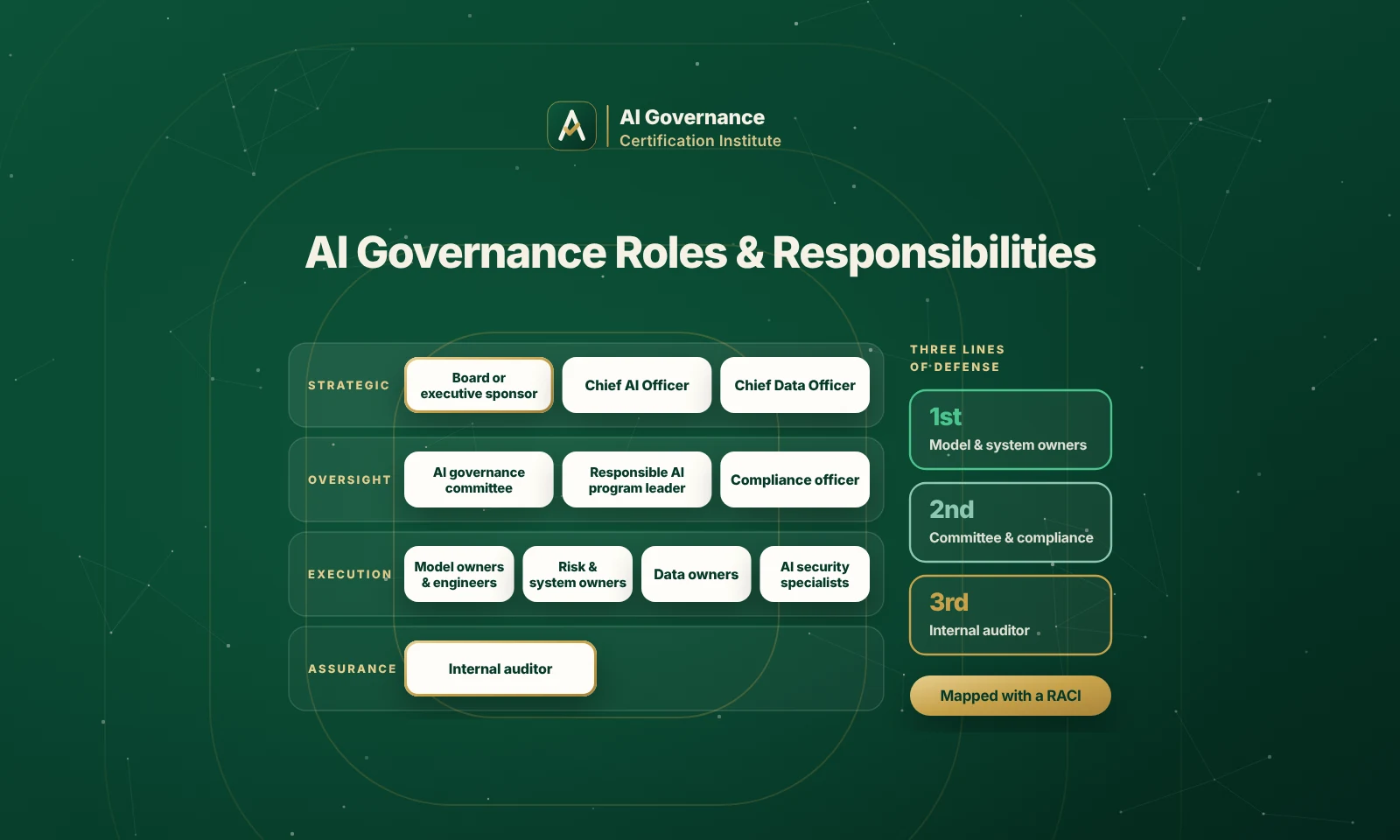
Somewhere in every serious AI governance program there has to be a room where someone can say no to a deployment, and mean it. That room is the AI governance committee. It is the cross-functional body with the authority to approve, pause, or stop an AI system, and without it, governance is a set of policies that no one actually enforces.
Because AI touches legal, ethical, technical, and operational questions at once, no single function can govern it alone, which is why the governance body is a committee rather than a role. It brings those perspectives into one place so that AI decisions are made with all of them in the room. This guide from the AI Governance Certification Institute (AIGCI) explains what the committee is, what its charter covers, who sits on it, how it decides, and how it differs from the board above it.
It is part of the roles cluster, so it assumes you know the broader set of governance roles and focuses on this one body, pointing back to the full roles map and the matrix that makes its decisions accountable.
What an AI Governance Committee Is
An AI governance committee is a cross-functional group that sets AI policy, reviews and approves AI use cases, and provides ongoing oversight of deployed systems. It is the decision-making center of the governance program: where a proposed AI use case is judged, where the hard ethical questions are arbitrated, and where a non-compliant system can be paused.
What makes it a committee rather than a role is that the questions it answers cannot be answered from one seat. Whether to deploy a high-risk model is at once a legal question, a privacy question, a security question, a technical question, and a business question. The committee exists so those answers are reached together rather than in isolation, which is also what stops any one function from either blocking everything or waving everything through.
What the Committee Does: Its Mandate
A committee's mandate is usually set out in a charter, and it spans three objectives and four core duties. The three objectives are strategic alignment, keeping AI initiatives matched to business value and risk appetite; risk and compliance, managing bias, privacy, security, and regulatory alignment with frameworks like the EU AI Act; and ethical guardrails, enforcing responsible AI principles such as transparency, human oversight, and fairness, in the spirit of any ethics committee.
Those objectives translate into four recurring duties. The committee sets policy, defining acceptable use and deployment guardrails. It reviews and approves use cases through an intake process, judging each on its risk tier and its value. It conducts risk surveillance, monitoring live systems for drift, bias, or regulatory change, with the authority to pause or terminate a non-compliant project. And it coordinates across departments, breaking down the silos between IT, legal, risk, and the business so AI is governed as one thing, not many.
Who Sits on the Committee
An effective committee deliberately brings together the perspectives AI decisions require. Six seats recur across well-designed committees.
|
Member |
What They Bring |
|---|---|
|
Chair or executive sponsor |
Top-level authority, escalation, and enforcement across units |
|
Legal counsel |
Intellectual property, liability, and regulatory judgment |
|
Privacy officer or DPO |
Data protection, consent, and data lineage |
|
Information security |
Vulnerabilities, threat vectors, and secure integration |
|
Enterprise architect or CTO |
Technical feasibility, infrastructure, and scalability |
|
Business unit leaders |
Practical context on use cases and operational value |
The chair matters most, because the committee needs someone senior enough, often a chief risk, security, or AI officer, to make its decisions stick. A committee that can be overruled by any business unit it reviews has no real authority.
The Committee Charter
A committee without a charter drifts into a discussion group. The charter is the document that gives it authority and defines how it operates. Copy the outline below as a starting point.
|
AI GOVERNANCE COMMITTEE CHARTER (outline to copy) - Purpose and scope of the committee - Authority: what it can approve, pause, and stop - Membership, the chair, and quorum - Decision thresholds: full-committee review versus department sign-off - The use-case intake and risk-tiering process - Meeting cadence and how urgent decisions are handled - Reporting lines to the board and the management review - How decisions and their rationale are documented |
The two lines people underweight are authority and decision thresholds. Without stated authority, the committee cannot actually stop anything; without clear thresholds, it either reviews everything and becomes a bottleneck, or reviews nothing that matters.
How the Committee Makes Decisions
The committee's central activity is deciding whether an AI use case may proceed, and the mechanism is an intake process feeding a risk-tiered review.
Proposed AI projects enter through a defined intake pipeline and are classified by risk, from minimal to high, often mirroring the risk tiers in regulation such as the EU AI Act. Low-risk cases may clear on a light review or department sign-off, while high-risk cases get full committee scrutiny before they are allowed to deploy. The same tiering drives ongoing surveillance, with the highest-risk systems watched most closely. This is what turns the committee from a talking shop into a gate: a clear path in, a risk-based decision, and the authority to say no.
Committee, Board, and Program Team: Who Is Who
The committee is easily confused with the board above it and the program team below it. The board holds ultimate accountability and sets risk appetite; the committee is the cross-functional body that makes operational governance decisions within that appetite; and the program team runs the day-to-day work the committee oversees. The full picture of how these fit together is in the program roles.
Keeping them distinct matters because their jobs are different. The board governs the organization and delegates AI oversight to the committee; the committee governs AI decisions; the team executes. Mapping who is accountable for which decision across all three is exactly what the RACI matrix is for.
How Often It Meets, and the Authority It Needs
Two things determine whether a committee is real: how regularly it meets, and whether its decisions bind.
Most committees meet on a regular cadence, often monthly or quarterly, with a path for urgent decisions between meetings, because a high-risk deployment cannot always wait for the next scheduled session. More important than frequency is authority. A committee whose approvals are advisory, that can be overridden by a determined business unit, governs nothing. The charter has to give it the power to pause or stop a deployment, and leadership has to back that power, or the committee becomes a formality that teams learn to route around, which is how shadow AI takes hold.
Common Mistakes When Standing Up the Committee
Committees fail in predictable ways, and most of the failures trace back to the charter. The first is the advisory trap: the committee reviews use cases and makes recommendations, but a business unit can proceed anyway. If approvals are not binding, the committee is theater, and teams quickly learn to treat it as a box to tick rather than a gate to pass.
The second is the bottleneck. A committee that insists on reviewing every AI use case, however trivial, becomes the slowest part of the organization, and people route around it. Risk-tiering is the fix: reserve full committee review for genuinely high-risk cases and delegate the rest to a lighter, faster path with clear criteria.
The third is composition drift. A committee stacked entirely with technologists misses legal and ethical risk; one stacked with lawyers misses what is technically feasible. The balance of seats is deliberate, and it has to be maintained as people rotate off. The fourth is the committee that meets but keeps no records, leaving no evidence of its decisions when an auditor or regulator asks why a given system was approved. Decisions and their rationale have to be documented, because in governance an undocumented decision is, for practical purposes, a decision that never happened.
What the Committee Should Track
Beyond approving individual use cases, a mature committee watches the AI portfolio as a whole. It keeps a register of deployed AI systems and their risk tiers, tracks incidents and model performance issues, monitors regulatory developments that could reclassify an existing system, and reviews whether approved systems are still operating within the conditions they were approved under. This portfolio view is what lets the committee catch problems that no single use-case review would surface, such as several individually low-risk systems that together create a concentrated dependency or a shared point of failure.
Frequently Asked Questions
What Is an AI Governance Committee?
It is a cross-functional body that sets AI policy, reviews and approves AI use cases, and oversees deployed systems. It brings legal, privacy, security, technical, and business perspectives into one place so AI decisions are made together, and it holds the authority to approve, pause, or stop an AI system.
Who Should Be on an AI Governance Committee?
A senior chair or executive sponsor, legal counsel, a privacy officer or DPO, information security, enterprise architecture or a CTO, and business unit leaders. The mix is deliberate: AI decisions span all these domains, so the committee needs a seat for each, chaired by someone senior enough to make its decisions stick.
What Does an AI Governance Committee Decide?
It sets acceptable-use and deployment policies, reviews and approves proposed AI use cases on a risk-tiered basis, monitors live systems for drift and compliance with the power to pause or terminate them, and coordinates AI governance across departments. In short, it decides what AI the organization deploys and on what terms.
What Is the Difference Between the Committee and the Board?
The board holds ultimate accountability for AI governance and sets the organization's risk appetite; the committee is the cross-functional body that makes operational governance decisions within that appetite. The board delegates AI oversight to the committee, and the committee reports back to it. One sets the boundaries; the other governs inside them.
Does ISO 42001 Require an AI Governance Committee?
ISO 42001 requires that roles, responsibilities, and authorities be assigned and that oversight happens, but it does not mandate a committee by name. In practice a committee is the most common and effective way to meet those requirements, because the cross-functional decisions AI governance needs are hard to make without one.
Give the Committee the Competence to Govern
A committee is only as good as the judgment of the people on it, and governing AI well takes more than seniority; it takes understanding of what the standard and the risks actually require. Building that understanding is what training provides. You can see every route through the ISO 42001 courses, with the implementer path taught clause by clause in the Lead Implementer certification, so the people in the room can make decisions worth backing.