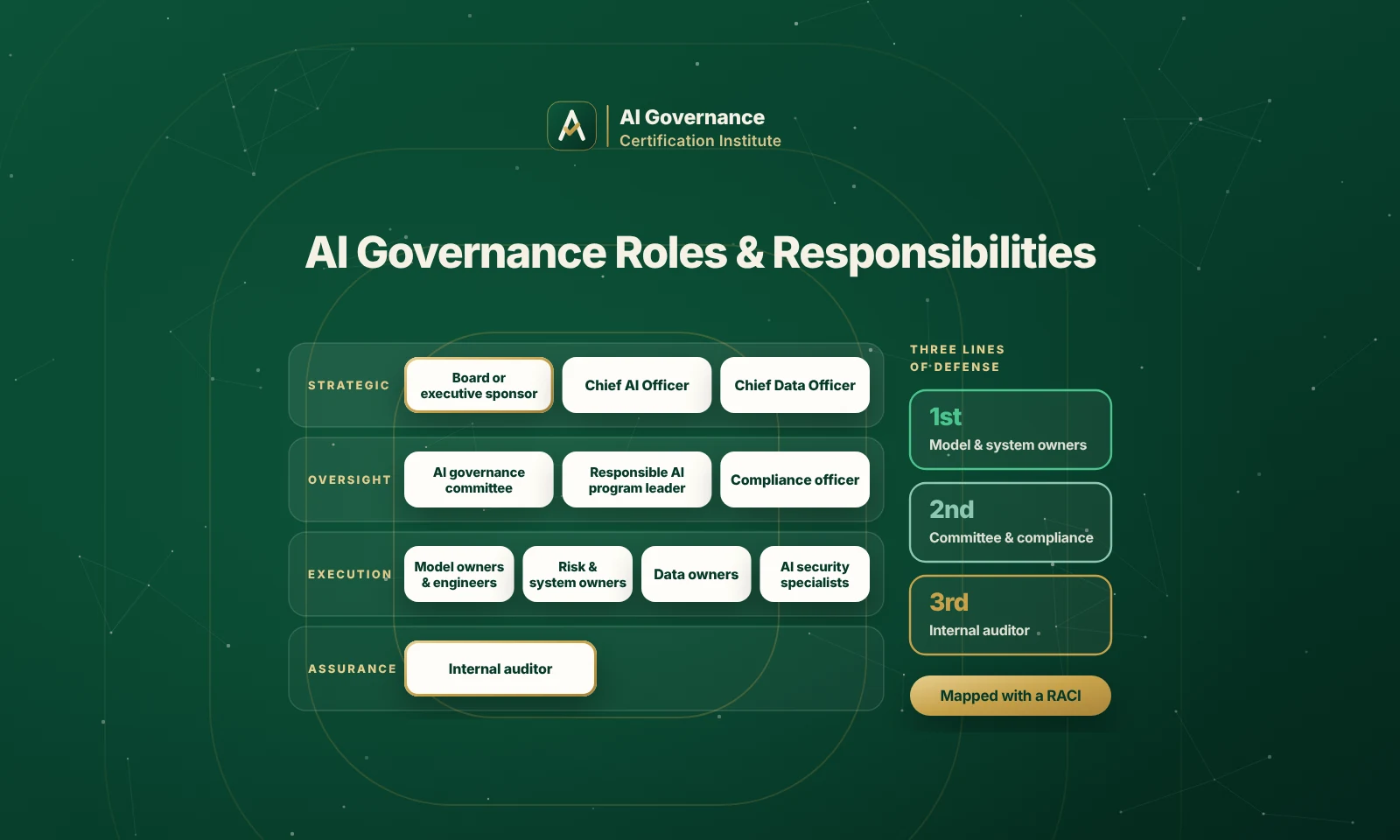
The roles in an AI governance program can be organized in three very different ways, and the choice quietly decides whether your AI moves fast or stalls. The same people, arranged differently, produce either a bottleneck that breeds shadow AI or a platform that accelerates safe innovation. Picking the structure is nearly as consequential as picking the people.
Team structure is an organizational structure question applied to AI governance: how do you distribute decision-making between a central authority and the business units that actually build and use AI. There are three established answers, and this guide from the AI Governance Certification Institute (AIGCI) walks through each, their trade-offs, and which fits which kind of organization.
This page sits in the roles cluster. It assumes you know the roles themselves and focuses on how to arrange them, pointing back to the roles and the oversight committee where those need their own depth.
Three Ways to Structure AI Governance
Every model answers the same question, where does authority sit, and lands in a different place. Centralized puts it all in one team; federated pushes it out to the business units; hub-and-spoke splits it deliberately between the two. The differences are not cosmetic: each produces a different balance of speed, consistency, and risk, and each has a characteristic way of failing.
The Centralized Model
In a centralized model, a single core team, often an AI center of excellence, owns all policy-making, risk assessment, vetting, and approval for the whole organization. Business units bring their AI ideas to the central team, which reviews, tests, and approves or rejects them against uniform enterprise standards.
The strength is control: maximum consistency, strict risk management, and no duplicated tooling. The weakness is that the center becomes a bottleneck, lacks deep context about niche business units, and frustrates teams enough that they route around it, which is how centralized governance paradoxically breeds shadow AI. It fits heavily regulated organizations, smaller ones, and companies taking their first steps into enterprise AI, where consistency matters more than speed.
The Federated Model
The federated model is the opposite. Governance responsibilities and risk decisions are pushed out to individual business units or product teams. A lightweight central authority sets high-level principles, such as ethical AI commitments and privacy rules, but the frontline owns its own model validation, monitoring, and compliance.
The strength is context and speed: the people approving AI understand the domain, so decisions are fast and well-informed. The weakness is fragmentation, inconsistent tooling, uneven quality of oversight across departments, and the difficulty of maintaining a single source of truth. It fits massive multi-division enterprises where domain nuance, a retail recommendation engine versus a medical diagnostic tool, outweighs uniform control.
The Hub-and-Spoke Model
The hub-and-spoke model is the hybrid, and it is widely regarded as the scalable sweet spot for mature organizations. It splits the work deliberately between a central hub and local spokes.
-
The hub. The central team owns enterprise infrastructure, global policies, approved tool and model libraries, and observability standards. It acts as an enabler, not a gatekeeper.
-
The spokes. Local teams own use-case discovery, domain-specific iteration, and local deployment, operating autonomously inside the guardrails the hub defines.
-
The bridge. Embedded liaisons, often called AI champions, sit within the spokes and connect them back to the hub.
The strength is balance: enterprise-wide safety and consistency without the bottleneck, because the central team becomes a platform provider rather than a slow approval desk. The weakness is that it needs clear boundaries and good communication, and it stumbles if the hub creeps back into micromanagement. Research on organizations that successfully scale AI finds them about three times more likely to use hub-and-spoke than any other structure, which is why it has become the default recommendation for scaling enterprises.
The Three Models at a Glance
Set side by side, the trade-offs are stark. The table compares the three on the dimensions that decide which one you can live with.
|
Dimension |
Centralized |
Federated |
Hub-and-Spoke |
|---|---|---|---|
|
Speed to deploy |
Slow |
Fast |
Balanced and fast |
|
Risk control |
Very high |
Variable |
High and consistent |
|
Domain context |
Low |
Very high |
High, locally executed |
|
Main failure mode |
Bottlenecks |
Shadow AI and silos |
Boundary ambiguity |
|
Best for |
Regulated or early-stage |
Large multi-division |
Scaling enterprises |
Which Model Is Right for You
The right structure depends on three things: your size, your maturity, and your regulatory exposure. A small or highly regulated organization taking its first steps is usually best served by a centralized model, because consistency and control matter most and the volume is manageable.
A very large, diversified enterprise often has no choice but to federate, because no central team can understand every domain. But most organizations scaling AI land on hub-and-spoke, because it gives them central guardrails and local speed at once. A useful rule of thumb: start more centralized when you are small or new, and move toward hub-and-spoke as the number of AI systems and teams grows beyond what one central team can review.
How the Structure Should Evolve as You Scale
The right structure is not fixed; it changes as the organization grows, and the common failure is staying in one model too long.
A company taking its first steps usually starts centralized, because there is little to govern and consistency is easy to enforce. As the number of AI systems and teams grows, the central team starts to become a bottleneck, and the warning sign is unmistakable: frustrated teams begin adopting AI tools without approval, the classic signal of shadow AI. That is the moment to shift toward hub-and-spoke, keeping central guardrails while pushing execution out to the business units. Very large, diversified organizations may go further still, toward a more federated model. The point is to match the structure to your current scale, and to change it deliberately when the old one starts generating the failure mode it is known for.
Where the Team Sits and Who It Reports To
Structure is not only horizontal, across business units, but vertical, up the organization. Wherever the team sits, the reporting lines have to preserve two things: senior sponsorship and the independence of assurance.
The governance function, the hub in a hub-and-spoke model, should report high enough to have authority, typically to a Chief AI Officer or directly to executive leadership, because governance without seniority gets overruled. At the same time, the assurance role, internal audit, has to keep a reporting line that is independent of the function it audits, so it can report uncomfortable findings without pressure. A structure that buries governance low in the organization, or that lets the audited manage the auditor, undermines itself no matter which of the three models it uses.
How Structure Relates to Roles and the Committee
Structure and roles are two halves of the same design. The roles define who owns what, set out in the program roles; the structure decides how those owners are arranged relative to a central team and the business units. One without the other is incomplete: roles with no structure produce confusion about escalation, and a structure with undefined roles is just an org chart.
The decision-making body at the center of any of these models is the governance committee, whether it is the whole of a centralized model or the hub of a hub-and-spoke one. How that committee is composed and what it decides is covered in the oversight committee.
Common Structuring Mistakes
A few mistakes recur regardless of which model an organization picks:
-
Over-centralizing at scale. Keeping all approvals in one team until the bottleneck pushes people into shadow AI.
-
Federating with no guardrails. Distributing responsibility without the shared policies and tools that keep it consistent.
-
A hub that micromanages. A central team that was meant to enable but slips back into gatekeeping, recreating the centralized bottleneck.
-
No bridge between hub and spokes. Omitting the embedded champions, so central policy and local practice drift apart.
-
Governance reporting too low. Placing the function so far down the organization that its decisions are routinely overruled.
Frequently Asked Questions
What Are the AI Governance Team Structure Models?
Three main ones: centralized, where a single core team owns all governance; federated, where responsibility is distributed to business units; and hub-and-spoke, a hybrid where a central hub sets guardrails and tooling while local spokes execute inside them. Each trades speed against consistency differently.
What Is the Hub-and-Spoke AI Governance Model?
It is a hybrid structure in which a central hub owns enterprise policy, infrastructure, and approved tools while acting as an enabler, and local spokes own use-case discovery and deployment within the hub's guardrails, with embedded AI champions bridging the two. It is widely considered the most scalable model for mature organizations.
Which AI Governance Structure Is Best?
There is no single best, but hub-and-spoke is the most common choice for organizations scaling AI, because it balances central control with local speed. Centralized suits small or heavily regulated organizations, and federated suits very large, diversified enterprises. The right answer depends on your size, maturity, and regulatory exposure.
How Big Should an AI Governance Team Be?
It depends on the model and the organization. A centralized team in a small company might be a handful of people; a hub-and-spoke structure in a large enterprise has a small central hub plus distributed champions across business units. The number of AI systems and teams you govern matters more than the size of the company, because that is what the team actually has to cover.
Where Should the AI Governance Team Report?
What Is the Difference Between Federated and Hub-and-Spoke?
Both distribute execution to business units, but hub-and-spoke keeps a stronger, enabling central hub that owns shared policy, tools, and standards, while a purely federated model has only a lightweight central authority setting high-level principles. Hub-and-spoke trades a little autonomy for much more consistency, which is why it scales better for most organizations than full federation.
High enough to have authority, usually to a Chief AI Officer or executive leadership, so governance decisions are not routinely overruled. The one exception is the assurance role, which should report independently of the function it audits, so internal audit can raise findings without pressure from the people being audited.
Design the Structure, Then Staff It Well
The best structure still depends on people who understand what good AI governance requires. Building that capability is what training provides. You can see every route through the ISO 42001 courses, with the implementer path taught clause by clause in the Lead Implementer certification, so whichever model you choose is run by people equipped to make it work.