The people best placed to govern AI may already be sitting in the security team. The 2024 ISC2 Cybersecurity Workforce Study found that a third of cybersecurity professionals now see AI as critical to their work, yet only 12 percent of hiring managers prioritise AI skills, and more than a third of security teams report real gaps in AI expertise. That gap is an opening.
If you already secure systems for a living, ISO/IEC 42001:2023, the international standard for AI management systems, is closer to your day job than it looks. This guide, from the AI Governance Certification Institute (AIGCI), shows why, and how to make the move.
Cybersecurity professionals transition into AI governance faster than most, because ISO/IEC 42001:2023 is a risk-based management system, and managing risk through a system is exactly what security teams already do.
|
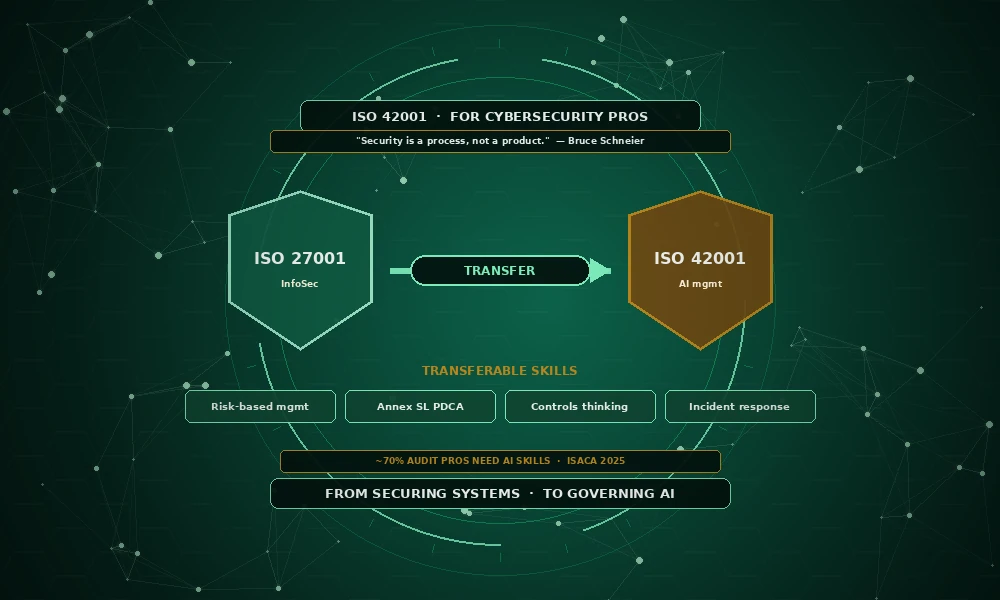
"Security is a process, not a product." Bruce Schneier, cryptographer and security technologist, in his 2000 essay The Process of Security |
Schneier's line, from his 2000 essay, is the whole idea in six words. Good security is not a gadget you buy once; it is a continuous process you run.
ISO 42001 takes that same philosophy and points it at AI. It is a management system, not a control you install, which is why security professionals grasp it quickly.
Why cybersecurity professionals have a head start in AI governance
Move into AI governance from security and you are not starting over. You are re-aiming a skill set that already fits. Here is what you bring on day one:
-
Risk-based thinking. You already weigh likelihood against impact and decide what to treat.
-
Management-system fluency. If you know ISO 27001, you already know Clauses 4 to 10, because ISO 42001 shares the same structure.
-
A controls mindset. Mapping obligations to controls and evidence is second nature to you.
-
Assurance discipline. Audit, monitoring, and incident response transfer directly to an AI management system.
-
Executive fluency in risk. You can already explain risk to a board, which AI governance badly needs.
How your security skills map to ISO 42001
Almost every core security activity has a direct counterpart in an AI management system, as the mapping below shows.
|
Security skill |
Maps to in ISO 42001 |
Relationship |
|---|---|---|
|
Threat and risk assessment |
AI risk and impact assessment |
Same method, new risk types |
|
ISO 27001 Annex A controls |
ISO 42001 Annex A controls |
Sibling control sets |
|
ISMS (Clauses 4 to 10) |
AIMS shares the structure |
Directly transferable |
|
Access and data protection |
AI data governance |
Extends to training data |
|
Incident response |
AI issue and incident handling |
Adapts to model failures |
|
Audit and assurance |
Internal audit (Clause 9.2) |
Same discipline |
The one advantage that matters most: ISO 27001
If you have worked with ISO 27001, you hold the single biggest shortcut into ISO 42001. Both standards are built on the same ISO Harmonized Structure, so Clauses 4 to 10 line up almost one to one: context, leadership, planning, support, operation, performance evaluation and improvement.
The management-system machinery you already run for information security is the same machinery ISO 42001 uses for AI. What changes is the Annex A control set and the risks it addresses.
That overlap is worth understanding in detail, because it tells you exactly what carries over and what is new. Our companion piece on how the two standards compare breaks down the shared structure and the distinct controls side by side.
The headline for a security professional is simple: you are not learning a new discipline, you are extending one you already practise into a new domain of risk.
What is genuinely new: the gaps to close
Honesty matters here. A security background does not cover everything ISO 42001 asks for. The genuinely new material is narrow and learnable, and it clusters in four areas:
-
Bias and fairness. How discrimination enters a model through its data, and how to test for it.
-
Transparency and explainability. When and how an automated decision must be explained.
-
Human oversight. Designing the points where a person can review, override, or stop an AI system.
-
AI data governance. Governing the quality, provenance, and lifecycle of training and test data.
Notice what is not on that list: you do not need to build models or write machine-learning code. AI governance is about managing AI responsibly, not engineering it.
Each gap is a topic you can study in a focused course rather than a second degree, and every one of them builds on judgement you already exercise when you decide which risks to accept, mitigate or escalate.
What ISO 42001 adds to a security professional's toolkit
Security frameworks protect information; ISO 42001 governs AI, which is a wider brief. The NIST AI Risk Management Framework makes the point that AI risk reaches beyond security into fairness, transparency, and accountability.
Adding ISO 42001 to your credentials signals that you can govern those risks, not just defend the perimeter, and that matters as regulation such as the EU AI Act makes AI governance a legal expectation rather than a nice to have.
Three myths security professionals believe about AI governance
A few assumptions hold good security people back. Each one is worth retiring.
-
Myth 1: it is a coding job. Reality: AI governance is about managing AI, not building it. Your value is risk, controls, and assurance, not model architecture.
-
Myth 2: security already covers AI risk. Reality: security covers confidentiality, integrity, and availability. It does not cover bias, transparency, or human oversight, which is exactly where ISO 42001 lives.
-
Myth 3: it is too early to specialise. Reality: the standard is published, regulation is arriving, and the workforce gap is real. Early movers define the field rather than chase it.
Which certification fits a cybersecurity professional
Two levels are worth your attention, and for most security professionals the choice is clear.
|
Level |
What it builds |
Best for a security pro who wants to |
|---|---|---|
|
Foundation |
Working knowledge of the standard |
Explore AI governance and speak the language |
|
Lead Implementer |
Ability to build and run an AIMS |
Lead AI governance, the natural next step |
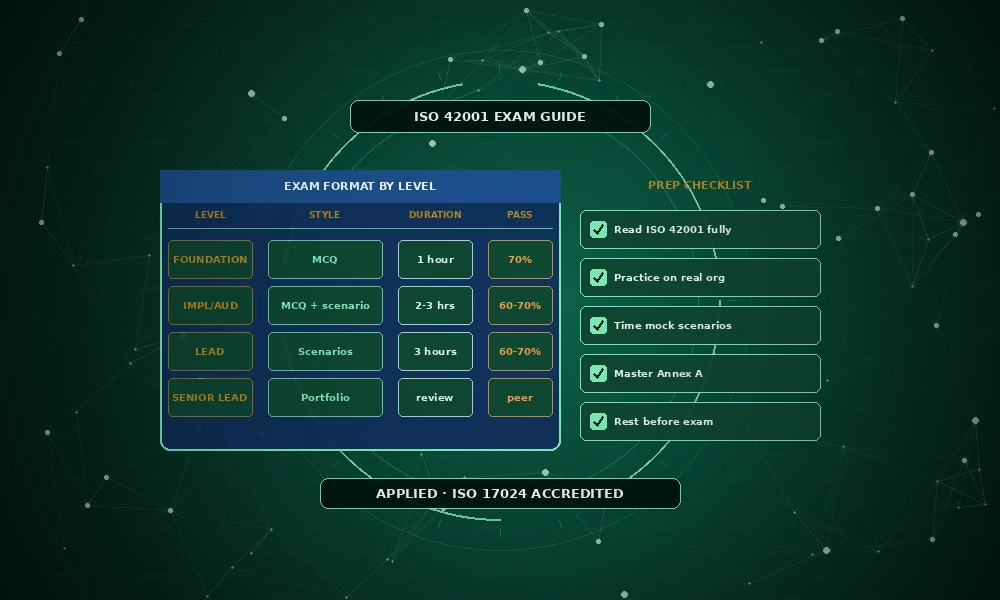
Because you already carry management-system and controls experience, the Lead Implementer route usually fits best. For the full picture of scope and effort, follow the Lead Implementer path.
And when you are ready for the step-by-step move, our dedicated guide on moving from cybersecurity to AI governance maps the whole journey. This page is the why; that guide is the how.
Why the timing favours security professionals now
The market signals all point the same way. Consider three numbers from the 2024 ISC2 study:
-
4.8 million. The global cybersecurity workforce gap, a record high, so employers are hungry for people who can take on more.
-
33 percent versus 12 percent. The share of professionals who call AI critical, against the share of hiring managers prioritising AI skills, a gap early movers can fill.
-
45 percent. The share citing the lack of a defined AI strategy as the main barrier to AI adoption, which is precisely a governance problem.
Put simply, organizations are adopting AI faster than they can govern it, and the people they trust with risk are already on the security team. A recognised AI governance credential turns that trust into a mandate.
It also future-proofs your role: as AI is embedded into products, supply chains, and internal tooling, the security function is being asked to answer for it and the professionals who can say yes with evidence are the ones who will lead that work rather than react to it.
Where ISO 42001 can take a security career
Certification does not box you into one title. It opens a set of adjacent roles, each of which rewards the risk-and-controls instinct you already have.
|
Role |
What it focuses on |
Route for a security pro |
|---|---|---|
|
AI security and governance lead |
Governing AI risk across the organization |
Lead Implementer |
|
AI risk manager |
Assessing and treating AI-specific risk |
Lead Implementer plus risk background |
|
AI assurance specialist |
Auditing and assuring AI systems |
Lead Implementer or an auditor track |
|
AI compliance analyst |
Mapping AI obligations to controls |
Lead Implementer plus compliance work |
Each is a specialisation you can grow into from where you already sit, which is why security is one of the smoothest on-ramps into AI governance.
How to make the move, step by step
-
Map your security skills to ISO 42001 using the table above, so you can see how much you already have.
-
Close the four new gaps: bias, transparency, human oversight and AI data governance.
-
Choose your level: Lead Implementer if you intend to lead AI governance work.
-
Volunteer for AI governance inside your current organization before looking elsewhere.
-
Follow the transition guide for the detailed path from security to AI governance.
What the work actually looks like
In the AI governance work we see, a security professional settles in fast. The rhythm is familiar: identify what could go wrong, decide how much risk is acceptable, put controls and monitoring in place and prove it all with evidence.
The difference is the subject. Instead of a firewall rule or a patch cycle, you are assessing whether a model treats people fairly, whether its decisions can be explained, and whether a human can intervene when it matters.
A typical early task is an AI impact assessment. You gather the people who own a model, ask what it does and who it affects, and document the risks and the safeguards. It reads like a threat assessment, only the threats include unfairness and opacity alongside the usual concerns.
The muscle memory of security, structured, sceptical, evidence-driven, is exactly what the task rewards. That is why the transition tends to feel less like a career change and more like a promotion into a broader remit.
Questions cybersecurity professionals ask
Do I need to be a data scientist to certify?
No. ISO 42001 governs how AI is managed, not how it is built. You need to understand where AI risk sits, which the certification teaches. Coding and model-building are not required.
Is my ISO 27001 experience a real head start?
Yes, a significant one. ISO 42001 shares the same management-system structure as ISO 27001, so the clauses, risk approach, and audit discipline carry straight over. You are learning a new control domain, not a new way of working.
Which ISO 42001 certification should a security professional take?
Most are best served by Lead Implementer, because building and running a management system suits your background. Foundation is a sensible first step if you want to explore before committing.
Is AI governance just security for AI?
No. Security is part of it, but AI governance is broader. It adds concerns such as bias, transparency, and human oversight that traditional security work does not cover, which is exactly the new material to learn.
Will AI governance replace my security role?
It is more likely to expand it. Security and AI governance are converging, and professionals who can do both are rare and valuable. Many people add AI governance as a specialisation rather than leaving security behind.
Is there real demand for this?
Yes. With a record workforce gap and AI adoption outpacing governance, employers are actively seeking people who can oversee AI risk. A credential signals you are one of them.
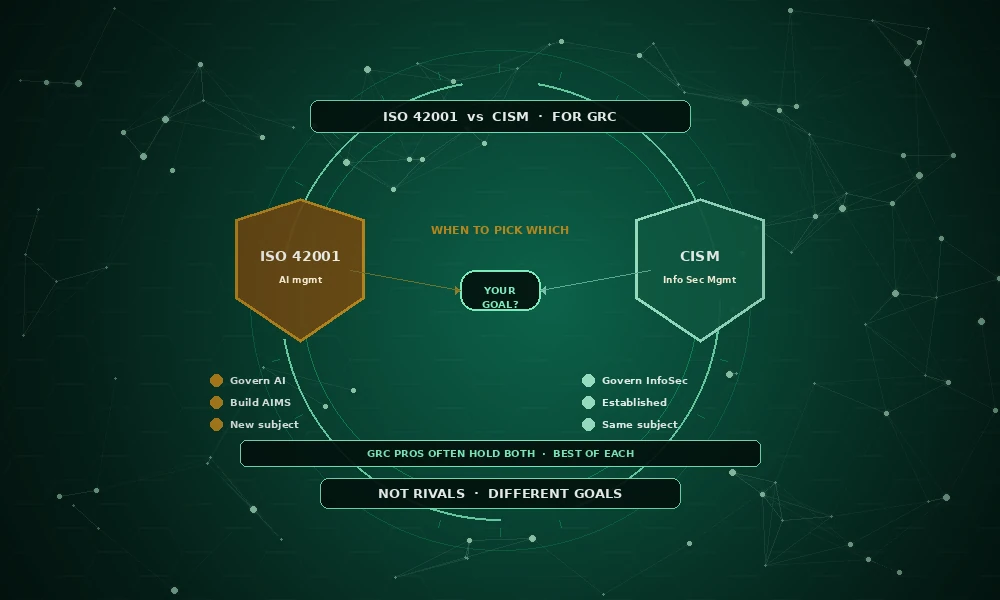
How does ISO 42001 sit with my CISSP or CISM?
It complements them. A CISSP or CISM proves deep security capability; ISO 42001 proves you can govern AI. Held together, they position you for the emerging roles where security and AI governance meet, which few professionals can currently fill.
Point your security expertise at the newest risk
You already know how to run risk as a process. AIGCI's Lead Implementer certification for security professionals builds the AI-specific knowledge on top of the management-system thinking you already have, so the move is an extension of your career rather than a restart. The perimeter you have spent years defending now includes the AI your organization relies on and governing it well is the next natural expansion of the security mandate.
To see how the institute supports professionals crossing into AI governance, read more about the institute.